
Handing over your auto insurance information at the hospital might feel like the right move, but relying on it alone could actually jeopardize your financial recovery. While it seems logical to let the car insurance handle everything, using health insurance for car accident injuries is often the most effective way to prevent medical debt from piling up while your legal claim is pending. It’s completely normal to feel anxious when you’re staring at a stack of bills and wondering who is truly responsible for paying them first. You want your doctors to be paid, but you also don’t want an insurance company “clawing back” every penny of your settlement through subrogation.
We understand the stress of managing physical recovery alongside financial uncertainty. This 2026 guide will show you exactly how to coordinate your benefits so you can protect your future settlement and keep your credit score intact. We’ll walk through the specific steps for presenting your cards at the ER, understanding how Florida’s potential no-fault repeal or New Jersey’s new $35,000 minimums affect you, and how to manage medical liens before they become a problem. You deserve a clear path to restoration without the fear of debt hanging over your head.
Key Takeaways
- Understand the “secondary payer” concept and how to correctly sequence your health insurance after your auto policy’s PIP or MedPay limits are reached.
- Learn how the “Make Whole” doctrine serves as a legal shield, ensuring you are fully compensated for your losses before an insurer can claim a portion of your settlement.
- Master the best practices for using health insurance for car accident injuries at every medical appointment to keep your providers paid and your credit score protected.
- Discover how a dedicated advocate can increase the final amount you take home by aggressively negotiating down medical liens and subrogation demands.
Does Health Insurance Cover Car Accident Injuries?
The short answer is yes. Private health insurance generally covers injuries sustained in a car crash just as it would any other medical emergency. If you break your arm in a fall at home or in a collision on the highway, your health plan is designed to provide for your care. However, the process isn’t always automatic. Many people hesitate to use their health plan because they believe the at-fault driver’s insurance should pay. While that’s true in theory, the at-fault carrier won’t pay your bills as they arrive. They only pay a single lump sum when your case settles, which could be months or years away. Hospitals and doctors won’t wait that long for payment.
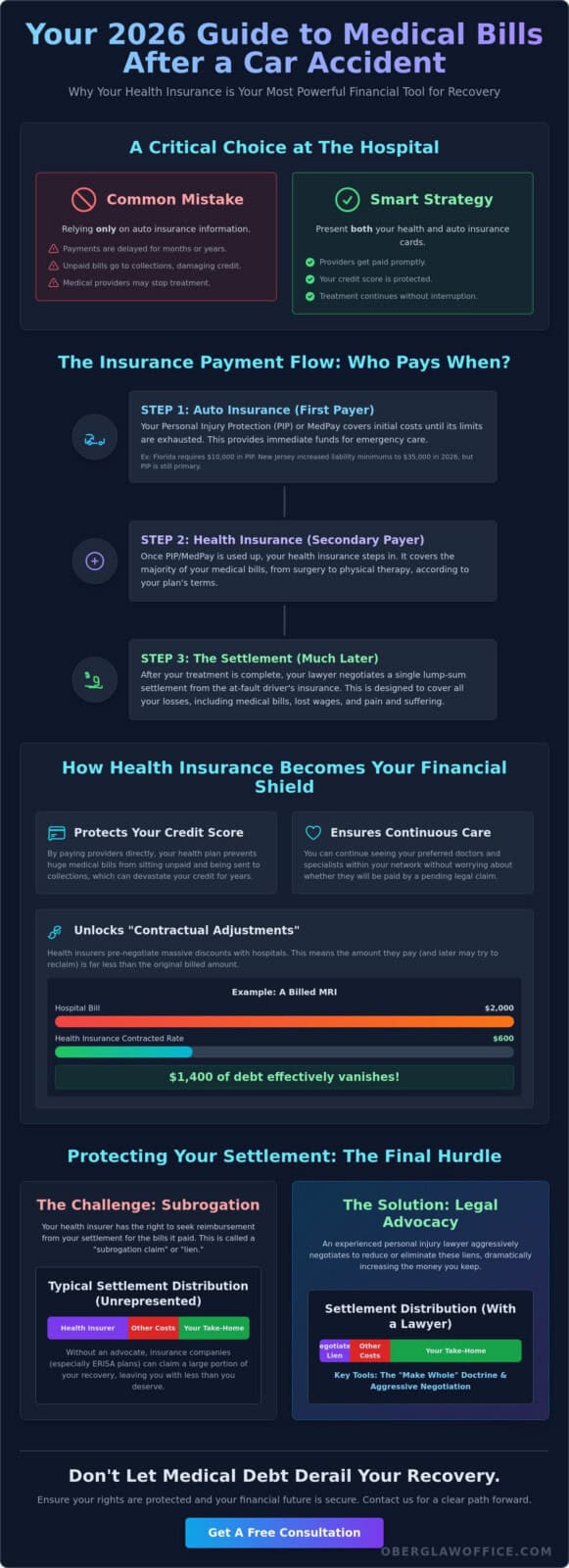
Your health insurer operates as a “secondary payer” in these situations. They want to ensure that any available auto insurance, such as Personal Injury Protection (PIP), is used first. Once those initial limits are reached, your health insurance steps in to cover the remaining costs. It’s vital to understand whether you have a standard private plan or an ERISA plan provided by a large employer. ERISA plans are governed by federal law rather than state regulations; this often gives them broader rights regarding Subrogation, which is the process of seeking reimbursement from your eventual settlement. Knowing which type of plan you have is the first step in protecting your financial future.
Why You Should Always Use Your Health Insurance
Using health insurance for car accident injuries is one of the smartest ways to protect your credit score. If medical bills go unpaid while you wait for a legal settlement, they will eventually move to collections. This can devastate your financial standing before your case even reaches a courtroom. Beyond credit protection, health insurance provides “contractual adjustments.” These are pre-negotiated discounts between the insurer and the hospital. If a clinic bills $2,000 for an MRI but your health insurer has a contract to pay only $600, that $1,400 difference effectively disappears. This significantly reduces the total amount of debt you have to worry about during your recovery. It also ensures you can continue seeing your preferred specialists without interruption.
When Health Insurance Might Deny a Claim
There are rare instances where a health plan might deny coverage. Some high-deductible or specialized employer plans contain specific exclusions for motor vehicle accidents, though this is becoming less common in 2026. More often, denials happen because the “order of operations” wasn’t followed. If you fail to bill your PIP or MedPay coverage first, your health insurer may reject the claim until they receive a “log of benefits” showing your auto coverage is exhausted. A Coordination of Benefits clause is a standard provision in most 2026 health policies that outlines these specific rules to prevent overpayment and determine which insurance company is responsible for the primary bill.
How Health Insurance Interacts with Auto Insurance Coverage
Understanding the hierarchy of payment is the key to protecting your wallet after a crash. Think of your insurance coverage as a series of protective layers. Each layer has a specific job to do and a specific time to show up. When you are using health insurance for car accident injuries, it typically sits as the third or fourth layer of protection, waiting for other primary policies to do their part first. This stacking order ensures that your medical providers are paid promptly while keeping your out-of-pocket costs as low as possible.
In many states with no-fault insurance laws, the first responder is your own Personal Injury Protection (PIP). For example, in May 2026, Florida drivers are still required to carry $10,000 in PIP, though the state legislature is currently considering a shift to a fault-based system. In New Jersey, minimum liability limits just increased to $35,000 as of January 1, 2026, but your PIP remains the initial buffer for medical costs. Only after these auto-specific funds are exhausted does your health insurance become the primary source of payment for your ongoing care.
PIP and MedPay: Your First Line of Defense
PIP and MedPay are essential because they provide immediate liquidity. Unlike health insurance, which may involve complex networks and prior authorizations, PIP is designed to get doctors paid quickly so your treatment isn’t delayed. Even if you have premium health insurance, these auto coverages are vital. They cover the gap expenses that health plans often shift back to the patient. If you’re struggling to coordinate these benefits, speaking with a professional who understands car accident representation can help ensure no money is left on the table.
Liability Coverage: The Final Settlement
A common misconception is that the at-fault driver’s insurance will pay for your surgery or physical therapy as the bills arrive. Unfortunately, that isn’t how bodily injury liability works. The other driver’s insurance company will only write one check, and they will only do it at the very end of your case in exchange for a full release of liability. This creates a dangerous financial gap. Using health insurance for car accident injuries is the bridge that carries you through this gap, allowing you to get the care you need today while your legal team works to secure a fair settlement for the future. We believe you shouldn’t have to choose between your health and your financial security while waiting for justice.
The Subrogation Trap: Why Your Health Insurer May Claim Your Settlement
It can feel like a betrayal when your health insurance company, the one you have paid premiums to for years, suddenly asks for a cut of your settlement. This process is governed by the legal definition of subrogation, which essentially allows an insurer to step into your shoes to recover costs they paid on your behalf. While it feels like a trap, using health insurance for car accident injuries actually saves you money in the long run. Because health insurers pay pre-negotiated, lower rates to hospitals, the total debt they want back is often thousands of dollars less than the original hospital bill. This means more of the final settlement stays in your pocket rather than going to a medical billing department.
One of your strongest defenses against an overreaching insurance company is the “Make Whole” doctrine. This legal principle suggests that an insurance company shouldn’t take a single dime from your recovery until you have been fully compensated for all your losses, including your pain, suffering, and lost wages. However, if your health plan is a self-funded ERISA plan through a large employer, they may try to bypass these state-level protections. These federal liens are notoriously aggressive and require a specialized eye to navigate. We believe you should keep as much of your settlement as possible, and that starts with understanding these complex payback rules before you sign any agreements.
What is a Medical Lien?
A lien is different from a simple subrogation claim. While subrogation is a contractual right between you and your insurer, a hospital lien is a direct claim filed by the medical facility against your legal case. A lien is a legal “I.O.U.” that ensures providers are paid from the final recovery before you receive your check. It effectively attaches to your file, meaning the insurance company paying the settlement is legally obligated to satisfy that debt before releasing the rest of the funds to you. This ensures that the doctors who treated you are compensated for their work.
Negotiating the Payback Amount
You should never accept the first reimbursement demand an insurance company sends at face value. Many insurers send a notice of lien for the full amount they paid, but this number is almost always negotiable. Under the “Common Fund Doctrine,” your lawyer can argue that since they did the work to secure the settlement, the health insurer should contribute to the legal costs by reducing their claim. We often use our leverage to slash these medical liens by 30%, 50%, or even more. By aggressively negotiating these numbers, we ensure that the “net” amount in your pocket is maximized, helping you move forward with financial confidence.
Best Practices for Managing Medical Bills After a Car Crash
Managing the paperwork after a collision is often as exhausting as the physical recovery itself. With 4.9 million medically consulted injuries resulting from motor vehicle incidents in 2024 alone, the sheer volume of billing data is staggering. To protect yourself, you must be organized from the very first ER visit. We recommend keeping a “Master Log” that includes every doctor, imaging center, and specialist you visit. This simple step ensures that no bill slips through the cracks and ends up in collections. When you arrive at an appointment, always present both your health and auto insurance cards. Instruct the clerk that you are using health insurance for car accident injuries only after your Personal Injury Protection (PIP) or MedPay coverage has been fully exhausted.
Monitoring your mailbox is just as critical as attending your appointments. You should carefully review every Explanation of Benefits (EOB) statement sent by your health insurer. Look specifically for “accident-related” flags or questionnaires. Insurers often send these to determine if another party is responsible for the bill. If you don’t respond promptly, they may pause your coverage or deny future claims related to the accident. Staying on top of these administrative details prevents the $559.3 billion total cost of motor vehicle injuries from becoming your personal financial burden.
What to Tell the Billing Department
You might encounter a billing department that refuses to take your health insurance card, insisting instead on filing a medical lien against your future settlement. This is a major red flag. Hospitals often prefer liens because they can collect their full “sticker price” rather than the discounted rate they negotiated with your health insurer. You have the right to insist that they bill your health insurance. If they ask you to sign a “Letter of Protection” (LOP), be cautious. An LOP is a legal agreement to pay the provider directly from your settlement, which can sometimes result in higher costs for you. If a provider is being difficult, it’s time to seek car accident representation to ensure your rights are protected.
Handling Denials and Disputes
Insurance companies often operate on a strict 30-day rule for certain disputes or additional information requests. If your health insurer rejects a claim because it’s “accident-related,” don’t panic. Usually, they just need your auto insurance claim number or a copy of the incident report to verify the order of payment. Providing this information quickly can restart the payment process. If the bills continue to mount or collection agencies begin to call, professional intervention is necessary. We take pride in standing between our clients and aggressive bill collectors, allowing you to focus entirely on your healing process while we handle the insurance companies.
How a Personal Injury Lawyer Protects Your Financial Recovery
Many people believe that the most important number in a legal case is the gross settlement amount. While a large headline figure looks impressive, the only number that truly matters is your “net” recovery. This is the actual amount of money that lands in your bank account after all medical providers and insurance companies have been paid. We focus on using health insurance for car accident injuries as a strategic tool to keep your medical debt as low as possible from day one. By ensuring your health plan pays its share at discounted rates, we reduce the total amount that must be paid back later, leaving more for your long-term restoration.
A skilled advocate does more than just argue about who caused the crash. We spend a significant amount of time behind the scenes auditing your medical records and negotiating with health insurers. If your employer uses a self-funded ERISA plan, they may try to claim 100% of their costs back without contributing to your legal fees. We fight these aggressive tactics by applying state-specific laws and the “Make Whole” doctrine discussed in previous sections. This ensures you aren’t left with a surprise bill six months after your case is over. Our goal is to handle the insurance giants so you can focus on your physical healing.
Maximizing the ‘Net’ Recovery
The math of a personal injury case is straightforward but requires careful management. Your final recovery is calculated by taking the total settlement and subtracting the attorney’s fee and your negotiated medical bills. Consider this scenario: a $50,000 settlement with $0 in medical liens is far better for your family than a $100,000 settlement where $60,000 is clawed back by insurers. We work to slash those medical liens by 30% or more; we use the “Common Fund Doctrine” to force insurers to pay their fair share of the costs of recovery. This meticulous approach gives you the peace of mind that your financial future is secure and every “payback” is resolved before the case closes.
Your Advocate Against Insurance Giants
You shouldn’t have to face a massive health insurance corporation alone while you’re still healing from a catastrophic injury. We act as your steadfast protector, coordinating the complex web of PIP, MedPay, and health insurance to maximize your in-pocket cash. If you need specialized care but cannot afford the upfront costs, we can often provide “Letters of Protection.” These documents allow you to receive high-quality treatment from specialists who agree to wait for payment until your case is resolved. This ensures you get the medical attention you deserve without the immediate stress of hospital bills. If you’re overwhelmed by the coordination process, Schedule a free strategy session with Oberg Law Office to discuss your medical bill coordination.
Secure Your Financial Future and Focus on Healing
You have learned that your physical recovery doesn’t have to come at the expense of your financial stability. By correctly using health insurance for car accident injuries, you protect your credit score and ensure your doctors receive payment while your legal claim moves forward. It is vital to remember that subrogation demands and medical liens are not set in stone. These are negotiable legal hurdles that, when handled correctly, allow you to keep a much larger portion of your final settlement.
Navigating these insurance layers alone is overwhelming, but you don’t have to do it. Attorney Gregg Oberg provides personalized advocacy backed by over 25 years of experience fighting insurance companies. Our firm operates on a performance-based fee structure, meaning we only get paid if you win. We are here to stand as your steadfast protector against aggressive adjusters and complex billing departments. Let us handle the legal heavy lifting so you can focus entirely on your restoration and your family. You deserve a partner who is personally invested in your success.
Get a Free Consultation to Protect Your Settlement
Frequently Asked Questions
Do I have to use my health insurance for car accident injuries?
You aren’t legally required to use your health plan, but it’s the most effective way to protect your financial health. Using your coverage ensures that your doctors are paid immediately while your legal case moves forward. This prevents medical providers from sending your unpaid bills to collection agencies. It also allows you to benefit from the discounted rates your insurer has already negotiated with hospitals.
What happens if my health insurance pays for my treatment and I win a settlement?
Your health insurance company will likely seek reimbursement for the costs they covered through a process called subrogation. They’ll notify your attorney of their intent to recover these funds from your final settlement. We step in to negotiate these claims aggressively. Our goal is to reduce the “payback” amount so that a larger portion of the settlement stays in your pocket for your long-term recovery.
Can my health insurance company refuse to pay for my car accident injuries?
A health insurer generally cannot refuse to cover your care, but they can delay payment if you haven’t followed the correct order of operations. They often require proof that your auto insurance PIP or MedPay benefits are exhausted before they step in as the primary payer. Some employer-sponsored plans may have specific exclusions. It’s vital to have a professional review your policy’s coordination of benefits clause.
What is subrogation in a personal injury case?
Subrogation is a legal doctrine that allows an insurance company to recover money they paid on your behalf from the person who caused your injuries. If they pay $5,000 for your ER visit, they have a right to be paid back from your settlement with the at-fault driver. We ensure the insurer doesn’t overreach. We use legal protections to make sure you are “made whole” before they take their cut.
Should I give the hospital my health insurance card or the other driver’s insurance info?
You should always provide your own health insurance card and your auto insurance information. Never give the hospital the at-fault driver’s insurance details. The other driver’s carrier will not pay your medical bills as they arrive; they only pay a single lump sum at the end of your case. Using health insurance for car accident injuries is the only way to ensure your medical debt doesn’t spiral out of control today.
Will my health insurance premiums go up if I use it for an auto accident?
No, your health insurance premiums won’t typically increase because you used your benefits for an accident. Health insurance rates are based on large group pools or general risk assessments rather than your individual claim history. Your health plan is a service you’ve already paid for through your premiums. You should feel confident using it to get the medical attention you need without fear of a rate hike.
What is a Letter of Protection (LOP) and should I sign one?
A Letter of Protection is a legal contract where a medical provider agrees to treat you now in exchange for a promise of payment from your future settlement. It’s a valuable tool if you don’t have insurance or if your policy limits are reached. However, you should never sign an LOP without your lawyer’s approval. We ensure the terms are fair and that the provider isn’t overcharging you for your care.
How does PIP insurance work with my private health insurance?
Personal Injury Protection (PIP) acts as your primary layer of coverage. It pays the first dollar of your medical bills up to your policy limit, regardless of who caused the crash. Once those PIP funds are fully spent, your private health insurance becomes the secondary payer. This coordination ensures a seamless transition of payment so that your treatment continues without any administrative delays or interruptions in your care.