Can a driver blame a crash on a split-second emergency and automatically escape responsibility? If you’re asking “what is the sudden emergency doctrine,” the key point is that an unexpected event may affect how someone’s actions are evaluated, but it doesn’t erase fault by itself. The circumstances still matter, including whether the person contributed to the emergency and how they responded.
It can be unsettling if an insurer raises this doctrine after your accident. Legal terms can make it hard to tell whether an unexpected event changes who may be responsible or whether the argument is being used to dispute your claim. The rules vary by jurisdiction, and some courts consider an emergency as part of the ordinary reasonableness analysis rather than as a separate doctrine.
This guide explains the doctrine in everyday language, what it generally does and doesn’t establish, and which facts may matter when it’s raised. You’ll also learn how witness accounts, video, and crash details may help clarify what happened. Understanding these issues can help you ask informed questions without assuming the doctrine decides your claim before the facts and applicable law are considered.
Key Takeaways
- Learn what is the sudden emergency doctrine and why its application depends on the facts and the law in the relevant jurisdiction.
- Consider whether the emergency was truly unexpected and whether the responding person’s actions may have contributed to it.
- Keep in mind that raising the doctrine doesn’t automatically prove a person acted reasonably or determine who was at fault.
- Preserve available crash information and record what you remember without guessing, changing records, or confronting anyone.
- Understand which questions and evidence may help clarify how the doctrine could affect an injury claim.
What Is the Sudden Emergency Doctrine in Negligence Law?
After a collision, legal terms can make an already stressful situation harder to understand. If you’re wondering what is the sudden emergency doctrine, it’s a fact-specific legal principle that may affect how a person’s actions are evaluated when an unexpected emergency arises. It doesn’t apply automatically, and courts may treat it differently depending on the jurisdiction.
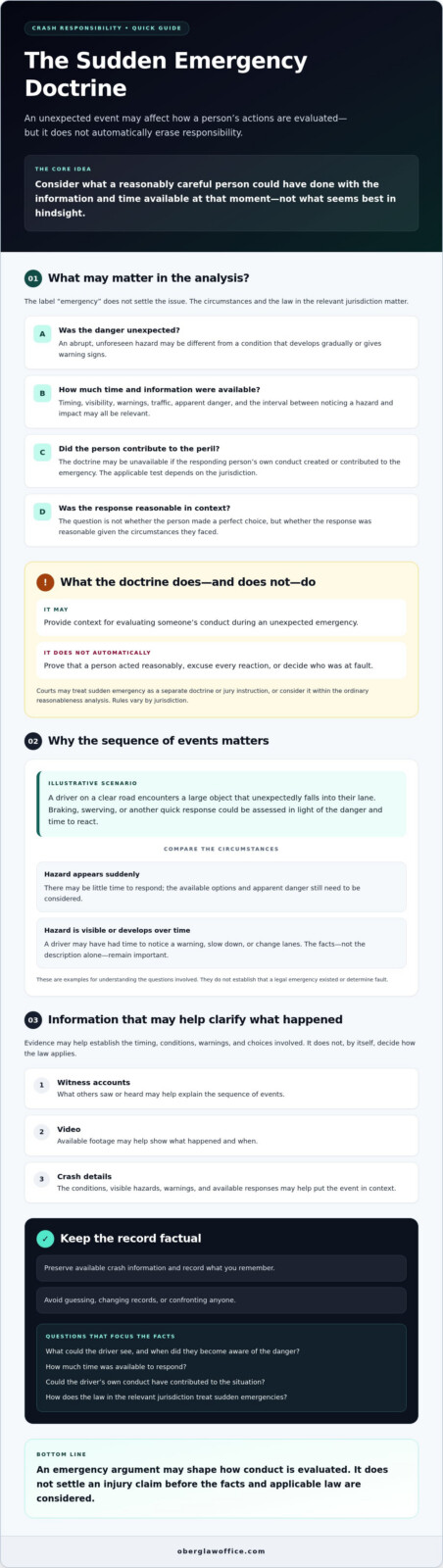
The central question is whether the person acted reasonably in the circumstances they faced. Someone forced to react quickly may not have the same opportunity to weigh options as someone who had time to think. The doctrine doesn’t require a perfect split-second choice, but it also doesn’t excuse every reaction. It may provide context for evaluating conduct, but it doesn’t grant automatic immunity from responsibility.
Some jurisdictions treat sudden emergency as a separate legal doctrine or jury instruction. Others consider the emergency within the ordinary reasonable-person standard or as one factor among others. The applicable law depends on where the claim is considered, so it’s important to check the rules that govern the particular claim rather than rely on a general description.
What does the doctrine ask a factfinder to consider?
A factfinder, such as a jury, may consider what a reasonably careful person could have done with the information available at the time. The question isn’t whether the driver chose the best response in hindsight. It’s whether the response was reasonable given the apparent danger, the time available, and the surrounding conditions. The law’s treatment of that question varies by jurisdiction.
What counts as a sudden emergency?
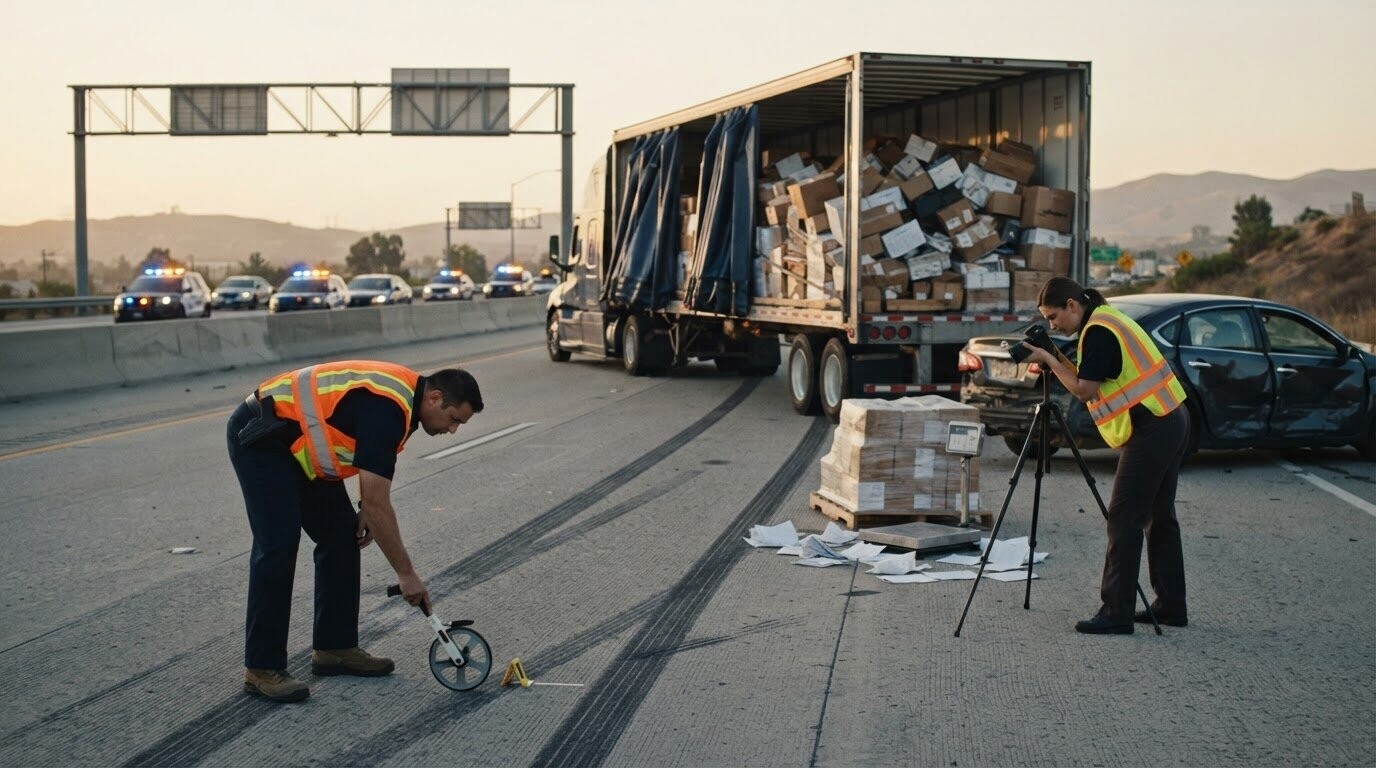
Illustrative example: A driver traveling on a clear road might encounter a large object that unexpectedly falls into their lane. Swerving, braking, or another quick response could be examined in light of the danger and the time available to react. That example doesn’t establish that a legal emergency existed. The facts and applicable law matter.
An abrupt, unforeseen hazard differs from a condition that develops gradually, such as worsening visibility or a mechanical problem that gives warning signs. A sudden event doesn’t necessarily qualify as an emergency, and a person generally can’t rely on the doctrine if their own conduct helped create the peril. The related concept of imminent peril describes the idea of responding to an immediate danger, but the legal rules still depend on the jurisdiction and case facts.
When Might the Sudden Emergency Doctrine Apply to an Accident?
Whether the doctrine is relevant depends on the circumstances, not simply on whether a driver describes something as an emergency. A driver asking “what is the sudden emergency doctrine” should know that courts may consider whether the danger arose unexpectedly, whether the driver had a reasonable chance to respond, and whether their own conduct contributed to the situation. The emergency doctrine is generally associated with a sudden peril a person didn’t create, but the precise rule and how it’s used vary by jurisdiction.
The same event can be assessed differently as timing, visibility, warnings, and available choices change. The doctrine’s possible relevance doesn’t settle whether a driver was negligent or excuse conduct automatically. It may instead shape how the facts are considered under the law that applies to the claim.
How do timing and foreseeability affect the analysis?
Imagine a driver encounters an unexpected hazard around a bend with little time to react. Compare that with a hazard visible from a distance, where the driver might have had time to slow down or change lanes. Prior warnings, clear sightlines, traffic, and the time between noticing the danger and impact may all matter. These hypothetical examples don’t establish fault; they show why the sequence of events deserves close attention.
What if the person responding helped create the emergency?
The doctrine may be unavailable if the responding person’s own conduct created or contributed to the peril. For example, evidence of speeding or distraction could matter if it contributed to a dangerous situation, while an unforeseeable event may present a different question. Whether conduct legally counts as contributing, and what test applies, depends on the jurisdiction. Don’t assume from one detail alone that a driver created the emergency or that it was unavoidable.
Useful questions include what the driver could see, when they became aware of the danger, and what options were realistically available. Photos, video, witness accounts, vehicle data, and the crash timeline may help clarify those details, if available. Preserve relevant information and describe what you remember without filling gaps with guesses.
If an insurer raises the doctrine, it can help to have the specific facts and applicable law assessed together. Learn more about Oberg Law Office’s car accident representation and discuss whether the firm can assess your claim.
Does the Sudden Emergency Doctrine Automatically Excuse Negligence?
No. Raising the sudden emergency doctrine doesn’t, by itself, establish that a driver acted reasonably or eliminate responsibility for a crash. It’s an argument about the circumstances surrounding a person’s actions, not a final decision about fault. The factfinder may still weigh the evidence, decide which accounts are credible, and consider whether the conduct caused or contributed to the collision.
If you’re asking what is the sudden emergency doctrine in relation to negligence, think of it as context for evaluating conduct, not a free pass. The Sudden Emergency Doctrine may be treated differently depending on the jurisdiction, and the precise legal question can vary. An insurer’s decision to raise the argument is its position, not a court or jury determination.
How is an emergency argument different from an automatic defense?
The distinction is simple: an emergency may help explain a driver’s choices, but it cannot prove every element of a legal defense on its own. Consider what the argument may explain and what it cannot establish by itself:
Why a driver had limited time or options, and what danger they appeared to face when they reacted.
That the driver acted reasonably, didn’t contribute to the danger, or wasn’t negligent. Those questions depend on the full evidence and applicable law.
Evidence may include the sequence of events, visibility, witness accounts, vehicle or roadway information, and whether the driver had warning or time to respond. Conflicting accounts can also affect credibility. A conclusion about fault or any allocation of responsibility must follow the governing law and the evidence, not just the label attached to the event.
How does it relate to comparative negligence?
Comparative negligence is a general approach, where recognized by the applicable law, for assigning responsibility among parties whose conduct contributed to an accident. An emergency argument addresses the circumstances in which someone acted; comparative negligence addresses how responsibility may be allocated. They’re related, but they’re not interchangeable.
For example, a factfinder might consider whether an emergency affected what a driver could reasonably do, then separately assess each party’s role under the jurisdiction’s rules. The doctrine doesn’t dictate a particular allocation or guarantee that compensation will increase or decrease. Laws differ in how they handle emergency arguments and comparative fault, so avoid assuming one jurisdiction’s rule applies to another claim.
When an insurer uses the doctrine to dispute negligence, the important questions remain what the evidence shows and which law governs. A careful review can separate the insurer’s position from what the facts may support.
What Evidence Can Help Explain a Sudden Emergency After a Crash?
After a crash, you may be dealing with injuries, vehicle damage, and questions from an insurer all at once. Focus first on immediate safety and medical needs. When you’re able, preserve information that may help show what you could see, when events unfolded, and what choices were available. That context can matter if someone raises the sudden emergency doctrine.
Reliable evidence can help reconstruct the event’s timeline, but it doesn’t decide fault by itself. Record what you remember as accurately as you can. Separate what you personally saw or heard from what you learned later, and don’t guess, edit original records, or confront another person to obtain information.
Which records may help establish the sequence of events?
Keep relevant material in its original form when possible, and note where it came from. Depending on what’s available, useful information may include:
- Photos of the scene, road conditions, signs, visibility, and vehicle damage.
- Names and contact details for witnesses, if you can obtain them safely and appropriately.
- Dash-camera footage and possible surveillance video from nearby businesses or properties.
- Police or incident reports, which can document reported details but don’t necessarily settle legal fault.
- Claim letters, emails, and other communications with insurers.
Some video or digital records may be overwritten or become unavailable. If you know a recording may exist, consider making a prompt, written request to preserve it. Don’t trespass or try to access someone else’s systems. Keep copies of requests and responses with your other claim documents.
What should you do if an insurer raises the doctrine?
Ask the insurer to identify the specific facts and legal basis for its position. Keep the response and related claim documents. If you’re asked to describe the crash, stick to what you know and avoid guessing about legal responsibility or agreeing with a conclusion you don’t understand. The insurer’s explanation is its position, not necessarily the final word on how the evidence or law applies.
For related next steps, review this car accident claim guidance. If you’d like help assessing the evidence and applicable law, you can request a free initial strategy session with Oberg Law Office. An assessment can help clarify the issues without assuming how a claim will turn out.
How Can the Doctrine Affect an Injury Claim, and What Can You Do Next?
The doctrine may shape how a driver’s actions are argued, but it can’t predict the outcome of an injury claim. The decision may depend on what happened before impact, what the driver could reasonably foresee, and how reliable evidence supports each account. The rules vary by jurisdiction, so an insurer’s use of the doctrine doesn’t, by itself, resolve who was at fault or whether you may recover compensation.
If the facts are disputed, it may help to organize what you know. Consider the sequence of events, any warnings or hazards, the time available to react, and the records or witnesses that may support each version. For broader information about injury claims, see this personal injury claim guidance.
When may a lawyer’s review be useful?
A case-specific review may be helpful when accounts conflict, an insurer invokes the doctrine, fault remains disputed, or you’re dealing with significant injuries. A lawyer can assess available evidence alongside the law that applies to your claim and explain what questions remain unresolved. That review can help you understand the insurer’s position without treating it as a final decision about responsibility or assuming a particular result.
What can you expect from an initial conversation?
You don’t need every answer before asking questions. If available, gather a brief timeline, photos or reports, information about your injuries, and communications from the insurer. Clear records can make the conversation more useful, but don’t delay urgent medical care or feel you must have a complete file first.
Oberg Law Office offers free initial strategy sessions for injured clients. If you choose to pursue representation, the firm’s fees are collected as a percentage of recovery rather than upfront. An initial conversation doesn’t automatically create an attorney-client relationship, and any representation depends on the firm’s review and acceptance of the matter.
If you’re still asking what is the sudden emergency doctrine and how it may affect your claim, you can discuss your questions with Oberg Law Office during a free initial strategy session. A conversation can help clarify the issues and possible next steps without promising a particular outcome.
Take the Next Step With a Clearer Understanding
Asking “what is the sudden emergency doctrine” doesn’t have a one-size-fits-all answer. The doctrine may affect how a driver’s conduct is evaluated, but raising it doesn’t automatically excuse negligence or decide who is at fault. The facts, available evidence, and law in the relevant jurisdiction all matter.
If an insurer has raised the doctrine or you’re unsure how it may affect your injury claim, a case-specific review can help clarify the questions and possible next steps. Oberg Law Office provides personalized personal injury representation and offers free initial strategy sessions for injured clients. If you choose to pursue representation, fees are collected as a percentage of recovery rather than upfront.
Discuss your questions in a free initial strategy session. You don’t have to sort through confusing legal language alone. A clearer understanding can help you move forward with confidence.
Frequently Asked Questions
What is the sudden emergency doctrine?
The sudden emergency doctrine is a fact-specific principle a decision-maker may use to evaluate someone’s conduct during an unexpected emergency. It recognizes that a person facing an immediate danger may have little time to choose a response. The precise rule, and whether it applies, depend on the jurisdiction and circumstances. For example, an unexpected roadway hazard might be considered, but that alone doesn’t establish that a driver acted reasonably or determine fault.
Does the sudden emergency doctrine excuse negligence?
No, it doesn’t automatically excuse negligence or remove responsibility. Emergency circumstances may help explain a person’s actions, but the evidence and applicable law still matter. A decision-maker may consider whether the person acted reasonably and whether their conduct contributed to the danger. In some jurisdictions, someone may not benefit from the doctrine if their own actions created the emergency. How that rule applies to a particular crash can’t be determined from the label alone.
What are examples of a sudden emergency while driving?
Hypothetical examples might include an unexpected obstacle appearing in a travel lane or a roadway hazard emerging with little warning. Whether either event qualifies legally depends on details such as how suddenly it arose, whether it could have been anticipated, and what response options the driver had. These examples aren’t legal conclusions. The jurisdiction’s rules and the full factual record may change how an emergency is evaluated.
Can a driver use the sudden emergency doctrine if they caused the emergency?
Generally, the doctrine concerns a peril the person relying on it didn’t create, but its exact wording and application vary by jurisdiction. A driver’s earlier actions, any opportunity to anticipate danger, and the event’s timeline may all matter. For instance, the facts may raise questions about whether a hazard was truly unavoidable or whether earlier conduct contributed to it. A brief description can’t resolve those questions; disputed facts should be reviewed under the law governing the claim.
Is the sudden emergency doctrine the same as comparative negligence?
No. The sudden emergency doctrine concerns how conduct may be evaluated in an emergency context. Comparative negligence generally refers to allocating responsibility among parties when that system applies. Both concepts may arise in one accident dispute, but they aren’t interchangeable: an emergency argument doesn’t itself determine how responsibility is allocated. The rules differ by jurisdiction, so don’t assume a particular percentage, threshold, or effect without checking the law that governs the claim.
What evidence matters when an insurer raises the sudden emergency doctrine?
Evidence that helps establish the timeline and what people could perceive may be relevant. This can include scene photographs, witness contact information, available dash-camera or surveillance video, vehicle damage, and police or incident records. None of these materials independently proves fault. Preserve available evidence promptly, since some recordings may be overwritten, and keep claim letters and other insurer communications. If the insurer’s position or the underlying facts are disputed, consider seeking case-specific guidance.
Does the sudden emergency doctrine apply in every state?
No. Jurisdictions differ in whether they recognize the doctrine as a separate instruction or consider emergency circumstances within a broader reasonableness analysis. The legal treatment can also depend on the type of case and its facts. A rule described in one jurisdiction may not apply elsewhere, and legal standards can change. Check the law governing your claim or ask a qualified lawyer to assess the relevant jurisdiction and circumstances.