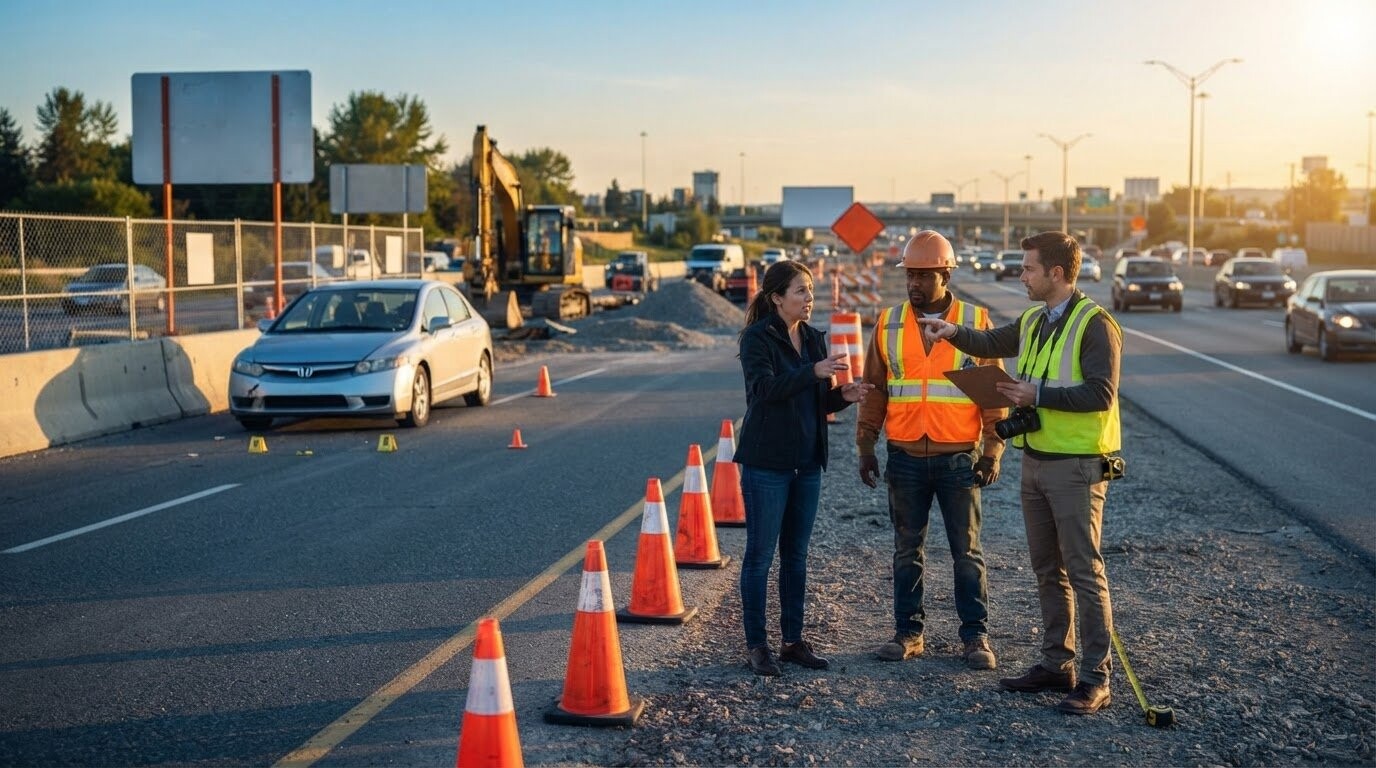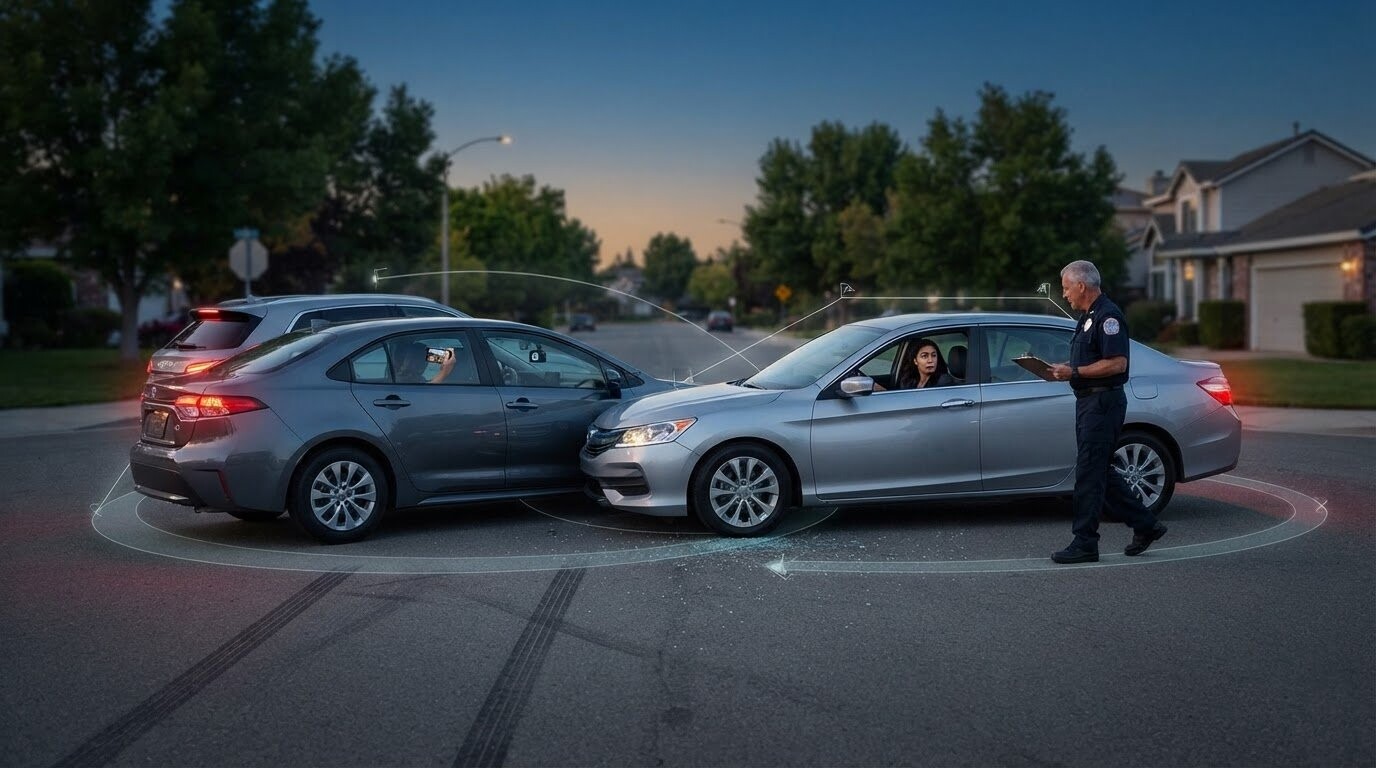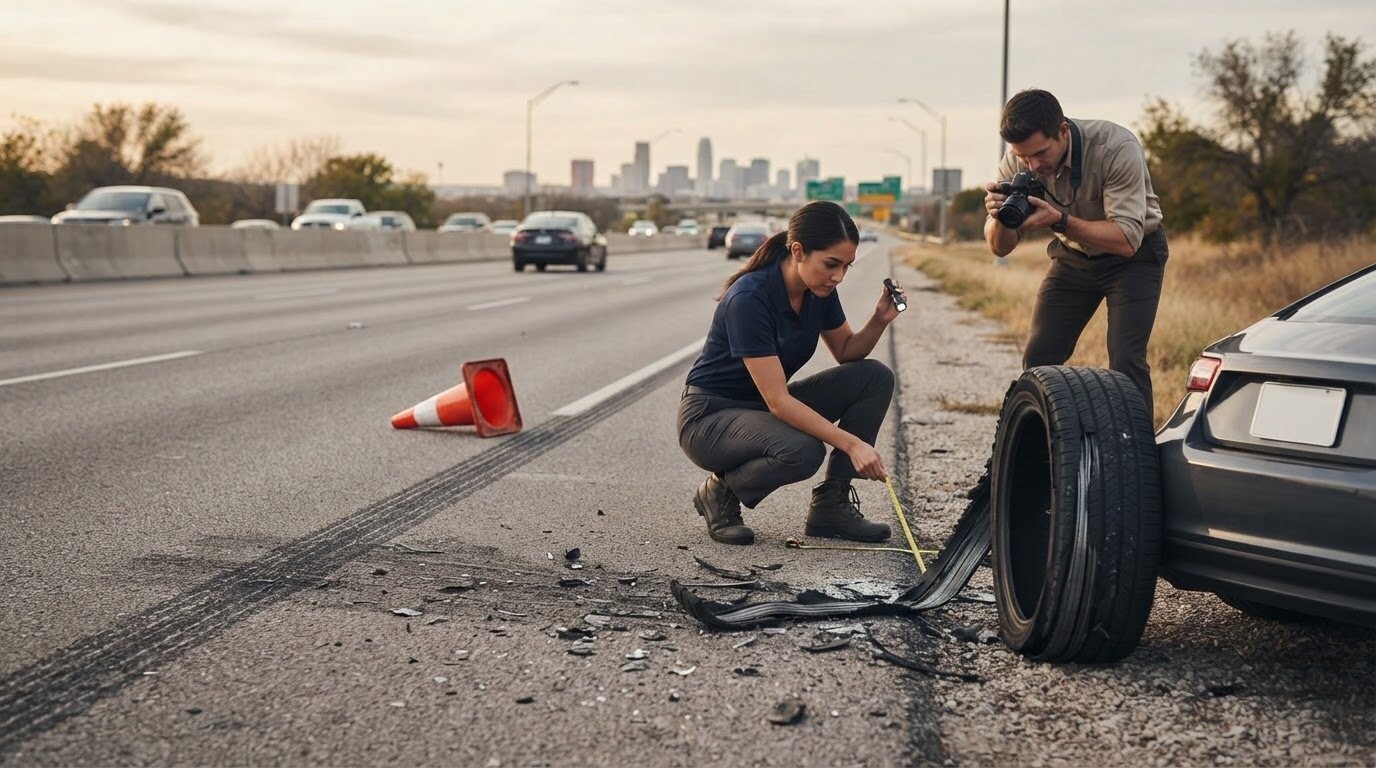
A dangerous intersection doesn’t automatically make a city liable, but poor road design may be part of the story behind a serious crash. If you’re considering suing the city for poor road design, the key questions are whether a dangerous condition contributed to your injuries, whether the responsible public entity can be held liable, and whether you can meet the rules for bringing a claim.
It’s understandable to worry that government immunity or a strict notice deadline could affect your options before you know what happened. These claims can involve special procedures, and the rules vary by jurisdiction. Evidence can also be time-sensitive. Photos, crash reports, witness accounts, maintenance records, and roadway plans may help show what happened and whether the condition was known or should have been discovered.
This article explains what facts may support a road-design injury claim, what evidence to preserve, and why it’s important to identify the right public entity and act promptly. You’ll also learn how a potential claim against a public entity may differ from claims involving another driver or responsible party. No single road defect guarantees a recovery, but understanding the issues can help you protect your options.
Key Takeaways
- Suing the city for poor road design may be possible when evidence connects a dangerous road condition to your crash and injuries, but a design flaw alone doesn’t establish liability.
- Public-entity immunity and formal notice requirements vary. Identify the potentially responsible agency and check the rules that apply before taking action.
- Preserve useful evidence, including scene photos, crash and medical records, witness details, and information about the road’s condition.
- Responsibility may involve a public entity, contractor, property owner, or another road user. The evidence can help clarify each party’s role.
- You don’t need to settle on a legal theory before seeking an assessment. A review can help evaluate potential defendants, evidence, and applicable notice rules.
Suing the City for Poor Road Design: When Might an Injury Claim Be Possible?
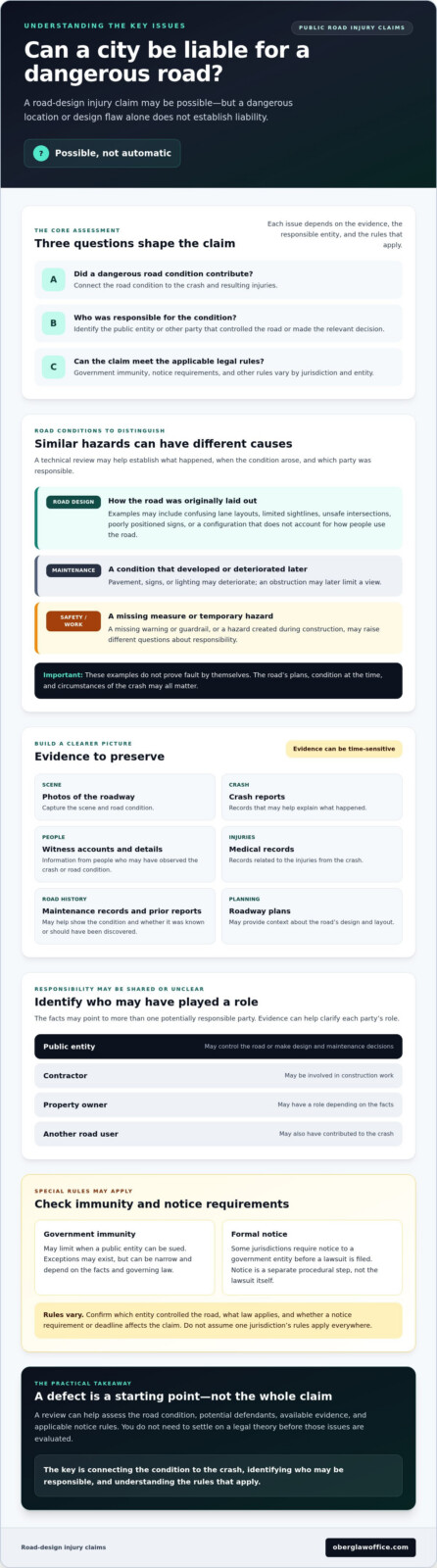
A crash can leave you hurt, shaken, and unsure whether the road played a role. A confusing intersection, obstructed view, or missing safety feature may have contributed, but a road condition alone doesn’t prove that a public entity is legally at fault. A practical starting point is to identify what may have contributed to the crash, then assess the evidence and the law that applies to the entity responsible.
It also helps to distinguish road design from other roadway problems. A design concern may involve how a road was originally laid out. A maintenance issue may arise when pavement, signs, or lighting deteriorate. Missing warnings or safety measures may raise separate questions, while construction work can create temporary hazards. These issues can overlap, but they may involve different decisions, records, and responsible parties.
What road conditions could contribute to a claim?
Possible concerns include confusing lane layouts, limited sightlines, unsafe intersections, poorly positioned signs, or a road configuration that doesn’t account for how people use it. A crash may also involve later deterioration, changes made during construction, or a missing guardrail or warning. These examples don’t establish fault on their own. A technical review may be needed to assess the road, its plans, its condition at the time, and whether the hazard was unreasonably dangerous under applicable law.
A review may also help distinguish an original design decision from a later failure to maintain or warn. For example, a limited view could relate to the road’s layout, an obstruction that developed later, or a temporary work zone. The distinction matters because it may affect which entity or other party was responsible for the condition.
Does a dangerous road automatically make a city liable?
No. A dangerous condition alone doesn’t prove every element of a claim. Depending on the jurisdiction and facts, questions may include whether the entity had a relevant legal duty, whether it knew or should have known about the hazard, whether the condition caused the crash and injuries, and whether a defense or statutory rule applies. Government entities may also raise sovereign immunity, though the scope of that protection and any exceptions vary.
A crash at a dangerous location may raise questions, but the location alone doesn’t prove who was legally responsible. Evidence about the road, the collision, prior reports, and the entity’s role can help answer those questions. Suing the city for poor road design calls for more than identifying a defect: the evidence, applicable law, and specific public entity all matter.
How Government Immunity and Notice Rules Affect Road-Design Claims
Even when a roadway appears unsafe, a claim against a public entity can face procedural and legal barriers that don’t apply in the same way to a claim against a private driver. Rules vary by jurisdiction and by entity, so don’t assume that a general description of government liability tells you what applies to your situation.
Why public-entity immunity can change the analysis
Government immunity is a legal protection that may limit when a public entity can be sued. Laws may create exceptions, but they can be narrow and depend on specific facts. The relevant rules may treat an original design choice differently from later maintenance, a missing warning, or another safety issue. A road-design manual, such as the Federal Highway Administration’s Project Development and Design Manual, may provide useful technical context, but it doesn’t by itself establish liability or determine whether an exception applies.
Before relying on an exception, confirm the governing law and identify who controlled the road or made the decision at issue. That may require distinguishing among a public agency’s design choices, its maintenance practices, and decisions made by another entity. The label attached to a problem isn’t enough to determine whether immunity applies.
What should you verify about notice and deadlines?
Some jurisdictions require an injured person to send formal notice to a government entity before filing a lawsuit. This notice is a separate procedural step, not the lawsuit itself, and the notice period may be shorter than the ordinary deadline for bringing a case. The required contents and delivery process can vary, too.
Identify the potentially responsible entity promptly, then verify its rules. Check whether notice must include details such as the incident date and location, the nature of the injury, or the basis of the claim. Confirm the designated recipient and accepted delivery method as well. Don’t assume that telling an employee, submitting a general complaint, or notifying the wrong agency satisfies a formal requirement. Keep copies of anything sent and proof of delivery.
Because notice rules vary by jurisdiction and entity, early legal review may help protect your procedural options. An attorney can review the available facts, help identify potential defendants, and check which notice and immunity rules need to be verified. If you’re considering suing the city for poor road design, you can discuss your crash and possible injury claims and ask whether the firm handles public-entity claims in your jurisdiction.
Who May Be Responsible for Poor Road Design, and What Evidence Helps?
A roadway may involve several decision-makers, and the agency responsible for one part may not control another. To assess who may have a role, investigators may need to learn who designed, approved, built, maintained, or controlled the road. That investigation can identify potential parties, but it doesn’t establish that any one of them is legally responsible. The entity’s status may also matter, including whether the legal doctrine of sovereign immunity or other rules affect a potential claim.
Which parties might need investigation?
Depending on the facts, possible parties could include a public agency, a contractor involved in roadwork, a property owner whose land or access affects the roadway, or another driver. A contractor’s involvement doesn’t automatically make it liable, just as a public agency’s control of a road doesn’t automatically establish fault. Records and applicable law help clarify each party’s role.
What evidence can help show what happened?
Evidence should help answer two different questions: Was there a dangerous road condition? And did that condition contribute to this crash and injury? A photograph of a blocked sign, for example, may document the condition. Crash records, witness accounts, or expert analysis may help explain whether it affected what a driver could see or do.
Preserve what you can safely and lawfully access, including scene photos or video, witness names and contact details, vehicle damage, and available crash documentation. Public records that may be relevant include roadway plans, inspection and maintenance logs, construction records, and information about earlier incidents. If it’s safe to do so, document potential evidence before it is altered or repaired.
The table gives examples of evidence that may help clarify a party’s role. It isn’t proof of liability by itself.
| Possible party | Evidence that may clarify its role |
|---|---|
| Public agency | Roadway plans, approval records, inspection logs, maintenance records, prior complaints, and crash histories |
| Contractor | Construction plans, work orders, temporary traffic-control records, and records showing what work was performed |
| Property owner | Property and access records, photographs, and information about features that may affect visibility or traffic movement |
| Another road user | Witness statements, available video, vehicle damage, crash documentation, and reconstruction analysis |
For complex collisions, qualified experts may assess visibility, traffic control, roadway geometry, or crash reconstruction. Their analysis can connect technical conditions to how the crash unfolded. If you’re considering suing the city for poor road design, preserving records early can help an attorney assess which parties warrant further investigation.
Protecting Your Options After a Road Design Crash
A collision can leave you dealing with injuries and urgent practical concerns. Focus first on safety and medical care. Once you’re safe, a few careful steps can help preserve information about the roadway and the crash, even if you aren’t yet sure who may be responsible.
What should you document as soon as it’s safe?
Use this order as a guide, but don’t put yourself or anyone else at risk to gather evidence:
- Get to safety and seek medical care. Follow emergency responders’ instructions and have injuries evaluated. Your health comes first.
- Record the basic details. Note the date and time, the road and direction of travel, weather, visibility, and what you remember happening. Keep the location information in your private records; don’t publish identifying local details online.
- Photograph or video the scene only from a safe place. Capture road markings, signs, sightlines, lighting, surface conditions, relevant vehicle positions, and damage. Don’t enter traffic, trespass, or alter the scene to get a better view.
- Save witness information. Write down names and contact details, if available, and make a brief note of what each person may have seen.
Memories can change or fade, so make a private, dated account while the events are still clear. If you can’t safely document the scene, don’t force it. Ask responding officials about available documentation or records instead.
How can you request records and preserve evidence?
Keep related materials together, including crash reports, medical records, photographs, repair estimates, witness details, and communications with insurers or public agencies. Save original files when possible, and note when and how you received them. Continue documenting medical care and the effects of your injuries as treatment progresses.
Some evidence may be held by an agency, contractor, or another party. An attorney can assess whether public-records requests or preservation letters are appropriate and whether notice requirements affect next steps. Don’t assume records will be retained indefinitely or that a general complaint preserves a legal claim.
For broader context about injury claims and what may follow a crash, consult a personal injury case guide. If you’re considering suing the city for poor road design, prompt legal review may help assess potential parties, evidence, and applicable procedures before records disappear or accounts become harder to reconcile. You can ask about your crash and possible injury claims, including whether public-entity claims can be reviewed in your jurisdiction.
Choosing Your Next Step: A Road-Design Claim or Another Injury Claim?
After a crash, you don’t have to decide whether the road, another driver, or both caused your injuries before asking for an assessment. A potential claim against a public entity may involve immunity rules and formal notice procedures. A claim involving another driver or contractor may raise different legal and evidence questions. More than one party could warrant investigation, but responsibility depends on the facts and applicable law.
An attorney review can help sort through possible paths: who controlled or worked on the roadway, whether another road user contributed to the collision, what evidence is available, and which procedures may apply. Oberg Law Office represents people injured in car accidents and other personal-injury matters. Whether the firm can take a public-entity road-design claim depends on the jurisdiction and the details, so ask directly rather than assuming.
How do you assess whether a lawyer may help?
Ask how the attorney evaluates injury claims involving public entities, what steps may help preserve evidence, and how notice rules will be checked for your jurisdiction. You can also ask who will handle your matter and how you’ll receive updates. A general car accident attorney guide can help you prepare questions about representation, though a potential road-design claim may raise additional public-entity issues.
What should you know about fees and the first conversation?
Oberg Law Office offers injured clients a free initial strategy session. The firm uses contingency-based representation, with the fee calculated as a percentage of a recovery under the written agreement. Before deciding whether to proceed, read that agreement and ask how case expenses are handled. Don’t assume those terms are the same as the attorney’s fee.
If you’re weighing suing the city for poor road design against another injury claim, an initial discussion can help identify what needs review without requiring you to settle on a legal theory first. You can request an initial strategy session to discuss the available evidence, possible defendants, and jurisdiction-specific procedures. Ask whether the firm can assess a public-entity claim where your crash occurred.
Take the Next Step With Clearer Information
A road defect may be part of why a crash happened, but it doesn’t automatically make a public entity liable. A potential claim depends on evidence connecting the condition to your injuries, the role of each possible defendant, and the immunity and notice rules that apply where the crash occurred. Preserving records and getting timely guidance can help protect your options.
If you’re considering suing the city for poor road design, you don’t need to identify the final legal theory on your own. An attorney can review what you have, assess possible defendants, and check jurisdiction-specific procedures. Oberg Law Office represents injured people in car accident and other personal-injury cases. Attorney Gregg Oberg has more than 25 years of legal practice experience, and the firm offers free initial strategy sessions and contingency-based representation. Fees are based on a percentage of any recovery under the written agreement, so ask how case expenses are handled.
Request a free initial strategy session to discuss your evidence and possible next steps. You deserve clear information as you decide how to move forward.
Frequently Asked Questions
Is it possible to sue a city for poor road design?
It may be possible, but a dangerous road or crash alone doesn’t establish a valid claim. You generally need evidence that a legally actionable condition contributed to your injury, and public entities may have special legal protections. The rules differ by jurisdiction, including any exceptions to immunity and required notice procedures. A qualified attorney can review the facts and verify applicable deadlines before you decide how to proceed.
Can I sue if poor road design contributed to my car accident?
Potentially, if evidence supports the legal elements required where the crash occurred, including a duty, an actionable condition, and a connection between that condition and your injuries. Investigators may review roadway plans, maintenance records, crash documentation, and expert opinions. Another driver or a contractor could also be relevant. Suing the city for poor road design isn’t the only possible path; the facts and governing law determine which claims may be available.
How long do I have to notify a city about a road-injury claim?
There’s no single notice deadline that applies everywhere. Some jurisdictions require formal notice to a public entity before a lawsuit, and the time limit may be separate from the ordinary deadline for filing the lawsuit. The correct recipient, delivery method, and information required can also differ. Identify the potentially responsible entity and get jurisdiction-specific legal guidance promptly. Don’t assume that a general complaint or conversation with an employee meets formal notice rules.
Who can be held responsible for an accident caused by a road condition?
Depending on the evidence, parties to investigate may include a public entity, a road designer, a construction or maintenance contractor, another driver, or another responsible party. Who designed, approved, built, maintained, or controlled the roadway may help clarify each party’s role, but involvement alone doesn’t prove legal responsibility. Plans, inspection records, photographs, witness accounts, and expert analysis may help show what happened and whether a party’s conduct contributed to the injury.
What evidence should I collect after a crash linked to poor road design?
First, get to safety and seek medical care. If it’s safe, photograph road markings, signs, visibility, lighting, surface conditions, and vehicle damage. Record witness contact details and preserve crash reports, medical documents, repair estimates, and insurance communications. Don’t enter traffic or trespass to gather evidence. Road conditions may change, so save what you can promptly and ask an attorney whether public-records requests or formal preservation steps may fit your circumstances.
Can I bring a claim if I was partly responsible for the crash?
Possibly. The effect of shared fault depends on the law that applies, which may allow recovery under some circumstances or limit it under others. Evidence about each person’s actions and how the roadway condition contributed can matter. Don’t assume that partial responsibility automatically prevents a claim. A legal review can assess the available evidence and explain how the jurisdiction’s fault rules may affect your options.
What compensation may be available in a road-design injury claim?
Depending on the evidence and applicable law, a claim may seek compensation for losses such as medical care, lost income, or pain and suffering. Rules may limit what can be recovered from a public entity or restrict certain categories of damages. No outcome is guaranteed, and the type and extent of any potential recovery depend on the facts and governing law. Keep records of your losses and ask an attorney what may apply.