
What if a truck driver’s log looks complete but doesn’t match where the truck actually traveled? After a crash, that inconsistency can raise serious questions. Log book falsification in truck accidents can be difficult to identify from a single entry. A discrepancy alone doesn’t prove wrongdoing, but it shouldn’t be dismissed without context.
You may want to know what these logs record, who can obtain them, and whether electronic or paper evidence will still be available later. Relevant records can help clarify what happened, while a rushed conclusion may leave important details unexplained.
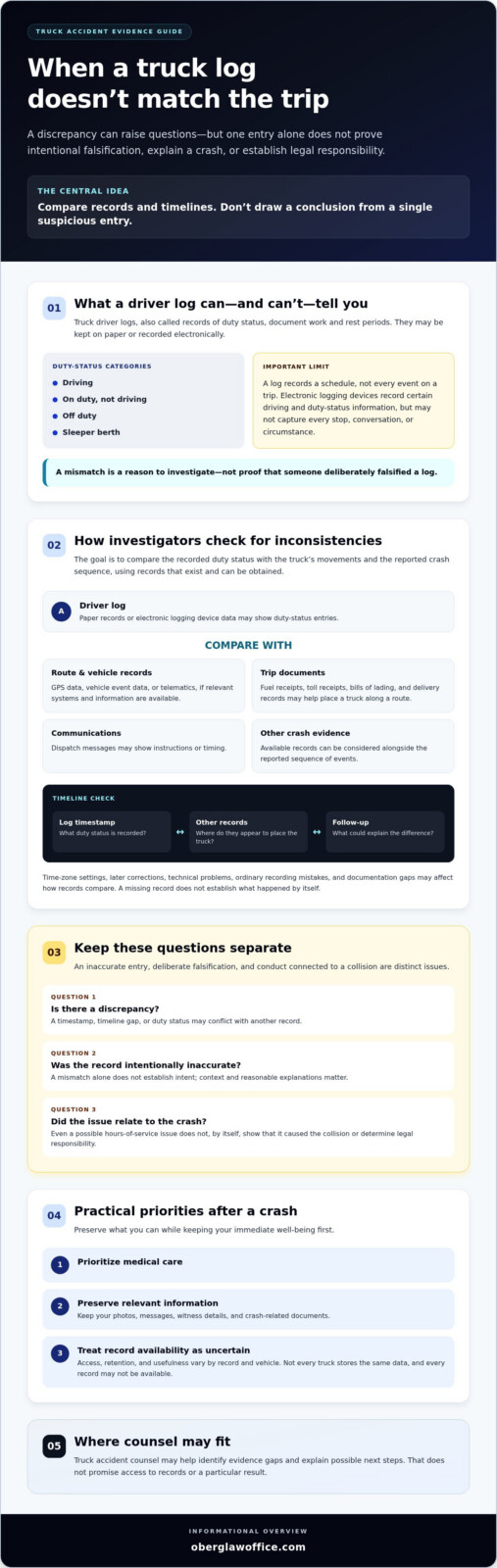
This article explains what suspicious log entries may indicate and how investigators compare them with GPS data, fuel and toll receipts, dispatch messages, and other records. You’ll also find practical steps for preserving evidence and protecting your injury claim, as well as guidance on when legal help may be useful. A careful review can put a discrepancy in context, but it can’t guarantee a particular outcome.
Key Takeaways
- Driver logs track duty status on paper or electronically, but an entry needs context before its meaning is clear.
- Log book falsification in truck accidents is assessed by comparing records and timelines, not by relying on one suspicious entry.
- An inaccurate record alone doesn’t establish intentional falsification or prove that it caused the crash.
- Prioritize medical care, then preserve your photos, messages, witness details, and crash-related documents.
- Truck accident counsel may help identify evidence gaps and explain possible next steps, without promising access to records or a particular result.
What does log book falsification in truck accidents mean?
After a serious truck crash, a conflict between a driver’s reported schedule and the apparent timeline can raise difficult questions. Was the driver working, resting, or driving when the collision happened? A log entry may be worth examining, but a mismatch alone doesn’t explain why the records differ.
Truck driver logs, also called records of duty status, document a driver’s work and rest periods. They may be kept on paper or recorded electronically. The phrase log book falsification in truck accidents refers to intentionally recording inaccurate information, not simply finding a mismatch or clerical error. A suspected discrepancy is a reason to investigate, not proof that someone deliberately falsified a log.
What information do truck driver logs record?
Duty-status entries show how a driver’s time is categorized, such as driving, on duty but not driving, off duty, or in a sleeper berth. These records document a driver’s schedule, but they aren’t a complete account of every event on a trip. Electronic logging devices record certain information related to driving and duty status. They don’t necessarily capture every stop, conversation, or circumstance.
Federal Hours of Service (HOS) regulations provide background on rules governing commercial drivers’ work and rest periods. The requirements, exceptions, and records that apply can depend on current regulations and the circumstances. Verify them before drawing conclusions about a particular driver or crash.
What may make a log entry look suspicious?
A timestamp that conflicts with other records, a gap in the timeline, or a duty status that seems inconsistent with the truck’s documented route may deserve closer review. For example, a log might show the driver off duty when another reliable record places the truck on the road. That conflict is a question to investigate, not a verdict.
Context matters. Time-zone settings, later corrections, technical problems, and ordinary recording mistakes may explain an apparent inconsistency. Investigators need to compare the entry with other available evidence and consider reasonable explanations before concluding that a record was intentionally changed or inaccurately made.
That distinction matters after a crash. An inaccurate entry, deliberate falsification, and conduct connected to the collision are separate questions. A careful review can help clarify them, but no single discrepancy automatically establishes what happened or who may be legally responsible.
How investigators check truck logs against other crash evidence
A log entry is one part of a larger timeline. Investigators look for patterns across independent records, asking whether the driver’s recorded duty status, the truck’s movements, and the reported crash sequence fit together. Comparing records can help explain a discrepancy, but a conflict isn’t automatically proof of wrongdoing.
Which records may corroborate or conflict with a log?
Depending on what exists and can be obtained, a review may include electronic logging device (ELD) data, dispatch messages, bills of lading, fuel receipts, and delivery records. Vehicle event data or telematics may also help if the truck has relevant systems and the information is available. Dispatch messages may show instructions or timing, while receipts and delivery records may help place a truck along a route.
How investigators check truck logs can include comparing supporting documents with log entries to look for inconsistencies. Access, retention, and usefulness vary by record and vehicle. Don’t assume every truck stores the same data or that every record will be available.
How can timelines expose inconsistencies?
Investigators may align timestamps from available records with route details and the reported sequence of events. For example, if a log shows a particular duty status while a dispatch message and delivery record appear to place the truck elsewhere at that time, the conflict may prompt follow-up questions. Each record needs to be interpreted in context, including how its time was recorded.
Clock settings, time-zone differences, corrections, and gaps in documentation can affect how timestamps compare. A missing record doesn’t establish what happened by itself. Investigators may need to determine whether records use consistent time settings and whether other evidence helps explain an apparent gap.
Corroboration gives a discrepancy context, not automatic proof. Even if records point to a possible hours-of-service issue, that alone doesn’t establish that the issue caused the collision or determine legal responsibility. In log book falsification in truck accidents, key questions include whether entries were intentionally inaccurate and whether reliable evidence connects the discrepancy to the crash.
If you’re trying to understand which records may matter after a collision, this truck accident lawyer guide may help you consider questions about evidence and next steps. A careful review can identify what is known, what remains uncertain, and which records may need further evaluation.
Does a falsified truck log prove fault or liability?
No. An entry that appears inaccurate doesn’t automatically prove that a driver caused the crash or that the entry was deliberately falsified. A careful review separates three questions: Is the record inaccurate? Was it made or changed intentionally? Does the conduct shown by the record relate to the collision and injuries?
For log book falsification in truck accidents, that distinction matters. A record may raise concerns, but its significance depends on supporting evidence, the crash circumstances, and the applicable law. The table below shows how investigators may consider those questions without treating a discrepancy as a conclusion.
| What the review finds | What may support it | Possible significance | What remains unresolved |
|---|---|---|---|
| A log time conflicts with another timestamp | Separate records place the truck at a different time or location | The conflict may warrant further investigation | Whether a clock setting, correction, or mistake explains it |
| An entry appears intentionally altered | Record history or other evidence may help establish how it changed | It may raise questions about the accuracy of the account | Who made the change, why, and whether it relates to the crash |
| A possible rest or scheduling concern appears | Records and crash evidence may help establish the driver’s circumstances | It could be relevant if connected to the collision | Whether the concern contributed to the crash or claimed harm |
How do negligence and causation relate to log evidence?
In general, an injury claim must connect relevant conduct to the collision and the harm being claimed. If reliable evidence suggested a driver was fatigued, for example, that circumstance might matter if it could be linked to the events leading to the crash. A scheduling concern alone doesn’t establish that connection.
The facts and applicable law determine whether a particular record supports a claim. Legal standards, including rules governing whether evidence may be used, can vary by jurisdiction and should be verified for the case.
What other explanations should investigators consider?
An apparent discrepancy may reflect a data-entry mistake, a device problem, an authorized edit, or an incomplete record. Investigators shouldn’t assume any of these explanations, but they shouldn’t assume intentional misconduct either. Comparing multiple independent records can help test competing explanations and reveal which account best fits the overall timeline.
A log entry is evidence to evaluate, not a stand-alone answer. Whether it supports a particular claim depends on the full record, how reliably the information can be interpreted, and the jurisdiction-specific legal rules that apply.
What should you do if you suspect truck log falsification?
After a serious crash, you may have questions about the driver’s records while dealing with injuries and immediate concerns. Take things one step at a time. Your safety and medical care come first. You don’t need to prove what happened or investigate the trucking company on your own.
- Get medical care and follow safety instructions. Seek emergency help if needed, and keep records of treatment and follow-up care.
- Save information already in your possession. Keep crash-scene photos, messages, insurer communications, medical documents, and notes about what you remember.
- Preserve original files. Avoid editing photos, messages, or other potential evidence. Note when and how you obtained each item.
- Write down witness details, if appropriate. Keep names and contact information you already have, but don’t pressure anyone to provide a statement.
- Don’t confront the driver or access restricted systems. Avoid trying to obtain logins, change records, or investigate through unauthorized means.
What information can you safely preserve yourself?
Keep copies of documents connected to the crash, including medical records, insurer letters or messages, photographs, and your own notes. If you have a picture of a vehicle, road condition, or visible damage, retain the original file rather than cropping or marking it up. Record when and how you received or saved materials, and store copies somewhere secure.
Your notes can help you remember details that may otherwise become harder to recall. Separate what you personally observed from what someone else told you. You don’t need to interpret a log entry or decide whether it proves log book falsification in truck accidents. Preserve what you have and leave the analysis to a careful review.
When should you ask a lawyer about preserving records?
Some electronic or business records may be subject to limited retention periods, but timing and availability depend on the record and circumstances. If you’re concerned that information could be deleted, overwritten, or controlled by the trucking company or another party, consider seeking legal guidance promptly. A lawyer may assess which records could matter and whether a preservation request is appropriate. That doesn’t guarantee the records will be available or obtained.
If the collision caused severe harm, ask about truck accident evidence preservation and possible next steps. An initial strategy session with Oberg Law Office can help you understand your options. The firm represents people injured in truck accidents and handles personal-injury cases without upfront fees, collecting a percentage of a recovery.
How truck accident counsel can investigate logbook falsification
A log discrepancy can be hard to assess while you’re recovering and trying to understand what happened. Truck accident counsel may review available records, build a timeline, consider witness accounts, and assess whether a suspected inaccuracy has a meaningful connection to the collision and your injuries. The goal is to identify what the evidence supports, what it doesn’t, and what questions remain, not to assume that a mismatch proves misconduct.
Depending on the case, a lawyer may evaluate driver logs alongside other available records and the crash circumstances. Counsel can also explain possible ways to seek or preserve relevant information. Access isn’t guaranteed, and the records available vary from case to case.
What happens during an initial case review?
You can bring whatever information you have, such as crash documents, medical records, insurer communications, photographs, and witness contact details. Don’t delay urgent medical care to gather paperwork. The lawyer may ask when and where the crash occurred, which vehicles were involved, what injuries you’ve experienced, and whether you know of driver or company records that may be relevant.
An initial discussion helps assess possible options and next steps. It doesn’t guarantee that the lawyer will take the case, that particular records can be obtained, or that you’ll recover compensation. Use the conversation to ask how an investigation might proceed and what uncertainties need to be addressed.
How can you compare legal help for a truck-log case?
Ask how the lawyer evaluates electronic records and other evidence, what steps may be considered to preserve information, and how gaps or competing interpretations will be explained. It’s also reasonable to ask who will communicate with you and how fees and case expenses are handled. Review the written agreement carefully so you understand its terms.
Oberg Law Office represents people injured in truck accidents. Attorney Gregg Oberg has practiced law for over 25 years, and the firm offers free initial strategy sessions. Personal-injury representation is handled without upfront fees, with the firm collecting a percentage of a recovery. Ask how the agreement applies to your case and how expenses are treated.
If you’re considering what to do after a crash, you can request an initial truck accident strategy session to discuss your questions and possible next steps. A careful review may help clarify the evidence, but no particular outcome is assured.
Take the next step toward clarity
A log entry that seems wrong deserves a careful look, but it doesn’t prove intentional falsification or establish who caused a crash. In log book falsification in truck accidents, context matters. Investigators compare available records and timelines, then assess whether suspected conduct is connected to the collision. In the meantime, preserving your crash-related photos, messages, and documents can help keep important details organized.
You don’t have to sort through every unanswered question alone. Oberg Law Office represents people injured in truck accidents. Attorney Gregg Oberg has practiced law for over 25 years, and the firm offers free initial strategy sessions to discuss possible next steps. Personal-injury representation is handled without upfront fees, with fees based on a percentage of a recovery and the terms of the agreement.
Talk with Oberg Law Office about your truck accident concerns. A conversation can help you understand what may warrant further review. Take things one step at a time, and focus first on your health and recovery.
Frequently Asked Questions
What counts as log book falsification in a truck accident?
Log book falsification generally means intentionally recording inaccurate information about a truck driver’s duty status or schedule. A mismatch, missing entry, or correction doesn’t by itself prove deliberate falsification. It may have another explanation, such as a data-entry mistake or technical issue. Investigators consider the context and compare the log with other available records before concluding whether an entry was intentionally inaccurate.
Can an ELD prove that a truck driver falsified a log?
An electronic logging device (ELD) may provide information relevant to a log’s accuracy, but its data doesn’t automatically prove intentional falsification. An ELD records certain driving and duty-status information, not every detail of a trip or the reason behind an entry. Investigators may compare available device data with other records and consider possible errors, corrections, or technical issues before reaching a conclusion.
Does a falsified truck driver log automatically prove negligence?
No. Even if a record is shown to be inaccurate or intentionally falsified, that doesn’t automatically establish negligence or show that the conduct caused the collision. A claim generally requires evidence connecting relevant conduct to the crash and the injuries. The facts and applicable law matter, including how the record relates to the events. Suspected log falsification alone can’t guarantee a particular legal outcome.
What evidence can be compared with a truck driver’s logbook?
Depending on what exists and can be obtained, investigators may compare logs with dispatch communications, bills of lading, fuel receipts, delivery records, GPS information, or weigh station records. Vehicle event data or telematics may also be relevant if the truck has suitable systems and the information is available. Each source has limits, so investigators consider how records were created, their timestamps, and whether they support or conflict with the reported timeline.
How long are truck driver logs and ELD records kept?
Retention depends on the record type, who holds it, and current requirements. Some carrier-held driver logs may be subject to a six-month retention period, while ELD providers are required to store logs for eight years beginning January 1, 2026. Verify these rules before publication and for a specific case. Don’t assume every related record is kept for the same period.
Can an injured person request a truck driver’s logbook?
You can ask for relevant records, but access isn’t automatic. The process depends on the circumstances and applicable legal procedures. A lawyer may assess whether records can be requested from a carrier or another party and explain possible ways to seek them. Preserve documents and information you already have, and consider seeking legal guidance promptly if you’re concerned that important records could be deleted or overwritten.
What should I do if I suspect a trucking company changed records?
Don’t confront company personnel, access restricted systems, or alter potential evidence. Keep your original photos, messages, medical documents, insurer communications, and notes about what happened. Record how and when you obtained each item. If company-held records may be changed, deleted, or overwritten, consider promptly asking a truck accident lawyer about preservation options. A preservation request may help address the concern, but it can’t guarantee access to records.