Could a truck’s load have made a crash harder to avoid or its impact more severe? An overloaded truck accident lawsuit may depend on more than whether the truck exceeded a weight limit. Evidence needs to connect the load to the crash and help show who controlled or approved it.
If you’re hurt, it’s understandable to worry that the trucking company or insurer has records you can’t access, or that you don’t know who may be responsible. The truck driver, motor carrier, shipper, or another party could share liability, depending on the facts. An overloaded load alone doesn’t prove negligence. Weight tickets, shipping documents, inspection reports, and electronic truck data may help clarify what happened.
This article explains how excess weight can affect a truck’s handling and stopping, what evidence may support a claim, and how to protect important records. You’ll also learn why deadlines vary by state and what to consider when evaluating legal help, including how contingency-fee arrangements work.
Key Takeaways
- An overloaded truck accident lawsuit depends on evidence linking the load to the crash, not simply proof that the truck was heavy.
- Records such as weight tickets, bills of lading, and loading documents may help show what was loaded and who handled it.
- Excessive or unevenly distributed cargo may affect braking or handling, depending on the truck and crash circumstances.
- Drivers, carriers, loaders, and shippers may warrant investigation, but involvement alone doesn’t establish legal responsibility.
- Learn what to consider when discussing evidence, insurance communications, and possible next steps with a truck accident attorney.
Could an Overloaded Truck Accident Lawsuit Be Supported?
A serious truck crash can leave you dealing with injuries, uncertainty, and difficult questions about what happened. If you suspect the truck’s load played a role, an overloaded truck accident lawsuit may involve investigating whether the cargo was too heavy, improperly distributed, or inadequately secured, and whether that condition contributed to the collision.
These are separate questions. A load that exceeded a legal limit doesn’t automatically prove negligence or show that it caused the crash. A claim needs evidence connecting the loading condition to the events and resulting harm. The applicable standard can depend on the truck’s configuration, the route, permits, and federal or state rules. A truck may qualify as a commercial vehicle, but that label alone doesn’t determine which weight requirements apply.
What does “overloaded truck” mean in a legal investigation?
Investigators distinguish between a truck that exceeds an applicable weight limit and one carrying cargo in an unsafe way. A truck may be within its overall weight limit but have too much weight on certain axles, or cargo that isn’t adequately secured. Either condition could matter, depending on the facts.
Vehicle ratings, axle limits, route-specific rules, and any required permits can all affect the analysis. For example, a limit that applies on one road or to one configuration may not apply in the same way on another. The relevant federal and state standards must be checked for the crash location and route.
When can the load matter to the cause of a crash?
Excessive weight may place added demands on braking systems, tires, or other components. Uneven weight or shifting cargo may affect stability or steering. These are possible mechanisms, not proof that an unsafe load caused a particular collision. Weather, road conditions, driver actions, mechanical problems, and other factors may also require investigation.
Evidence of a weight-rule violation and evidence that the violation contributed to the crash are not the same. Load records, vehicle data, inspection findings, crash-scene evidence, and expert analysis may help connect the two. An unsafe load matters when evidence connects it to the crash. That connection is central to evaluating whether the facts support a claim, rather than assuming that an overloaded truck is automatically responsible.
How Can an Overloaded Truck Cause or Worsen a Crash?
A truck’s load can affect how the vehicle responds, but no single effect proves why a crash happened. Excess weight may increase demands on brakes, tires, suspension, or other components. Depending on the truck and circumstances, that stress could contribute to a mechanical problem or make it harder for the driver to respond. Speed, road conditions, vehicle maintenance, and driver actions also matter.
How weight and distribution may affect vehicle control
Consider a truck carrying cargo unevenly, with more weight concentrated on one side or axle. Even if its total load appears acceptable, that distribution could affect balance, steering, or stability during a turn or sudden maneuver. The outcome depends on the vehicle’s design and the conditions at the time. Investigators should assess the load alongside the truck’s movement and other crash evidence.
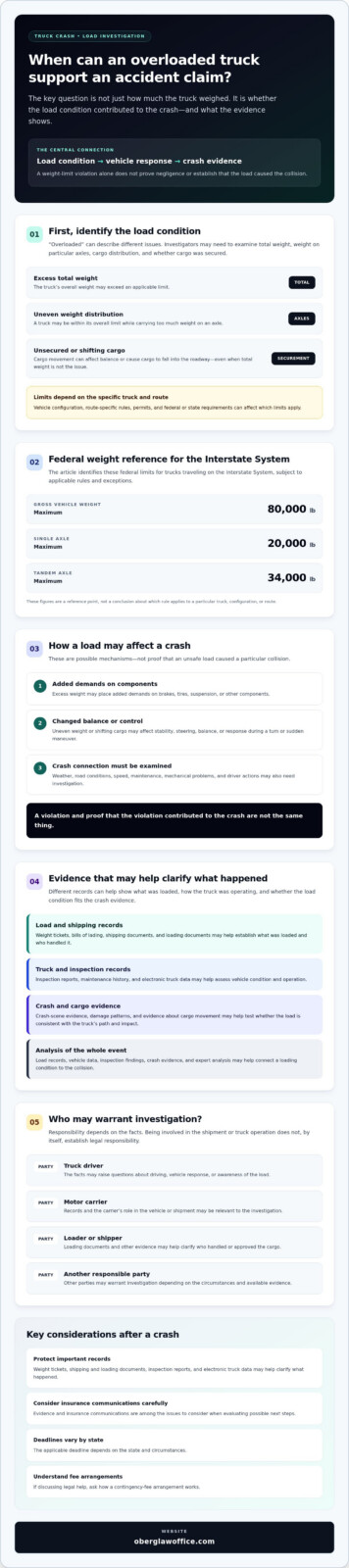
For trucks traveling on the Interstate System, the applicable federal limits include a maximum gross vehicle weight of 80,000 pounds, a single-axle limit of 20,000 pounds, and a tandem-axle limit of 34,000 pounds, subject to applicable rules and exceptions. The federal weight regulations provide a reference point, but the truck’s route, configuration, and any applicable state requirements still need to be considered.
Why cargo securement and vehicle condition also matter
Excess total weight, poor weight distribution, and unsecured cargo are related but distinct concerns. A load may shift even if it doesn’t exceed a weight limit. Movement can change the truck’s balance or cause cargo to fall into the roadway. Conversely, cargo can be secured yet still exceed an applicable weight limit. Each possibility calls for a different factual inquiry.
Inspection records, damage patterns, maintenance history, and evidence about the cargo may help test competing explanations. For example, investigators may examine whether a tire or brake issue existed before the crash, or whether cargo movement is consistent with the vehicle’s path and impact. Federal Motor Carrier Safety Administration requirements may be relevant, but their applicability depends on the vehicle, operation, and governing rules. They should be verified for the specific circumstances rather than assumed.
Load condition, vehicle evidence, and crash dynamics must be assessed together to determine whether cargo contributed to a collision. That connection can be central in an overloaded truck accident lawsuit. Proof of a violation alone doesn’t establish causation.
If you’re unsure what evidence may clarify how the load affected the crash, consider discussing the circumstances with a lawyer handling truck accident representation.
What Evidence Can Help Prove an Overloaded Truck Accident Claim?
Evidence can help answer four connected questions: what the truck carried, who loaded or handled it, whether applicable requirements were followed, and whether the load contributed to the crash. No single record necessarily answers all four. For example, the Insurance Institute for Highway Safety notes that loaded tractor-trailers may need 20% to 40% more distance to stop than cars. That general comparison doesn’t establish what caused a particular collision. An overview of the dangers of large trucks provides helpful safety context, but crash-specific evidence is still essential.
Which records may show how the truck was loaded?
Bills of lading, shipping and dispatch records, weight tickets, loading documents, and available permit records may help reconstruct a load’s contents, weight, timing, and handling. Load records can help identify what was carried, when, and by whom. They may point investigators to a driver, motor carrier, shipper, or loader, but naming a participant doesn’t by itself establish that party’s legal responsibility.
| Evidence | Question it may help answer |
|---|---|
| Bills of lading, shipping and dispatch records | What cargo was assigned, described, and transported? |
| Weight tickets, loading and permit records | What was the recorded weight, how was it loaded, and was a permit documented? |
| Inspection and maintenance records | Was a vehicle condition or mechanical issue present? |
| Electronic vehicle data, photographs, witness accounts, and crash reports | What happened before and during the collision, and what physical conditions were visible? |
Why preserving evidence quickly may matter
Vehicles may be repaired, cargo moved, and electronic or business records altered, overwritten, or become unavailable. Retention periods and access vary, and evidence’s admissibility and value depend on the circumstances. Keep copies of your photographs, messages or letters, medical records, and witness names and contact details. Don’t alter or discard potentially relevant materials. Before contacting a trucking company or other potentially responsible party, consider speaking with counsel about how to protect evidence and make appropriate requests.
In an overloaded truck accident lawsuit, an attorney may help identify records to seek and communicate with insurers, but no particular document guarantees access or proves fault. A lawyer can also assess which evidence may be useful under the rules that apply to your case.
Who May Be Responsible, and What Should You Do Next?
Responsibility in an overloaded-truck crash may involve more than the person behind the wheel. Depending on the evidence and applicable law, investigators may examine the driver, motor carrier, loader, shipper, or another party. But a company’s name on a document, ownership of the truck, or involvement in transporting cargo doesn’t automatically establish legal fault. The key is to determine what each party controlled or did, and whether that conduct contributed to the crash.
How investigators assess responsibility for the load
An investigation may trace who selected, loaded, secured, inspected, dispatched, and operated the truck. Those roles can overlap, but they aren’t interchangeable: ownership or a contractual role alone doesn’t decide legal responsibility. Records and other evidence help establish what each participant actually did. A truck-accident attorney can help evaluate those roles and the available evidence.
Deadlines for filing a claim and rules about whether a person’s own actions affect recovery vary by jurisdiction. Don’t assume the same deadline or fault rule applies everywhere. Have the law for the crash location and circumstances checked promptly.
What should you do next?
- Document: Keep photographs, messages, crash paperwork, and witness contact details.
- Preserve: Save relevant records and avoid altering or discarding potential evidence.
- Seek medical care: Follow up on injuries and keep copies of related records.
- Avoid speculation: Stick to what you personally observed when speaking with others.
- Get legal guidance: Ask about evidence preservation, insurance communications, and deadlines before deciding what to do next.
What should you ask before choosing a truck-accident lawyer?
Ask how the lawyer investigates weight, cargo, vehicle, and electronic evidence in truck cases. Clarify who will handle your matter, how the firm communicates, and what case strategy may be considered. Confirm whether the lawyer is authorized to handle cases in the relevant jurisdiction and whether the firm will accept yours.
Oberg Law Office offers free initial strategy sessions. Attorney Gregg Oberg has practiced law for more than 25 years. The firm handles personal-injury representation on a contingency-fee basis, with attorney fees collected as a percentage of financial recovery. Ask for the fee agreement in writing and review how case expenses are handled. A contingency arrangement doesn’t necessarily mean every expense is waived.
If you’re considering an overloaded truck accident lawsuit, you can discuss your truck-crash questions in an initial strategy session.
How Oberg Law Office Can Help After an Overloaded-Truck Crash
After a serious truck crash, sorting through records, fault questions, and insurance communications can feel like too much to manage alone. Oberg Law Office represents people injured in truck and other vehicle crashes. Attorney Gregg Oberg has practiced law for more than 25 years, and the firm offers free initial strategy sessions to discuss your circumstances and possible next steps.
What to expect from an initial strategy session
You don’t need to arrive with every answer. It may help to summarize what happened, your injuries, any witnesses you know about, and which documents or photographs you already have. You can also explain what you suspect about the truck’s load, while distinguishing what you observed from what you’re still trying to confirm.
The conversation can help identify potential evidence and legal questions, but it can’t guarantee that a claim will succeed or predict a particular outcome. Ask whether the firm can handle a case in the jurisdiction where the crash occurred, who would work on the matter, how you’ll receive updates, and what next steps may be considered.
How legal help may support an overload investigation
An attorney may review available loading and weight records, vehicle information, and crash evidence to evaluate how the load could relate to the collision. Legal help may also include examining which parties’ actions warrant investigation and communicating with insurers about the claim. What can be pursued depends on the evidence, applicable law, and the firm’s ability to accept the case.
If the crash caused life-altering harm, ask whether catastrophic injury representation may be relevant to your circumstances. You can also ask how the firm’s contingency-fee arrangement works: attorney fees are collected as a percentage of financial recovery, but case expenses may be handled separately. Review the written agreement so you understand the terms before deciding.
An initial strategy session is a chance to raise concerns, understand possible options, and decide whether you’re comfortable with the next step. If you’re considering an overloaded truck accident lawsuit, Request a free initial strategy session to discuss what happened and confirm whether the firm can handle your matter.
Take a Clear Next Step Toward Answers
An overloaded truck accident lawsuit depends on more than showing that a truck carried too much or unsafe cargo. Evidence must help connect the load to the crash and clarify which parties may have played a legally relevant role. Records can be difficult to obtain or preserve, so timely, careful action matters. Deadlines and fault rules vary by jurisdiction, making it important to confirm which laws apply to your situation.
You don’t have to sort through every unanswered question on your own. Gregg Oberg has practiced law for more than 25 years, and Oberg Law Office offers free initial strategy sessions to discuss truck-crash evidence, possible responsibility, and insurance communications. Personal-injury representation is handled on a contingency-fee basis, with attorney fees collected as a percentage of financial recovery. Ask how case expenses are treated and review the agreement’s terms.
If you’re considering your options, request a free initial strategy session and ask whether the firm can handle your matter. A conversation can help you understand possible next steps.
Frequently Asked Questions
Does an overloaded truck automatically make the trucking company liable?
No. An overloaded truck doesn’t automatically make the trucking company liable. A claim generally requires evidence of legally relevant fault and a connection between that conduct and the crash and your injuries. Investigators may examine who controlled the load, applicable weight or securement rules, vehicle condition, and crash dynamics. Even a documented violation must be assessed in context. Responsibility depends on the facts and the law that applies.
How can I prove a truck was overloaded before a crash?
Records and physical evidence may help establish the truck’s weight and how its cargo was handled. Potential sources include weight tickets, bills of lading, shipping and loading documents, dispatch records, and available permits. Inspection records, electronic vehicle data, photographs, witness accounts, and crash reports may provide additional context. These records may not be available or admissible in every case, so prompt legal guidance can help identify what to seek and preserve.
Who can be sued after an overloaded truck accident?
Depending on the evidence and applicable law, potential parties for investigation may include the driver, motor carrier, shipper, loader, or another participant. Investigators consider who selected, loaded, secured, dispatched, inspected, and operated the truck. A party’s involvement, ownership, or appearance in a shipping record doesn’t automatically establish legal responsibility. An overloaded truck accident lawsuit requires a case-specific review of each party’s role and any connection to the crash.
What should I do after a crash involving a possibly overloaded truck?
Prioritize medical care, then preserve what you can. Keep photographs, crash paperwork, medical records, messages, and witness names or contact details. Write down what you personally observed, but avoid guessing about the truck’s weight or who caused the crash. Don’t alter or discard potentially relevant evidence. Before contacting a trucking company or insurer about disputed facts, consider seeking legal guidance about documentation and evidence preservation.
How long do I have to file an overloaded truck accident lawsuit?
The filing deadline depends on the jurisdiction and circumstances of the claim. Many states have personal-injury deadlines of two or three years, but that general range may not apply to your case, and special rules can affect the time available. Don’t rely on a typical deadline or wait for every investigation detail before asking. Promptly confirm the applicable limit with a lawyer qualified to handle the matter.
Can I bring a claim if the truck’s load shifted or was unsecured?
Possibly. Cargo that shifts or isn’t adequately secured may be relevant even if the truck’s total weight didn’t exceed an applicable limit. A claim would still need evidence connecting the cargo condition to the collision and resulting harm. Loading and securement records, photographs, physical damage, witness accounts, and crash evidence may help explain what happened. The facts and governing rules determine whether a claim is viable.
Do I have to pay a truck accident lawyer upfront?
Oberg Law Office handles personal-injury representation on a contingency-fee basis, so clients don’t pay upfront attorney fees under that arrangement. Attorney fees are collected as a percentage of financial recovery. Case expenses may be treated separately, so ask how they’re handled and review the written agreement before deciding. The firm offers free initial strategy sessions, and you should confirm whether it can accept a case in the relevant jurisdiction.