
The biggest fear after a serious accident isn’t just the physical recovery; it’s the anxiety of receiving a settlement check only to find that legal fees and hidden expenses took the lion’s share. It’s a valid concern because understanding a lawyer contingency fee calculation shouldn’t require a finance degree. You deserve to know exactly how your compensation is divided before you commit to a partnership. While standard industry rates often fall between 33.3% and 40%, the real impact on your bank account depends on how those percentages interact with the specific costs of your case.
We know you’re looking for security and fairness during a time that feels anything but stable. You’ve likely heard the phrase “no win, no fee,” but you’re still worried about being left with bills you can’t pay. This guide will show you exactly how these totals are reached, including the critical difference between gross and net recoveries. By the end, you’ll have the clarity to estimate your actual recovery and the confidence to sign a retainer agreement knowing your interests are protected.
Key Takeaways
- Understand how the “No Win, No Fee” model removes financial risk, ensuring you only pay when your attorney successfully secures compensation for you.
- Demystify the lawyer contingency fee calculation by learning how your final check is determined after deducting attorney fees and litigation costs from the gross settlement.
- Learn the critical difference between attorney fees and case costs to avoid surprises when it’s time to distribute your settlement funds.
- Discover why contingency percentages may shift from 33.3% to 40% or more depending on whether your case settles early or proceeds to a full trial.
- Gain the confidence to review your retainer agreement for red flags, such as hidden administrative fees, before you sign on the dotted line.
What is a Contingency Fee and How Does it Benefit Accident Victims?
After a serious accident, your focus should be on healing, not how you’ll pay for a lawyer. The legal world can feel cold and out of reach, especially when you’re facing a billion-dollar insurance company. This is why the contingency fee model exists. It’s a “No Win, No Fee” promise that ensures you never pay for legal representation unless your attorney successfully recovers money for you. This structure is the standard for personal injury cases across the United States because it prioritizes your recovery over a lawyer’s hourly rate.
This model creates a shared risk between you and your advocate. When your attorney takes your case, they’re essentially becoming an investor in your claim. They put in the work, the hours, and the resources, knowing they only get paid if they win. This aligns your interests perfectly. Your lawyer is motivated to maximize your recovery because their own payment depends on it. It transforms the legal process from a distant transaction into a collaborative partnership. Understanding what is a contingency fee arrangement is the first step toward reclaiming your security after a life-altering event.
The Core Components of a Contingency Agreement
The word “contingency” simply means that the payment is dependent on a specific outcome. In legal terms, a “win” usually refers to any financial recovery obtained on your behalf. This could come from a pre-trial settlement, where the insurance company agrees to pay a set amount, or a court verdict if the case goes to trial. Because every case is unique, most injury lawyers offer a free initial strategy session. This meeting allows a professional to evaluate the merits of your claim and explain how a lawyer contingency fee calculation will apply to your specific situation without any financial pressure on your end.
Access to Justice Without Upfront Costs
Financial barriers shouldn’t prevent you from seeking fairness. Many victims of truck accidents or catastrophic injuries face zero savings and mounting debt. The contingency model allows you to hire elite legal counsel that you otherwise couldn’t afford. You don’t have to worry about the “billable hour” anxiety that plagues other areas of law. Every phone call, every piece of research, and every negotiation is covered under the initial agreement. This provides a level of peace of mind that is essential when you’re already navigating the emotional aftermath of a traumatic event. It ensures that the quality of your legal representation is determined by the strength of your case, not the size of your bank account. Using a clear lawyer contingency fee calculation, you can see exactly how this partnership protects your financial future from day one.
The Math of Justice: Calculating Gross vs. Net Recovery
When you receive word that your case has settled, the initial feeling is usually one of immense relief. The legal battle is over, and justice has been served. However, that relief can quickly turn into confusion when you look at the final breakdown of the numbers. Understanding how a lawyer contingency fee calculation actually works is the best way to prepare for the final distribution of your funds. It isn’t just about one percentage; it’s a step by step process that ensures all parties, from your medical providers to your legal team, are fairly compensated for their roles in your recovery.
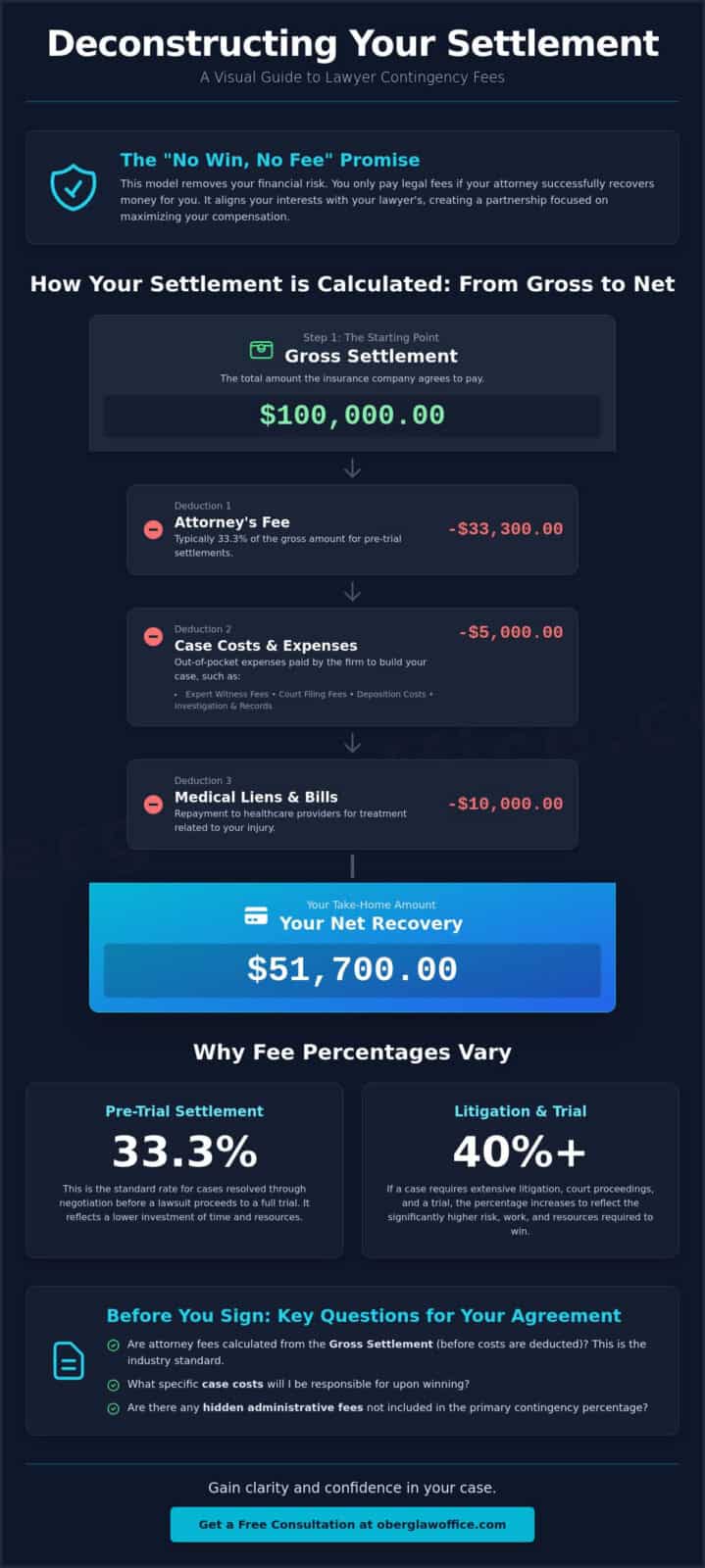
The process follows a specific order of operations. First, we determine the Gross Settlement, which is the total “top-line” amount the insurance company agrees to pay. From there, the attorney’s fee is calculated as a fixed percentage. Next, we deduct the legal costs and disbursements, which are the out-of-pocket expenses the firm paid to build your case. Finally, any outstanding medical liens are addressed. These are legal claims by healthcare providers or insurance companies to be paid back for the care they provided. What remains is your Net Recovery, the actual check that goes into your pocket to help you move forward with your life.
Gross Recovery vs. Net Recovery: Why the Distinction Matters
In the legal world, “Gross” refers to the total settlement amount before any deductions are made. Conversely, “Net” represents your actual take-home pay after every fee, cost, and lien has been satisfied. Calculating fees on the gross amount is the industry standard because it reflects the total value the attorney secured through their advocacy and negotiation. This ensures the firm is compensated for the full scope of the result they achieved for you. If you’re feeling unsure about how these numbers apply to your specific accident, you can reach out to a professional for a clear explanation of your rights.
A Hypothetical Calculation Example
To see the lawyer contingency fee calculation in action, let’s look at a hypothetical $100,000 settlement. If your agreement specifies a 33.3% fee and your lawyer incurred $5,000 in costs to hire experts or gather records, the math looks like this:
- Gross Settlement: $100,000
- Attorney Fee (33.3%): -$33,333
- Legal Costs: -$5,000
- Net Recovery (Before Liens): $61,667
It’s important to remember that medical liens can further adjust this final number. If you owe a hospital $10,000 for emergency surgery, that amount is typically paid directly from your $61,667 portion. While these deductions might seem daunting, they represent the fulfillment of the debts incurred by the accident, leaving you with a clean slate and the remaining funds to support your long-term healing.
Legal Costs and Disbursements: What Else Comes Out of the Settlement?
When we discuss your lawyer contingency fee calculation, it’s vital to separate the attorney’s fee from the case costs. While the fee is the payment for our professional time and expertise, “costs” or “disbursements” are the actual expenses we pay to third parties to build your case. Think of these as the fuel required to drive your claim toward a successful finish line. We understand that after a bicycle accident or a slip and fall, you likely don’t have thousands of dollars sitting in a bank account to pay for experts or court filings. That’s why we advance these costs for you. You don’t pay a dime out of pocket while the case is active.
High-value claims, such as those involving catastrophic injury representation, often require significant upfront investments to prove negligence against a formidable opponent. We take on this financial burden because we believe in the strength of your case. These disbursements are eventually reimbursed from the gross settlement amount, ensuring that the firm can continue to provide this level of dedicated advocacy for every neighbor in our community. Common examples include basic administrative needs like certified postage, long-distance travel for investigators, and the fees required to secure copies of your medical history.
High-Impact Expenses: Expert Witnesses and Investigations
To win against large institutions, we often need to bring in specialized help. Accident reconstruction experts are essential for proving exactly how a truck accident occurred when the facts are in dispute. Similarly, medical experts provide the testimony needed to explain the long-term impact of your injuries to a jury. Obtaining certified medical records and official police reports also carries a cost; however, these documents are the bedrock of a successful claim. These experts ensure your story is told with the authority it deserves.
Court Costs and Litigation Expenses
If your case moves into the litigation phase, the expenses naturally increase. Every lawsuit begins with a court filing fee and the cost of serving a summons to the defendant. As we prepare for trial, we pay for court reporters to record depositions and provide transcriptions of testimony. We also invest in professional trial exhibits, such as high-quality visual aids, to help a jury understand the fairness of your request. These tools are not just “extras”; they’re the weapons we use to protect your future. Every step of the lawyer contingency fee calculation is designed to be transparent, so you always know exactly how your recovery is working for you.
Why Do Lawyer Contingency Percentages Vary?
You’ve likely noticed that not every lawyer charges the same amount. While many firms follow a similar framework, the specific percentage in your lawyer contingency fee calculation depends on several factors. The most common baseline is a 33.3% fee, or one-third of the recovery, for cases that reach a settlement before a lawsuit is officially filed. This lower rate reflects the reduced time and lower financial risk involved when an insurance company agrees to a fair settlement early in the process.
The math changes if your case requires litigation. If we have to file a lawsuit or proceed to a full trial, the percentage often increases to 40% or more. This jump isn’t arbitrary; it accounts for the massive increase in labor, resources, and risk the firm takes on to fight a billion-dollar institution in court. Additionally, some states mandate a “Sliding Scale” model for specific case types. For example, in states like Connecticut, the law requires the percentage to decrease as the settlement amount grows, ensuring you retain the majority of a high-value recovery.
Experience and Reputation vs. Fee Percentage
The caliber of your advocate directly impacts your final result. A veteran truck accident lawyer texas brings specialized industry knowledge and a history of successful verdicts that a generalist simply cannot match. You aren’t just paying for a service; you’re paying for senior-level attention and the “personal touch” that ensures your case isn’t lost in a high-volume mill. An experienced attorney often secures a significantly higher gross settlement, which means that even with a standard fee, your net recovery is often much higher than it would be with a discount lawyer. If you want to know what your specific case might be worth, contact us for a clear, personalized assessment.
Risk Assessment: How Lawyers Choose Which Cases to Take
Every contingency agreement is a leap of faith for the law firm. Because we operate on a “no-recovery, no-fee” basis, we act as the primary investor in your claim. When evaluating a case, we look at the probability of winning and the potential for a meaningful recovery. If liability is difficult to prove or if the insurance policy is too small to cover your catastrophic injuries, the fee agreement might reflect that increased risk. Some cases are unfortunately rejected not because the victim isn’t hurt, but because the legal path to a successful recovery is blocked by factors beyond our control. This careful selection process ensures that when we do take your case, we’re fully committed to seeing it through to a successful finish.
Navigating Your Fee Agreement: What to Ask Before You Sign
The written Retainer Agreement is the most important document you’ll sign during your legal journey. It isn’t just a formality; it’s a contract that serves as your primary protection. While we’ve discussed the math behind a lawyer contingency fee calculation, seeing those terms in writing ensures there are no surprises when your case concludes. You should feel comfortable reading every line. If a firm uses overly dense “legalese” that leaves you more confused than when you started, don’t hesitate to ask for a plain-English explanation. A trustworthy advocate wants you to feel secure in your partnership.
Transparency is the hallmark of a specialized, person-oriented practice. As you review the agreement, keep a sharp eye out for red flags like “administrative surcharges” or “file setup fees” that exist outside the standard percentage and case costs. These are often hidden ways for high-volume firms to pad their bottom line at your expense. You should also ask one critical question: “Who pays the costs if we lose the case?” In a true “No Win, No Fee” model, the firm should absorb the advanced litigation expenses if they fail to secure a recovery for you. This ensures the risk is truly shared.
Direct Interaction with Your Legal Team
Before committing, confirm that a senior personal injury lawyer will be personally handling your claim. You deserve more than just a support staff member’s attention. Ask about communication protocols and how often you’ll receive updates on the costs being advanced on your behalf. Every client has the right to an itemized closing statement at the end of their case. This document provides a transparent lawyer contingency fee calculation, showing exactly where every dollar of the gross settlement is going before you receive your net recovery check.
Closing the Deal: Your Free Strategy Session
Your first meeting is a low-pressure opportunity to evaluate the firm’s values and expertise. To make the most of this session, bring your police report, medical discharge papers, and any correspondence from insurance adjusters. These documents help your attorney provide a more accurate estimate of potential fees and costs. If the firm feels like a steadfast protector and a knowledgeable guide, you can move forward with confidence. Signing the agreement is the final step in the preparation phase, allowing your legal team to begin the investigation and start the work of restoring your security and fairness.
Empowering Your Recovery with Financial Clarity
You now have the tools to look at a retainer agreement with confidence. You understand that a lawyer contingency fee calculation isn’t just a random number; it’s a reflection of shared risk and a commitment to your justice. By distinguishing between attorney fees and case costs, you can better estimate your final net recovery. This clarity allows you to focus on what truly matters: your physical and emotional healing. You deserve an advocate who values transparency as much as results.
At Oberg Law Office, we believe you shouldn’t have to navigate this path alone. With over 25 years of Texas legal experience, Attorney Gregg Oberg provides the personal attention your case deserves. We stand by our promise of no fees unless we win your case. Schedule your free initial strategy session with Oberg Law Office today and take the first step toward reclaiming your future. You’ve faced enough uncertainty lately. Let us provide the stability and advocacy you need to move forward with peace of mind.
Frequently Asked Questions
Is the contingency fee negotiable?
Contingency fees are technically negotiable, although most reputable firms maintain standard rates to ensure they can provide the necessary resources for your case. While you have the right to discuss the fee structure during your initial consultation, remember that a lower fee might result in fewer resources dedicated to your claim. Factors such as the clarity of liability and the potential value of the settlement can sometimes influence these discussions in high-value cases.
What happens to the advanced costs if my lawyer loses the case?
In a true “No Win, No Fee” arrangement, you typically don’t owe your lawyer for advanced litigation costs if the case is lost. This means the firm absorbs the expenses for expert witnesses, medical records, and filing fees. It’s vital to confirm this in your specific retainer agreement, as some contracts may distinguish between legal fees and out-of-pocket disbursements. We believe in taking on the financial risk so you can focus on your physical recovery.
Are medical bills included in the lawyer’s contingency fee calculation?
Medical bills are not part of the lawyer contingency fee calculation; they are separate debts paid from your portion of the recovery. The attorney’s fee is a fixed percentage of the gross settlement, while medical liens are paid to healthcare providers for the treatment you received. Your legal team will often work to negotiate these bills down after winning your case, which helps maximize the final amount that stays in your pocket.
Can a lawyer change the percentage in the middle of a case?
Your lawyer cannot change the fee percentage mid-case unless the original retainer agreement specifically allows for it. Most standard agreements include a tiered structure where the percentage increases if the case moves from settlement negotiations to active litigation or trial. Any other modifications to the fee structure would require a new written agreement signed by both you and the attorney to remain legally binding and fair.
What is a ‘sliding scale’ contingency fee?
A sliding scale contingency fee is a structure where the attorney’s percentage decreases as the total recovery amount increases. For example, in states like Connecticut, law mandates that fees are capped at 33.3% for the first $300,000 and drop to lower percentages for amounts exceeding that threshold. This model is designed to protect victims in high-value cases, ensuring that the injured party retains the vast majority of a multi-million dollar settlement or verdict.
Does the contingency fee cover the costs of an appeal?
Standard contingency fee agreements usually don’t cover the extensive legal work required for an appeal. If the insurance company appeals a court victory, a separate agreement is typically needed to handle the additional research and oral arguments in a higher court. It’s important to discuss this possibility early on, especially in complex cases where a trial verdict is likely to be challenged by the opposing party’s legal team.
Do I have to pay a retainer fee in addition to the contingency percentage?
You don’t have to pay an upfront retainer fee when hiring a personal injury lawyer on a contingency basis. Unlike other legal fields where you might pay thousands of dollars just to start a case, the contingency model removes all initial financial barriers. The firm’s payment is entirely dependent on securing a recovery for you, which ensures that everyone has access to high-quality legal representation regardless of their current savings.
How do I know if my lawyer’s fee is ‘reasonable’?
A reasonable fee typically falls within the industry standard of 33.3% to 40% of the total recovery. You can evaluate reasonableness by looking at the firm’s experience, the personal attention they provide, and their willingness to advance all case costs. A fair lawyer contingency fee calculation should be clearly outlined in your written contract, leaving no room for hidden administrative charges or unexpected surcharges at the end of your case.