Did you know that nearly 48% of auto liability claims are now closed without a single dollar being paid to the victim? If you just received a rejection letter, you’re likely wondering what happens if the at-fault driver’s insurance denies liability after an accident that clearly wasn’t your fault. It feels like a door has been slammed in your face while your medical bills continue to mount. You feel powerless against a massive corporation that uses complex legal jargon to protect its bottom line; it’s a stressful position that no one should have to face alone.
We understand the weight of this uncertainty, but a denial is often just a tactical opening move by the insurer, not a final legal verdict. This 2026 guide provides the exact steps you need to take to turn a refusal into a successful recovery. You’ll learn about the legal levers available to victims, how to force an insurance company to reconsider their stance, and the ways to secure a fair settlement despite that initial denial. We’re here to help you move from a state of confusion to a feeling of total empowerment.
Key Takeaways
- Understand that a liability denial is often a tactical financial decision by the insurer rather than a final legal verdict.
- Discover exactly what happens if the at-fault driver’s insurance denies liability and how to trigger your own coverage to keep your recovery on track.
- Learn how to gather specific types of new evidence, like dashcam footage or witness statements, to dismantle the insurance company’s arguments.
- Explore how moving from a claim to formal litigation can force an insurer to open their internal files and reconsider their settlement offer.
- See why partnering with an experienced advocate allows you to focus on healing while a professional handles the complex fight for your restoration.
Understanding Why Insurance Companies Deny Liability
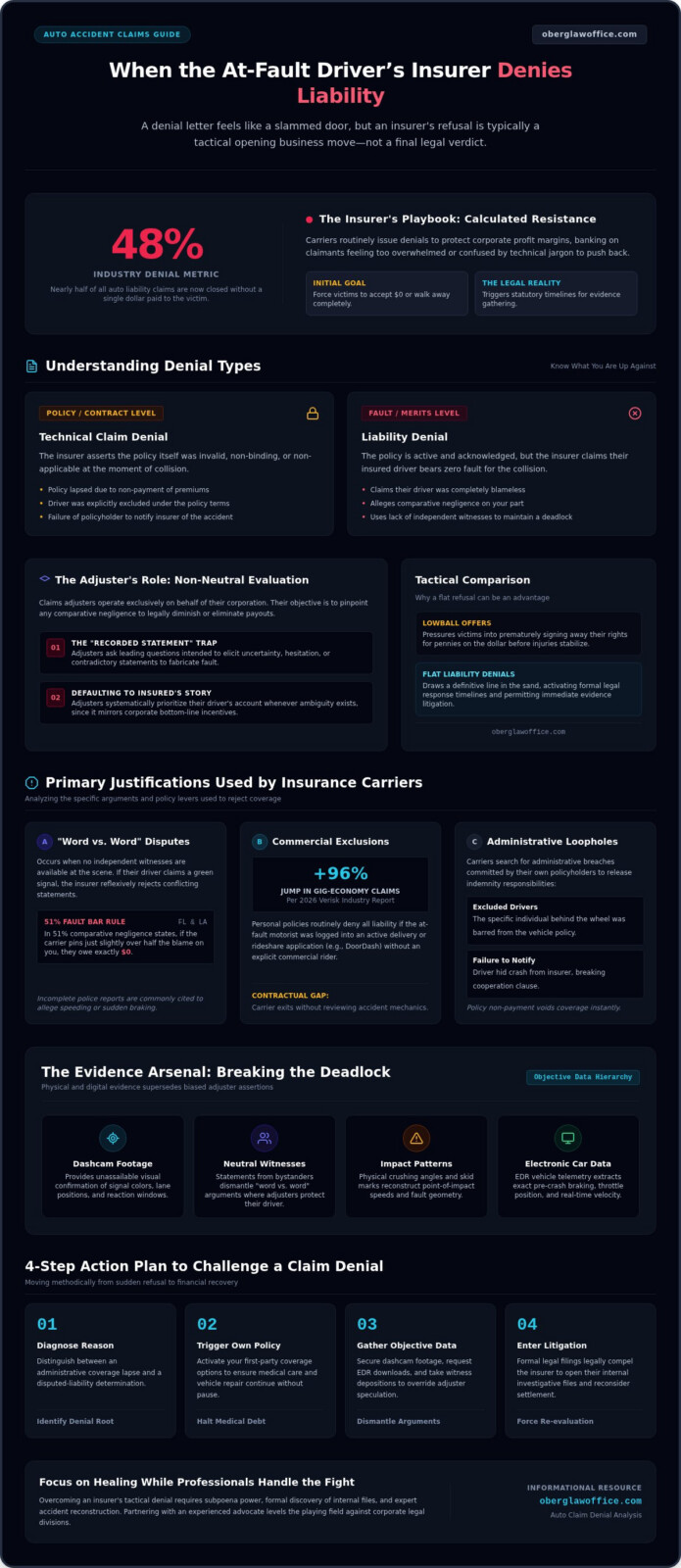
Receiving a letter that says “liability denied” feels like a door slamming shut on your recovery. A liability denial is simply the insurance company’s formal refusal to accept that their driver was at fault for the crash. It’s important to understand that this isn’t a final legal verdict from a judge; it’s a calculated business decision. By denying responsibility, the insurer is protecting its bottom line and hoping you’ll feel too overwhelmed to push back. We’ve seen this happen many times, and we want you to know that you aren’t alone in this fight.
You must distinguish between a technical claim denial and a liability denial. A claim might be denied because of a lapsed policy or an excluded driver, but a liability denial means they acknowledge the policy is active but claim their driver did nothing wrong. Knowing what happens if the at-fault driver’s insurance denies liability is the first step toward regaining control. Often, this denial is just a standard negotiation tactic designed to see if you’ll settle for nothing or walk away entirely.
The Role of the Claims Adjuster
Claims adjusters are not neutral investigators. They work for the insurance corporation, and their primary goal is to find “comparative negligence” on your part. If they can shift even a small percentage of the blame onto you, they can significantly reduce what they owe. They often use the “recorded statement” as a trap; they’ll ask leading questions designed to make you sound uncertain or contradictory. Adjusters typically prioritize their driver’s version of the story because it aligns with their financial interests. They’re looking for any excuse to save their company money at your expense.
Denial vs. Lowball Offers
It might sound strange, but a flat denial can sometimes be easier to challenge than a tiny settlement offer. A “lowball” offer tries to tempt you into signing away your rights for a fraction of what you deserve. A total denial, however, draws a clear line in the sand and triggers specific legal response timelines that a skilled advocate can use to your advantage. In the context of an insurance contract, liability is the legal obligation of a carrier to indemnify their policyholder for damages caused to others under the terms of a third-party liability insurance policy. When an insurer refuses this obligation, it opens the door for us to dig deeper into the evidence. Understanding what happens if the at-fault driver’s insurance denies liability allows you to move from a place of uncertainty to a position of strength.
Common Reasons for a Liability Denial
When an insurance carrier says “no,” they usually point to one of several specific justifications. While it feels personal, it’s often a calculated move based on the information they have, or rather, the information they choose to emphasize. Understanding what happens if the at-fault driver’s insurance denies liability requires looking closely at whether they are disputing the facts of the crash or the validity of the policy itself. We’ve seen these companies use technicalities to walk away from their obligations, but knowing their playbook is the first step in fighting back.
The ‘Word vs. Word’ Scenario
Insurers frequently deny claims when there are no independent witnesses. If their driver says the light was green and you say it was red, the adjuster will likely side with their policyholder to avoid a payout. They rely on the doctrine of comparative negligence to argue that you were at least partially responsible. In states with a 51% bar, such as Florida or Louisiana as of 2026, they only need to pin slightly more than half the blame on you to pay nothing at all. Even if no citation was issued at the scene, an insurer can still deny liability by claiming the police report was incomplete or failed to capture your speeding or sudden braking. Physical evidence, such as vehicle damage patterns or electronic data from the cars, becomes your strongest tool to break this tie.
Technical and Administrative Denials
Sometimes the denial isn’t about how the crash happened, but whether the insurance contract covers it at all. A common reason is a “coverage gap” or lapsed policy where the driver failed to pay their premiums. Other times, it’s a policy exclusion. For instance, a 2026 Verisk report shows a 96% jump in gig-economy claims; many personal policies now automatically deny coverage if the driver was logged into a delivery app like DoorDash without a commercial rider. Other technical reasons include:
- Excluded Drivers: The person behind the wheel was specifically barred from the policy.
- Failure to Notify: The at-fault driver never told their insurer about the crash, which violates their contract and allows the insurer to deny the claim.
- Intentional Acts: Insurance never covers damage caused on purpose, which can include certain road rage incidents.
If you’re staring at a denial letter and don’t know your next move, a free strategy session can help you identify which of these technical levers the insurance company is trying to pull against you. Knowing exactly what happens if the at-fault driver’s insurance denies liability helps you prepare for the next phase of your recovery.
Evaluating Your Options After a Claim Denial
A denial letter is not the end of your story, but it is a crossroads. You have several paths forward, and choosing the right one depends on the evidence you have and the severity of your injuries. The most common reaction is to do nothing, which is exactly what the insurance company wants. They’re counting on you to feel defeated so they can close their file with zero dollars paid. When you understand what happens if the at-fault driver’s insurance denies liability, you realize that walking away only rewards the insurer’s aggressive tactics.
Some victims choose to file an internal appeal. While this allows you to present new evidence, like a corrected police report or witness statements, insurers rarely reverse their own decisions without significant pressure. You might also consider filing a formal complaint with your state department of insurance to ensure the carrier followed proper procedures. Another powerful option is turning to your own Uninsured Motorist (UM) coverage. Under standard 2026 policy terms, a liability denial often triggers your own benefits, providing a much-needed safety net for your medical bills and lost wages.
Self-Representation vs. Professional Advocacy
Trying to fight a multi-billion dollar corporation on your own is an uphill battle. Experienced personal injury lawyers at Oberg Law Office have the resources to dig deeper than a claims adjuster ever will. We use the litigation process to subpoena cell phone records, black box data, and internal insurance files that you simply cannot access alone. Negotiating by yourself also carries the risk of missing the statute of limitations. In states like Florida and Louisiana, this deadline is now only two years for most negligence claims; if you spend that time in fruitless talks, you lose your right to sue forever.
When to Walk Away vs. When to Fight
Not every denial is worth a multi-year legal battle, but high-stakes cases demand a firm response. If you’ve suffered life-altering harm, the perspective of a catastrophic injury lawyer at Oberg Law Office is clear: you cannot afford to accept a “no.” We assess the long-term costs of your care against the difficulty of proving fault. When liability is disputed but the damages are significant, the legal system provides the tools to force a reconsideration. Knowing what happens if the at-fault driver’s insurance denies liability means recognizing that a formal lawsuit often changes the insurer’s financial risk, making a settlement more likely than it was during the initial claims phase.
Step-by-Step: How to Challenge a Denied Claim
If you’ve already received a denial, don’t panic. Understanding what happens if the at-fault driver’s insurance denies liability is about knowing how to transition from a claimant to a litigant. Your first step is to request a formal letter detailing the specific reason for their decision. This document is your roadmap; it tells us exactly which arguments we need to dismantle. Once we have their reasoning in writing, we can gather new evidence, like dashcam footage or additional witness statements, that the adjuster may have ignored. We then send a formal demand letter that addresses their specific points with undeniable proof.
Your challenge must be built on facts, not just feelings. If the insurer remains stubborn, the final step is to consult a professional to evaluate the potential for a bad faith claim. When you show the insurance company that you’re prepared for a fight, their risk calculation often shifts. If you’re ready to move past the denial and toward a recovery, you can schedule a free strategy session to review your denial letter today.
Gathering Bulletproof Evidence
To overturn a denial, we often need to look beyond the basic police report. We work to obtain cell phone records that can prove the other driver was distracted or black box data from commercial vehicles that reveals their speed and braking patterns at the time of impact. Working with accident reconstruction experts allows us to use the physics of the crash to prove exactly how the collision occurred. Your medical records also play a vital role; they establish a clear timeline of your injuries, proving they were caused by the accident and not a pre-existing condition.
The Threat of Bad Faith Litigation
Insurance companies are legally required to handle claims with honesty and fairness. Bad faith occurs when an insurer denies a claim without a reasonable basis or fails to conduct a proper investigation. Insurers have a legal duty to investigate claims fairly. When they fail this duty, they may be liable for extra-contractual damages, which are penalties that go beyond the original policy limits. The mere threat of bad faith litigation is often enough to force a settlement because it puts the insurance company’s own assets at risk, rather than just their policyholder’s coverage. Knowing what happens if the at-fault driver’s insurance denies liability means recognizing when the insurer has crossed the line from a simple dispute into a legal violation.
How a Personal Injury Attorney Overcomes Insurance Denials
“What happens if the at-fault driver’s insurance denies liability?” is a question that usually comes from a place of fear and confusion. We’re here to replace that uncertainty with a clear plan of action. When you hire a car accident lawyer who knows the industry’s playbook, you stop being a victim of their tactics and start being a formidable opponent. Filing a lawsuit changes the insurer’s financial risk calculation immediately. They know that once we enter the litigation phase, they can no longer ignore the evidence or rely on surface-level excuses.
The litigation process gives us the power of “Discovery,” which is a game-changer for denied claims. We can legally compel the insurance company to hand over their internal files, investigation reports, and even the notes their adjusters made during the initial review. This often reveals discrepancies that force the insurer to reconsider their position. Best of all, you can access this level of advocacy without any upfront costs. Our contingency-fee structure ensures that we only get paid if we win, making high-quality legal representation accessible to everyone, regardless of their current financial situation.
Direct Access to Senior Legal Minds
You deserve more than a “settlement mill” where your case is just another number on a spreadsheet. Working with Gregg Oberg means you benefit from over 25 years of experience in predicting and dismantling insurer moves. We don’t just process paperwork; we create a customized strategy for every client. By identifying the exact weak point in a denial, we can apply pressure where it’s most effective, turning a “no” into a fair recovery. You’ll interact directly with senior professionals who are personally invested in the outcome of your case.
Taking the Burden Off Your Shoulders
The physical and emotional aftermath of a crash is exhausting. You shouldn’t have to spend your energy arguing with adjusters who are trained to minimize your pain. We handle every phone call, email, and legal filing, acting as a shield between you and the corporation. This allows you to focus on your healing while we focus on the fight. If you’re ready to stop feeling powerless, Schedule your free strategy session today and let us handle the burden of your recovery. Knowing what happens if the at-fault driver’s insurance denies liability is the first step toward the restoration you deserve.
Take the Next Step Toward Your Restoration
A denial letter can feel like a final judgment, but it is often just the beginning of a strategic fight. You now know that insurance companies use specific tactics to protect their profits, and you understand the legal levers available to force a reconsideration. Whether it is uncovering hidden evidence through discovery or holding an insurer accountable for bad faith, you don’t have to face this massive corporation alone. Understanding what happens if the at-fault driver’s insurance denies liability is the first step toward securing the settlement you deserve.
At Oberg Law Office, we act as your steadfast protector. With over 25 years of legal experience, attorney Gregg Oberg provides direct representation to every client, ensuring you never get passed off to support staff. We operate on a contingency-fee basis, which means you pay nothing unless we win your case. You have the right to be made whole, and we have the determination to help you get there. Fight back against your insurance denial. Get a free strategy session with Oberg Law Office today. You’ve been through enough; let us carry the legal burden while you focus on your healing.
Frequently Asked Questions
Can I still sue if the insurance company denied my claim?
Yes, you can absolutely file a lawsuit even after a denial. An insurance carrier’s decision is a business stance, not a legal ruling. By filing a suit, you move the case into the court system where a judge or jury determines the truth. This process often forces the insurer to reconsider their position because they no longer have the final say in the outcome of your recovery.
How long do I have to challenge an insurance denial?
Your time to act is limited by your state’s statute of limitations. For example, as of 2026, Florida and Louisiana have shortened their negligence deadlines to two years for most claims. If you spend too long trying to negotiate after a denial, you might lose your right to pursue compensation forever. It’s vital to track these dates carefully to ensure your legal levers remain available.
What if the other driver lied to their insurance company about the accident?
It’s common for at-fault drivers to provide a self-serving version of events to their adjusters. This is exactly what happens if the at-fault driver’s insurance denies liability based on a “word vs. word” dispute. We overcome these lies by gathering objective evidence, such as nearby security camera footage, electronic data from the vehicles, and statements from independent witnesses who have no stake in the outcome.
Does a denial mean I have to pay my own medical bills?
While a denial means the other insurer won’t pay immediately, you aren’t necessarily stuck with the bill. You can use your own health insurance or trigger your Uninsured Motorist (UM) coverage. Under standard 2026 policy terms, a liability denial from the other carrier legally qualifies them as an uninsured driver, allowing you to access the benefits you’ve already paid for through your own policy.
Will my own insurance rates go up if I file a claim after a denial?
Most states prevent insurers from raising rates for accidents where you were not at fault. Filing a first-party claim after a third-party denial is a standard way to seek restoration. While every policy is different, using the coverage you pay for to handle medical bills or vehicle repairs should not penalize you for another driver’s negligence or their insurance company’s refusal to be fair.
What is a ‘Bad Faith’ insurance claim?
A bad faith claim arises when an insurance company fails its legal duty to handle a claim fairly. This includes denying a claim without a reasonable investigation or refusing to pay when liability is clear. If an insurer acts in bad faith, they may be forced to pay extra-contractual damages. These penalties go beyond your original claim amount to punish the company for its dishonest behavior toward the victim.
How much does it cost to hire a lawyer to fight a denied claim?
You can hire a professional advocate with zero dollars out of pocket. We work on a contingency-fee basis, which means our payment is a percentage of the final settlement we secure for you. If we don’t win your case, you don’t owe us any legal fees. This structure ensures that everyone has access to high-quality legal protection, even when fighting against a billion-dollar insurance corporation.
What happens if both insurance companies deny liability?
When both insurers refuse responsibility, you are caught in a liability deadlock. This often happens in complex multi-vehicle crashes or “word vs. word” scenarios. In these cases, understanding what happens if the at-fault driver’s insurance denies liability is critical. You typically must file a lawsuit to break the tie, using the discovery process to uncover the technical evidence needed to prove who was actually at fault for the collision.