
What if the official document meant to protect your rights actually puts them at risk? It’s incredibly frustrating to read an accident report and realize the officer got the story wrong. You might feel like your voice wasn’t heard or that the other driver’s version of events took center stage while you were being treated by medics. When you’re asking yourself, what if I disagree with the police report, you aren’t just nitpicking details. You’re trying to prevent an insurance company from using a flawed narrative to deny the compensation you deserve.
You don’t have to accept a mistake as the final word. While insurance adjusters often treat these reports as the ultimate truth, they aren’t always admissible in court, and they certainly aren’t set in stone. This guide will show you exactly how to challenge inaccuracies, from correcting simple clerical errors to filing a formal supplemental statement that ensures your side is heard. We’ll explore the difference between factual mistakes and disputed opinions, and how objective evidence like dashcam footage or electronic data can help you set the record straight and protect your personal injury claim.
Key Takeaways
- Understand why insurance companies rely so heavily on police reports and how a flawed document can unfairly impact your settlement.
- Discover the specific steps to take when asking “what if I disagree with the police report” to differentiate between simple clerical errors and disputed officer opinions.
- Learn how to gather powerful visual evidence and witness testimony that can effectively challenge an officer’s narrative of the crash.
- Find out how a professional legal advocate can bypass a biased report to negotiate directly for the compensation you deserve.
- Master the process of requesting a supplemental statement to ensure your version of events is officially part of the record.
The Role of a Police Report in Your Injury Claim
A police report acts as the foundational document for almost every injury claim. When an officer arrives at the scene of your accident, they create a summary of what they see, who they talk to, and what they believe happened. This document includes objective data like the time of day, weather conditions, and the location of vehicle damage. However, it also includes the officer’s personal conclusions about fault. If you find yourself asking, what if I disagree with the police report, you’re likely facing an immediate challenge with an insurance company. Adjusters treat this report as a primary source of truth, often using it to justify denying a claim before you even have a chance to tell your side of the story.
A negative report isn’t just a piece of paper; it’s a tool that insurance companies use to protect their bottom line. If the officer’s narrative suggests you were even partially at fault, you can expect a lowball settlement offer or a total claim denial. We see this happen often when an injured person is rushed to the hospital and the officer only interviews the other driver. This creates a one-sided record that can haunt your case if it isn’t addressed quickly.
Why Adjusters Rely Heavily on Officer Findings
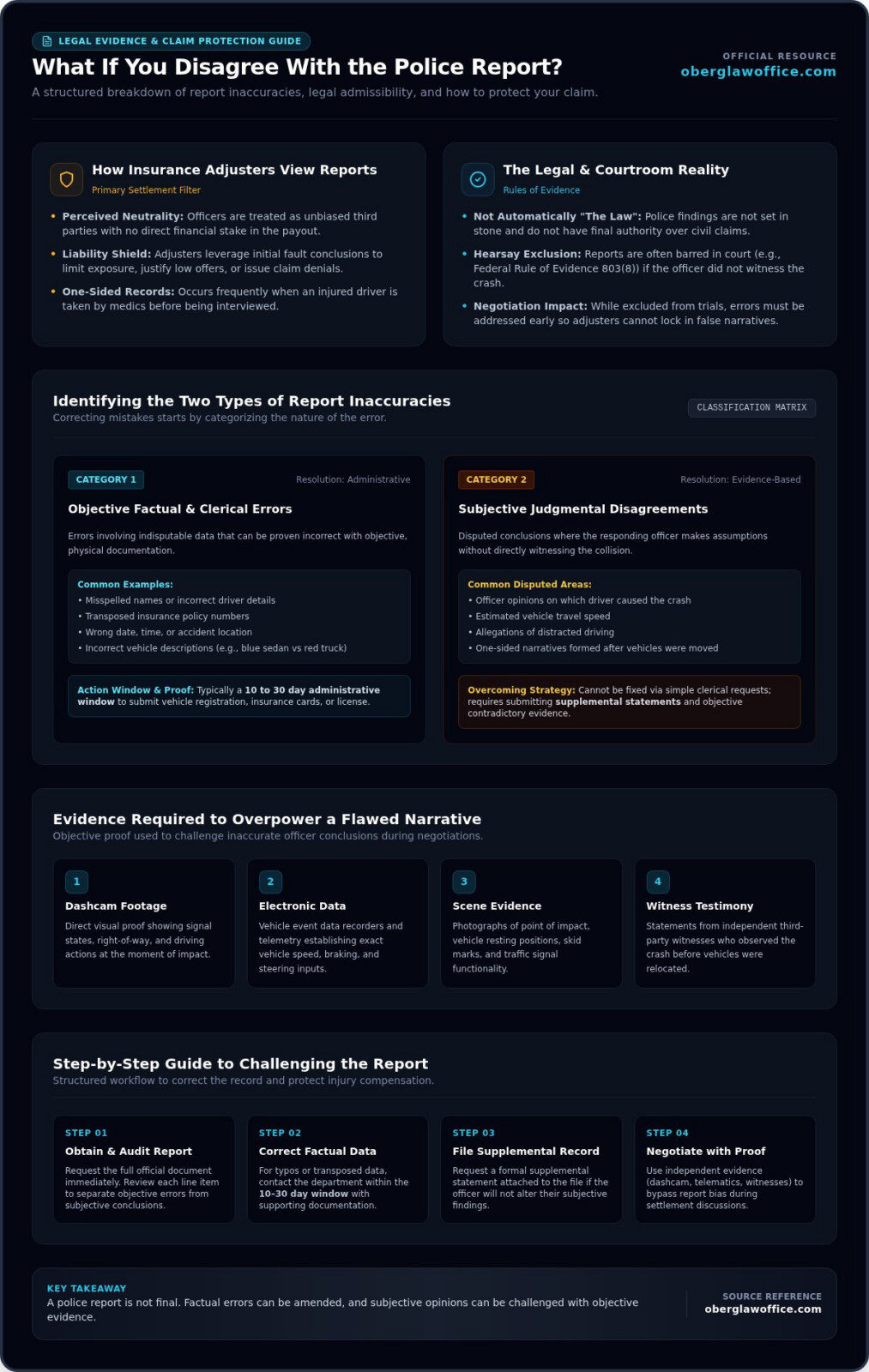
Insurance adjusters prefer police reports because officers are viewed as neutral third parties. Unlike the drivers involved, the responding officer has no financial stake in whether you receive a settlement. They are trained to document specific details like skid marks, point of impact, and traffic signal functionality. Adjusters use the police report as a convenient shield to set initial fault percentages and limit their company’s financial exposure. Because this document is “official,” an adjuster will rarely look past it unless they’re presented with undeniable evidence that contradicts the narrative.
The Legal Admissibility Myth
There is a common misconception that whatever the officer writes is automatically “the law.” In reality, police reports are frequently excluded from evidence in a courtroom because they are considered hearsay. Under rules like Federal Rule of Evidence 803(8), an officer’s subjective opinion on who caused a crash is often barred because the officer didn’t actually see the accident happen. They are simply repeating what others told them.
While your attorney can often keep a flawed report out of a trial, the document still exerts massive influence during settlement negotiations. Correcting the record early is vital because it prevents the insurance company from “locking in” a false narrative that could prejudice your claim for months. You need to address these errors before they become the permanent foundation of your case.
Identifying Factual Errors vs. Judgmental Disagreements
Not all mistakes on a crash report carry the same weight. When you’re sitting at your kitchen table asking, what if I disagree with the police report, you need to look closely at the type of error you’ve found. Errors generally fall into two categories: objective factual mistakes and subjective judgmental disagreements. Distinguishing between the two is the first step in building a strategy to protect your claim. Factual errors are often simple to resolve through administrative channels, while judgmental errors require a more nuanced, evidence-based approach to overcome.
Insurance companies love to see a “favorable” police report because it gives them a reason to pay out less. If the report contains errors that make you look responsible, you’re fighting an uphill battle from day one. Understanding the difference between a typo and a bad opinion allows you to focus your energy where it matters most.
Correcting Factual and Clerical Mistakes
Objective factual errors involve data that can be proven wrong with a simple piece of paper. This includes misspelled names, the wrong date or time, incorrect vehicle descriptions, or transposed insurance policy numbers. If the officer wrote that you were driving a blue sedan when you were in a red truck, that is a clerical error. Most police departments allow you to correct these items by providing documentation like your vehicle registration, insurance card, or driver’s license. Factual corrections rarely require a legal battle because the evidence is indisputable. You should typically act within the 10 to 30 day administrative window following the report’s filing to ensure these changes are made while the officer’s field notes are still accessible.
Challenging Disputed Liability Judgments
Subjective errors are much more difficult to handle. These occur when the officer records their opinion on who caused the crash, how fast you were traveling, or whether you were distracted. Officers are human; they often arrive after the cars have been moved and have to piece together a story from limited evidence. If they missed a key witness or misinterpreted skid marks, their “judgment” might be completely wrong. Convincing an officer to change their professional opinion is a challenge because it feels like an attack on their expertise.
Instead of arguing with the officer, you should focus on building a separate, stronger body of evidence. Using a personal injury recovery guide can help you understand how to gather the facts needed to contradict a flawed report. If you feel overwhelmed by the process, you can schedule a strategy session with Oberg Law Office to have a professional review the document and help you decide on the best path forward.
A Step-by-Step Guide to Challenging the Report
When you realize the official record of your accident is wrong, it’s easy to feel powerless. However, you have a right to ensure the file accurately reflects the truth. If you find yourself wondering, what if I disagree with the police report, following a structured process can help you turn a frustrating situation into an empowered defense of your claim. Most law enforcement agencies have administrative windows, often between 10 and 30 days, where it is easiest to submit changes or additional information.
- Step 1: Obtain a certified copy. You can usually download your report through portals like LexisNexis BuyCrash or CARFAX Crashdocs for a small fee, or request a physical copy directly from the precinct’s records division.
- Step 2: Audit the details. Read every line. Highlight factual errors like a wrong VIN or date in one color, and highlight disputed opinions about fault or speed in another.
- Step 3: Gather your proof. Collect dashcam footage, photos of the final resting positions of the vehicles, or contact information for witnesses the officer didn’t interview.
- Step 4: Schedule a conversation. Contact the reporting officer via the non-emergency line to discuss the discrepancies.
- Step 5: Submit a supplement. If the officer won’t change the main report, ask for the formal procedure to add your own statement to the file.
Communicating with the Reporting Officer
Approaching the officer with the right mindset is critical. They are often balancing dozens of cases and may have spent less than 20 minutes at your accident scene. Instead of accusing them of making a mistake, present your evidence as “new information” that wasn’t available at the time of the initial investigation. If you have a dashcam video or a witness statement, explain that you want to help them make the report as complete as possible. If the officer is dismissive or is no longer with the department, don’t argue. Simply move to the next administrative step of filing a formal addendum through their supervisor or the records department.
Drafting an Effective Supplemental Statement
A supplemental statement is a formal addendum that is permanently attached to the original crash report. While officers rarely delete their own narrative conclusions, they are typically required to include your written account if you follow the proper channels. Your statement should be concise, factual, and free of emotional language. Focus on the mechanics of the crash, such as your speed, lane position, and the actions of the other driver. Because this document can be used by insurance adjusters to either help or hurt your case, you should have a car accident lawyer review your draft before you submit it. A professional eye ensures you don’t accidentally include details that could be misinterpreted as an admission of fault.
Gathering Evidence to Overpower a Flawed Narrative
When an officer’s opinion contradicts your memory, you need objective data that doesn’t have a bias. If you’re asking yourself, what if I disagree with the police report, the answer lies in the evidence you collect outside of the officer’s initial investigation. While the report is a powerful document, it is essentially a reconstruction of events by someone who wasn’t there. You can overcome a flawed narrative by presenting hard facts that make the officer’s version of the accident logically or scientifically impossible.
Building a case that challenges an official record requires a proactive approach. You must look for the details the responding officer may have missed during a busy shift. This includes everything from electronic data hidden inside your vehicle to the testimony of bystanders who were never interviewed at the scene. By compiling a comprehensive file of independent evidence, you provide the insurance adjuster with a reason to look past the police report and toward the actual truth of the collision.
The Power of Independent Video Footage
Dashcams have become the gold standard for overturning incorrect police reports. A video recording provides an undisputed, second-by-second account of traffic signal colors, lane positions, and the sudden movements of other drivers. If you don’t have a dashcam, you must act quickly to secure surveillance footage from nearby businesses or residential doorbells. You should aim to preserve this evidence within 48 to 72 hours of the crash. Many commercial and municipal camera systems operate on a loop and may overwrite critical files within 7 to 14 days, making immediate action a necessity for your claim.
Utilizing Expert Accident Reconstruction
In high-stakes cases involving catastrophic injuries, professional accident reconstructionists can provide the technical baseline needed to refute a narrative. These experts use physics and engineering to analyze skid marks, debris patterns, and vehicle crush zones. They also pull data from the Event Data Recorder (EDR). Under federal standards in 49 CFR Part 563, most light-duty vehicles record five seconds of data immediately preceding an impact, including vehicle speed, brake status, and steering angle. This electronic proof can scientifically prove you were not speeding or that you attempted to avoid the crash, regardless of what the officer wrote. If you need help interpreting a report or uncovering this data, you should request a free strategy session to review your options with a professional.
How an Attorney Negotiates Beyond the Police Report
You have gathered your evidence and identified the errors, but the insurance adjuster is still pointing at the officer’s narrative to deny your claim. This is a common roadblock. If you’re still wondering what if I disagree with the police report, remember that an attorney’s job is to look past that single document. While insurance companies use the report as a shield, a skilled legal advocate uses it as a starting point for a much larger investigation. They don’t just accept the officer’s conclusions; they build a case that makes those conclusions irrelevant.
An attorney’s primary tool in this process is the formal demand letter. This document presents a comprehensive argument for your compensation, utilizing the independent evidence you’ve collected, such as dashcam footage and witness statements. By presenting a narrative that is backed by hard facts, your legal team forces the adjuster to evaluate the actual mechanics of the crash rather than relying on a rushed officer’s summary. Since roughly 90% to 95% of personal injury claims resolve through settlement negotiations before ever reaching a courtroom, these early negotiations are where the real battle for fairness is won.
Dismantling the Insurance Company’s Defense
Insurance adjusters often rely on the police report to lock in low fault percentages and protect their company’s bottom line. If an adjuster refuses to look at your evidence and hides behind a clearly incorrect report, they may be skirting the line of bad faith. Your attorney can push back by using depositions to question the reporting officer under oath. These interviews often reveal that the officer spent very little time at the scene or failed to speak with key witnesses. Showing that the initial investigation was incomplete effectively dismantles the foundation of the insurance company’s defense. During a free strategy session, a senior legal professional can review the disputed report and identify these specific paths to victory, ensuring you aren’t silenced by a single piece of paper.
Your Path to Fair Recovery
It’s important to remember that a bad police report is just one piece of evidence, not the final verdict on your future. You have the right to a recovery that reflects the truth of what happened. The first step is gathering your documents and seeking a professional review to see how the law applies to your specific situation. Because most personal injury firms operate on a contingency fee basis, you can challenge a flawed report with zero upfront costs. You only pay if your legal team successfully recovers compensation for you. Don’t let a wrong report stop your recovery. Schedule your free strategy session with Oberg Law Office today.
Take Control of Your Accident Recovery
Finding mistakes in an official document is stressful, but a flawed narrative doesn’t have to be the end of your claim. You now know that while insurance adjusters lean on these reports, they aren’t the final word on your case. When you ask, what if I disagree with the police report, the answer is to act decisively. By distinguishing between clerical typos and disputed opinions, you can follow the right administrative path to supplement the record with dashcam footage, witness statements, and electronic vehicle data.
You shouldn’t have to face large insurance institutions alone. Attorney Gregg Oberg brings over 25 years of legal experience to your side, offering the direct communication and specialized guidance you need to set the record straight. We operate on a contingency-based structure, meaning there is no fee unless we win your case. This allows you to fight for fairness without any financial risk. Don’t let a single officer’s opinion dictate your future. Schedule your free accident strategy session with Oberg Law Office today and start building a case rooted in the truth. We are here to protect your rights and help you move forward with confidence.
Frequently Asked Questions
Can a police report be changed after it is filed?
Yes, a police report can be amended, but the process depends on the type of mistake. Factual errors like a misspelled name or wrong VIN are usually corrected by providing proof to the records division. However, officers rarely delete their own narrative opinions once filed. Instead, they typically add a supplemental page to the original file. This allows your side of the story to become a permanent part of the official accident record.
What if the police officer refuses to talk to me about the report?
If the reporting officer refuses to speak with you, you should contact their supervisor or the department’s records division directly. Officers are often busy with active investigations and might not return every phone call. You have a right to request the formal procedure for filing a supplemental statement. This administrative path ensures your version of the crash is documented even if the individual officer is unavailable or unwilling to discuss the discrepancies.
Is a police report the final word on who is at fault?
No, the police report is not the final word on liability, even though insurance adjusters treat it with high priority. Officers are not eyewitnesses; they arrive after the fact and make a reconstruction based on limited information. If you’re wondering, what if I disagree with the police report, remember that the officer’s opinion on fault is often inadmissible in court. You can overcome a bad report with stronger evidence like dashcam footage, black box data, or witness testimony.
Can I add my own statement to an existing police report?
You can absolutely add your own statement to an existing police report by filing a formal supplement or addendum. Most law enforcement agencies allow drivers to submit a written account of the accident to be appended to the file. This is a critical step if you were unable to give a statement at the scene due to injuries. Having a professional review your draft ensures your statement is factual and doesn’t accidentally harm your claim.
What if the police report has the wrong date, time, or location?
Factual errors regarding the date, time, or location of a crash are the easiest mistakes to fix. You should contact the records department of the investigating agency and provide documentation that proves the error, such as a timestamped photo or a medical record. Because these are objective data points rather than subjective opinions, officers are generally willing to make these corrections quickly to ensure the accuracy of their department’s database.
Will a bad police report automatically cause my insurance claim to be denied?
A negative police report does not guarantee a claim denial, but it does give insurance companies a reason to offer a lowball settlement. Adjusters use the report to set initial fault percentages, which can impact your compensation. When asking what if I disagree with the police report, the goal is to provide the adjuster with independent evidence that makes the report’s conclusions look unreliable. This forces them to re-evaluate the claim based on all available facts.
Do I need a lawyer if the police report says I am at fault?
If a report incorrectly places you at fault, seeking legal guidance is the best way to protect your rights. An attorney with experience in complex accident cases can hire experts to prove the officer’s conclusions were scientifically impossible. At Oberg Law Office, we use over 25 years of experience to challenge these narratives. We work on a contingency basis, so you can fight a flawed report without any upfront costs or financial risk to your family.