Did you know that roughly 45% of disputed car insurance claims hinge entirely on disagreements about who was at fault? You’ve likely spent days replaying the accident in your head, knowing you aren’t to blame, only to have an insurance adjuster tell you otherwise. It’s a frustrating, lonely feeling when a large institution ignores the facts and threatens your financial security. We understand the anxiety of facing rising premiums and the fear of losing out on the settlement you need for your medical bills.
You don’t have to accept an unfair verdict as the final word. This guide shows you exactly how to dispute a car accident fault determination to protect your right to compensation and restore your peace of mind. We’ll walk through the specific steps to dismantle an adjuster’s decision, from leveraging 2026 dashcam telematics to navigating the 51% bar rule. You’ll learn how to challenge automated insurance algorithms and use a professional strategy to ensure your voice is finally heard. It’s time to move from a state of uncertainty to a position of strength.
Key Takeaways
- Learn how to leverage “silent witness” evidence, such as dashcam footage and high-resolution scene photos, to challenge an adjuster’s biased version of events.
- Follow the exact steps for how to dispute a car accident fault determination by identifying factual errors in your Liability Letter and submitting a professional rebuttal.
- Understand how insurance companies use rigid algorithms to assign blame, and learn why these decisions are often negotiable opening arguments.
- Discover how professional legal advocacy can protect your right to compensation for medical bills and lost wages when an insurer tries to shift blame onto you.
- Gain the confidence to face large institutions by utilizing the same investigative resources and legal pressure that force carriers to reconsider their findings.
Understanding Car Accident Fault and Why It Matters
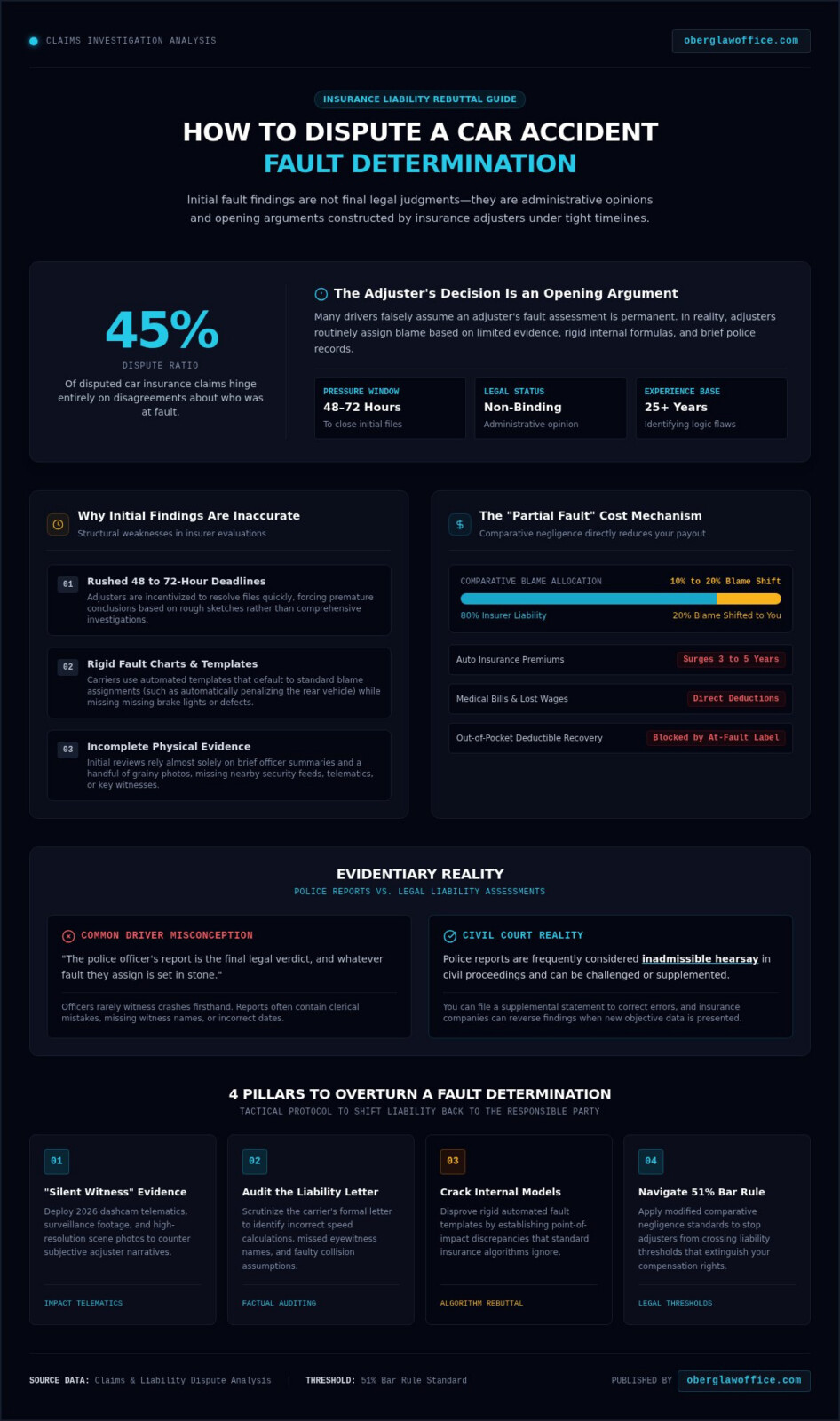
When you’re standing on the side of the road after a crash, the last thing on your mind is an insurance adjuster’s spreadsheet. Yet, within days, that adjuster will issue a fault determination. This is simply the insurance company’s internal assessment of who is liable for the accident. It’s a crucial moment because this decision dictates who pays for what. Many people mistakenly believe this is a permanent legal judgment. It isn’t. It is an administrative opinion that acts as the insurer’s opening argument. Learning how to dispute a car accident fault determination starts with understanding that this opinion is often based on a fraction of the total evidence.
Insurance companies frequently use comparative negligence rules to assign a percentage of blame to everyone involved. This is the “partial fault” trap. If an adjuster can shift even 10% or 20% of the blame onto you, their company saves thousands of dollars. They might claim you were speeding slightly or failed to “keep a proper lookout,” even if the other driver clearly caused the collision. These percentages aren’t just numbers; they’re direct deductions from the compensation you deserve for your recovery.
The Financial Impact of a Fault Finding
An unfair fault finding hits your wallet immediately and lingers for years. If you’re found at fault, your insurance premiums will likely spike, often remaining high for three to five years. More importantly, being labeled “at fault” can block your access to a personal injury settlement, leaving you to pay for medical bills and lost wages out of your own pocket. Deductible recovery is the process of getting your out-of-pocket repair costs back from the at-fault driver’s insurance company after a successful dispute. Without overturning a wrong decision, that money stays in the insurance company’s bank account instead of yours.
Why Initial Fault Decisions Are Frequently Inaccurate
Adjusters are under immense pressure to close files quickly. They often make decisions within 48 to 72 hours, relying heavily on a brief police report and a few grainy photos. This haste leads to “easy” conclusions. For example, they might automatically blame the rear driver in a fender bender, ignoring the fact that the front car had no functional brake lights. They often miss crucial witness statements or nearby security footage that tells the real story. Their initial narrative is a rough sketch, not a finished portrait, and it’s your right to correct the lines they drew in error.
How Insurance Adjusters Determine Fault Behind the Scenes
Behind every insurance company’s decision is a claims adjuster working as a dedicated investigator for their employer. Their primary job is to evaluate the evidence and apply state-specific traffic laws to determine liability. However, it’s vital to remember they work for the insurance company, not for you. They often rely on internal “fault charts” that auto-assign blame based on the type of collision. These templates are rigid and frequently fail to account for the unique, split-second realities of your specific crash. Understanding their methods is the first step in learning how to dispute a car accident fault determination effectively.
Adjusters also examine vehicle damage patterns to reconstruct the impact. They look for “point of impact” data to estimate speed and vehicle positioning. If the damage doesn’t perfectly match their pre-set models, they may default to a conclusion that favors their employer. If you find yourself hitting a wall with an adjuster, seeking a free strategy session with an experienced professional can help you identify exactly where their logic fails. We’ve spent over 25 years seeing how these internal assessments are built, and we know how to spot the cracks in their arguments.
Police Reports vs. Insurance Liability Assessments
Many drivers believe the responding officer’s report is the final verdict. This is a common myth. In reality, police reports are often inadmissible as hearsay in civil court because the officer didn’t actually witness the crash. While adjusters use them as a guide, they are not legally binding. If an officer wrote down the wrong date, misspelled a witness’s name, or missed a key detail, you can submit a supplemental statement to correct the official record. An insurance company can, and often does, disagree with a police officer’s assessment if new evidence like dashcam footage comes to light.
Negligence Standards: Comparative vs. Contributory
Adjusters are experts at using state negligence laws to minimize payouts. Depending on your state’s rules, even being found “10% at fault” can slash your compensation by thousands of dollars. In certain jurisdictions, being just 1% at fault can bar you from recovering anything at all. Adjusters use these rules as a negotiation tool to pressure you into accepting a lower settlement. Knowing how to dispute a car accident fault determination is essential when an adjuster tries to shift a small percentage of blame onto you just to save the company money. If you’re struggling with an unfair decision, disputing an unfavorable insurance claim through formal channels is often the only way to protect your financial future.
Critical Evidence to Overturn a Fault Determination
Evidence is the only tool powerful enough to break an adjuster’s preconceived narrative. If you’re wondering how to dispute a car accident fault determination, you must move beyond “he said, she said” and present objective facts. High-resolution photography of the scene, captured from multiple angles, provides a baseline for the investigation. However, in 2026, digital footprints often speak louder than photos alone. You need to gather every piece of data that contradicts the insurer’s initial theory.
Digital Evidence in the Modern Era
GPS data from your vehicle or smartphone can prove your exact speed and the moment you applied the brakes. You shouldn’t wait for the insurer to look for this; you need to secure it immediately. Nearby business surveillance footage is equally vital, but it often auto-deletes every 14 to 30 days. Sending a formal spoliation letter within 7 days of the crash ensures this footage is preserved before it’s gone forever. In 2026, smartphone telematics and app-based GPS logs provide a millisecond-by-millisecond account of vehicle behavior that serves as undeniable proof in liability disputes.
Dashcam footage has become the “silent witness” that insurance companies simply cannot ignore. While an adjuster might doubt your memory, they can’t argue with a time-stamped video showing a light turning green or a driver swerving into your lane. Modern vehicles also contain Electronic Data Recorders (EDRs). Following the NHTSA final rule published in May 2026, many newer vehicles now record up to 20 seconds of pre-crash data, including throttle position and seat belt status. Accessing this through specialized tools like the Bosch CDR900 system can provide the technical evidence needed to flip a case in your favor.
Physical Evidence and Expert Reconstruction
Physical marks on the pavement tell a story that adjusters often misinterpret. Skid marks and debris patterns help investigators calculate speed and the exact point of impact. By analyzing vehicle “crush zones,” we can determine the angle of the collision to prove you weren’t the one who initiated the contact. When the facts are complex, we bring in professional accident reconstructionists to build a 3D model of the crash. Following state guidelines on auto insurance claims ensures your evidence is presented in a way that regulators and courts respect.
Finally, don’t overlook third-party witnesses. These are people who aren’t involved in the crash and have no financial stake in the outcome. Their statements carry significant weight because they are viewed as unbiased. We focus on gathering these statements early, while memories are fresh, to ensure your side of the story is backed by independent voices. This combined approach of digital, physical, and testimonial evidence is how we dismantle an unfair fault finding.
Steps to Formally Dispute an Insurance Fault Finding
Once you receive the “Liability Letter” from an insurance company, the clock starts ticking. This document outlines exactly why the adjuster believes you’re responsible for the crash. You shouldn’t take their word as gospel. Instead, treat it as a roadmap for your rebuttal. Carefully review every sentence for factual errors, such as incorrect street names, misunderstood traffic light sequences, or ignored weather conditions. Knowing how to dispute a car accident fault determination involves systematically dismantling each of these points with the evidence you’ve already secured.
Your next move is to compile a structured rebuttal package. This isn’t just a letter; it’s a professional presentation of your case. You’ll want to gather your photos, dashcam clips, and witness statements into a single, organized file. If the adjuster’s decision contradicts specific traffic codes, cite those codes directly. This shows the insurer that you’re informed and prepared to stand your ground against their initial findings.
Drafting Your Rebuttal Letter
Your letter should be rooted in facts, not feelings. While it’s natural to feel angry about an unfair decision, an emotional tone often leads adjusters to dismiss your claims. Clearly list every point of the finding you disagree with and reference specific exhibits for each claim. For example, if the adjuster claims you were speeding, point to your GPS telematics data as “Exhibit A.” This level of detail makes it much harder for the company to maintain its original position without appearing negligent.
The Internal Appeals Process
If the initial adjuster refuses to budge, you have the right to request a “second look” from a supervisor or a different department. Most companies have an internal hierarchy designed to catch errors before they escalate into formal litigation. Under NAIC standards, carriers typically face deadlines to complete investigations or provide a formal disposition within 15 to 40 days. If the investigation remains open, they’re often required to send you a written delay notice every 30 days to keep you informed of the status.
When an insurance company remains stubborn despite overwhelming evidence, you may need to contact your state’s insurance ombudsman for regulatory oversight. However, for most people, the most effective way to force a fair review is through professional advocacy. If you’re tired of feeling unheard, you can schedule a free strategy session to see how we can take the heavy lifting of the dispute process off your shoulders. We know how to navigate these corporate hierarchies to get the results you deserve.
How a Personal Injury Lawyer Helps You Win the Dispute
Trying to handle a multi-billion dollar insurance company alone is exhausting. You’re already dealing with physical pain and car repairs; you shouldn’t have to become a legal expert overnight. A specialized attorney acts as your knowledgeable guide, taking the weight of the dispute off your shoulders. When you’re learning how to dispute a car accident fault determination, professional representation changes the dynamic from a one-sided conversation to a fair fight. We’ve spent over 25 years helping victims stand up to institutions that try to minimize their suffering.
Attorneys provide access to professional investigators and accident reconstructionists that individuals often cannot afford on their own. These experts can pull data from heavy truck EDRs or map out complex intersection collisions with precision. Perhaps more importantly, your lawyer handles all communication with the insurance company. Adjusters are trained to listen for “admissions of guilt” or statements they can twist to increase your percentage of fault. By letting a professional speak for you, you avoid the trap of accidental self-incrimination while you focus on healing.
Legal Leverage and Negotiation
Insurance companies are businesses focused on their bottom line. They often ignore a lone individual, but they pay attention when a firm with extensive experience enters the room. We use “demand packages” to present a winning case, combining every piece of digital and physical evidence into a compelling narrative. If the insurer remains stubborn, the threat of litigation often forces a fairer assessment. According to the Insurance Research Council, represented claimants recover an average of $77,600 compared to just $17,600 for those without an attorney. This 340% difference exists because lawyers can use tools like depositions to uncover the truth from the other driver under oath. For more on this process, check out Gregg Oberg’s guide to hiring a car accident lawyer.
The Peace of Mind in Professional Advocacy
Your primary job after a crash is to focus on your physical recovery. While you attend doctor’s appointments and physical therapy, your legal team handles the heavy lifting of the dispute. We ensure that every legal deadline and statute of limitations is met, so you don’t lose your right to compensation on a technicality. Best of all, this support is accessible to everyone through a performance-based fee structure. There are no upfront costs; we only get paid if we win your case. This shared risk ensures we’re just as invested in your success as you are. If you’re ready to flip the script on an unfair insurance decision, schedule a free strategy session with Oberg Law Office today.
Take Control of Your Recovery and Your Future
An insurance adjuster’s initial decision doesn’t have to be the final word on your accident. By understanding that fault is often based on incomplete data, you can use modern tools like dashcam footage and smartphone telematics to set the record straight. Learning how to dispute a car accident fault determination is a vital step in protecting your financial security and ensuring your medical bills are covered. You’ve already faced the trauma of a crash; you don’t have to face a massive insurance company without a steadfast protector by your side.
At Oberg Law Office, we bring over 25 years of experience to every case we handle. You’ll work directly with Attorney Gregg Oberg, receiving the personal attention and professional advocacy you deserve. We operate on a contingency-based structure, which means there are no fees unless we win your case. Don’t let an unfair verdict stand in the way of your restoration. Get a Free Strategy Session with Oberg Law Office today and start moving from uncertainty to empowerment. You have the right to be heard, and we’re here to make sure that happens.
Frequently Asked Questions
Can I still get a settlement if I was partially at fault?
Yes, you can still recover compensation in most states even if you share some blame. Most jurisdictions follow comparative negligence rules, which allow you to collect damages as long as your fault doesn’t exceed a certain threshold, usually 50% or 51%. Your final settlement will be reduced by your percentage of fault. It’s vital to challenge any unfair blame assigned to you, as even a small change can significantly increase your final recovery amount.
How long do I have to dispute a fault determination?
You should act as quickly as possible to protect your rights. While the legal statute of limitations for a lawsuit might be two years, insurance companies have much shorter internal windows for appeals. Most carriers require you to initiate a dispute within 30 to 60 days of receiving their liability letter. Learning how to dispute a car accident fault determination early ensures you can secure time-sensitive evidence, like business surveillance footage, before it’s deleted.
What if the police report says I am at fault but I disagree?
A police report isn’t the final word on legal liability. Responding officers often arrive after the crash and rely on secondary accounts, which makes their conclusions inadmissible hearsay in many civil courts. You can challenge an officer’s opinion by providing objective evidence they didn’t have, such as dashcam video or smartphone telematics. We focus on correcting the record with hard data that proves what actually happened on the road during the collision.
Does a fault determination automatically mean my insurance rates will go up?
Generally, an at-fault determination leads to a premium increase that can last for three to five years. However, successfully overturning that decision can protect your rates and your “good driver” standing. Since roughly 45% of disputed claims involve disagreements over liability, it’s worth the effort to fight an inaccurate finding. Preventing an at-fault label on your record is one of the best ways to maintain long-term financial security after a difficult accident.
Will I have to go to court to dispute an insurance decision?
It’s unlikely you’ll need to step into a courtroom. Over 95% of car accident cases resolve through pre-trial settlements and administrative negotiations. Disputing a fault finding is typically a process of exchanging evidence and rebuttal letters with insurance adjusters or supervisors. While we prepare every case as if it might go to trial, our goal is to force a fair assessment through strong evidence and professional negotiation long before a judge is involved.
What should I do if the other driver’s insurance company calls me?
You aren’t required to speak with the other driver’s insurance company, and it’s usually best if you don’t. Adjusters are trained to ask leading questions designed to get you to admit partial blame. Anything you say can be used to justify a lower settlement or a denial of your claim. Simply tell them that you’re seeking legal representation and that your attorney will handle all future communications to ensure your rights stay protected during the process.
Can a lawyer help me if the insurance company already denied my claim?
A claim denial is often just an insurance company’s opening negotiation tactic. An experienced lawyer can help you reopen the case by presenting new evidence or identifying legal errors in the adjuster’s reasoning. With over 25 years of experience fighting these institutions, Attorney Gregg Oberg knows how to use demand packages and the threat of litigation to turn a denial into a fair settlement. We don’t accept their first answer if the facts are on your side.
What is the most important piece of evidence in a fault dispute?
In 2026, digital evidence like dashcam footage and Electronic Data Recorder (EDR) data is the most powerful tool you have. These “silent witnesses” provide an objective account of speed, braking, and impact angles that subjective witness statements can’t match. When you’re figuring out how to dispute a car accident fault determination, this technical data is often the key to dismantling an adjuster’s biased theory and securing the compensation you deserve for your medical bills.