
Last Tuesday, a Mesquite resident sat at their kitchen table staring at a $14,250 hospital bill that arrived just weeks after a distracted driver changed their life. It’s overwhelming to manage physical therapy while your inbox fills with aggressive emails from insurance adjusters. You likely feel that the system is designed to keep you in the dark, and you’re right to be wary of companies that prioritize their profits over your recovery. Learning how to file a personal injury claim is the first step toward reclaiming your peace of mind and holding negligent parties accountable.
Beyond the immediate personal injury case, many victims also find they need assistance with related legal matters.
At Oberg Law Office, we believe you deserve a clear path forward. This 2026 guide teaches you the step-by-step process of securing fair compensation while protecting your family’s future from predatory settlement offers. You’ll learn how to accurately value your physical and emotional suffering so you don’t leave money on the table. We’ve outlined a strategic checklist of actions to take and a breakdown of the negotiation process to ensure you walk into every conversation with total confidence. By the time you finish reading, you’ll have the expert roadmap needed to turn your uncertainty into a focused plan for justice.
Key Takeaways
- Learn how to build a solid foundation for your recovery by documenting your injuries immediately and understanding the difference between an insurance claim and a legal lawsuit.
- Discover exactly how to file a personal injury claim by following five critical steps, from gathering scene evidence to securing the official reports needed for your case.
- Gain clarity on what your case is truly worth by learning how to calculate economic losses, future earning capacity, and the non-economic impact on your life.
- Protect your rights during insurance negotiations by learning how to handle adjusters and why avoiding recorded statements is vital to securing your settlement.
- Find out how professional legal advocacy levels the playing field against corporate teams, ensuring you have a dedicated protector without any upfront costs.
Understanding the Personal Injury Claim Framework
You’ve likely spent the last few days dealing with doctors, car repairs, and the stress of missing work. It feels overwhelming, but you don’t have to carry this weight alone. A personal injury claim is a legal tool designed to help you recover what you lost. At its heart, this claim is a formal demand for financial compensation from a person or company whose negligence caused your suffering. Understanding how to file a personal injury claim begins with recognizing that you are seeking justice for a wrong that shouldn’t have happened.
There’s a big difference between an insurance claim and a lawsuit. Most cases start as an insurance claim, which is an administrative process where we negotiate with an adjuster to reach a fair settlement. If the insurance company refuses to be reasonable, the process shifts into litigation. This is where we file a formal lawsuit in a Texas court. Throughout this journey, you hold the burden of proof. This means you must provide clear evidence, such as police reports from the Mesquite Police Department or medical records from 2025, to show the other party was responsible. The timeline for these cases varies; a straightforward settlement might conclude in 6 to 9 months, while complex litigation can last 2 years or longer.
The Legal Basis: Negligence and Liability
Every driver on our roads and every shop owner in our neighborhood has a duty of care to keep others safe. When someone ignores this duty, they become liable for the damages they cause. Negligence is the failure to exercise reasonable care. Whether it’s a distracted driver on Highway 80 or a spill left on a grocery store floor, that lapse in judgment has consequences.
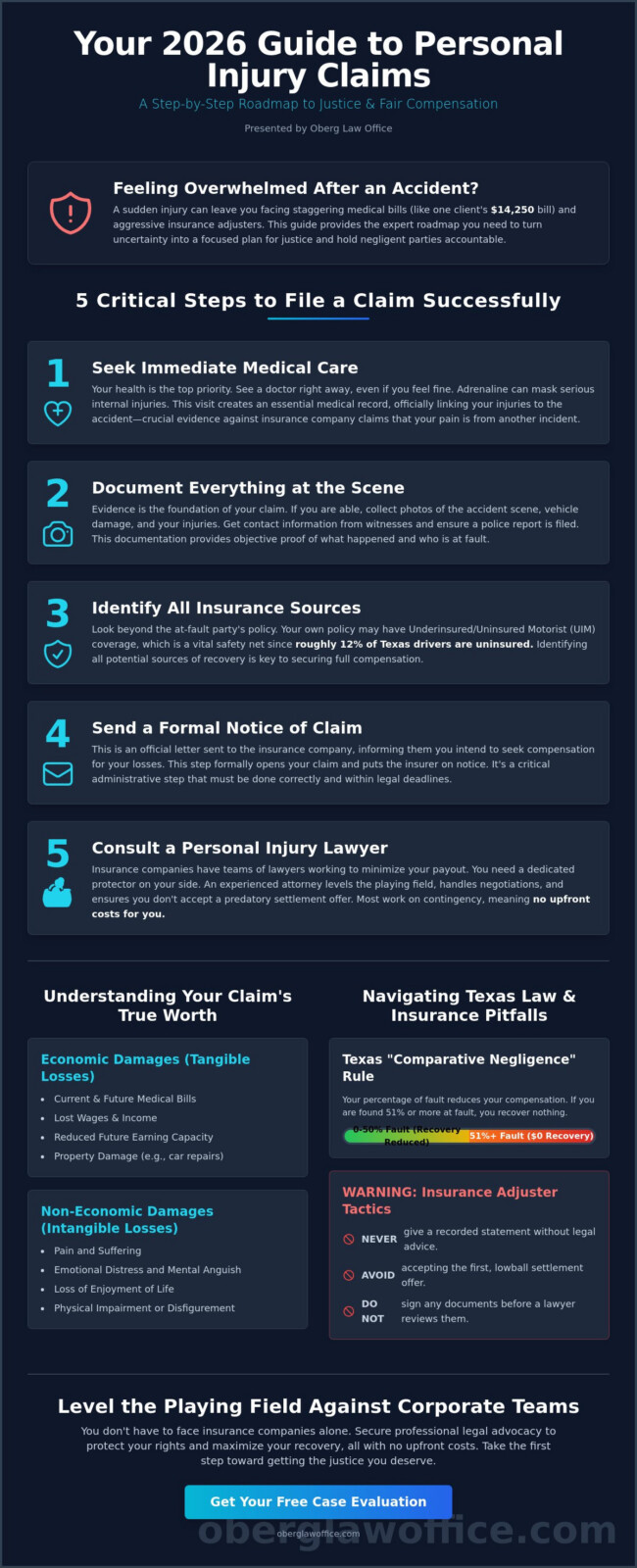
Texas law uses a system called “comparative negligence” to determine payouts. If a jury finds you were 15% at fault for an accident, your total compensation is reduced by that same 15%. However, if your responsibility is found to be 51% or higher, the law prevents you from recovering any compensation at all. We work hard to protect you from unfair blame so you get the full support you deserve.
The Goal of a Claim: Making the Victim Whole
The legal system uses “damages” as a way to balance the scales of justice. Since we can’t undo the accident, we use financial recovery to address your losses. This isn’t just about a single paycheck; it’s about your total well-being. Physical injuries lead to medical debt, which causes emotional stress, which then impacts your ability to provide for your family. These issues are deeply interconnected.
Recovering from a serious accident requires a plan that covers your health and your finances simultaneously. Reaching out to a Mesquite personal injury lawyer is the first step toward building that foundation. We focus on the legal hurdles so you can focus on your physical therapy and your family. Our goal is to ensure that by the end of your case, you have the resources necessary to move forward with your life with dignity and security.
5 Critical Steps to File a Personal Injury Claim Successfully
You’ve just been through a traumatic event, and your world feels upside down. Knowing how to file a personal injury claim correctly is the first step toward reclaiming your peace of mind and securing your family’s future. At the Oberg Law Office, we’ve seen how insurance companies try to take advantage of your vulnerability during this time. You need a clear roadmap to protect your rights from the very start.
First, get to a doctor immediately. Even if you feel okay, internal injuries often hide behind the initial rush of adrenaline. This visit creates the essential paper trail that links your accident to your injuries. Without this, an adjuster will likely claim your pain came from a different incident. Next, identify every possible insurance source. This includes the at-fault driver’s coverage, your own underinsured motorist protection, and even umbrella policies. In Texas, roughly 12% of drivers operate without insurance, so checking your own policy is a vital safety net.
Once you’ve identified the parties, you must send a formal notice of claim. This letter tells the insurance company you intend to seek compensation for your losses. For a better understanding of the formal requirements and deadlines involved in these initial filings, you can consult the California Courts Self Help Guide, which provides a clear framework for the legal process. Finally, start a claim diary. Write down your daily pain levels and any “lost opportunities,” such as missing a child’s soccer game or a family wedding, to document the true human cost of your injury.
Evidence Preservation at the Scene and Beyond
Photos are your strongest allies because they don’t forget details. Take pictures of skid marks, property damage, and the weather conditions at the time of the crash. These images provide indisputable proof that stays clear even as memories fade. Always call the police to the scene. A formal police report serves as a neutral, third-party account that carries significant weight during negotiations. Before you leave, collect contact information for any witnesses. Their statements can confirm your version of events when the negligent party tries to change their story later.
The Importance of Continuous Medical Documentation
Your recovery is a marathon, and consistency is key to your case. Insurance adjusters look for “gaps in treatment” to devalue your claim. If you skip physical therapy for 14 days, they’ll argue your injuries aren’t serious. Follow every rehabilitation plan your doctor prescribes to demonstrate the severity of your condition. Medical records are the primary evidence for physical damages in any legal proceeding. If the paperwork starts to feel like too much to handle while you’re trying to heal, speaking with a compassionate Mesquite attorney can help you stay organized and focused on your recovery.
Assessing Liability and Calculating Claim Value
You’re likely feeling overwhelmed by the weight of medical bills and the stress of a changing future. It’s a heavy burden to carry alone. Understanding the true value of your case is a vital step in learning how to file a personal injury claim that actually covers your needs. We focus on three specific pillars: economic damages, non-economic damages, and in rare cases of extreme negligence, punitive damages. While punitive awards are meant to punish the wrongdoer, the first two categories are designed to make you whole again.
Calculating value isn’t just about adding up today’s receipts. It’s about protecting your tomorrow. We look at the full picture of your life in Mesquite, ensuring that every missed bonus and every future physical therapy session is accounted for. Insurance adjusters often try to rush you into a low settlement before you know the full extent of your needs. We don’t let that happen.
Calculating Economic Damages (Special Damages)
Economic damages are the tangible, out-of-pocket costs resulting from your accident. We start by tallying every single medical bill. This includes the initial $1,200 ambulance ride, emergency room fees, and every pharmacy receipt. We also document transportation costs to and from doctors in the Dallas-Fort Worth area. If you’ve suffered catastrophic injuries, we must account for long-term costs like home modifications. Installing a wheelchair ramp or widening doorways can cost between $2,000 and $15,000. We work with vocational experts to project lost earning capacity, ensuring your claim covers the promotions and retirement contributions you would have earned if the accident hadn’t occurred.
Quantifying Pain, Suffering, and Emotional Distress
The physical pain and emotional trauma you endure don’t come with a price tag, but they are often the most significant part of a high-value settlement. When you’re learning how to file a personal injury claim, you’ll encounter two main ways to value these losses. The “Multiplier Method” takes your total economic damages and multiplies them by a number, usually between 1.5 and 5, based on the severity of your injuries. Alternatively, the “Per Diem” approach assigns a specific dollar amount to every day you live with pain.
We use psychological evaluations to prove the reality of PTSD or anxiety after a crash. These documents show how the accident caused a loss of enjoyment of life or a loss of consortium with your spouse. These aren’t just abstract concepts; they are real losses that deserve real compensation. Our goal is to ensure the insurance company sees the person behind the paperwork, not just a claim number.
Navigating Insurance Negotiations and Avoiding Pitfalls
Dealing with insurance adjusters can feel like a betrayal of trust. While their commercials promise protection, their adjusters are trained to protect the company’s bottom line, not your family’s future. They’re professional negotiators. Their goal is to settle your claim for as little as possible, as quickly as possible. Understanding this reality is a vital part of learning how to file a personal injury claim successfully.
The adjuster might ask for a recorded statement shortly after your accident. You should politely decline. These recordings are often used to find inconsistencies in your story or to trick you into admitting fault. If they offer a quick check within days of the crash, it’s almost certainly a low-ball offer. Accepting that first check usually means you waive your right to ask for more money later; even if your injuries turn out to be more severe than you realized. A formal demand letter serves as the real starting point for negotiation. This document outlines your medical costs, lost wages, and the impact the injury has had on your life, showing the insurer that you’re prepared and serious.
Communication Strategies for Claimants
Your words have power. When you speak to the opposing insurance company, follow the “less is more” rule. Stick to the basic facts of the date and location. Never sign a blanket medical release. These forms allow insurers to scour your entire medical history, searching for a pre-existing condition from 10 years ago to blame for your current pain. Your privacy matters. We protect it by ensuring they only see what’s relevant to your current recovery.
Digital footprints also matter. In 2023, insurance defense teams utilized social media activity in roughly 75% of personal injury litigation to undermine claimant testimony. A single photo of you smiling at a birthday party can be twisted to suggest you aren’t actually in pain. It’s best to stay off social media entirely until your case is resolved. This protects your credibility and ensures you don’t inadvertently lower your claim value while you’re still figuring out how to file a personal injury claim correctly.
When the Insurance Company Refuses to Budge
Sometimes, insurance companies use bad faith tactics. This includes ignoring your calls, refusing to explain a denial, or offering a settlement that doesn’t even cover your basic hospital bills. Texas law requires insurers to handle claims fairly. If they refuse to act in good faith, the next step is moving the fight to civil court. This transition is common in high-stakes cases involving corporate entities. For instance, if you’re battling a commercial carrier, a truck accident lawyer Texas residents rely on can help you navigate the aggressive tactics used by big trucking companies.
Don’t let an insurance company dictate the value of your recovery. If you’re struggling to get a fair response, contact the Oberg Law Office today for a free consultation where you’ll speak directly with an attorney who cares.
Securing Professional Advocacy for Maximum Recovery
Understanding how to file a personal injury claim is the first step toward justice, but the path ahead is often blocked by corporate legal teams. Insurance companies employ adjusters and lawyers whose sole job is to minimize your payout. You don’t have to face them alone. Professional advocacy levels the playing field, ensuring you aren’t bullied into a lowball settlement. Many families worry about the cost of hiring a lawyer, but the contingency fee model makes high-quality representation accessible to everyone. You pay nothing upfront. Our firm only receives a fee if we successfully recover money for you, which means our interests are perfectly aligned with yours.
The right attorney provides more than just legal advice; they offer a personal touch that makes a difference in your recovery. You deserve to speak directly with the person handling your case. This direct communication builds trust and ensures every detail of your story is heard. Taking the first step is simple. A free initial strategy session allows you to evaluate your options without any financial risk or pressure. It’s a chance to get clear answers about your rights and the potential value of your claim.
The Investigative Power of a Law Firm
Evidence can vanish in the blink of an eye. Within 48 hours of an accident, skid marks fade and memories blur. Our firm acts quickly to preserve the facts. We use subpoenas to obtain 5G cell phone records that might prove a driver was texting. We also pull “black box” data from vehicles to see the exact speed and braking patterns at the moment of impact. If liability is disputed, we hire accident reconstruction experts to build a digital model of the crash. Additionally, we manage the strict Texas two-year statute of limitations. Missing this deadline by a single day will end your case, so we ensure every document is filed precisely on time.
The Oberg Law Office Difference
At Oberg Law Office, we act as a steadfast protector for the injured in Mesquite and the surrounding communities. We’ve spent more than 25 years standing up to big insurance companies, and that experience translates into real leverage at the negotiating table. We know the games they play and how to beat them. When you work with us, you aren’t just another file on a desk. You’re a neighbor who deserves respect. While we handle the aggressive adjusters and the complex paperwork involved in how to file a personal injury claim, you can focus entirely on your healing and your family. We take the burden off your shoulders so you can reclaim your life.
Take Control of Your Recovery Today
You’ve taken a vital step by learning the process to protect your future. Navigating the legal framework and calculating the true value of your damages can feel overwhelming when you’re trying to heal. You don’t have to face the insurance companies alone. Understanding how to file a personal injury claim gives you the foundation; however, having a steadfast protector by your side ensures you aren’t treated like just another file number.
At Oberg Law Office, we bring 25+ years of Texas legal experience to your fight for justice. You’ll speak directly with Attorney Gregg Oberg to discuss your case, not a paralegal or an assistant. We operate on a contingency basis, which means there’s no fee unless we win your case. This partnership allows you to focus on your physical recovery while we handle the complex negotiations and legal hurdles.
Get a Free Case Review with Oberg Law Office
Your path to justice starts with a single conversation. We’re ready to stand with you and secure the compensation you deserve.
Frequently Asked Questions
How long do I have to file a personal injury claim after an accident?
In Texas, you generally have two years from the date of your accident to file a lawsuit. This deadline is strictly enforced under Texas Civil Practice and Remedies Code Section 16.003. If you miss this window, you’ll likely lose your right to seek compensation forever. It’s best to start the process early so we can secure evidence like traffic camera footage or witness statements before they disappear.
Can I still file a claim if I was partially responsible for the accident?
You can still recover compensation as long as you are 50% or less at fault for the incident. Texas uses a modified comparative negligence rule found in Chapter 33 of the Civil Practice and Remedies Code. Your final payout is reduced by your percentage of blame. For example, if a Mesquite jury finds you 20% responsible for a crash, you’ll receive 80% of the total damages awarded.
What happens if the person who hit me does not have insurance?
You can seek recovery through your own Uninsured Motorist (UM) coverage or file a claim directly against the driver’s personal assets. Data from the Insurance Research Council shows that roughly 14% of drivers are uninsured. We’ll help you look through your own policy to find the protection you need. This safety net is vital for protecting your family when others fail their financial responsibilities.
Do I have to go to court if I file a personal injury claim?
Most cases don’t end up in a courtroom, as about 95% of personal injury claims settle during the negotiation phase. Knowing how to file a personal injury claim correctly helps us build a strong case that often forces insurance companies to settle fairly. If the insurer refuses to offer what’s right, we’re fully prepared to stand by you in a Dallas County or Kaufman County court to fight for justice.
How much does it cost to hire a personal injury lawyer?
We work on a contingency fee basis, meaning you don’t pay any upfront costs or hourly fees. We only get paid if we successfully win your case and recover money for you. This model ensures that every neighbor in our community has access to professional legal help regardless of their current financial situation. You can focus on your physical healing while we handle the complex legal work.
What is the average settlement for a personal injury claim in 2026?
Settlement amounts vary based on your specific injuries, but the Insurance Information Institute reports that the average auto liability claim for bodily injury has reached $24,211. Your recovery depends on your specific medical bills, lost income, and the pain you’ve endured. We look at every way the accident changed your life to ensure we’re asking for a number that truly covers your needs.
Should I accept the first settlement offer from the insurance company?
You should rarely accept the first offer because it’s often a “lowball” amount designed to protect the insurance company’s profits. Insurers frequently try to settle quickly before you know the full cost of your future medical care. Once you sign their release forms, you can’t go back for more. We’ll review any offer you receive to make sure it’s fair for your family’s future.
How long does the personal injury claim process typically take?
The timeline usually ranges from six months to over a year depending on how long your medical treatment lasts. Part of knowing how to file a personal injury claim is understanding that we shouldn’t settle until you’ve reached “Maximum Medical Improvement.” We won’t rush your case just to finish it quickly; we’ll take the time necessary to ensure you receive the full compensation you deserve.