
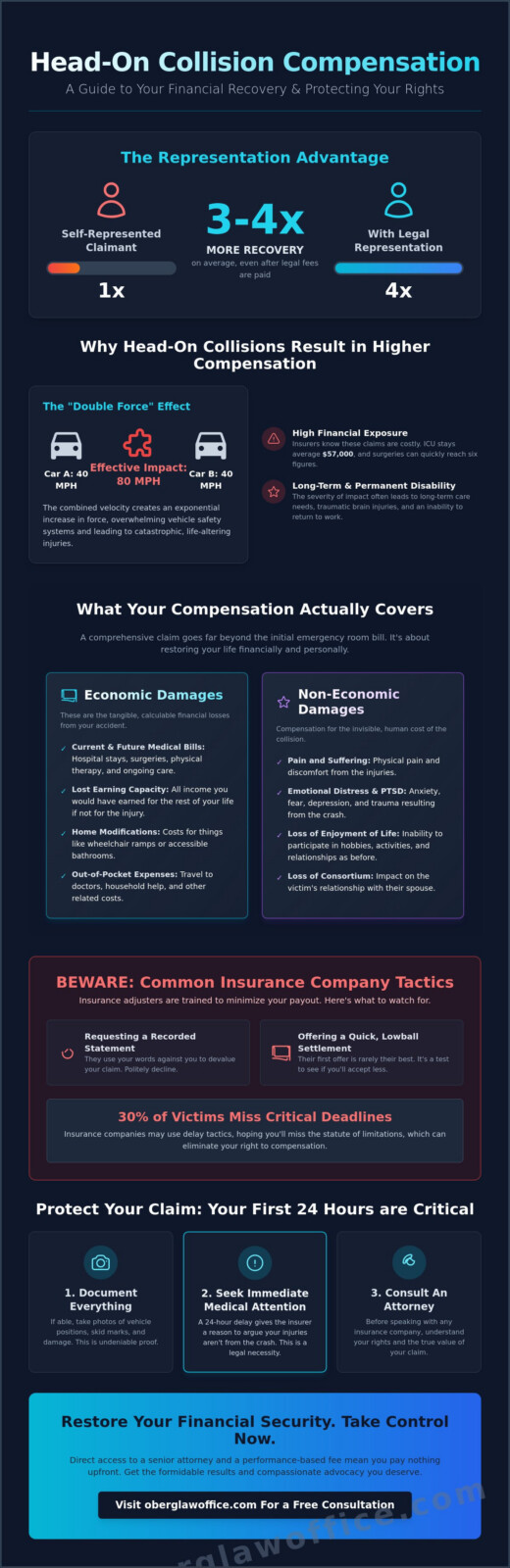
Did you know that represented injury claimants recover three to four times more on average than those who handle their own claims, even after legal fees are paid? It’s a startling reality, especially when you’re already struggling with mounting medical debt and the inability to return to work. You’ve been through a traumatic event, and the last thing you need is an aggressive insurance adjuster pushing you toward a lowball settlement. Securing fair head-on collision injury compensation is about more than just paying off an emergency room bill; it’s about restoring the stability you lost the moment that impact occurred.
We understand the weight on your shoulders. You deserve total coverage for your medical expenses and the replacement of every cent of lost income. In this comprehensive 2026 guide, we’ll pull back the curtain on how legal experts calculate payouts and what you can do right now to protect your financial future. We’ll explore current California insurance minimums, examine why 30% of victims miss critical deadlines, and provide a clear roadmap to help you move from a state of uncertainty to a feeling of total empowerment.
Key Takeaways
- Understand why the extreme force of impact in these crashes often results in higher financial exposure for insurance companies.
- Learn how to distinguish between economic losses like medical bills and non-economic damages that quantify your emotional trauma.
- Discover the specific factors legal experts use to calculate head-on collision injury compensation rather than relying on misleading average payout figures.
- Identify common insurance company traps, including the dangers of providing a recorded statement or accepting the very first settlement check offered.
- Find out how direct access to a senior attorney and a performance-based fee structure can help restore your financial security without upfront costs.
Why Head-On Collision Injury Compensation Often Exceeds Other Claims
Head-on collisions are among the most violent events a person can experience on the road. Because the impact is direct and concentrated, the resulting head-on collision injury compensation often reflects the life-altering nature of the crash. When two vehicles collide front-to-front, the energy released is significantly higher than in a typical fender bender or side-impact accident. This massive transfer of energy leads to catastrophic injuries that require intensive medical intervention.
Insurance companies recognize that these cases carry higher financial exposure. They know that a victim isn’t just looking at a few physical therapy sessions; they are often facing ICU stays that average $57,000 or emergency surgeries that can quickly reach six figures. Beyond the immediate medical bills, these accidents create a ripple effect that touches every part of your life. Spouses often have to leave work to become full-time caregivers, and the emotional trauma can strain family dynamics for years. In the most tragic circumstances, these crashes lead to a wrongful death claim, which requires a specialized legal approach to secure the future of surviving family members.
The ‘Double Force’ Effect Explained
The physics of a head-on crash are unique because of the combined velocity of both vehicles. If you are traveling at 40 mph and hit a stationary object, your car must absorb the energy of that 40 mph impact. However, if you hit an oncoming vehicle also traveling at 40 mph, the closing speed is effectively 80 mph. This “double force” effect explains why even low-speed head-on impacts can result in permanent disability or traumatic brain injuries.
Vehicle safety ratings play a dual role here. While modern crumple zones are designed to absorb some of this energy, the sheer magnitude of a head-on impact can still overwhelm these systems. This is why head-on collision injury compensation must account for the high probability of long-term care, as the human body simply wasn’t built to withstand such extreme deceleration.
Immediate Steps to Protect Your Claim Value
The moments following a crash are chaotic, but they are also the most critical window for documenting evidence. If you are physically able, taking photos of the vehicle positions and skid marks provides undeniable proof of how the impact occurred. This documentation becomes the foundation of your recovery process.
Seeking medical attention immediately is a legal necessity, not just a health choice. Insurance adjusters look for any reason to devalue your experience. A single 24-hour delay in seeking professional medical treatment gives the insurance company a reason to argue that your injuries were caused by something other than the accident.
Categories of Damages: What Can You Actually Recover?
Recovering from a crash isn’t just about paying off the ambulance bill. It’s about restoring your life to exactly what it was before that split second of impact. When we discuss head-on collision injury compensation, we look at several distinct categories of damages to ensure you aren’t left holding the bill for someone else’s mistake. These categories are designed to cover both the numbers on a receipt and the invisible weight you carry every day.
Economic Recovery: Beyond the Hospital Bill
Economic damages are the tangible, measurable losses you’ve suffered. They start with your immediate medical care but extend much further. A truly comprehensive claim includes future medical needs, such as long-term physical therapy, specialized equipment, or even home modifications like wheelchair ramps. If your injuries were severe enough to prevent you from returning to your career, we calculate your lost earning capacity. This represents the total income you would have earned over your lifetime if the accident hadn’t happened. Many victims forget to track smaller out-of-pocket expenses, such as the cost of gas for traveling to specialists or hiring help for household chores you can no longer perform. Every dollar counts toward your restoration.
Non-Economic Damages: The Human Cost
While bills are easy to add up, the human cost of a collision is harder to quantify. This is where we address pain, suffering, and the loss of enjoyment of life. We use specific methods to value these experiences, such as applying a multiplier to your economic damages based on the severity of your trauma. We also document the emotional distress and PTSD that often follow a violent impact. Beyond your own suffering, we consider the impact on your family through loss of consortium. This legal term recognizes how the accident has changed the fundamental relationship and support system between you and your spouse. According to NHTSA traffic crash data, crashes involving high speeds or impairment often result in these devastating life changes.
In cases where the other driver’s behavior was especially reckless, such as a DUI, you may also be eligible for punitive damages. These aren’t meant to repay a specific bill; instead, they serve to punish the wrongdoer and discourage others from acting the same way. Throughout this process, reaching Maximum Medical Improvement (MMI) is a critical milestone. This is the point where your doctors determine you’ve healed as much as possible. Settling your head-on collision injury compensation claim before reaching MMI is a risk, as you may not yet know the full cost of your future care. If you’re feeling pressured by an insurance adjuster to sign a release while you’re still in the hospital, seeking catastrophic injury representation can help protect your right to a full recovery.
The ‘Average Payout’ Myth vs. Real-World Valuation Factors
You probably want a straight answer to a simple question: “What is my case worth?” It’s the first thing most people ask when they’re facing a long recovery. While you might see websites listing Typical Car Accident Settlement Amounts, the reality is that there is no true “average” in personal injury law. Every human life is unique, and every crash has its own set of complications. Your head-on collision injury compensation isn’t a fixed number; it’s a variable outcome based on how well your story is told and how effectively the evidence is presented.
Real-world valuation depends heavily on factors like comparative negligence. If a court or insurance company decides you were even 10% at fault for the accident, your final check will be reduced by that same 10%. We also look beyond the insurance policy to the defendant’s personal assets. If the person who hit you was driving for a business or has significant personal wealth, there may be more avenues for recovery than just a standard auto policy. We leave no stone unturned to ensure your financial future is secure.
Factors That Swing the Settlement Needle
The strength of your case often comes down to clear liability versus disputed fault. When there is zero doubt that the other driver crossed the centerline, the insurance company’s leverage disappears. We also consider the “likability” factor, which is how a jury might perceive both you and the defendant if the case went to trial. A credible, honest victim who has clearly suffered often commands a higher settlement offer. The specific county or court jurisdiction where your claim is filed can change settlement values significantly based on the historical tendencies of local juries in that area.
Policy Limits and Underinsured Motorist Coverage
One of the hardest truths in personal injury law is the “policy limit” ceiling. If the driver who hit you carries only the state-mandated minimum insurance, that amount is often the most their insurance company will ever pay, regardless of how high your medical bills climb. This is where your own Underinsured Motorist (UIM) coverage becomes a lifeline. It acts as a bridge, covering the gap between the other driver’s small policy and the actual value of your head-on collision injury compensation.
In cases involving truck accident representation or commercial vehicles, we often find “umbrella” policies. These are secondary layers of insurance that provide millions of dollars in additional coverage. Identifying these policies early is a critical part of our work, as it ensures that the “ceiling” on your recovery is high enough to cover a lifetime of care and lost income.
Countering Insurance Company Tactics in 2026
Insurance adjusters often call within hours of a crash. They sound concerned, but their primary goal is to protect their company’s bottom line by minimizing your head-on collision injury compensation. They rely on a “Delay, Deny, Defend” strategy. By dragging out the process, denying clear liability, or defending their insured driver regardless of the facts, they hope you’ll become desperate. That first check they offer might look like a lifeline when medical bills are piling up, but it’s usually a fraction of your case’s real worth. Accepting it often means signing away your right to ask for more once the full extent of your injuries is known.
Protecting Your Words and Your Rights
One of the most dangerous traps is the recorded statement. Adjusters are trained to ask leading questions that can make you sound unsure about the facts or the extent of your pain. You have no legal obligation to speak with them alone. Similarly, be cautious with “Medical Authorization” forms. These documents often give the insurer access to your entire medical history. They use this to claim your current injuries are actually “pre-existing conditions” from years ago. Even your social media posts are fair game; a single photo of you smiling at a dinner can be twisted into evidence that you aren’t actually suffering. The safest path is to redirect all communication to your legal representative immediately.
Building a Bulletproof Case File
To win against these corporate tactics, we build a case that is impossible to ignore. In head-on collisions, we frequently bring in accident reconstruction experts who use the laws of physics and tire mark analysis to prove exactly how the other driver crossed the line. We also secure “Black Box” data, or the Electronic Data Recorder, from modern vehicles. This device provides objective proof of speed, braking, and steering in the seconds before impact. This data doesn’t lie and it doesn’t forget. When we combine this evidence with expert medical testimony that forecasts your lifelong health needs, the insurance company loses its ability to “defend” the indefensible. If you’re tired of being harassed by adjusters while you’re trying to heal, our car accident representation ensures you never have to face them alone. We act as your shield, allowing you to focus on your recovery while we handle the formidable task of securing your future.
Choosing Oberg Law Office: Compassionate Advocacy, Formidable Results
You’ve dealt with enough stress. Between surgeries, physical therapy, and the constant ring of the phone, your primary focus should be on healing, not arguing with a multibillion-dollar corporation. At Oberg Law Office, we believe that securing your head-on collision injury compensation shouldn’t feel like a distant, cold transaction. It should feel like a partnership. Unlike larger “settlement mill” firms where you might be passed off to a file manager or a legal assistant, here you get direct access to Attorney Gregg Oberg. We bring a neighborly approach to every case, backed by a 25-year track record of legal excellence right here in our community.
We handle the heavy lifting so you don’t have to. From gathering police reports to subpoenaing black box data, we manage the complex logistics of your claim. Our contingency fee promise is a signature part of our commitment to accessibility; you pay nothing unless we recover money for you. We share the risk because we believe in your right to justice. This performance-based structure ensures that our interests are perfectly aligned with yours. We are personally invested in every outcome, acting as a steadfast protector against those who would try to devalue your experience.
The Personal Touch in Catastrophic Claims
Personalized representation isn’t just a comfort; it leads to better settlement outcomes. When we take the time to understand the nuances of your daily struggles, we can present a more compelling argument for the non-economic damages we discussed earlier. We don’t just see a case number; we see a neighbor whose life has been turned upside down. Our commitment to transparency means you’ll receive constant communication and honest answers throughout the process. For a deeper look at what to expect when hiring a lawyer, you can read our comprehensive car accident legal guide.
Your Path Forward Starts with a Free Strategy Session
Taking the first step toward restoration shouldn’t be intimidating. During your initial consultation, we listen to your story and evaluate the specific merits of your head-on collision claim. We’ll look at the available insurance limits, the clarity of liability, and the extent of your medical needs to provide a realistic outlook. We’re here to be your knowledgeable guide, moving you from a state of uncertainty to a feeling of total empowerment. Contact us today for your free personal injury case review and let us help you protect your financial future.
Take Control of Your Path to Recovery
The road back from a head-on impact is steep, but you don’t have to climb it alone. We’ve explored how the unique physics of these crashes lead to higher financial exposure and why insurance companies use every tool in their kit to minimize your head-on collision injury compensation. From documenting the scene to uncovering hidden policy limits, every step you take now defines your financial security for years to come.
You deserve a protector who sees you as a person, not a file number. With over 25 years of legal experience, our firm provides the specialized representation needed to counter aggressive adjusters and secure the restoration you’re owed. You’ll work directly with senior attorney Gregg Oberg, ensuring your case benefits from decades of insight. Because we operate on contingency-based fees, there is no financial risk to you. We only get paid when we recover money for you.
It’s time to move from a state of uncertainty to a position of strength. Schedule Your Free Strategy Session with Oberg Law Office today. Let’s start building your future together.
Frequently Asked Questions
How much is the average settlement for a head-on collision in 2026?
There is no single fixed average because every person’s recovery needs are different. However, data from 2026 shows that the median settlement for cases resolved without litigation is approximately $23,000. For disabling injuries, costs can exceed $1 million. Your specific payout depends on insurance limits, the severity of your medical needs, and how effectively your legal team proves the full extent of your losses.
Can I still get compensation if I was partially at fault for the head-on crash?
Yes, you can still recover damages even if you share some responsibility for the accident. Under comparative negligence rules, your final check is simply reduced by your percentage of fault. If a jury decides you were 20% responsible for the collision, you would receive 80% of the total award. We work hard to minimize the fault attributed to you so you keep as much of your settlement as possible.
How long does it take to get a payout from a head-on collision lawsuit?
Most cases take between several months and over a year to reach a final resolution. The timeline depends heavily on how long it takes you to reach Maximum Medical Improvement. We don’t want to settle your case until we know the full cost of your future care. Rushing into a quick settlement often means leaving significant money on the table that you’ll need for long-term recovery.
What if the other driver doesn’t have enough insurance to cover my injuries?
If the at-fault driver has “minimum” coverage, we first look to your own Underinsured Motorist policy to bridge the gap. We also investigate whether the driver was working at the time, which could open up a larger commercial insurance policy. In some cases, we can pursue the defendant’s personal assets. Our goal is to find every available dollar to ensure your medical bills and lost wages are fully covered.
Should I accept the first settlement offer from the insurance company?
No, you should almost never accept the first offer provided by an insurance adjuster. These initial checks are typically lowball offers designed to close your file as cheaply as possible. Once you sign that check, you lose your right to ask for more money, even if you discover you need another surgery later. It’s vital to have a professional review any offer before you sign away your future rights.
What is the statute of limitations for filing a head-on collision claim?
In California, the general deadline to file a personal injury lawsuit is two years from the date of the accident. If you are filing a claim against a government entity, this window is much shorter, often only six months. Over 30% of eligible victims miss these critical deadlines and lose their right to sue. We recommend starting the process early to ensure all evidence is preserved and your rights remain protected.
Do I need a lawyer if the other driver was clearly at fault?
Yes, because proving fault is only the first step in securing fair head-on collision injury compensation. Insurance companies often admit fault but then spend months disputing the severity of your injuries or the cost of your future care. Represented claimants recover three to four times more on average than those who go it alone. We handle the complex negotiations so you can focus entirely on your physical and emotional healing.
What kind of evidence is most important in a head-on collision case?
Objective data from the vehicle’s “Black Box” and professional accident reconstruction reports are the most powerful pieces of evidence. While witness statements are helpful, electronic data provides an indisputable record of speed, braking, and steering in the seconds before impact. We also prioritize expert medical testimony to prove the long-term impact of your injuries. This combination of physical evidence and medical expertise makes it much harder for insurers to devalue your claim.