
What if the most painful part of your car accident isn’t the physical injury, but the way an insurance adjuster tries to boil your trauma down to a single, cold number? It’s frustrating when the invisible nature of your emotional distress is dismissed, leaving you anxious about your future medical needs. Learning how to calculate pain and suffering from a car accident is the first step in ensuring your stolen quality of life is financially recognized. Whether you’re navigating non-economic damage caps that may apply in your jurisdiction or filing elsewhere, these standard formulas are merely the starting point for a fair negotiation.
We understand that you’re looking for restoration, not just a transaction. In this guide, you’ll discover the exact Multiplier and Per Diem methods insurance companies use to value your trauma. We’ll provide a clear list of evidence to gather so you can justify a higher settlement and find the confidence to stand up to an adjuster. From understanding factors that influence settlement values to identifying permanent physical impairments, you’ll gain the knowledge needed to move from uncertainty to empowerment as we work toward the compensation you deserve.
Key Takeaways
- Recognize that your recovery involves more than just medical bills by understanding how non-economic damages cover both your physical pain and emotional distress.
- Learn the mechanics behind the Multiplier and Per Diem formulas so you can accurately determine how to calculate pain and suffering from a car accident.
- Discover why consistent medical documentation and personal injury journals are essential for turning your invisible trauma into tangible evidence for your claim.
- Prepare yourself against common insurance tactics, such as the pre-existing condition trap, that adjusters use to minimize your settlement offer.
- Understand how a dedicated advocate can protect your interests and help you navigate the complex path toward full restoration and financial security.
What is Pain and Suffering in a Car Accident Case?
When you are recovering from a crash, the medical bills are easy to see. They arrive in the mail, clearly printed with dates and dollar amounts. But the constant ache in your back that prevents you from lifting your child, or the sudden flash of panic you feel every time you approach an intersection, doesn’t come with a receipt. These intangible experiences are what the legal system calls non-economic damages. Pain and suffering is the legal term that encompasses the physical and emotional distress you endure because of someone else’s negligence. It is a vital part of your claim because it addresses the actual human experience of the injury rather than just the financial fallout.
Understanding how to calculate pain and suffering from a car accident requires looking beyond the hospital invoices. While economic damages cover your out-of-pocket costs, pain and suffering damages are meant to restore your sense of well-being. In many significant injury cases, these damages represent the largest portion of the final settlement. This is because a broken leg might heal in a few months, but the trauma of the event or the limitation of chronic pain can last a lifetime. Insurance adjusters often try to downplay these claims as “subjective,” but for you, the impact is undeniably real.
Physical Pain and Suffering vs. Mental Anguish
Physical pain is the direct result of the bodily harm you sustained. It includes the immediate agony at the scene, the discomfort of surgeries, and the grueling nature of physical therapy sessions. Every time you have to push through a painful rehabilitation appointment, that experience adds weight to your claim. Mental anguish is different. It is the internal struggle that follows the wreck. You might deal with fear, deep grief, or a persistent loss of sleep and appetite. These aren’t just “feelings”; they are documented symptoms of the trauma you’ve been forced to carry. We see our clients fighting both battles every day, and we believe both deserve fair recognition.
The ‘Invisible’ Injuries: Why Quality of Life Matters
Some of the most profound losses after an accident are the ones others can’t see. Loss of enjoyment of life occurs when you can no longer participate in the hobbies or daily activities that once brought you joy. If you can’t go for your morning run or play the guitar because of your injuries, your quality of life has been diminished. Similarly, loss of consortium addresses how the accident has strained your relationship with your spouse, affecting your intimacy and emotional connection. Pain and suffering is the human cost of another’s negligence. It is the price paid for the moments and memories you can no longer experience. If you feel like your insurance company is ignoring these “invisible” injuries, a car accident lawyer can help ensure your voice is heard and your trauma is valued correctly.
The Two Primary Methods for Calculating Pain and Suffering
Insurance companies aren’t in the business of being generous. They use standardized formulas to keep their payouts as low as possible. When you’re trying to figure out how to calculate pain and suffering from a car accident, you’ll likely encounter two main strategies. Adjusters often lean on sophisticated software like Colossus to strip the emotion out of your claim. This software analyzes data points to suggest Typical Car Accident Settlement Amounts for similar injuries in your area to set a baseline. However, these programs cannot feel your pain or see how your life has changed. They are tools for the company, not for your recovery.
The Multiplier Method: Why Your Medical Bills are the Starting Point
The Multiplier Method is the approach you’ll see most frequently in personal injury cases. It takes your “economic” damages, which is the total of your medical bills and lost income, and multiplies that sum by a number between one and five. This multiplier represents your non-economic losses. A low multiplier, like 1.5 or 2, is usually reserved for minor injuries like whiplash that heal relatively quickly without long-term impact. A high multiplier of 4 or 5 is used for life-altering events such as catastrophic injuries, permanent scarring, or trauma requiring multiple surgeries. The goal is to anchor your intangible suffering to the very real costs you’ve already incurred. If an adjuster is pushing a low multiplier despite your significant daily struggles, speaking with a car accident lawyer can help you push back for a fairer valuation.
The Per Diem Method: Valuing Your Time and Recovery
Per diem is a Latin term meaning “by the day.” This method assigns a specific dollar value to each day you live with the pain caused by the crash. A common way to justify this daily rate is to use your actual daily earnings. The logic is simple: if it takes as much effort to manage your recovery as it does to work a full-time job, you deserve to be compensated accordingly. This calculation continues until you reach Maximum Medical Improvement (MMI). This is the point where a doctor decides you’ve healed as much as you’re going to. The Per Diem Method is often highly effective for long-term, slow-healing injuries where the daily grind of physical therapy and chronic discomfort is the primary burden. It forces the insurance company to look at your recovery as a marathon rather than a single event. Using this method can highlight the true duration of your suffering, ensuring that no day of your recovery is overlooked.
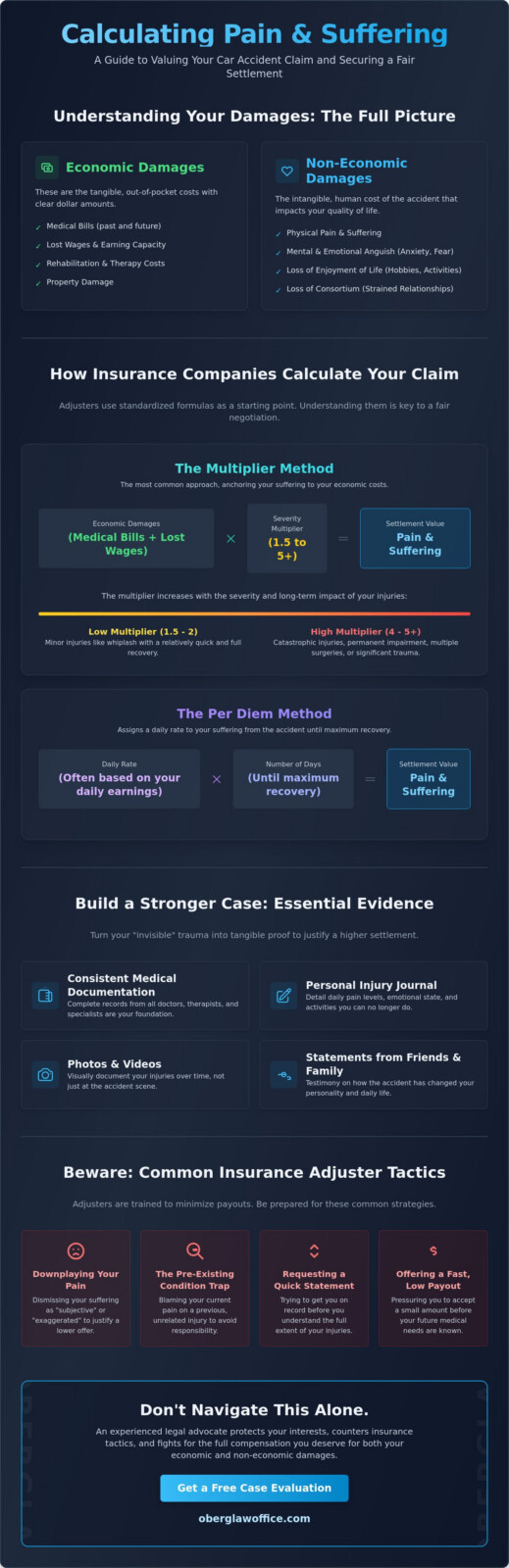
Essential Evidence to Prove Your Non-Economic Damages
Insurance adjusters often view claimants as mere numbers on a spreadsheet. To them, your pain is an abstract concept that they want to minimize to protect their company’s bottom line. To counter this, you must provide hard evidence that makes your suffering undeniable. Proving your loss requires a strategic collection of records that align with the legal definition of “non-economic damages”. This evidence moves your claim from a simple list of medical bills into a comprehensive story of how your life has been permanently altered.
Many people feel hesitant to “complain” to their doctors about every minor ache or a persistent bad mood. However, in the legal world, if it isn’t in your medical records, it essentially didn’t happen. Your physician’s notes are the most powerful tool you have. When you describe your anxiety, your inability to sleep, or the sharp pain in your shoulder, you aren’t being difficult; you are creating vital documentation. These notes provide the clinical foundation that adjusters use when they start thinking about how to calculate pain and suffering from a car accident.
Documentation That Adjusters Cannot Ignore
Beyond hospital records, you should maintain a detailed log of your medications. Prescription logs for pain management and mental health drugs show the length and intensity of your struggle. Additionally, don’t underestimate the power of visual evidence. Take photographs of your injuries immediately after the crash and continue to document the progression of healing or permanent scarring. A daily pain journal bridges the gap between clinical medical records and the lived reality of your suffering. It allows you to record things a doctor might miss, like the frustration of needing help to get dressed or the sadness of missing a family event because you were too exhausted from pain.
Using Testimony to Humanize Your Claim
While records are essential, testimony from those who know you best adds a human layer to your case. A spouse can provide a unique perspective on the loss of companionship and the emotional support you can no longer provide. Friends and family are often the best “before and after” witnesses, explaining how the accident stopped you from being the active, joyful person you once were. Even employer statements can be helpful. They can describe your inability to maintain focus or perform tasks that used to be second nature. In complex cases, we often bring in experts like psychologists or vocational specialists. A professional psychological evaluation can significantly impact settlement value by providing an objective look at PTSD or depression. This combined approach ensures that when you determine how to calculate pain and suffering from a car accident, the final number reflects every facet of your loss.
Insurance Tactics: How Adjusters Lowball Pain and Suffering
Insurance companies aren’t just neutral parties; they are formidable institutions designed to protect their own interests. When you are determining how to calculate pain and suffering from a car accident, you aren’t just fighting for a number. You’re fighting against a system of practiced denials. Adjusters often use the “Minor Impact” defense, arguing that if your car only has a few scratches, your body couldn’t possibly be injured. This logic ignores the reality of how kinetic energy affects the human spine. They also use social media surveillance to undermine your claim. One photo of you smiling at a dinner table can be twisted into “proof” that your mental anguish has vanished.
Another common tactic is the “Pre-Existing Condition” trap. They’ll scour your medical history from years ago to find a minor back strain or a previous bout of anxiety. Their goal is to blame your current agony on your past rather than the crash. They also watch for a “Gap in Treatment.” If you miss a single physical therapy session because you couldn’t find a ride or were too much in pain to move, they’ll claim you must be fully recovered. These tactics are designed to make you feel like a claim number rather than a person in need of restoration.
Common Insurance Denials and How to Counter Them
Adjusters have a script of excuses ready to deploy. Knowing how to respond can protect the value of your claim. Consider these common lowball arguments and the reality behind them:
- Excuse: “You didn’t seek mental health treatment immediately.” Counter: Trauma and PTSD often manifest weeks after the initial shock wears off; a delay doesn’t mean the distress isn’t real.
- Excuse: “Your lifestyle seems fine on social media.” Counter: A single photo represents a split second of effort to be present for family, not the 23 other hours of daily pain and recovery.
- Excuse: “The multiplier we used is standard for this injury.” Counter: There is no “standard” for unique human suffering. Every person’s path to healing is different.
The Danger of the Quick Settlement Offer
The fastest offer is usually the lowest. Within days of your crash, an adjuster might call with a check that seems helpful at first glance. They want you to sign a release before you realize you have a herniated disc or long-term nerve damage that requires future surgery. Once you sign that document, your right to seek further compensation is gone forever. You can politely decline these early offers by stating that you are still undergoing medical evaluation and don’t yet know the full extent of your needs. Protecting your future financial security is more important than a quick payout today. If you feel pressured to sign or aren’t sure if an offer is fair, you should request a review of your case from our car accident representation team to ensure your trauma is being valued with the integrity it deserves.
Why Legal Advocacy is Critical for Your Full Recovery
Fighting a billion dollar insurance company while you are trying to heal from a crash is an exhausting, unfair battle. You are dealing with physical pain and the weight of future medical bills, while the adjuster is focused solely on their bottom line. They have teams of experts and software designed to minimize your experience. When you’re trying to figure out how to calculate pain and suffering from a car accident, you shouldn’t have to do it alone. A car accident lawyer levels the playing field by acting as your steadfast protector, ensuring your voice is heard and your trauma is respected.
The most powerful tool in your arsenal is the credible threat of litigation. Insurance companies don’t offer fair settlements because it’s the right thing to do. They do it because they want to avoid the cost and risk of a trial. When we represent you, the adjuster knows that we are prepared to take your case before a jury if they refuse to be reasonable. This pressure often forces them to move past their basic formulas and recognize the true human cost of your injury. At our firm, you aren’t just a file number assigned to a support staff member. You work directly with a senior attorney who is personally invested in your restoration.
The Contingency Fee Promise: No Recovery, No Fee
High quality legal representation should be accessible to everyone, regardless of their current financial situation. We use a performance based fee structure, which means you don’t pay us anything unless we successfully recover money for you. This removes the financial barrier to justice and perfectly aligns our interests with yours. We fight for every dollar because we believe in fairness and security for our neighbors. This partnership allows you to focus entirely on your physical and emotional healing while we handle the complex legal heavy lifting and negotiations.
Your Path to Justice Starts with a Free Strategy Session
Taking the first step toward a personal injury recovery can feel overwhelming, but you don’t have to navigate this path in the dark. When you speak with Gregg Oberg about your case, you’ll receive a clear, honest assessment of your rights. We will look at the specific facts of your crash to determine how to calculate pain and suffering from a car accident in a way that reflects your actual losses. This strategy session is a low pressure opportunity to move from a state of uncertainty to a feeling of empowerment. We are here to guide you toward a result that truly makes you whole again.
Take Control of Your Financial and Emotional Recovery
Your journey back to wholeness involves more than just physical healing. It requires a fair recognition of the emotional and mental toll your accident has taken. By understanding how to calculate pain and suffering from a car accident, you’ve taken the first step toward reclaiming your future. You now know how to use the Multiplier and Per Diem methods to your advantage, and you’ve learned to spot the lowball tactics insurance adjusters use to minimize your trauma. Consistent documentation and professional advocacy are your strongest tools in this process.
You don’t have to face these billion dollar institutions alone. With over 25 years of personal injury experience, our firm stands as a steadfast protector for our neighbors. We offer direct access to senior legal counsel and work on a contingency-based fee structure, which means you only pay if we win. Schedule Your Free Pain and Suffering Strategy Session with Oberg Law Office Today to ensure your quality of life is valued with integrity. You’ve been through enough; let us handle the legal burden while you focus on getting back to the life you love.
Frequently Asked Questions
Is there a limit on how much I can receive for pain and suffering?
Limits on these damages depend entirely on your state’s laws and the type of case. For example, in 2026, Colorado has a hard cap of $1.5 million on non-economic damages for personal injury claims unless there is a permanent physical impairment. Many other states don’t have a specific statutory limit for car wreck cases. Understanding these local regulations is a vital part of learning how to calculate pain and suffering from a car accident accurately.
Can I claim pain and suffering if I didn’t break any bones?
You absolutely can seek compensation even without a visible fracture. Soft tissue injuries, whiplash, and concussions can cause chronic pain that disrupts your ability to work or care for your family. Insurance companies often try to dismiss these as minor, but your physical discomfort and emotional distress are legally valid. We focus on documenting how these “invisible” injuries have limited your daily life to ensure your settlement reflects your actual experience.
How do I prove mental anguish if I haven’t seen a therapist?
You don’t always need a therapist’s bill to prove emotional distress. While professional records are helpful, you can also use personal injury journals and testimony from those who know you best. Friends and family can describe changes in your personality, sleep patterns, or appetite since the crash. Your primary care doctor’s notes about your anxiety or stress also serve as strong evidence. We help you gather this human documentation to bridge the gap between medical charts and reality.
Will my social media posts really affect my pain and suffering claim?
Yes, your social media activity is one of the first things an insurance adjuster will investigate. A single photo of you smiling at a dinner table can be twisted into proof that your mental anguish has vanished. Adjusters look for any reason to lower your settlement offer. It’s best to set your accounts to private and avoid posting about your activities until your case is fully resolved. Protecting your claim means being cautious about your digital footprint.
How long does it take to get a settlement for pain and suffering?
The timeline usually depends on when you reach maximum medical improvement. We can’t accurately determine how to calculate pain and suffering from a car accident until we know the full duration of your recovery. Settling too early is a risk because you might miss out on compensation for chronic issues that appear later. Most cases take several months to over a year to ensure every day of your suffering is accounted for in the final demand.
Do I have to pay taxes on the pain and suffering portion of my settlement?
Generally, you don’t have to pay federal income taxes on settlement money for physical injuries or sickness. The IRS considers this compensation a restoration of what you lost rather than new income. This tax-free status typically includes the portion for pain and suffering as long as it stems from a physical injury. However, if you claimed medical deductions in previous years, you might owe taxes on that specific amount. We recommend checking with a tax professional for your specific situation.
Can I file for pain and suffering if the accident was partially my fault?
You can still recover compensation as long as you aren’t more than 50% responsible for the wreck. This is known as modified comparative negligence. Your final settlement will be reduced by your percentage of fault. For instance, if your damages are $100,000 but you are 20% at fault, you would receive $80,000. We work hard to minimize the fault assigned to you so you can keep the maximum amount of your recovery.
What happens if the at-fault driver’s insurance isn’t enough to cover my pain?
If the at-fault driver’s policy limits are too low, we look for other sources of recovery to make you whole. This often includes your own Underinsured Motorist (UIM) coverage. We also investigate if the driver was working at the time, which might open up a commercial insurance policy with higher limits. Our goal is to find every available avenue to ensure you aren’t left holding the bill for someone else’s negligence. We explore all options to protect your financial security.