What if the driver who struck your car isn’t actually the one legally responsible for the crash? Most people assume the person who hits the side of another vehicle is automatically to blame, but determining fault in a t-bone accident is rarely that simple. You’re likely dealing with sharp physical pain and the crushing anxiety of medical bills piling up while trying to make sense of a police report that feels incomplete or confusing. It’s a heavy burden to carry when you’re just trying to get your life back on track.
We know how overwhelming this process feels, especially when you’re facing a long road to recovery. This guide will help you understand the complex factors used to establish liability in side-impact collisions so you can protect your right to fair compensation. You’ll gain a clear understanding of right-of-way laws and learn how modern evidence, such as 2026 automated red-light enforcement data, plays a role in your case. We’ll also preview the essential steps for gathering evidence to ensure you have the confidence to pursue the settlement you deserve.
Key Takeaways
- Understand why the driver who struck the other car isn’t always the one to blame by focusing on right-of-way laws instead of the point of impact.
- Discover how digital evidence like dashcam footage and Event Data Recorder (EDR) data provides an objective account of the crash.
- Learn how the process of determining fault in a t-bone accident involves the “fault pie,” where even a small percentage of liability can impact your final settlement.
- Protect your claim by learning the specific steps to take after an intersection collision, including why you should avoid giving recorded statements to insurers.
- Identify the unique vulnerabilities of side-impact collisions and why the lack of vehicle crumple zones makes these cases legally and medically distinct.
Understanding T-Bone Accidents and the Impact of Liability
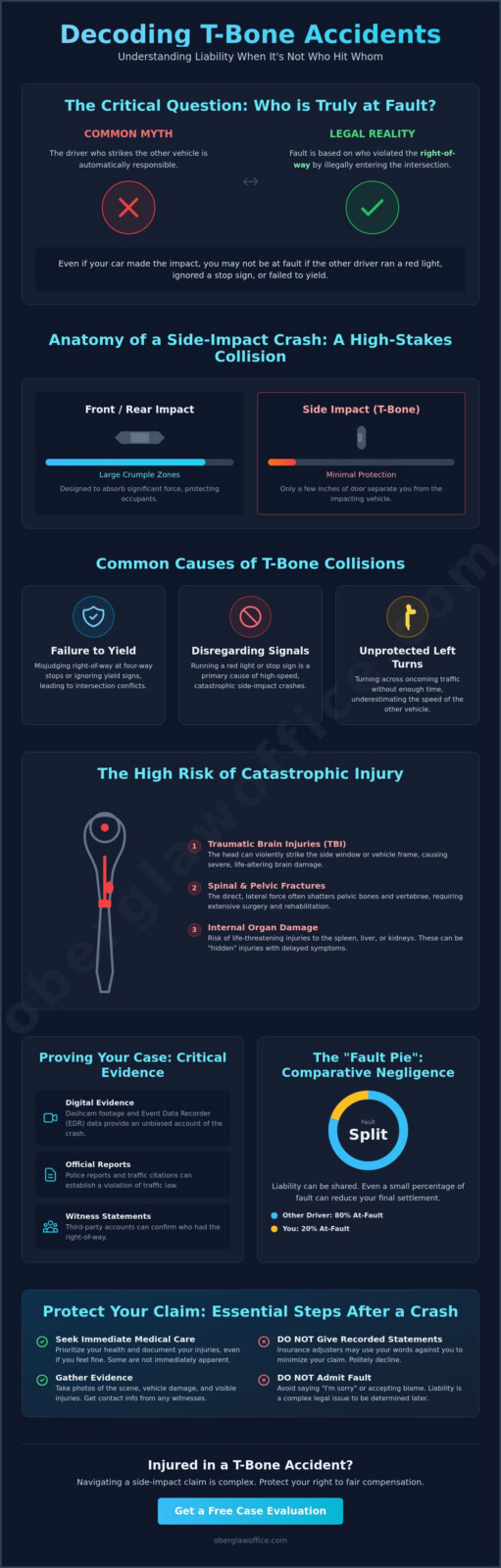
A side collision, commonly known as a T-bone accident, is one of the most frightening experiences a driver can face. These crashes happen when the front of one vehicle slams into the side of another, forming a “T” at the point of impact. Most of these incidents occur at intersections where traffic signals or stop signs should have prevented the conflict. Because vehicle sides offer significantly less protection than the front or rear, the force is transferred almost directly to the occupants. There are no long hoods or trunks to absorb the energy. Instead, there’s often just a few inches of door paneling and glass between you and a multi-ton vehicle.
Determining fault in a t-bone accident often turns into a stressful dispute over the facts. Both drivers might claim they had the right of way, or that the other person was distracted or speeding. This confusion is exactly what insurance adjusters look for. In the first 48 hours after your crash, these adjusters are already busy piecing together a narrative. Their goal is rarely your full recovery. They’re protecting their bottom line. They might call you under the guise of a neighborly check-in, but they’re often searching for any admission that could lower their liability and reduce your compensation.
Common Scenarios Leading to Side-Impact Crashes
Most T-bone accidents are the result of a single driver’s mistake or a split-second lapse in judgment. We see these patterns frequently in our community’s intersections. Common causes include:
- Failure to yield: Drivers often misjudge who arrived first at a four-way stop or ignore the rules of a flashing red light.
- Disregarding signals: Running a steady red light or blowing through a stop sign is a leading cause of high-speed side impacts.
- Unprotected left turns: A driver may turn left across oncoming traffic, wrongly assuming they have enough time to clear the lane before the other vehicle arrives.
The Severity of T-Bone Injuries
The lateral force of a side-impact crash is incredibly punishing on the human body. Because the seatbelt and seat structure provide less support against sideways movement, injuries are often catastrophic. Traumatic brain injuries (TBIs) are common as the head strikes the side window or the frame of the invading vehicle. The direct force often leads to pelvic and spinal fractures that require extensive surgery and months of rehabilitation. Internal organ damage to the spleen or liver is also a major concern. These internal injuries are particularly dangerous because they might not show symptoms during an initial ER visit. It’s vital to have a medical team that understands how to look for these hidden complications after a side-impact event.
The ‘Who Hit Whom’ Fallacy: Debunking Myths About Fault
If you’ve been in a side-impact crash, you might assume the driver who slammed into your car is automatically the one who has to pay. This is a common misconception. In reality, the physical point of impact is often a distraction from the actual legal truth. Determining fault in a t-bone accident is based on the violation of traffic laws and right-of-way, not just which bumper hit which door. You shouldn’t let the visual of the crash dictate your understanding of your rights.
Legal liability often rests on the concept of “illegal entry.” If a driver enters an intersection against a red light or fails to yield at a stop sign, they have no legal right to be in that space. Even if you were the one who struck their passenger side door, they are the negligent party because they created the hazard. It’s a hard concept to grasp when you’re the one holding the steering wheel during the impact, but the law looks at the sequence of events leading up to the crunch of metal. If you’re struggling with a complex liability dispute, seeking experienced car accident representation can provide the clarity you need to move forward.
When the Striking Driver is NOT at Fault
There are many situations where the person who “did the hitting” is actually the victim. We see this often when a driver pulls out of a private driveway or a parking lot without looking, leaving the oncoming driver zero time to react. In other cases, a driver might suffer a sudden and unpredictable mechanical failure, such as a total brake collapse. If the driver who was hit ran a red light, they are the one who violated the right-of-way. In these scenarios, the striking driver is simply a participant in a crash they couldn’t avoid.
The Role of Traffic Control Devices
Sometimes, the fault doesn’t lie with either driver. Malfunctioning signals can lead to “conflicting greens,” where both directions of travel believe they have the right-of-way. In 2026, many states like California have expanded automated red-light enforcement, which provides crucial digital evidence in these disputes. We also look at the timing cycles of yellow lights; if a light changes too quickly for a driver to safely clear the intersection, the municipality might share liability. Obstructed stop signs, hidden by overgrown trees or poorly placed construction equipment, can also shift the burden of fault away from the drivers involved.
Critical Evidence Used to Prove Fault in Side-Impact Collisions
Objective facts are the only way to cut through the confusion of a crash. When you’re dealing with the trauma of a side-impact collision, your memory might be hazy; that’s a natural response to a high-stress event. This is why we prioritize digital evidence like dashcam footage and nearby business surveillance. In 2026, California’s expanded automated red-light enforcement programs provide a new layer of data that can be instrumental in determining fault in a t-bone accident. These cameras don’t blink and they don’t forget, making them a powerful tool for proving who actually had the right-of-way.
Beyond cameras, we look at the physical clues left on the asphalt. Skid marks tell a story of a driver who tried to stop, while the absence of those marks suggests someone who never even saw the danger. This physical evidence, combined with the official police report, forms the foundation of insurance negotiations. While a police report isn’t always the final word in a courtroom, adjusters give it significant weight when deciding how to value your claim in the weeks following the accident. We make sure the reporting officer has all the facts to ensure the record is as accurate as possible.
Leveraging Vehicle Telematics and EDR Data
Most modern vehicles are equipped with an Event Data Recorder (EDR), which acts as a “black box” for your car. This device captures a technical snapshot from the five seconds leading up to an impact. It reveals your exact speed, whether the cruise control was active, and precisely when the brakes were engaged. We use this data to prove if the other driver was speeding or if they failed to take evasive maneuvers, such as swerving, to avoid the collision. This level of detail removes the guesswork from the investigation.
Witness Testimony and Credibility
A “disinterested” witness is someone who saw the crash but doesn’t know either driver. Their testimony carries immense weight because they have no stake in the outcome. We work quickly to secure these statements before memories fade or people move away. Additionally, cell phone records have become a vital tool in modern cases. If data shows a driver was mid-text or using an app at the moment of impact, it provides undeniable proof of distracted driving. This evidence helps us hold the responsible party accountable, ensuring you aren’t left paying for someone else’s negligence.
How Comparative Negligence Affects Your T-Bone Accident Claim
Determining fault in a t-bone accident isn’t always about finding one person who did everything wrong. Instead, insurance adjusters and courts often view liability as a “fault pie” that can be divided among multiple parties. This concept is known as comparative negligence. If an investigation finds that you were 10% or 20% responsible for the crash, your final compensation will be reduced by that exact amount. While it feels unfair when you’re the one who was struck, insurance companies aggressively use this tactic to protect their profits by shifting even a small portion of the blame onto you.
In many jurisdictions, including Texas, the law follows the “51% Rule.” This means that if you’re found to be 51% or more at fault for the collision, you lose your right to recover any damages at all. It’s a high-stakes calculation. Because every percentage point represents thousands of dollars in medical bills and lost wages, you can’t afford to let an insurance company’s biased assessment go unchallenged. We focus on ensuring that the “fault pie” is divided fairly, based on hard evidence rather than an adjuster’s desire to save money.
Common Ways Fault is Shared in T-Bone Cases
Even if the other driver ran a red light, an insurance company might argue you share the blame. They look for specific factors to reduce their payout, such as:
- Speeding: If you were traveling above the limit while entering the intersection, they’ll claim your speed made the impact worse or prevented you from stopping.
- Failure to take evasive action: Adjusters may argue that you had enough time to swerve or brake but failed to do so.
- Visibility issues: Driving with your headlights off during dusk or heavy rain can be used as evidence of contributory negligence.
Fighting Unfair Fault Allocations
You don’t have to accept the “computerized” fault calculators that insurance companies use to nickel and dime victims. We use professional accident reconstruction to challenge these shared fault claims. By analyzing the data from the Event Data Recorders we discussed earlier, we can prove exactly how much time you had to react. Expert witnesses can clarify complex intersection dynamics, showing that the crash was unavoidable for you regardless of your speed or steering. If you’re facing an unfair fault assessment, we can help you fight for the compensation you deserve through experienced car accident representation.
Navigating the Legal Path Toward Recovery After a T-Bone Crash
After the initial shock of a collision subsides, your focus naturally shifts to healing and restoration. But while you’re managing doctor visits and physical therapy, the legal clock is already ticking. The steps you take in the days following the crash are vital for preserving your rights. We act as your steadfast protector during this time, ensuring that the burden of dealing with insurance adjusters doesn’t fall on your shoulders while you’re trying to get back on your feet. You deserve a partner who is personally invested in your recovery.
One of the biggest mistakes you can make is giving a recorded statement to the other driver’s insurance company. They might sound neighborly and concerned, but their primary goal is to protect their bottom line. They’ll often ask leading questions designed to make you admit to even a small percentage of blame. Since determining fault in a t-bone accident relies so heavily on precise details about speed and timing, a single misspoken word can significantly reduce your compensation. We recommend politely declining these requests and letting your advocate handle all communication instead.
We believe that everyone deserves high-quality legal help regardless of their current financial situation. This is why we operate on a performance-based fee structure. You don’t pay us anything unless we successfully recover money for you. This shared risk ensures that we are fully committed to your case, providing you with the security of professional leadership without the stress of upfront costs. It levels the playing field against large insurance institutions that have unlimited resources to fight your claim.
The Insurance Negotiation Process
Understanding the difference between a first-party claim with your own insurer and a third-party claim against the other driver is the first step in the negotiation phase. Initial settlement offers from the other side are almost always lower than what your case is actually worth. They often fail to account for the long-term impact of your injuries. A mesquite personal injury lawyer knows how to calculate non-economic damages, such as your physical pain and emotional distress, ensuring the final settlement reflects the true cost of the accident.
When to File a Formal Lawsuit
If an insurance company refuses to offer a fair settlement, filing a formal lawsuit becomes a necessary step to secure your future. We keep a close eye on the statute of limitations in your jurisdiction to ensure you don’t lose your right to sue. Once a lawsuit is filed, we enter the discovery phase. This is a powerful stage where we force the other side to hand over evidence they might have been hiding, such as internal emails or witness contact information. By choosing dedicated car accident representation, you’re signaling to the opposition that you won’t be bullied into a low-ball settlement. Determining fault in a t-bone accident is a complex process, but you don’t have to face it alone.
Take the Next Step Toward Restoration
Recovering from a side-impact crash is about more than just healing physical wounds; it’s about restoring your sense of security and fairness. You now understand that right-of-way laws, not the point of impact, are the true standard for determining fault in a t-bone accident. By leveraging digital evidence and fighting back against aggressive insurance adjusters who try to shift blame, you can protect the compensation you need for your medical bills and lost wages. This process is complex, but it’s a path you don’t have to walk by yourself.
You deserve a partner who brings both professional authority and compassionate advocacy to your case. With over 25 years of experience in personal injury law, our firm acts as a steadfast protector for our neighbors. You’ll work directly with senior legal professionals who are personally invested in your recovery, and we maintain a performance-based fee structure where there are no fees unless we win. We’re here to ensure you’re treated with the integrity and respect you deserve.
Schedule your free, no-obligation strategy session with Oberg Law Office today. We’re ready to help you move from a state of uncertainty to a feeling of empowerment.
Frequently Asked Questions
Is the person who T-boned the other car always at fault?
No, the driver who strikes the side of another vehicle is not automatically liable for the crash. Legal responsibility depends on who violated the right-of-way or traffic signals. If a driver pulls out in front of you from a side street without looking, they are the negligent party even though your front bumper hit their car door. Determining fault in a t-bone accident is about identifying the initial traffic violation that caused the conflict.
What happens if both drivers claim they had a green light?
When stories conflict, we rely on objective third-party evidence to find the truth. In 2026, many areas have expanded automated red-light enforcement programs that provide digital proof of signal status at the exact time of impact. We also look for dashcam footage, nearby business surveillance, and statements from uninvolved witnesses. These independent sources are much more reliable than the memories of drivers who have just experienced a traumatic event.
Can I still recover damages if I was speeding during a T-bone accident?
Yes, you can often still recover compensation even if you were partially at fault for the collision. Most states use comparative negligence laws to handle these situations. In Texas, for example, you can recover damages as long as your share of the fault is 50% or less. Your total payout will be reduced by your percentage of blame, such as your speed making the injuries more severe than they would have been otherwise.
How do insurance companies determine who had the right-of-way?
Adjusters review the police report, traffic laws, and the physical layout of the intersection to decide liability. They also analyze vehicle damage and skid marks to reconstruct the path of both cars. Modern adjusters frequently use data from Event Data Recorders to see exactly how fast each car was going and when the drivers hit their brakes. We make sure they have all the facts so they don’t use incomplete data to deny your claim.
What kind of evidence is most important in a side-impact crash?
Digital evidence is currently the gold standard for proving liability in intersection accidents. Surveillance footage from nearby traffic cameras or private businesses provides an unbiased view of the crash as it happened. We also prioritize “black box” data from the vehicles, which records technical details like steering angles and brake application. This hard data is much harder for an insurance company to dispute than a driver’s personal recollection of the event.
Should I call the police for a T-bone accident if there are no visible injuries?
Yes, you should always call the police to the scene of a side-impact collision. Many serious injuries, such as internal bleeding or traumatic brain injuries, don’t show symptoms until hours or days after the crash. Having a police officer document the scene, the weather conditions, and the initial statements of everyone involved is vital. This official report serves as a foundational piece of evidence when determining fault in a t-bone accident later on.
How long do I have to file a claim after a T-bone accident?
The time you have to file is limited by your state’s statute of limitations. While you should notify your insurance company quickly, the deadline for filing a formal lawsuit varies significantly by location. It’s important to consult with a legal professional early to ensure you don’t miss these critical dates. Waiting too long can result in the loss of your right to seek any compensation, regardless of how clear the other driver’s fault may be.
What is the average settlement for a T-bone car accident?
Settlement amounts depend heavily on the severity of your injuries and the available insurance coverage. 2026 estimates suggest average settlements between $20,000 and $25,000 for minor claims. However, moderate injuries like fractures or herniated discs often result in settlements ranging from $50,000 to $200,000. For severe cases involving permanent damage or traumatic brain injuries, settlements can reach $200,000 to well over $1,000,000 depending on the specific circumstances of the crash.