
Did you know that rear-end collisions account for nearly 2.5 million reported incidents every year? Despite being the most common type of crash on our roads, insurance companies often treat these life-altering events like minor inconveniences. If you’re currently staring at a stack of medical bills and wondering what is a fair settlement for a rear-end collision, you aren’t alone. You’re likely feeling the heavy weight of mounting debt and the intense pressure to sign a quick release just to make the phone calls stop. It’s exhausting to focus on your physical recovery when you’re worried about your financial future.
You deserve a recovery that reflects the actual impact on your life, not just a generic industry average. We’re here to help you calculate the true value of your claim by accounting for both your immediate bills and your long-term health needs. In this 2026 guide, we’ll break down how California’s specific settlement ranges and comparative negligence laws affect your final numbers. You’ll learn how to identify lowball offers and gain the tools needed to ensure you receive the maximum compensation you deserve.
Key Takeaways
- Learn why generic averages are often misleading and how to determine what is a fair settlement for a rear-end collision based on your unique road to restoration.
- Discover how to categorize economic and non-economic damages so that your settlement accounts for both your receipts and the human cost of the crash.
- Identify how factors like comparative negligence can impact your payout and what you can do to prove the trailing driver’s liability.
- Master the immediate actions you must take to protect your claim, from securing medical evidence to documenting your daily recovery journey.
- Understand how a performance-based fee structure allows you to partner with a dedicated advocate who is personally invested in your recovery.
Understanding the “Average” Rear-End Collision Settlement
A Rear-end collision can happen in a heartbeat, but the financial fallout often lasts for years. When you ask what is a fair settlement for a rear-end collision, you’re really asking for a path back to the life you had before the crash. A truly fair settlement is defined as the full restoration of your pre-accident life. This means you shouldn’t just be “okay”; you should be made whole again, both physically and financially. Many people look at national averages to find an answer, but these numbers are frequently misleading. They don’t account for regional cost-of-living differences or the specific medical costs in your local community.
There’s a massive difference between a “property damage only” claim and one involving bodily injury. If your car just has a dented bumper, the settlement is usually a straightforward check for repairs. But when you’re hurt, the calculation becomes personal. In 2026, we see settlement tiers that vary wildly based on the severity of the harm done to you. For minor injuries, settlements typically range from $10,000 to $50,000. If you’ve suffered a moderate injury like a herniated disc, that range often sits between $20,000 and $50,000. However, severe injuries that change your ability to work or move can lead to settlements ranging from $100,000 to well over $2,000,000.
While these figures provide a general framework, consulting with experienced professionals is vital; for example, you can learn more about Fenderson Law Firm to see how they evaluate personal injury cases and help clients navigate the recovery process.
Why One-Size-Fits-All Numbers Fail
Two people can suffer identical whiplash injuries, yet their settlements might look nothing alike. This happens because “just compensation” is based on your unique life. If your injury prevents you from lifting your toddler or performing your specific job duties, your claim’s value reflects that loss. The “venue,” or the specific county where your case is filed, also changes the outcome. Some local jurisdictions are known for being more empathetic toward victims, while others are more conservative. We don’t look at you as a statistic; we look at how the crash disrupted your specific daily routine.
Typical Settlement Ranges for 2026
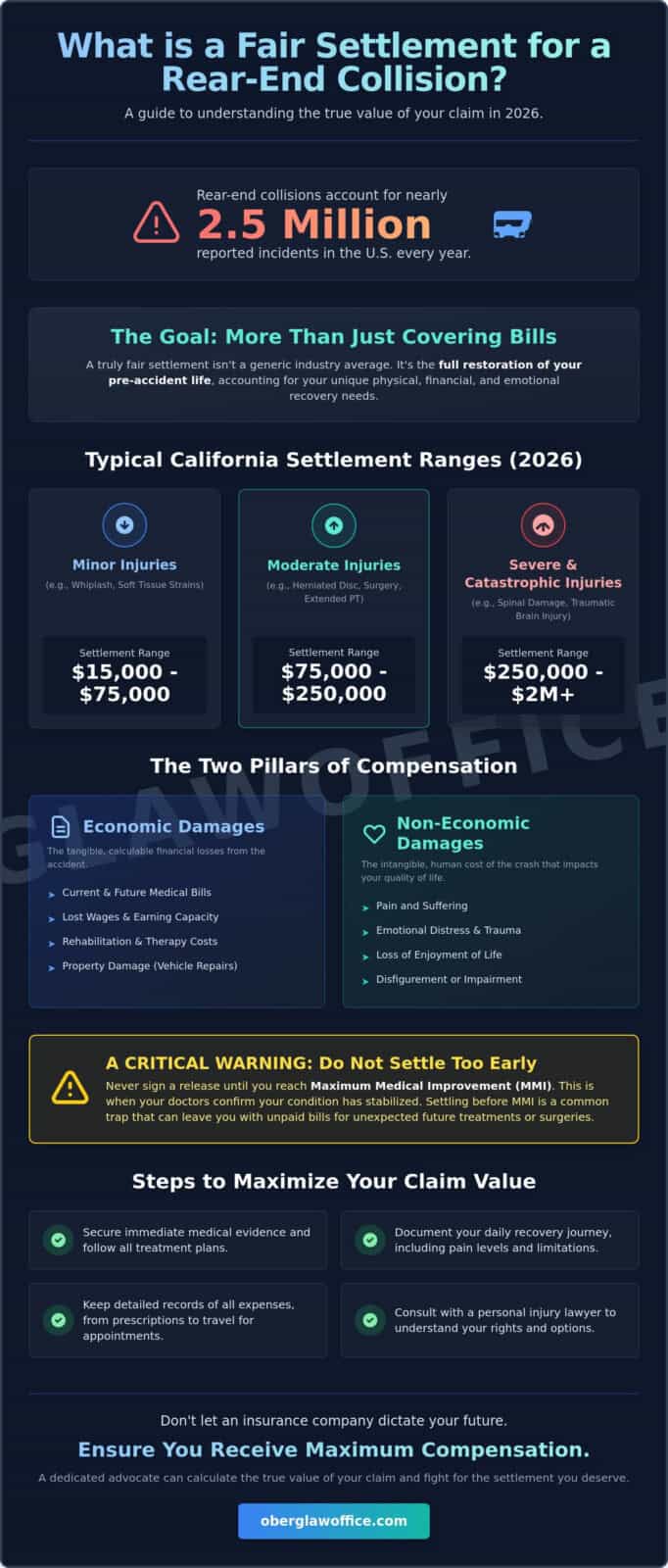
While every case is different, looking at regional data helps set realistic expectations. In California, for example, the ranges are often higher due to medical costs and state-specific laws:
- Minor fender benders: For soft tissue injuries like whiplash, California settlements often range from $15,000 to $75,000.
- Moderate injuries: If you require surgery or extended physical therapy, payouts typically fall between $75,000 and $250,000.
- Severe crashes: For catastrophic spinal injuries or traumatic brain damage, settlements frequently start at $250,000 and can exceed $1,000,000 to ensure your long-term security.
When you’re wondering what is a fair settlement for a rear-end collision, remember that the goal is restoration. You shouldn’t have to settle for a number that leaves you struggling with future medical needs or unpaid bills.
The Two Pillars of Compensation: Economic and Non-Economic Damages
You aren’t just a set of medical records or a claim number. You’re a person trying to put your life back together after a traumatic event. To determine what is a fair settlement for a rear-end collision, we must look at the two distinct pillars of legal compensation: economic and non-economic damages. Balancing these two categories ensures that your settlement covers both the bills on your desk and the invisible burdens you carry every day.
Insurance adjusters often use specific formulas to arrive at a settlement offer. One common approach is the “Multiplier Method,” where your total economic losses are multiplied by a number between 1.5 and 5 based on the severity of your pain. Others use a “Per Diem” method, which assigns a daily dollar value to your suffering until you reach a specific recovery milestone. Regardless of the method used, you should never sign a release until you reach Maximum Medical Improvement (MMI). This is the point where your doctors believe your condition has stabilized. Settling before MMI is a common trap; it may leave you without funds if your injuries require unexpected surgery later on.
Calculating Tangible Economic Losses
Economic damages are the foundation of your claim because they are backed by “hard” evidence like receipts and invoices. This includes every ER visit, specialist consultation, and rehabilitative session. We also look closely at your employment records. A fair settlement must include lost wages, but it shouldn’t stop at your base salary. It needs to account for missed overtime, performance bonuses, and even the vacation days you were forced to use for recovery. According to National Highway Traffic Safety Administration (NHTSA) data, driver behavior is the primary cause of most crashes, so you shouldn’t be responsible for these mounting costs. For catastrophic cases, we work with life-care planners to project your medical needs decades into the future.
Assigning Value to Pain and Suffering
Non-economic damages represent the human cost of the crash. This includes physical discomfort, chronic anxiety, and a loss of enjoyment of life. If your injuries prevent you from picking up your children or participating in hobbies you once loved, those losses have real legal value. This is typically the most contested part of a negotiation because it is subjective. For married accident victims, we also consider “Loss of Consortium.” This legal concept addresses the damage the accident has done to the companionship and intimacy within your marriage. If you’re struggling to quantify these life changes, a dedicated car accident representation professional can help you document the full scope of your experience.
When you’re asking what is a fair settlement for a rear-end collision, remember that the total should reflect your unique reality. Every bill and every moment of pain matters in the eyes of the law.
Factors That Can Increase or Decrease Your Settlement Value
Understanding what is a fair settlement for a rear-end collision requires looking beyond your medical bills. Several “invisible” factors can either boost your compensation or provide the insurance company with an excuse to lower their offer. In most cases, the law applies a “rear-end presumption.” This means the driver who hit you from behind is almost always found at fault. However, this isn’t a guarantee of a full payout. Your settlement is often a balancing act between the severity of your injuries and the legal technicalities of the crash itself.
Insurance adjusters are trained to look for ways to shift blame. They might point to a pre-existing back condition to claim your pain didn’t start with the accident. They might also scrutinize your own actions at the time of the impact. This is where professional advocacy becomes essential to protect your right to a full recovery. We don’t let them use your medical history as a weapon to devalue your current suffering.
The Impact of Fault and Liability
While the trailing driver is usually responsible, you might face a reduction in your payout if you contributed to the accident. For example, if you had a broken brake light or suddenly reversed in traffic, you could be found partially liable. In California, we follow a “pure comparative negligence” system. Unlike some states where being 51% at fault bars you from any recovery at all, California allows you to collect damages even if you’re partially responsible. However, your final check will be reduced by your percentage of fault. A solid police report is your first line of defense here; it solidifies the facts before memories fade. This is a critical part of the process outlined in the California Department of Insurance guide, which helps victims understand their rights during a claim.
How Insurance Policy Limits Cap Recovery
Sometimes, the value of your case is higher than the money available. Every insurance policy has a “hard ceiling” known as a policy limit. As of January 1, 2025, California requires minimum liability coverage of:
- $30,000 for injury or death to one person
- $60,000 for injury or death to more than one person
- $15,000 for property damage
If your medical bills exceed $30,000 but the at-fault driver only carries the state minimum, you might struggle to collect the full amount you deserve. This is why Uninsured/Underinsured Motorist (UM/UIM) coverage on your own policy is so vital. It acts as a safety net when the other driver’s insurance falls short. If you were hit by a commercial vehicle, such as a delivery truck, the limits are often much higher, sometimes reaching millions of dollars. Knowing which “bucket” of money you’re pulling from is a major part of determining what is a fair settlement for a rear-end collision.
Steps to Maximize Your Rear-End Accident Claim Value
You’ve already endured the shock of the impact and the frustration of a damaged vehicle. Now, the real work of restoration begins. To ensure you receive what is a fair settlement for a rear-end collision, you must take active steps to prove the full extent of your losses. Insurance companies aren’t in the business of volunteering maximum payouts. They look for any reason to doubt your story or downplay your pain. By being proactive from day one, you can build a wall of evidence that makes it much harder for adjusters to lowball your claim.
One of the biggest mistakes victims make is speaking with the other driver’s insurance adjuster before they’re ready. You’ll likely get a call within days asking for a “recorded statement” to help speed things up. Don’t do it. These adjusters are trained to ask leading questions that can trick you into admitting fault or saying you feel better than you actually do. Instead, focus on gathering your own evidence. Take clear photos of the vehicle damage, the scene of the crash, and any visible injuries like bruising or lacerations. Keep the contact information for any witnesses who saw the trailing driver’s behavior before the impact.
The Critical Role of Consistent Medical Care
The most important thing you can do is seek medical attention immediately, even if you feel “fine” right after the crash. Adrenaline often masks serious injuries like whiplash or internal bruising. If you wait weeks to see a doctor, the insurance company will argue that your injuries were caused by something else or that they aren’t truly serious. These “gaps in treatment” are a primary tool used to devalue claims. Follow your doctor’s orders to the letter. If they prescribe physical therapy or diagnostic tests like MRIs, make sure you go. This proves you’re doing your part to mitigate damages and get back on your feet.
Documenting the “Invisible” Impact
Economic damages are found in receipts, but non-economic damages are found in the details of your daily life. We recommend keeping a daily log to record the challenges you face. Don’t just write “I’m in pain.” Instead, be specific about what you can no longer do. Maybe you couldn’t lift your child, missed a family event, or felt intense anxiety while driving through the same intersection. These concrete examples are much harder to ignore than a general claim of discomfort. You can also gather testimony from friends or coworkers who can speak to how your life has changed since the accident. If you need help organizing this evidence, our team provides dedicated car accident representation to ensure every part of your story is heard.
When you’re fighting for what is a fair settlement for a rear-end collision, remember that your documentation is your greatest asset. Every doctor’s note and every journal entry brings you one step closer to a full and fair recovery.
How a Personal Injury Lawyer Secures a Truly Fair Settlement
When you’re dealing with the aftermath of a crash, the last thing you need is a legal battle. You’re likely exhausted from doctor visits and frustrated by the constant calls from insurance adjusters. Understanding what is a fair settlement for a rear-end collision isn’t just about adding up your current bills; it’s about having a dedicated guide who knows how to fight for your future. Many people hesitate to call a lawyer because they worry about the cost. We operate on a contingency fee model. This means you pay nothing up-front. We only get paid if we win your case. It’s a partnership where we share the risk, making quality legal care accessible to everyone in our community.
Insurance companies often count on your desperation. They know that as medical debt piles up, you might be tempted to take the first check they offer. These “lowball” offers rarely cover the long-term costs of whiplash or spinal injuries. We act as a formidable shield between you and these aggressive tactics. Our team handles the difficult conversations so you can focus on healing. We’re here to ensure the insurance company sees you as a person, not just a line item on a spreadsheet to help you secure what is a fair settlement for a rear-end collision.
Navigating Insurance Company Tactics
Adjusters frequently use “delay and deny” strategies to wear you down. They might request unnecessary records or stop returning your calls for weeks at a time. We counter these moves with a professional Demand Letter. This document is backed by deep legal research and clear evidence that leaves no room for excuses. If the insurance company refuses to offer a number that reflects your true losses, we’re prepared to take the next step. Sometimes, filing a formal lawsuit is the only way to gain the leverage needed for a just result. We won’t let them bully you into settling for less than you deserve.
The Oberg Law Office Commitment
At our firm, we believe in the personal touch. You won’t be handed off to support staff or junior clerks. You’ll interact directly with senior professionals who are personally invested in your recovery. If a commercial vehicle caused your crash, we provide specialized advocacy against trucking companies to hold them accountable. We also recommend reading our comprehensive accident recovery guide to learn more about your rights. We offer a free initial strategy session to help reduce your anxiety and map out a clear path forward. You don’t have to navigate this alone. We’re here to help you move from a state of uncertainty to a feeling of total empowerment.
Restore Your Security and Future Today
You’ve learned that determining what is a fair settlement for a rear-end collision is about more than just totaling your hospital receipts. It’s about securing a future where your physical pain, emotional distress, and lost career opportunities are fully recognized. By prioritizing consistent medical care and documenting the invisible impacts on your daily life, you’ve already taken the first steps toward a successful claim. Now, you need a steadfast protector to ensure the insurance company respects those efforts.
Attorney Gregg Oberg brings over 25 years of experience fighting for accident victims across our community. We understand the weight you’re carrying, which is why you’ll have direct access to senior leadership throughout your case. We believe in accessibility and shared risk; you’ll never pay us a fee unless we win your case. Don’t let uncertainty or pressure from adjusters dictate your recovery. Schedule your free strategy session with Oberg Law Office today and let us help you restore what was lost. You deserve a partner who is as invested in your healing as you are.
Frequently Asked Questions
How much should I ask for in a rear-end collision settlement?
You should ask for an amount that covers your total medical bills, lost wages, and the human cost of your physical pain. Determining what is a fair settlement for a rear-end collision requires a detailed demand that accounts for your future care needs. We help you calculate this by looking at your life’s specific disruptions rather than just picking a random number.
Can I get a settlement for whiplash if my car has no damage?
Yes, you can recover damages for whiplash even if your vehicle shows little to no visible damage. Modern vehicle bumpers are designed to withstand low-speed impacts without crumpling, but the kinetic energy still transfers directly to your neck and spine. Medical records and diagnostic imaging are more important than car photos in these specific cases.
How long does a rear-end collision settlement take to process?
Most settlements take between six months and a year to reach a conclusion. This timeline is largely determined by how long it takes you to reach Maximum Medical Improvement (MMI). It’s vital to wait until your doctors have a clear picture of your long-term health needs so you don’t leave money on the table.
What if the person who rear-ended me has no insurance?
If the at-fault driver is uninsured, you can seek compensation through the Uninsured Motorist (UM) coverage on your own policy. This coverage is designed to step into the shoes of the other driver’s insurance. It ensures you aren’t left paying for someone else’s mistake out of your own pocket while you focus on recovery.
Should I accept the first settlement offer from the insurance company?
You should almost never accept the first settlement offer because it’s typically the lowest amount the insurance company hopes you’ll take. These offers are often made before the full extent of your injuries is known. Once you sign a release, you lose the right to ask for more money later if your condition worsens.
What is the average payout for a rear-end collision with a neck injury?
Payouts for neck injuries vary based on whether you have a soft tissue strain or a permanent injury like a herniated disc. While minor cases might settle for smaller amounts, injuries requiring surgery or causing chronic pain can result in much larger recoveries. Every case is unique to the individual’s specific recovery path and medical history.
Do I need a lawyer for a minor rear-end accident?
You may not need a lawyer for a true fender bender with no injuries, but you should consult one if you feel any physical discomfort. What feels like a minor ache today can become a chronic issue next month. A legal professional ensures you don’t accidentally waive your rights before your health is stable.
What happens if I am partially at fault for being rear-ended?
If you are partially at fault, you can still recover compensation under California’s pure comparative negligence laws. Your final settlement will be reduced by your percentage of responsibility. For example, if you’re found 20% at fault for a broken brake light, you would receive 80% of the total damages calculated for your claim.