
One second of distraction is all it takes to change your life forever, and the driver who caused your crash knows it. If you’re searching for a distracted driving accident lawyer in Mesquite, you’re likely dealing with something far more complicated than a simple fender-bender. You’re facing an insurance company that’s already working to minimize your claim, mounting medical bills that won’t wait, and the frustrating reality that proving a driver was on their phone at the moment of impact isn’t always straightforward.
You’re right to feel that this isn’t fair. Distraction is a choice, not an accident, and the person who made that choice should be held fully accountable for the consequences you’re living with right now.
This guide is here to help you understand exactly how to build a compelling case, what your claim may realistically be worth, and why having a dedicated local advocate in your corner makes all the difference. You’ll learn how digital forensics can uncover the truth, how experienced representation levels the playing field against big insurers, and what steps to take right now to protect your recovery.
Key Takeaways
- Distracted driving involves three distinct types of impairment—visual, manual, and cognitive—and understanding each one is essential to proving that a driver’s negligence, not chance, caused your crash.
- Digital forensics tools, including cell phone records and vehicle “black box” data, can establish exactly what a distracted driver was doing at the moment of impact, giving your case the hard evidence it needs.
- Working with an experienced distracted driving accident lawyer in Mesquite means having an advocate who knows how to calculate the full value of your claim—including non-economic damages like pain and suffering that insurers routinely undervalue.
- Oberg Law Office operates on a contingency-fee basis, meaning you pay nothing unless your case is won, and you’ll work directly with Gregg Oberg rather than being passed off to support staff.
- A free Strategy Session with Oberg Law Office can transform your uncertainty into a clear, confident plan of action—so you know exactly where you stand and what to do next.
The Rising Crisis of Distracted Driving Accidents
Distracted driving isn’t a new problem, but it’s a deepening one. What began as a concern about texting behind the wheel has evolved into something far more complex, and far more dangerous. Today’s vehicles come equipped with touchscreen dashboards, streaming apps, navigation systems, and voice assistants that demand constant cognitive engagement. Drivers aren’t just glancing at phones anymore; they’re managing entire digital ecosystems at 60 miles per hour.
That’s not an accident waiting to happen. That’s a choice being made, repeatedly, by people who believe their attention can be divided without consequence. When that belief collides with reality, it’s innocent people like you who pay the price.
Modern Distractions: Beyond the Smartphone
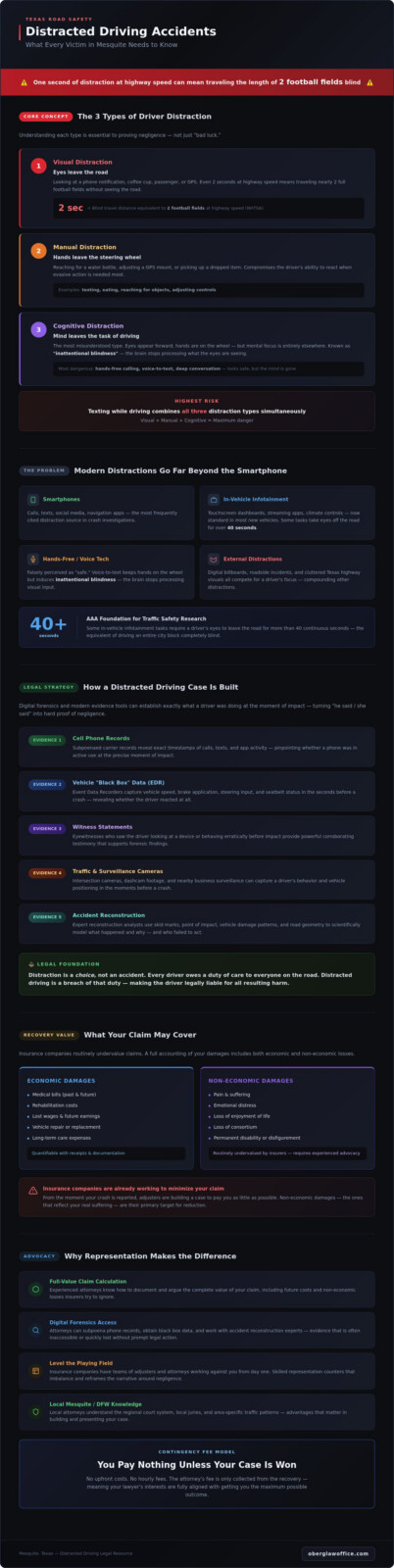
The smartphone gets most of the headlines, but it’s only part of the story. Integrated infotainment systems, the kind now standard in most new vehicles, require drivers to look away from the road to adjust temperature, change music, or input a destination. Research from the AAA Foundation for Traffic Safety has found that some in-vehicle technology takes a driver’s eyes off the road for more than 40 seconds during a single task.
Hands-free technology presents its own hidden danger. A driver using voice-to-text may keep both hands on the wheel, but their mind is somewhere else entirely. Cognitive scientists call this inattentional blindness, a state where the eyes are open but the brain simply isn’t processing what’s in front of them. External distractions compound the problem: digital billboards, roadside incidents, and the increasingly cluttered visual environment of busy Texas highways all compete for a driver’s focus.
The Reality of Distracted Driving Statistics in 2026
The National Highway Traffic Safety Administration consistently identifies distraction as a contributing factor in thousands of fatal crashes and tens of thousands of serious injuries each year in the United States. For families in Mesquite and across the Dallas-Fort Worth area, those numbers represent shattered routines, lost income, and grief that doesn’t resolve on any insurance adjuster’s timeline.
The economic toll extends beyond individual households. Emergency response, long-term rehabilitation, and lost workplace productivity place enormous strain on communities. Every preventable crash carries a cost that ripples outward.
At its core, distracted driving is a breach of the universal duty of care that every driver owes to every other person on the road.
That’s precisely why working with a knowledgeable distracted driving accident lawyer in Mesquite matters so much. Insurance companies are skilled at framing these crashes as unfortunate mishaps. An experienced advocate reframes the truth: this was negligence, and you deserve to be made whole because of it.
Understanding the Three Types of Driver Distraction
Not all distractions are created equal, and understanding the difference matters enormously when building your case. Researchers and traffic safety experts classify driver distraction into three distinct categories, and knowing how each one works can mean the difference between a vague claim of carelessness and a precise, provable argument for negligence.
Visual distraction occurs when a driver’s eyes leave the road. Studies from the National Highway Traffic Safety Administration have found that taking your eyes off the road for even two seconds at highway speeds means traveling the length of nearly two full football fields without actually seeing what’s ahead of you. A glance at a phone notification, a look down at a coffee cup, a check of a passenger in the back seat: each one creates a dangerous window of blindness.
Manual distraction happens when hands leave the steering wheel. Reaching for a water bottle, adjusting a GPS mount, or picking up a dropped item all compromise a driver’s ability to react quickly. At the moment your vehicle needed evasive action, that driver’s hands simply weren’t where they needed to be.
Cognitive distraction is the category that gets the least attention, and it’s arguably the most misunderstood. This is the “mind off the road” phenomenon: a driver whose eyes appear to be forward and whose hands are on the wheel, but whose mental focus is entirely elsewhere. Research from the AAA Foundation for Traffic Safety has documented that cognitive distraction measurably slows reaction times and reduces hazard detection, even when a driver appears to be paying attention. A driver having an intense phone conversation through a Bluetooth headset may look perfectly responsible. Their brain tells a different story.
The Myth of Multi-Tasking Behind the Wheel
The human brain doesn’t actually multi-task. It switches rapidly between tasks, and every switch carries a cognitive cost. When a driver divides attention between navigating traffic and managing a conversation, neither task gets full processing power. Scientists call this “cognitive load,” and when it’s high, a driver’s ability to perceive hazards drops significantly. This is why the defense “I was looking at the road” doesn’t hold up under scrutiny. Looking and seeing are two completely different things, and an experienced distracted driving accident lawyer in Mesquite knows exactly how to make that distinction clear to a jury or an insurance adjuster.
The most dangerous distractions are “super-distractions”: activities that combine all three categories simultaneously. Texting while driving is the most cited example because it demands visual attention to read the screen, manual engagement to type, and cognitive focus to compose a message. Three separate impairments, happening at once, for the duration of a single text.
Legal Implications of Specific Distractions
Texas law prohibits handheld device use while driving in school zones, and many municipalities have adopted broader restrictions. But the legal conversation around distraction extends well beyond what’s explicitly prohibited by statute. Courts and juries regularly consider whether a driver’s behavior fell below the standard of care that a reasonable person would exercise, regardless of whether a specific law was technically violated. That’s a critical distinction.
- Prohibited device use creates a strong presumption of negligence and can support punitive damages claims in egregious cases.
- Legal but distracting behavior, such as eating, adjusting in-vehicle systems, or interacting with passengers, can still be introduced as evidence of inattention.
- Any documented distraction at the time of a crash strengthens the argument that the driver breached their duty of care to others on the road.
The distinction between a momentary lapse and gross negligence also affects how much compensation you may be entitled to recover. If you’re uncertain how the specific circumstances of your crash translate into legal liability, speaking directly with Gregg Oberg can give you a clear, honest picture of where your case stands.
Proving Liability: How to Build a Distracted Driving Claim
Knowing a driver was distracted and proving it in a way that holds up under legal scrutiny are two very different things. Insurance adjusters know this, and they count on victims not knowing it. A well-built distracted driving claim doesn’t rest on assumptions or witness impressions alone. It’s constructed layer by layer, from digital records to physical evidence to expert analysis, each piece reinforcing the next.
Cell phone records are often the cornerstone of that construction. When subpoenaed, carrier records reveal exactly when calls were made, when texts were sent or received, and when data was actively transmitted. Timestamps can be cross-referenced against the precise moment of impact to establish, often to the second, whether a driver was actively using their device. Social media activity, streaming app data, and navigation app logs can all be pulled through the same process, providing a granular digital timeline that no defendant can simply talk their way out of.
Modern vehicles carry another layer of truth. Event Data Recorders, commonly called “black boxes,” capture critical pre-crash inputs: speed, brake application, throttle position, and steering behavior in the seconds before impact. If a driver never touched the brakes, that data will show it. If they were accelerating through an intersection, the record exists. Securing this data quickly matters because it can be overwritten or lost if the vehicle is repaired or totaled without a proper preservation request being filed.
Critical Evidence at the Scene and Beyond
The moments immediately following a crash are chaotic, but they’re also a window of irreplaceable opportunity. If you’re physically able, photograph the other driver’s vehicle interior through the window. A phone resting on the seat, a food wrapper, or a mounted device mid-navigation can all become meaningful exhibits. Nearby businesses, traffic cameras, and other drivers’ dashcams may have captured the entire sequence of events. That footage often gets overwritten within 24 to 72 hours, which is why a professional investigation needs to begin immediately, not after a few weeks of waiting on an insurance company’s timeline. The police report is a starting point, not a conclusion. Officers document what they observe at the scene, but they rarely conduct the kind of forensic follow-up that a thorough claim requires.
The Power of Expert Witnesses
Accident reconstructionists use physical evidence, including skid marks, point of impact, vehicle damage patterns, and road geometry, to establish speed, sight lines, and driver behavior before the collision. Digital forensics experts can authenticate and interpret device data in ways that are admissible and persuasive to a jury. If the driver was working at the time of the crash, delivering goods, taking a sales call, or driving a company vehicle, vicarious liability may extend accountability to their employer as well, significantly broadening the scope of available compensation.
This is exactly the kind of comprehensive, evidence-first approach that separates a skilled distracted driving accident lawyer in Mesquite from simply filing paperwork and hoping for a fair offer. If you’re unsure what evidence still exists in your case, speaking directly with Gregg Oberg can help you understand what’s recoverable and what steps need to happen right now to protect it.
Calculating the True Value of Your Recovery
Most people underestimate what their case is actually worth. That’s not an accident. Insurance companies are built around the idea that injured victims will accept the first number they’re offered because they’re exhausted, overwhelmed, and desperate for the financial bleeding to stop. Understanding how compensation is genuinely calculated puts you in a fundamentally different position at the negotiating table.
Economic vs. Non-Economic Damages
Economic damages are the tangible, documentable losses tied directly to your crash. Medical bills, emergency transport, surgery, physical therapy, prescription costs, and any necessary home modifications all fall into this category. Lost wages matter too, not just the paychecks you’ve already missed, but the earning capacity you may have lost permanently if your injuries prevent you from returning to your previous role or industry. A skilled personal injury lawyer in Mesquite, TX will work with medical and vocational experts to project those long-term losses accurately, because a settlement that ignores future costs isn’t a settlement at all. It’s a trap.
Non-economic damages are where many claims are most severely undervalued. These cover the losses that don’t come with a receipt: chronic pain, emotional distress, anxiety behind the wheel, disrupted sleep, and the simple inability to enjoy the activities that defined your life before the crash. Texas law recognizes these losses as real and compensable. Quantifying them requires a methodical approach, one that documents how your daily life has changed, what medical professionals say about your prognosis, and how the injury has affected your relationships and mental health over time.
Future medical needs deserve particular attention. If your injuries require ongoing treatment, a comprehensive life-care plan developed by medical specialists can project those costs across months or years. Without that documentation, you may settle for an amount that covers today’s bills while leaving next year’s rehabilitation costs entirely on you.
Punitive Damages in Distracted Driving Cases
Standard compensation addresses what you’ve lost. Punitive damages address something different: the deliberate recklessness of the person who caused your crash. Under Texas law, punitive damages become available when a defendant’s conduct rises to the level of gross negligence, meaning they were aware their behavior carried a substantial risk of serious harm to others and proceeded anyway. A driver who was texting at highway speed, or who was documented using their phone repeatedly in the moments before impact, may meet that threshold.
The purpose of punitive damages isn’t punitive in a vindictive sense. It’s corrective. Courts use them to send a clear message that certain behaviors carry consequences severe enough to change conduct. For victims, they also represent meaningful additional compensation that reflects the full moral weight of what happened to them.
As a dedicated distracted driving accident lawyer in Mesquite, Gregg Oberg evaluates every case for its full range of recoverable damages, not just the obvious ones. If you want an honest assessment of what your claim is genuinely worth, schedule a Strategy Session with Oberg Law Office and get a clear picture before you make any decisions.
Why Oberg Law Office is Your Steadfast Protector
There’s a meaningful difference between a law firm that handles your case and one that’s genuinely invested in your outcome. At Oberg Law Office, that distinction starts at the top. Gregg Oberg brings over 25 years of experience fighting for injured Texans, and when you call this office, you speak with him. Not a paralegal. Not a case manager. The attorney who will actually be in your corner.
That matters more than most people realize. Large, high-volume firms often assign incoming cases to junior staff while senior attorneys remain focused elsewhere. Here, the personal touch isn’t a marketing phrase. It’s the operating model. Gregg Oberg reviews your situation directly, evaluates your options honestly, and stays personally engaged from the first conversation through the final resolution.
A Collaborative Partnership for Your Recovery
When you’re recovering from a crash caused by a distracted driver, your energy belongs in healing, not in battling an insurance adjuster who’s paid to minimize your claim. Oberg Law Office takes that burden off your shoulders entirely. Every communication with the insurer, every records request, every negotiation is handled by your legal team so your focus can stay on getting better. If you’re also navigating related injury questions, our car accident lawyer Mesquite resource can give you additional context on how representation works across different crash types.
Every case Oberg Law Office accepts is prepared as if it’s going to trial. That isn’t just a philosophical stance; it’s a practical strategy. Insurance companies settle more favorably when they know the attorney across the table is genuinely ready to take the case before a jury. That preparation is your leverage.
Take the First Step Toward Justice
Uncertainty is one of the most exhausting parts of the aftermath of a crash. You don’t know what your case is worth, whether you have enough evidence, or what happens if you make the wrong move. The free Strategy Session at Oberg Law Office is designed to replace that uncertainty with clarity.
During your consultation, you’ll walk through the facts of your situation with Gregg Oberg directly, get an honest assessment of your options, and leave with a concrete understanding of what to do next. There’s no pressure, no obligation, and no guesswork.
The firm operates on a contingency-fee basis, which means you pay nothing unless your case results in a recovery. As a dedicated distracted driving accident lawyer in Mesquite, Gregg Oberg shares your risk and your goal: a fair result that reflects everything this crash has cost you.
You’ve already been through enough. Request your free Strategy Session today and take the first step toward the justice you deserve.
Your Path to Justice Starts With One Conversation
A distracted driver made a choice that changed your life. You deserve an advocate who takes that seriously. Throughout this guide, you’ve seen how digital evidence builds an airtight case, how the full value of your claim extends well beyond your immediate medical bills, and how having the right legal representation fundamentally shifts the balance of power against large insurance companies.
None of that knowledge matters if you don’t act on it. Evidence disappears. Deadlines pass. Insurance adjusters count on your hesitation.
As a dedicated distracted driving accident lawyer in Mesquite, Gregg Oberg brings over 25 years of experience, a contingency-based fee structure that means you pay nothing unless you win, and a genuine commitment to working with you directly rather than handing your case off to support staff.
You don’t have to figure this out alone. Request your free distracted driving strategy session with Gregg Oberg today and replace uncertainty with a clear, confident plan. Justice is within reach.
Frequently Asked Questions
Is it hard to prove the other driver was distracted?
It’s genuinely challenging, but it’s far from impossible with the right approach. Proving distraction requires building a layered case from multiple sources: subpoenaed cell phone records, vehicle Event Data Recorder data, witness statements, dashcam footage, and scene photographs. No single piece of evidence carries the case alone, but together they create a timeline that’s difficult to dispute.
The key is speed. Critical evidence gets overwritten, deleted, or lost quickly after a crash. An experienced distracted driving accident lawyer in Mesquite can issue preservation demands and subpoenas before that window closes, protecting the documentation your case depends on.
Can I still get compensation if I was partially at fault for the crash?
Yes, in most situations you can. Texas follows a modified comparative fault rule, which means you can recover compensation as long as your share of responsibility is 50 percent or less. Your total recovery is reduced by your percentage of fault, so if a jury finds you 20 percent responsible, you’d receive 80 percent of your awarded damages.
Insurance adjusters routinely try to inflate a victim’s share of fault to reduce or eliminate payouts. Having an attorney review the facts before you make any recorded statements to an insurer is one of the most protective steps you can take.
How much does it cost to hire a distracted driving accident lawyer?
At Oberg Law Office, the answer is straightforward: nothing upfront. The firm operates on a contingency-fee basis, meaning legal fees are only collected if your case results in a recovery. You don’t pay out of pocket to get experienced representation working for you from day one.
This structure matters because it removes the financial barrier that keeps many injured people from seeking the help they deserve. It also means your attorney’s interests are directly aligned with yours. A stronger outcome for you is the only way the firm gets paid.
What if the driver was using a hands-free device at the time?
Hands-free doesn’t mean distraction-free. Research consistently shows that cognitive distraction, where a driver’s mental focus is elsewhere even while their eyes are forward and hands are on the wheel, measurably slows reaction times and reduces hazard detection. A driver on a Bluetooth call who fails to brake in time is still a negligent driver.
Texas law doesn’t categorically prohibit hands-free device use, but that’s not the end of the legal analysis. Courts evaluate whether a driver’s conduct fell below the reasonable standard of care, and a cognitive impairment that contributed to your crash can absolutely support a negligence claim regardless of whether the technology was technically “legal.”
How long do I have to file a distracted driving claim in my state?
In Texas, the statute of limitations for personal injury claims is generally two years from the date of the crash. Missing that deadline typically means losing your right to pursue compensation entirely, regardless of how strong your case might be. Certain circumstances, such as claims involving government vehicles or injuries to minors, may involve different timelines.
Two years can feel like plenty of time, but the practical reality is that the strongest cases are built early. Waiting diminishes your evidence, complicates witness recollection, and hands the advantage to the insurance company. Starting sooner protects your options.
What kind of evidence do I need to save after the accident?
Preserve everything you can access immediately: photographs of both vehicles, the road surface, skid marks, traffic signals, and the other driver’s interior if visible through the window. Keep every medical record, bill, and prescription receipt. Save written records of missed work, and document how your injuries are affecting your daily life through a personal journal or notes on your phone.
Don’t overlook digital sources. Request any available traffic or surveillance camera footage from nearby businesses as quickly as possible, since most systems overwrite recordings within 24 to 72 hours. Your own dashcam footage, if you have one, should be backed up immediately and not overwritten.
Will my case have to go to court, or will it settle?
The majority of personal injury cases resolve through settlement before trial. That said, whether your case settles, and on what terms, depends heavily on how it’s prepared. Insurance companies offer better settlements when they know an attorney is genuinely ready to take a case before a jury rather than just using court as an empty threat.
At Oberg Law Office, every case is built with trial preparation in mind from the start. That preparation is your leverage at the negotiating table. If a fair settlement isn’t offered, you’ll have a case that’s ready to go the distance rather than one that has to scramble to catch up.
Can I sue a driver’s employer if they were distracted while working?
Yes, under a legal doctrine called vicarious liability, employers can be held responsible for the negligent actions of employees who were acting within the scope of their job duties at the time of the crash. A delivery driver, sales representative, or any employee making a work-related call while behind the wheel may expose their employer to significant liability.
This matters because employers typically carry much larger insurance policies than individual drivers, which can meaningfully expand the compensation available to you. Identifying whether an employer relationship exists is one of the first things a thorough investigation should examine, and it’s a question worth raising during your initial conversation with an attorney.