
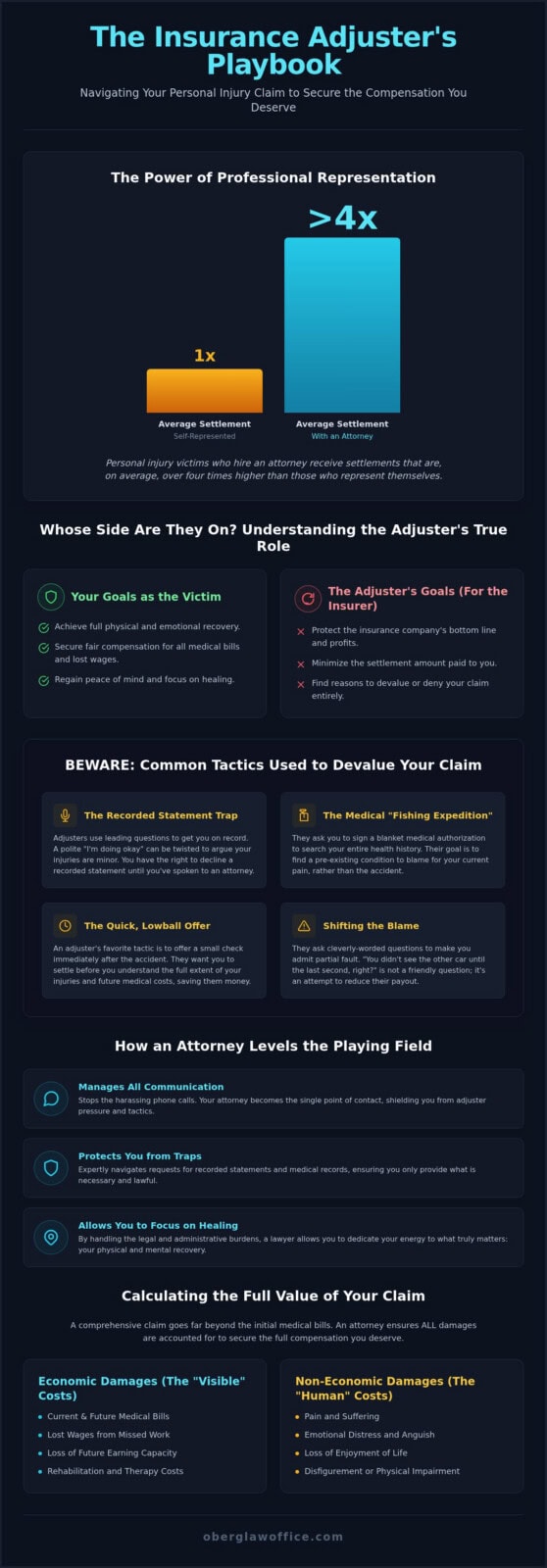
Did you know that personal injury victims who hire an attorney receive settlements that are, on average, over four times higher than those who represent themselves? It is a startling figure, but it highlights the steep uphill climb you face when dealing with insurance adjusters. Right now, you’re likely feeling the weight of constant phone calls and the mounting pressure to accept a low settlement while your medical bills continue to stack up. It is exhausting to feel like the insurance company is more interested in their bottom line than your physical recovery.
We understand the stress you are under, and we are here to help you regain your peace of mind. In this guide, you will learn how to manage these high-stakes interactions to secure the full compensation you deserve. We will walk through the 2026 legal landscape, including the new mandatory appraisal processes and your right to clear explanations for claim decisions. You will discover how to protect yourself from being tricked into admitting fault and how to ensure your settlement covers all medical costs and lost wages. It is time to stop feeling like a claim number and start feeling like a protected client.
Key Takeaways
- Understand that an adjuster’s loyalty lies with the insurance company’s bottom line rather than your full restoration.
- Identify common traps like recorded statements and medical “fishing expeditions” that occur when dealing with insurance adjusters in Texas.
- Learn to calculate the full value of your claim by accounting for both immediate medical bills and long term emotional distress.
- Gain a clear understanding of the investigation process, from securing police reports to analyzing vital dashcam footage.
- Discover the advantage of having a steadfast protector with over 25 years of experience personally handling every aspect of your case.
What is the Role of an Insurance Adjuster in a Texas Injury Claim?
When you file a claim after an accident, the insurance company assigns an adjuster to your case. This person is responsible for investigating what happened, determining who is at fault, and putting a price tag on your damages. While the official Role of an Insurance Adjuster might sound like a neutral evaluator, the reality is quite different. The adjuster is a professional negotiator whose primary job is to protect the insurance company’s profits. Their loyalty lies with their employer, not with your recovery or your family’s future.
You will likely encounter two types of adjusters. A first-party adjuster works for your own insurance company. Since you have a contract with them, they have a legal duty to act in good faith. A third-party adjuster, however, works for the other driver’s insurance. They have no contract with you and no obligation to be “fair.” Their goal is to find reasons to deny your claim or pay you the smallest amount possible. When dealing with insurance adjusters in Texas, it’s vital to remember that their friendly tone is often a strategic tool used to get you to lower your guard.
Adjusters Work for the Company, Not You
Adjusters are employees, and like any employee, they have performance goals. In the insurance world, success is often measured by how much money they “save” the company. This means every dollar they keep out of your pocket is a win for their employer. When an adjuster says, “I just want to get this settled so you can move on,” they are usually following a script. They want to lock you into a low settlement before you realize the true extent of your injuries. Many insurers now use automated claims software that calculates settlements based on cold data rather than the human reality of your pain. These programs frequently generate “low-ball” offers that ignore the unique hardships you are facing.
The Power of Professional Representation
Hiring an attorney changes the environment immediately. Insurance companies keep detailed records on law firms; they know who is willing to fight in court and who settles for the first offer. When a known trial attorney takes over your case, the adjuster’s approach often shifts from dismissive to serious. You no longer have to worry about saying the wrong thing during a phone call. By directing all communication through your legal team, you close the door on the adjuster’s tactical “fishing expeditions.” This partnership allows you to focus on healing while an expert ensures the insurance company respects your rights and treats your claim with the gravity it deserves.
Common Tactics Used to Devalue Your Personal Injury Settlement
Dealing with insurance adjusters in Texas requires a keen eye for subtle traps. These professionals aren’t just checking facts; they are actively building a defense against your claim. One of the most common moves is the “friendly” phone call that arrives within hours of your accident. While you are still in shock or dealing with the immediate pain of your injuries, the adjuster wants to lock you into a version of events that favors their bottom line. They know that speed is their greatest ally. If they can get you to accept a small check before you even know the full extent of your medical needs, they save the company thousands of dollars.
The Danger of the Recorded Statement
Adjusters often use recorded statements to catch you off guard. They might ask leading questions like, “You didn’t see the other car until the last second, right?” If you agree, they will later argue you weren’t paying attention to the road. Even a polite “I’m doing okay” in response to “How are you today?” can be twisted during negotiations to suggest your injuries are minor. You have the right to politely decline these recordings. Your Consumer Bill of Rights protects you from certain unfair practices, and refusing a recorded statement until you’ve spoken with an expert is a vital way to exercise those rights.
Medical Records and Privacy Traps
The “fishing expedition” usually starts with a request for a blanket medical authorization. If you sign this document, the insurance company can dig through your entire health history. They are looking for an old back injury from years ago or a childhood sports accident to blame for your current pain. They want to prove your injury is a pre-existing condition rather than a result of the crash. It is much safer to provide only the medical records that are directly related to the accident. This specific documentation is best handled by a steadfast protector who knows how to shield your private life from prying eyes.
Adjusters also frequently use “contributory negligence” to reduce your payout. In Texas, if you are found to be more than 50% at fault, you cannot recover any damages at all. Adjusters will look for any minor detail, such as driving slightly over the speed limit or failing to use a turn signal, to shift the blame onto you. By assigning you even 20% of the fault, they can legally slash your settlement by that same percentage. Understanding these tactics is the first step toward securing the justice you deserve.
Calculating the Full Value of Your Personal Injury Recovery
Assigning a dollar amount to your physical and emotional recovery is one of the most difficult parts of a claim. When you are dealing with insurance adjusters in Texas, they often present a settlement figure that seems official and final. Don’t be fooled. That number is usually the result of a computer program designed to save the company money. To secure a fair result, you must understand how a claim is actually valued. Your recovery should reflect the total impact the accident has had on your life, not just the immediate bills sitting on your kitchen table.
Economic vs. Non-Economic Losses
Damages fall into two main categories: economic and non-economic. Economic damages are the tangible, out-of-pocket costs you can prove with receipts and pay stubs. These include your current medical bills, the cost of future rehabilitation, lost wages from time missed at work, and the repair costs for your vehicle. If you feel an adjuster is ignoring these tangible losses or acting in bad faith, you can research the Texas Department of Insurance complaint process to understand your options for holding them accountable.
Non-economic damages are more personal and subjective. They cover your pain and suffering, emotional distress, loss of enjoyment of life, and physical disfigurement. Adjusters typically use the “multiplier method” to calculate these, where they multiply your total economic damages by a number between 1.5 and 5. Alternatively, they might use the “per diem” method, assigning a specific dollar value to every day you live in pain. Punitive damages are a rare legal remedy intended to punish a defendant for gross negligence or malicious intent rather than to compensate the victim for a specific loss.
Factoring in Future Needs
One vital milestone in any claim is reaching Maximum Medical Improvement (MMI). This is the point where a doctor determines your condition has stabilized and is unlikely to improve further. You should never sign a settlement release before reaching MMI. If you settle too early, you lose the right to ask for more money if you later discover you need another surgery or lifelong physical therapy. Dealing with insurance adjusters in Texas requires patience; they often push for a quick signature specifically to avoid paying for these long term needs.
Commercial cases often involve even higher stakes and more complex calculations. For example, a truck accident lawyer in Texas must account for massive insurance policies and the devastating nature of catastrophic injuries. In these high-value claims, we often work with medical and vocational experts to project your lost earning capacity decades into the future. We make sure the settlement you receive today is enough to protect your family tomorrow.
The Path to Justice: What to Expect in the Legal Process
The transition from managing stressful phone calls to entering a formal legal process can feel overwhelming. However, having a clear roadmap changes everything. Dealing with insurance adjusters in Texas becomes much less intimidating when you understand the structured steps required to hold them accountable. Your journey toward restoration typically follows a specific path designed to build a mountain of evidence that the insurance company cannot ignore.
- Step 1: The Initial Strategy Session. This is where we sit down together to analyze the merits of your accident claim. We listen to your story, identify the key legal issues, and determine the best way to protect your future.
- Step 2: Investigation. We go beyond the basics. Our team secures police reports, interviews witnesses, and tracks down vital dashcam or surveillance footage that the adjuster might hope stays hidden.
- Step 3: The Demand Letter. This is a formal document that presents the full extent of your damages. It tells the insurance company exactly what they owe you for your medical bills, lost wages, and pain.
- Step 4: Negotiation and Litigation. Most cases are resolved through tough negotiation. If the insurer refuses to offer a fair settlement, we prepare to take your story into the courtroom to fight for the justice you deserve.
The Discovery Phase and Pre-Trial Negotiations
If a lawsuit becomes necessary, we enter the discovery phase. This is a formal exchange of information where both sides must show their cards. You might be asked to give a deposition, which is a recorded question-and-answer session. Your attorney’s preparation is your best defense here, ensuring you feel confident and protected. Many cases also move toward mediation, where a neutral third party helps both sides reach an agreement. When an insurance company refuses to be fair, having a fearless advocate by your side ensures they take your claim seriously.
Texas Statutes of Limitations: Why Time is Your Enemy
Time is not your friend in a legal claim. Texas law provides a strict two year statute of limitations for personal injury claims. This means if you don’t file your lawsuit within two years of the accident date, you lose your right to recover any compensation. Waiting until the last minute often results in the loss of critical evidence and witness memories. Early legal intervention is the most effective way to secure a full personal injury recovery. If you want to protect your rights, you should schedule your personalized strategy session today to ensure no deadlines are missed.
Choosing Your Advocate: The Oberg Law Office Promise
Dealing with insurance adjusters in Texas is more than just a legal hurdle; it is an emotional marathon. You are trying to heal from an injury while a massive corporation treats your physical pain like a line item on a spreadsheet. It is exhausting to feel ignored or pressured when you are at your most vulnerable. At Oberg Law Office, we believe you deserve more than a cold, distant transaction. You deserve a partner who understands our local community and has the strength to stand up to insurance giants. When you choose us, you aren’t just hiring a firm; you’re gaining a steadfast protector who is personally invested in your restoration.
One of the biggest frustrations people face with larger law firms is being passed off to support staff or junior associates. We do things differently. When you trust us with your case, you get direct interaction with senior leadership. You will work directly with Gregg Oberg, ensuring your strategy is built on over 25 years of specialized experience. This personal touch means your questions are answered by the person actually fighting your legal battle, providing the clarity and reassurance you need during a difficult time.
The Benefit of 25+ Years of Legal Experience
Experience is not just a number on a website. It represents over two decades of seeing every tactic and trick insurance companies use to devalue claims. This deep knowledge of the industry allows us to anticipate an adjuster’s next move before they even make it. Whether we are negotiating a settlement or preparing for a trial, our history of success helps us secure higher recoveries for our clients. We refuse to treat you as just another case number. Our unwavering determination is rooted in a genuine desire to see justice served for every neighbor we represent, ensuring the insurance company treats your claim with the respect it deserves.
No Upfront Costs, No Risk to You
We understand that medical bills and lost wages can make the idea of hiring a lawyer feel out of reach. That is why we operate on a contingency-based fee model. We share the risk of your case by covering all the costs of investigation, including hiring expert witnesses and gathering vital evidence. You pay nothing upfront. We only get paid if we win your case, which aligns our success directly with yours. This approach removes the financial barrier to high-quality legal representation and gives you the peace of mind to focus entirely on your physical recovery. We invite you to schedule your free strategy session today to discuss your path forward in a supportive, low-pressure environment.
Take Control of Your Recovery Today
You have learned how to spot the tactical traps adjusters set and how to calculate the true impact of your injuries. Dealing with insurance adjusters in Texas is a high-stakes challenge, but you don’t have to face it alone. Protecting your rights means looking beyond the immediate pressure of medical bills and focusing on your long term restoration. Whether you are recovering from a car crash or a catastrophic injury, your future deserves a steadfast protector who understands the local landscape.
At Oberg Law Office, we bring over 25 years of Texas legal experience to your side. You won’t be passed off to support staff; you will work directly with attorney Gregg Oberg to build your case. We operate on a contingency-fee basis, which means there are no fees unless we win your case. We share the risk because we believe in your right to fairness and security. It’s time to move from a state of uncertainty to a feeling of empowerment. Take the First Step Toward Restoration-Schedule Your Free Strategy Session today. We are ready to stand with you every step of the way.
Frequently Asked Questions
How much does it cost to hire a personal injury attorney in Texas?
Hiring our firm costs you nothing out of pocket because we work on a contingency-fee basis. This means we only receive payment if we successfully secure a settlement or verdict for you. We cover the upfront expenses of your investigation and expert witness fees. This structure ensures that quality legal protection is accessible to every neighbor, regardless of their current financial situation. You can focus on your physical recovery while we handle the legal heavy lifting.
Should I give a recorded statement to the other driver’s insurance adjuster?
You should not provide a recorded statement to the other driver’s adjuster before consulting with an attorney. While it might seem like a simple conversation, adjusters are trained to use your words to minimize your recovery. When dealing with insurance adjusters in Texas, remember that they are looking for any reason to shift blame onto you. Politely declining their request protects your claim from being devalued by leading questions designed to trick you.
What is the average settlement for a personal injury claim in 2026?
While every case is unique, research shows that plaintiffs with legal representation receive significantly higher settlements, averaging $77,600 compared to just $17,600 for those who go it alone. In Texas, jury verdicts can vary wildly, with a median award of $12,281 but an average of over $826,000 due to high-value catastrophic cases. The final value of your claim depends on your specific medical costs, lost wages, and the long term impact on your life.
How long do I have to file an insurance claim after an accident in Texas?
In Texas, you generally have two years from the date of your accident to file a personal injury lawsuit. However, you should notify the insurance company and file your claim as soon as possible to preserve evidence. Once a claim is filed, the Texas Insurance Code requires insurers to acknowledge it within 15 days. Waiting too long can make it difficult to track down witnesses or secure dashcam footage, so early action is always the safest choice.
Can I still recover compensation if I was partially at fault for the accident?
Yes, you can still recover compensation in Texas as long as you are not more than 50% at fault for the accident. Texas follows a modified comparative negligence rule, which means your total award will be reduced by your percentage of fault. For example, if you are found 20% responsible, you would receive 80% of the total damages. If an adjuster tries to claim you are mostly at fault, having a steadfast protector is essential to clear your name.
What should I do if the insurance company offers me a settlement check right away?
You should consult with an attorney before cashing or signing a settlement check that arrives immediately after your accident. These early offers are almost always “low-ball” amounts intended to close your file before you reach Maximum Medical Improvement. Once you accept a check, you typically sign away your right to ask for more money later. Consulting with an expert is the best way to protect yourself when dealing with insurance adjusters in Texas who are pushing for a quick signature.
Do I have to go to court if I file a personal injury lawsuit?
No, most personal injury claims are resolved through negotiations or mediation without ever stepping foot in a courtroom. While we prepare every case as if it is going to trial, our goal is to secure a fair settlement that covers all your needs as efficiently as possible. If the insurance company refuses to be reasonable, we have the experience and determination to fight for you before a judge. You will be fully prepared and supported throughout the entire process.