
The check the insurance adjuster just offered you isn’t a gesture of goodwill; it’s a calculation designed to save them money while you’re still counting your medical bills. You’re likely feeling the weight of mounting hospital debt and the anxiety of missed paychecks while you’re stuck at home recovering. It’s frustrating to feel like just another file number when your life has been turned upside down. You want to know if what you’re being offered is fair, especially when the average car accident settlement in texas often falls between $20,000 and $30,000, though your specific case could be worth much more.
At Oberg Law Office, we believe you deserve to understand the true value of your claim rather than accepting the first lowball offer that comes your way. This article will help you discover the legal factors that determine the value of a car accident claim in Texas and how to maximize your potential recovery. We’ll walk through the specific pillars that influence your settlement, including how the state’s 51% fault rule works and why insurance limits matter. By the end, you’ll know exactly which factors increase your claim’s value and how to avoid the common mistakes that devalue your case.
Key Takeaways
- Learn why the average car accident settlement in texas is often a misleading figure and how your specific injuries dictate the actual value of your claim.
- Understand how the Texas 51% bar rule affects your ability to recover compensation if the insurance company tries to blame you for the accident.
- Discover the essential steps to document both your medical expenses and lost wages to build a foundation for a fair settlement.
- See how uncovering additional sources of liability, like mechanical defects, can help you recover more than just the basic insurance policy limits.
- Learn how working directly with a senior professional ensures your case receives the personal attention needed to stand up against large institutions.
Why There Is No Single “Average” Car Accident Settlement in Texas
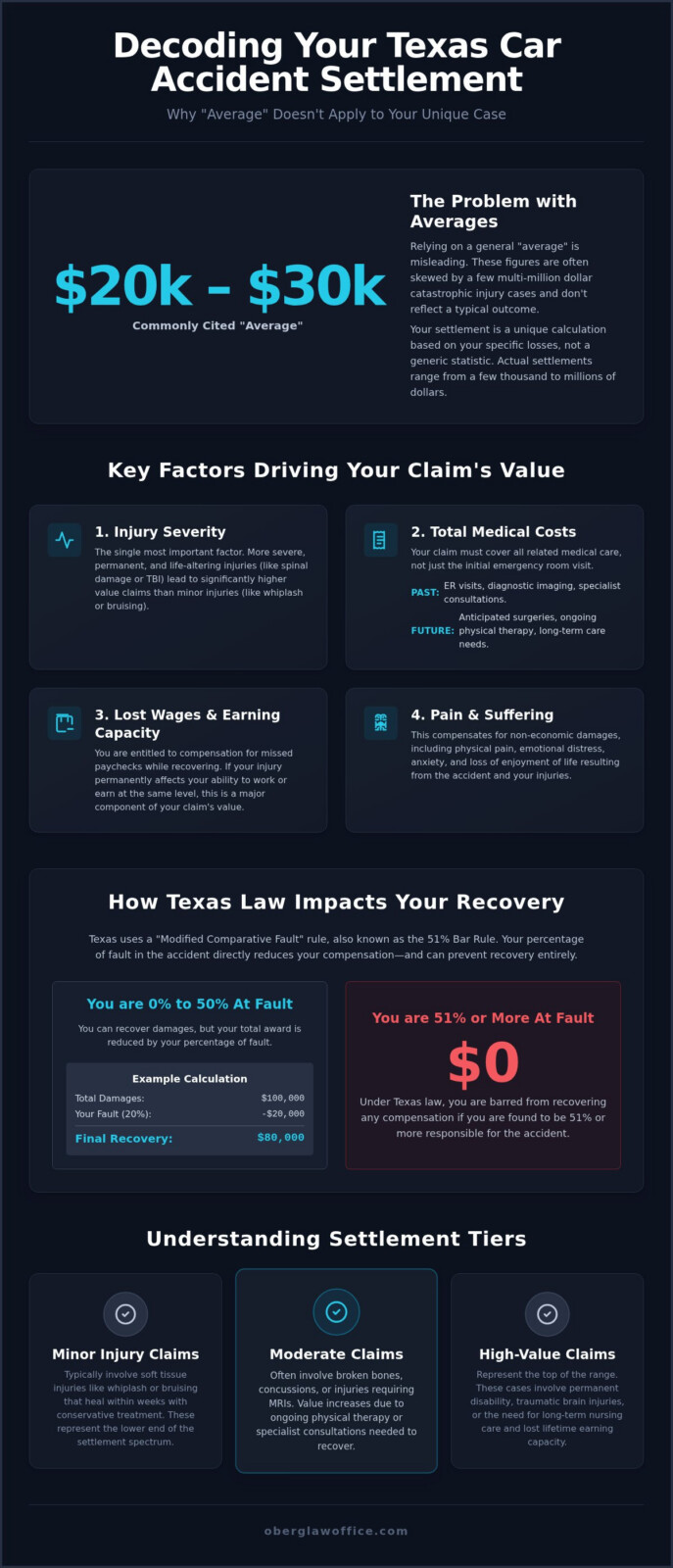
When you search for the average car accident settlement in texas, you’re looking for a roadmap through a very stressful time. It’s natural to want a specific number to help you plan for the future while medical bills sit on your kitchen table. However, a legal settlement is actually a private contract where you agree to release the at-fault party from liability in exchange for a set amount of compensation. Because these agreements are usually confidential, insurance companies don’t release their payout data to the public. This makes most “average” statistics you find online unreliable and often misleading.
Your case isn’t just a number in a spreadsheet. It’s a unique data set built from your specific medical records, the time you’ve been forced to miss at work, and the physical damage to your vehicle. Settlements in our state can range from a few thousand dollars for minor bruises to several million dollars for catastrophic life changes. Every detail of your recovery process shifts the needle, which is why a one size fits all estimate rarely reflects the reality of what a dedicated advocate can secure for you.
The Problem with Using General Statistics
Relying on a typical number can lead to unrealistic expectations that either undervalue your pain or leave you disappointed. Mathematical averages are often skewed upward by “outlier” cases involving multi-million dollar catastrophic injuries. These massive payouts are vital for those victims, but they don’t represent the standard recovery for a typical collision. You also have to consider the difference between a settlement and a jury verdict. A settlement is a guaranteed bird in the hand reached through negotiation; a jury verdict is a court-ordered amount that can be much higher but comes with the risk of receiving nothing if the trial doesn’t go your way. Your recovery is also heavily influenced by the modified comparative negligence rule, which can reduce your payout based on your level of responsibility for the crash.
Understanding the Settlement Range
While there’s no single average car accident settlement in texas, we can look at the spectrum of claims to see where your case might fall. Understanding these tiers helps you see how insurance adjusters categorize your life.
- Minor Injury Settlements: These usually define the lower end of the spectrum. They typically involve soft tissue injuries like whiplash or minor bruising that heals within a few weeks of conservative treatment.
- Moderate Claims: These cases often involve broken bones, concussions, or injuries requiring diagnostic imaging like MRIs. The value increases here because you likely need ongoing physical therapy or specialist consultations to return to your normal life.
- High-Value Claims: These represent the top of the range. These cases involve permanent disability, traumatic brain injuries, or the need for long-term nursing care. The settlements must account for a lifetime of lost earning capacity and future medical needs.
We focus on the personal details of your story because that’s what truly determines the value of your claim. By looking at your specific challenges rather than a generic average, we can build a case that reflects the true cost of what you’ve endured.
Key Factors That Determine Your Texas Settlement Amount
Your physical injury is the primary engine that drives the value of your legal claim. While looking at the average car accident settlement in texas gives you a broad perspective, your specific medical journey is what truly matters to the insurance adjuster. The more severe and permanent your injuries are, the higher the potential settlement. A broken bone that heals in six weeks carries a different weight than a spinal injury that limits your mobility for years to come. We look at the totality of your experience, starting with the immediate medical treatment you received at the scene or ER and extending to every specialist visit you’ve had since.
Future medical expenses are often overlooked by individuals trying to settle quickly. If your doctor anticipates that you’ll need surgery next year or ongoing physical rehabilitation, those costs must be factored into today’s negotiations. You only get one chance to settle your case. If you accept an offer that doesn’t account for future care, you’ll be left paying those bills out of your own pocket. Proving the other driver was 100% at fault is also vital. Any ambiguity regarding who caused the crash gives the insurance company an opening to reduce your payout.
The Role of Economic vs. Non-Economic Damages
Texas law divides your losses into two main categories: economic and non-economic. Economic damages are your “hard costs” that come with a receipt or a paper trail. These include hospital bills, medication costs, and the wages you lost because you couldn’t get to work. Non-economic damages represent the human cost of the crash. This includes pain, suffering, and the mental anguish of losing your independence or your ability to enjoy hobbies. Unlike some other states, Texas does not place a cap on these intangible losses in car accident cases, which allows for a recovery that truly reflects your personal ordeal.
Insurance Policy Limits and Availability
The most frustrating reality of personal injury law is the “ceiling” effect created by insurance policy limits. Most drivers carry the minimum coverage required by the state. Under the standard Texas auto insurance requirements, a driver may only have $30,000 in bodily injury coverage per person. If your medical bills are $100,000, that $30,000 policy is a hard limit unless there are other sources of recovery. This is why we check for Uninsured or Underinsured Motorist (UM/UIM) coverage on your own policy, which can bridge the gap. Claims involving corporate vehicles or commercial trucks often result in higher settlements because those entities carry much larger policies, sometimes reaching into the millions.
If you’re worried that an insurance policy limit might prevent you from getting the care you need, a personalized strategy session can help identify all potential avenues for compensation.
How Texas Laws Impact Your Final Compensation Recovery
Texas laws act as the invisible hand in every insurance negotiation. While you’re focused on the physical recovery and the average car accident settlement in texas, the legal framework in our state determines how much of that settlement actually reaches your bank account. It’s not enough to prove the other driver was careless; you also have to navigate specific statutes that insurance adjusters use to protect their bottom line. Understanding these rules early in the process prevents you from being blindsided by a reduced offer or a flat denial of your claim.
The most critical rule to understand is the “modified comparative negligence” system. This law dictates that your final recovery is tied directly to your percentage of responsibility for the crash. If you’re found partially at fault, your compensation is reduced by that exact percentage. For example, if your case is valued at $100,000 but you’re found to be 20% at fault for the accident, your final check will be $80,000. It’s a harsh reality that requires a steadfast defense of your actions behind the wheel. If you are 51% or more at fault, you recover $0.
Proportionate Responsibility in Texas
Insurance adjusters are experts at finding small ways to shift blame onto you. They might argue that you were driving slightly over the speed limit or that you didn’t react fast enough to a sudden hazard. Even a 10% or 20% shift in fault can significantly decrease your check, saving the insurance company thousands of dollars. They use these tactics because they know that highway safety statistics often show complex factors involved in every collision, and they’ll exploit any ambiguity. To fight back, we focus on gathering clear evidence, from dashcam footage to witness statements, to prove the other party bears the weight of responsibility.
The Texas Statute of Limitations
Time is a silent enemy in personal injury cases. In Texas, you generally have a two-year statute of limitations from the date of the accident to file a lawsuit. Waiting too long to take action can permanently bar your right to recovery, regardless of how severe your injuries are. While two years might seem like a long time, it moves quickly when you’re dealing with surgeries and rehabilitation.
Exceptions to this two-year rule are extremely rare and usually only apply to minors or specific instances where an injury wasn’t immediately discoverable. Early evidence collection is vital because skid marks fade, witnesses move away, and surveillance footage is often deleted after 30 days. Starting your claim early ensures we have the leverage needed to meet every legal deadline while the facts of your case are still fresh and undeniable. This proactive approach is the best way to secure the average car accident settlement in texas that truly reflects the challenges you’ve faced.
Calculating Your Damages: From Medical Bills to Pain and Suffering
Calculating the value of your case is more than just adding up receipts; it’s about painting a complete picture of how your life has changed since the crash. While you might be looking for a simple average car accident settlement in texas, your actual recovery depends on a meticulous four-step process. We begin by totaling your “hard” costs. This includes every ER visit, specialist consultation, and physical therapy session you’ve attended. These numbers provide the objective foundation for your claim, but they’re only the starting point of your story.
The second step involves documenting your lost wages. We use your tax returns and recent pay stubs to show exactly how much income you’ve lost while recovering. Third, we address the human cost through a “multiplier” or “per diem” method. This translates your physical pain and emotional distress into a dollar amount. Finally, we factor in property damage. This ensures the cost of repairing or replacing your vehicle is fully covered. By the time we finish this calculation, the figure often looks very different from a generic average car accident settlement in texas.
Proving Your Losses to the Insurance Adjuster
Insurance adjusters are trained to find reasons to pay you less. To protect your claim, you need a comprehensive medical narrative from your doctor that links your injuries directly to the accident. We also suggest keeping a “pain journal” to document the daily hurdles you face, like the inability to lift your child or the struggle to sleep. Be careful to avoid a “gap in treatment.” If you skip doctor appointments or wait weeks to seek care, the insurance company will argue that your injuries aren’t serious. This is the number one settlement killer in our state, as it gives adjusters the leverage they need to devalue your entire case.
Maximizing the Multiplier for Non-Economic Damages
A higher multiplier, such as 3x or 5x your medical bills, isn’t granted by default; it must be earned through evidence. Factors like permanent scarring, disfigurement, or a loss of mobility significantly impact this calculation. We look at how the accident has stolen your quality of life and strained your family relationships. If you can no longer participate in the community activities or hobbies that defined your life, that loss has real value. We fight to ensure the insurance company sees you as a person with a family, not just a claim number on a desk.
If you’re unsure how to document these intangible losses, you can contact our team for a free strategy session to ensure every detail of your suffering is accounted for in your demand.
How a Personal Injury Attorney Maximizes Your Texas Claim
Insurance adjusters are not your friends. They are skilled professionals trained to protect their company’s profits by paying out as little as possible on every claim. When you have an attorney by your side, you’re no longer a target for their high pressure tactics. Your lawyer handles every phone call and email, which stops the insurance company from twisting your words or tricking you into a recorded statement that could devalue your case. While you might be concerned with the average car accident settlement in texas, your advocate is focused on the maximum recovery your specific injuries deserve.
Whether you are dealing with the aftermath of a crash or navigating other complex legal pathways, you can explore Legal representation and filing services for immigration and personal injury cases with Gagliano Law, PLLC to ensure your rights are fully protected in every arena.
Maximizing a claim requires a deep investigation that goes far beyond the initial police report. We look for additional sources of liability that a layperson might miss, such as vehicle defects or corporate negligence if a commercial driver was involved. We also utilize a network of medical and accident reconstruction experts to provide testimony that proves the full extent of your losses. Perhaps most importantly, a lawyer brings the power of a litigation threat. Insurance companies are much more likely to offer a fair amount when they know you’re prepared to take the case to a Texas courtroom if they refuse to be reasonable.
The Value of Professional Negotiation
The first offer you receive from an insurer is almost always a “lowball” attempt. They’re testing to see if you’re desperate enough to take a quick check and walk away. An experienced advocate knows how to identify the hidden value in your medical records that an adjuster might try to ignore. By documenting the long term impact on your health and your ability to provide for your family, we restore fairness to a system that is inherently designed to favor large institutions. We don’t just accept what is offered; we demand what is just.
To understand the type of sophisticated growth infrastructure that supports elite plaintiff law firms in their fight for justice, you can visit Nexus Legal Group.
The Oberg Law Office Difference
At Oberg Law Office, we believe that personal injury representation should be personal. You aren’t just a file number to us; you are a neighbor facing a significant challenge. When you work with our firm, you interact directly with Gregg Oberg, a lawyer with over 25 years of Texas legal experience, rather than being passed off to support staff. We understand the physical and emotional aftermath of a crash, and we’re here to act as your steadfast protector against aggressive insurance companies.
We believe that everyone deserves access to high quality legal guidance regardless of their current financial situation. That’s why we operate on a contingency-based fee structure, meaning you don’t pay us anything unless we win your case. This shared risk ensures that our goals are perfectly aligned with yours. If you’re ready to move from a state of uncertainty to a feeling of empowerment, we can help you understand how your case compares to the average car accident settlement in texas and build a roadmap for your recovery.
Ready to see what your case is worth? Schedule your free strategy session today.
Take Control of Your Recovery Today
Navigating the aftermath of a collision is overwhelming, but you don’t have to face the insurance companies alone. We’ve seen how the average car accident settlement in texas is often just a baseline; your actual recovery depends on the unique details of your medical care and the clarity of your evidence. Remember that Texas laws like the 51% bar rule are designed to protect insurance profits, making it vital to have an advocate who knows how to defend your rights and document the true human cost of your injuries.
At Oberg Law Office, we provide the personal touch your case deserves. You’ll work directly with Gregg Oberg, a steadfast protector with over 25 years of Texas legal experience, rather than being handed off to a support team. We believe in accessibility and shared risk, which is why we offer a performance-based fee structure where you won’t owe us a dime unless we recover money for you. This allows you to focus on your physical healing while we handle the formidable task of fighting for your security and fairness.
Get Your Free Texas Accident Strategy Session
You’ve already taken the first step by educating yourself on your rights. Now, let’s work together to turn that knowledge into the tangible results you need to move forward with confidence.
Frequently Asked Questions
What is the average car accident settlement in Texas for 2026?
While there is no true mathematical average, the average car accident settlement in texas often falls between $20,000 and $30,000 for many claims. This figure is heavily influenced by a high volume of minor injury cases. For more serious injuries like broken bones or traumatic brain damage, recoveries often range from $45,000 to well over $200,000 depending on the specific losses you’ve endured and the available insurance limits.
How long does it take to receive a settlement check after a car accident?
Most people receive their settlement check within a few months to a year, but the timeline depends on the complexity of your medical treatment. It’s vital to wait until you reach Maximum Medical Improvement (MMI) before settling your case. If you settle too early, you might miss out on compensation for future surgeries or therapy that hadn’t been identified yet, leaving you to pay those bills yourself.
Can I still get a settlement if I was partially at fault for the crash?
You can still recover compensation as long as you are 50% or less at fault for the accident. Texas uses a proportionate responsibility rule, meaning your final check is reduced by your specific percentage of blame. For instance, if you’re found 10% responsible for the collision, you’ll receive 90% of the total damages. If your fault reaches 51%, you’re legally barred from any recovery under state law.
What if the at-fault driver does not have enough insurance to cover my bills?
If the at-fault driver’s policy is too small to cover your bills, we look for other sources of recovery like your own Uninsured or Underinsured Motorist (UM/UIM) coverage. In some cases, we can pursue the personal assets of the driver or check for additional “umbrella” policies. This is why a thorough investigation is essential to find every available dollar for your recovery when the other driver only carries the state minimum.
Do I have to go to court to get a car accident settlement in Texas?
Approximately 95% of car accident claims in Texas are settled out of court without the need for a trial. Most cases are resolved through direct negotiation with the insurance company or during a formal mediation session. While we prepare every case as if it’s going to trial to show the insurer we’re serious, a courtroom appearance is actually quite rare for most of our clients.
What are the most common factors that decrease a settlement amount?
The most common factors that devalue a case include gaps in medical treatment and a lack of clear documentation for your pain and suffering. Insurance adjusters also look for preexisting injuries or social media posts that might suggest you aren’t as hurt as you claim. Any admitted percentage of fault will also directly decrease your final check under the state’s modified comparative negligence rules.
Should I accept the insurance company’s first settlement offer?
You should almost never accept the first offer from an insurance company. These initial offers are typically “lowball” amounts designed to settle the claim quickly and for as little money as possible before you realize the full extent of your injuries. Once you sign a release, you can’t go back for more money even if your condition worsens. It’s always better to have a professional review the offer first.
How much does a personal injury lawyer charge for a car accident case?
Most personal injury lawyers work on a contingency-fee basis, which means there are no upfront costs to you. You only pay a percentage of the final settlement or award if we win your case. If we don’t recover money for you, you don’t owe us any legal fees at all. This structure ensures that everyone has access to high-quality legal protection regardless of their current financial situation.