
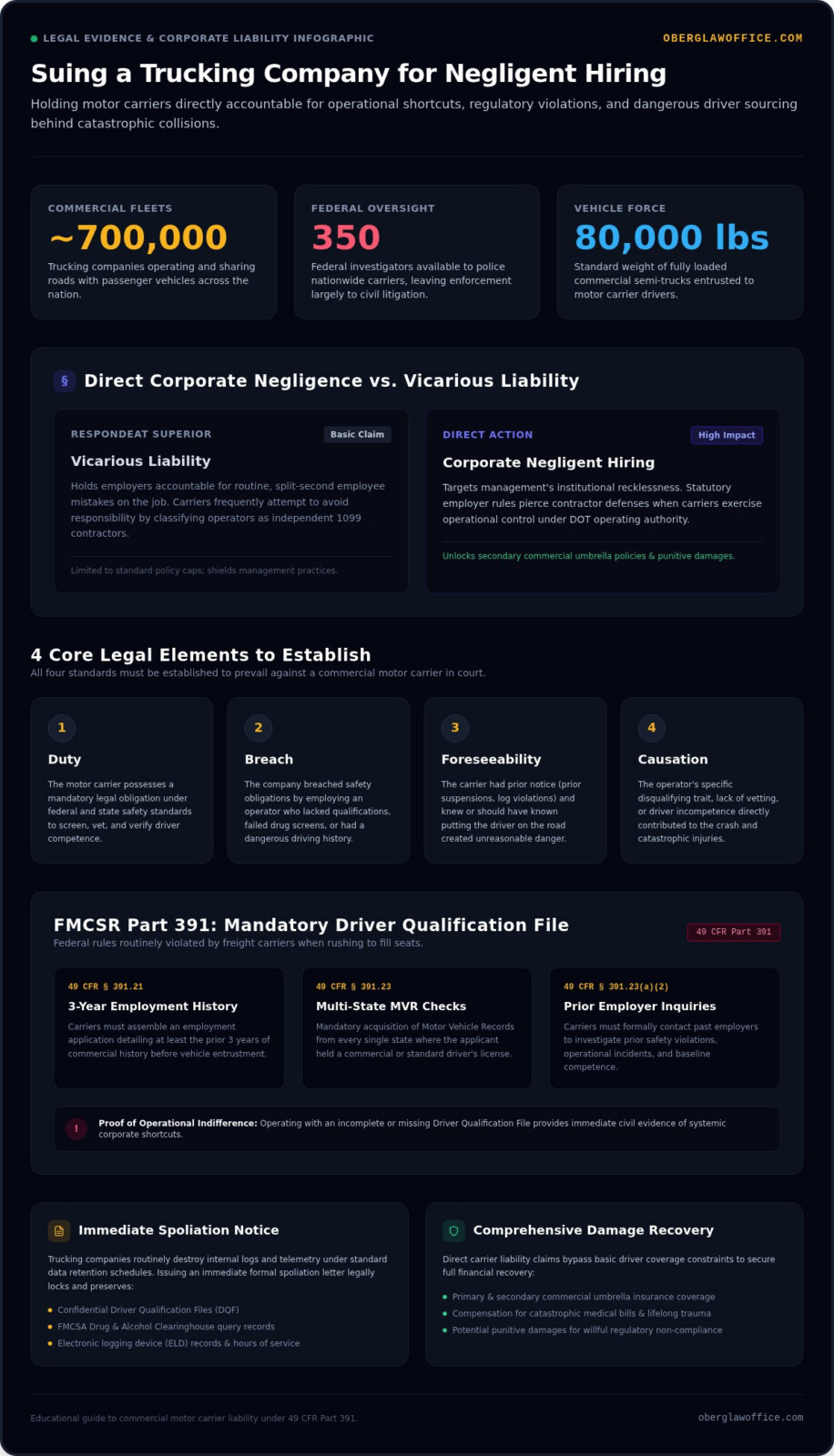
When an eighty-thousand-pound commercial truck upends your life, the motor carrier’s defense team will almost certainly claim their driver made an isolated, unpredictable mistake. That is rarely the whole truth. Across the country, approximately 700,000 trucking companies share the road with everyday families, and some routinely prioritize tight freight schedules over basic safety checks. When motor carriers bypass federal screening rules, suing a trucking company for negligent hiring cuts straight to the source of the danger, holding the corporation accountable for putting an unqualified driver behind the wheel.
You already feel the crushing weight of catastrophic injuries and surging medical bills, especially while corporate insurers scramble to deflect liability. You don’t have to carry that burden alone. Discover how targeting direct carrier negligence unlocks critical commercial umbrella policies beyond standard driver limits. This guide details how compelling the driver’s confidential qualification file exposes systemic corporate failures, dismantles deceptive carrier defenses, and helps you build an unassailable claim.
Key Takeaways
- Understand how establishing direct corporate liability holds motor carriers accountable for their own dangerous management practices rather than treating crashes as isolated driver mistakes.
- Learn how suing a trucking company for negligent hiring reveals violations of mandatory federal regulations under 49 CFR Part 391, such as skipped driving records and ignored safety checks.
- Discover why issuing an immediate spoliation letter is vital to preserve confidential Driver Qualification Files and prevent the routine destruction of critical carrier records.
- See how proving corporate hiring negligence can unlock primary commercial umbrella policies to secure full compensation for catastrophic medical bills and lifelong trauma.
- Find out how working with seasoned trial counsel under a contingency fee arrangement ensures your claim receives dedicated senior legal representation without upfront costs.
What Constitutes Negligent Hiring in the Commercial Trucking Industry?
A collision involving a commercial semi-truck rarely stems from a split-second mistake alone. Behind many devastating highway crashes lies a company culture that cut corners long before the truck ever left the loading dock. Negligent hiring is an independent, direct cause of action against a motor carrier. Rather than blaming the driver alone, it holds the transportation company accountable for its own reckless operational practices.
To prevail when suing a trucking company for negligent hiring, you and your legal team must establish four core legal elements:
- Duty: The motor carrier had a legal obligation under federal and state safety standards to screen, vet, and verify the competence of its drivers.
- Breach: The carrier breached that duty by employing a driver who lacked qualifications, failed drug screens, or possessed a dangerous driving history.
- Foreseeability: The carrier knew, or reasonably should have known, that placing this individual behind the wheel created an unreasonable danger to the traveling public.
- Proximate Causation: The driver’s specific incompetence or disqualifying trait directly contributed to the crash and your resulting injuries.
Establishing direct corporate negligence does more than validate the truth; it often unlocks secondary commercial umbrella policies and creates a pathway to punitive damages that standard insurance limits shield.
Direct Corporate Negligence vs. Vicarious Liability
Most basic personal injury claims rely strictly on respondeat superior. This doctrine holds an employer vicariously liable for an employee’s careless mistakes during the workday. Direct corporate negligence goes deeper by targeting management’s institutional recklessness. Motor carriers frequently attempt to dodge vicarious liability by labeling drivers as independent contractors or 1099 operators. Federal regulations and statutory employer rules dismantle this shield. If a carrier exercises operational control or permits an unsafe operator to haul freight under its Department of Transportation operating authority, the company cannot disown that driver when disaster strikes.
The Legal Doctrine of Foreseeability in Driver Sourcing
Entrusting an 80,000-pound commercial vehicle to an unqualified operator is inherently dangerous. In a negligent hiring lawsuit, foreseeability hinges on prior notice. Did the applicant have prior suspensions, multiple logbook violations, or a pattern of reckless driving on their record? When an employer ignores clear red flags during the application process, the catastrophic collision that follows is not an accident; it is the predictable consequence of putting corporate revenue ahead of public safety.
Federal Safety Regulations That Motor Carriers Routinely Violate
The Federal Motor Carrier Safety Administration (FMCSA) sets strict safety rules for a reason. Even so, with roughly 700,000 trucking companies operating across the nation and only 350 federal investigators to police them, real enforcement often happens through civil litigation. When freight companies scramble to fill empty seats, they routinely bypass federal hiring baselines. Uncovering these regulatory shortcuts is often the most powerful strategy when suing a trucking company for negligent hiring.
FMCSR Part 391: Mandatory Driver Qualification Files
Under 49 CFR Part 391, every motor carrier must assemble a comprehensive Driver Qualification File before entrusting a commercial vehicle to an operator. Carriers must obtain an employment application covering at least the previous three years under 49 CFR § 391.21, alongside Motor Vehicle Records (MVR) from every state where the applicant held a license under § 391.23. Reviewing federal driver qualification regulations shows that carriers also must contact previous employers to investigate prior safety incidents. When a carrier puts a driver on the road with an empty or incomplete file, that administrative shortcut proves operational indifference.
FMCSA Drug & Alcohol Clearinghouse Compliance Failures
Substance abuse screening is another mandatory safeguard that reckless carriers ignore. Under 49 CFR § 382.301, pre-employment drug screening is non-negotiable. Employers must also run mandatory queries through the FMCSA Drug and Alcohol Clearinghouse before putting any driver behind the wheel. This database flags unresolved violations, previous test refusals, and failed screenings from prior employers. Placing an operator with an active drug violation in the cab represents an indefensible breach of public safety.
Medical Certifications and Commercial Driver Disqualifications
Operating an eighty-thousand-pound vehicle requires sound physical health. Department of Transportation (DOT) physical examinations verify that a driver has adequate vision, hearing, and cardiovascular stability. Carriers often overlook lapses in medical certifications, including untreated obstructive sleep apnea or serious neurological disorders that lead to sudden incapacitation. Putting an uncertified or physically disqualified trucker on the interstate places everyone at risk. Pursuing dedicated truck accident representation allows your legal team to subpoena medical records and identify whether an invalid commercial driver’s license contributed to your crash.
Critical Evidence Needed to Prove Negligent Hiring and Retention
Motor carriers hold all the cards immediately following a wreck. The black box data, maintenance logs, and personnel files sit entirely in their possession. Without swift legal intervention, critical proof can vanish through scheduled record overwrites or convenient document purges. Successfully suing a trucking company for negligent hiring requires gathering objective evidence before corporate risk managers rewrite the narrative.
Sending a Formal Spoliation Letter to Preserve Evidence
A spoliation letter is a formal legal notice demanding the immediate preservation of all physical, mechanical, and digital evidence tied to a wreck. It must go out immediately. Under federal record-retention rules, carriers can legally purge electronic logging device (ELD) telematics, dispatch messages, and dashcam footage in as little as six months. A properly served spoliation demand legally binds the carrier to preserve several key assets:
- Engine Control Module (ECM) black box downloads documenting vehicle speed, braking, and throttle percentages.
- Electronic logging data cross-referenced against cell records to identify chronic hours-of-service violations.
- Dispatch communications showing pressure to meet unrealistic delivery windows.
- The complete Driver Qualification File, including application notes, previous employer questionnaires, and road test evaluations.
If a motor carrier destroys these files after receiving notice, trial judges can issue severe evidentiary sanctions, including instructing the jury to assume the destroyed records proved corporate wrongdoing.
Uncovering Concealed Driver Histories via Independent Discovery
While the traditional legal doctrine of respondeat superior holds employers liable for on-the-job driving mistakes, independent discovery targets the hiring desk. Trucking companies under tight staffing pressures frequently skip basic background inquiries. Subpoenaing state motor vehicle records often reveals suspended licenses, prior DUIs, or serious moving violations that an applicant concealed. Depositions of safety directors expose internal corporate pressures, highlighting instances where management knowingly looked past severe safety red flags just to keep a rig rolling.
Securing justice requires relentless investigation into hidden corporate records. Partnering with a dedicated truck accident lawyer ensures every corner of the carrier’s hiring apparatus is thoroughly audited, holding negligent motor carriers accountable when corporate shortcuts lead to life-altering harm.
Damages Recoverable in Corporate Trucking Negligence Lawsuits
A collision with an eighty-thousand-pound rig inflicts life-altering harm. When you establish corporate fault beyond simple driver error, your claim transforms from a standard vehicle crash case into complex institutional litigation. Proving direct corporate negligence pierces standard coverage caps, opening pathways to multi-layered commercial umbrella policies that protect your long-term security.
Economic vs. Non-Economic Injury Compensation
Commercial collisions create overwhelming financial fallout. Calculating what you are owed requires tallying current losses alongside decades of projected hardship. The law divides these recoveries into two vital categories:
- Economic Damages: Concrete financial losses, including medevac transport, emergency trauma surgeries, extended intensive care stays, prosthetic devices, lost earnings, and permanent reduction in earning capacity.
- Non-Economic Damages: The human toll of the wreck, such as chronic physical pain, mental anguish, permanent physical impairment, disfigurement, and loss of consortium for spouses struggling with the sudden upheaval of their partnership.
When injuries are severe, your legal team collaborates with certified life-care planners and forensic economists. These specialists calculate lifetime costs for continuous attendant care, home modifications, and future surgical interventions, ensuring the motor carrier’s insurer pays for the real scope of your recovery.
Pursuing Punitive Damages for Conscious Indifference
Ordinary negligence stems from a mistake; gross negligence involves a conscious indifference to human safety. When you proceed with suing a trucking company for negligent hiring, you target management decisions that put profit ahead of public well-being. If internal records prove the carrier knowingly hired an operator with a revoked commercial license, a history of reckless crashes, or failed drug screenings, the legal inquiry shifts. Juries readily award exemplary, or punitive, damages to punish corporations that gamble with innocent lives to preserve their delivery timetables.
Surviving a devastating wreck alters your reality instantly. Securing dedicated guidance from a compassionate catastrophic injury lawyer safeguards your family from financial ruin. If you are struggling under the weight of catastrophic harm, schedule a free legal strategy session with an experienced advocate who will stand beside you against corporate insurers.
Choosing the Right Legal Advocacy for Your Trucking Lawsuit
Confronting a corporate transportation carrier is fundamentally different from resolving a typical passenger car accident. When suing a trucking company for negligent hiring, you aren’t simply negotiating an everyday insurance settlement. You are challenging sophisticated defense firms determined to shield carrier executives from accountability. Managing catastrophic injuries while facing this institutional resistance is exhausting. You need a steadfast advocate in your corner who understands commercial fleet operations and possesses the courtroom tenacity to fight for your recovery.
Why Commercial Truck Litigation Demands Deep Courtroom Tenacity
Commercial fleet defense teams deploy aggressive strategies from day one. They stall discovery requests, object to releasing internal safety audit memos, and attempt to run out procedural clocks. Standard personal injury tactics that prioritize quick, discounted settlements fail against these well-funded corporate opponents. Overcoming their resistance demands seasoned trial readiness. With over 25 years of courtroom experience taking on national motor carrier insurers in serious vehicle collision claims, principal attorney Gregg Oberg knows how to dismantle corporate defense tactics and present unassailable evidence to a jury.
The Advantage of Direct Advocacy and Contingency Representation
Large settlement-mill firms routinely pass complex trucking cases down to junior associates or administrative staff. You deserve direct, compassionate partnership during such a vulnerable chapter of your life. Direct attorney representation guarantees your case is evaluated, investigated, and led personally by senior legal counsel from the initial filing through final verdict.
Financial anxiety should never prevent your family from pursuing justice. A contingency fee structure eliminates all upfront fees and out-of-pocket expenses, meaning you pay nothing unless your case reaches a successful resolution. This framework ensures our commitments align directly with securing maximum compensation for your medical needs and lifelong financial stability. During your initial consultation, senior counsel will review the crash evidence, identify federal safety breaches, and construct an actionable roadmap. Take the first step toward justice by scheduling a free initial strategy session with Oberg Law Office.
Reclaim Your Future After a Devastating Commercial Truck Crash
You don’t have to accept the motor carrier’s excuse that a catastrophic collision was an isolated driver mistake. Demanding accountability through corporate personnel audits exposes institutional safety shortcuts, compelling insurers to acknowledge systemic corporate failures. Suing a trucking company for negligent hiring shifts the legal spotlight to where it belongs: on the decision-makers who gambled with public safety to protect their bottom line.
Rebuilding your life takes dedicated support and seasoned trial experience. With over 25 years of courtroom advocacy holding commercial carriers accountable, principal attorney Gregg Oberg personally leads your claim rather than passing your future to junior staff. Financial stress shouldn’t stand in the way of justice. Our contingency fee structure ensures you pay zero fees unless financial compensation is recovered. Schedule your free, confidential truck accident strategy session today with Oberg Law Office, and take the first step toward lasting restoration and peace of mind.
Frequently Asked Questions
What is the difference between negligent hiring and negligent retention?
Negligent hiring occurs when a carrier recruits an unfit driver despite disqualifying red flags, whereas negligent retention happens when the company keeps an employee after learning about dangerous behavior on the job. Hiring focuses on pre-employment failures, like skipping mandatory background checks. Retention addresses management’s failure to reassign or fire a driver who accumulates recent speeding citations, failed drug tests, or preventable crashes while in their service.
Can an employer be sued if the commercial truck driver is an independent contractor?
Yes, motor carriers cannot hide behind independent contractor agreements to avoid legal accountability. Federal safety regulations classify lease operators under statutory employment rules whenever they haul freight under the motor carrier’s operating authority. When suing a trucking company for negligent hiring, your attorney targets the carrier’s independent corporate duty to vet anyone entrusted with commercial equipment, regardless of what tax form the driver signs.
How quickly must an attorney send a spoliation letter to preserve the driver’s records?
An attorney should send a spoliation letter immediately following the collision. Federal guidelines permit transportation companies to overwrite or discard electronic logs and dashcam files after six months. In practice, onboard computer systems often overwrite telematics data within days. Serving a formal legal preservation demand right away stops carriers from destroying critical proof before formal litigation discovery begins.
What background checks are trucking companies legally required to run before hiring?
Motor carriers must thoroughly review three years of driving history and employment records under 49 CFR Part 391. Carriers must pull Motor Vehicle Records from every state where the applicant held a license, verify commercial licensing status, check safety performance with former employers, and confirm valid medical examiner certifications. They must also perform mandatory pre-employment drug screening before dispatching the driver onto public roads.
Can I recover punitive damages in a negligent hiring lawsuit against a motor carrier?
Yes, you can recover punitive damages if the carrier acted with gross negligence or conscious indifference to human safety. While compensatory damages cover medical debt and trauma, punitive awards punish reckless corporate practices. When suing a trucking company for negligent hiring, proving that management knowingly dispatched an unlicensed, impaired, or severely unqualified driver provides the legal ground necessary to demand exemplary damages from a jury.
How much does it cost upfront to hire an attorney to sue a trucking company?
It costs nothing out of pocket to retain dedicated legal representation for your collision claim. Reputable truck litigation firms operate on a contingency fee structure. You pay zero upfront costs for court filings, accident reconstruction specialists, or investigative hours. The firm only collects legal fees as an agreed percentage of your final settlement or courtroom verdict, keeping your family protected from financial risk.
What happens if the motor carrier failed to check the FMCSA Drug & Alcohol Clearinghouse?
Skipping the FMCSA Clearinghouse query constitutes a serious federal safety breach that establishes direct corporate liability. Federal law requires every carrier to search this database before hiring any commercial operator. If an applicant has an unresolved drug violation or test refusal on record and the carrier never checks, the company is directly liable for any crash caused by that driver’s subsequent impairment.