
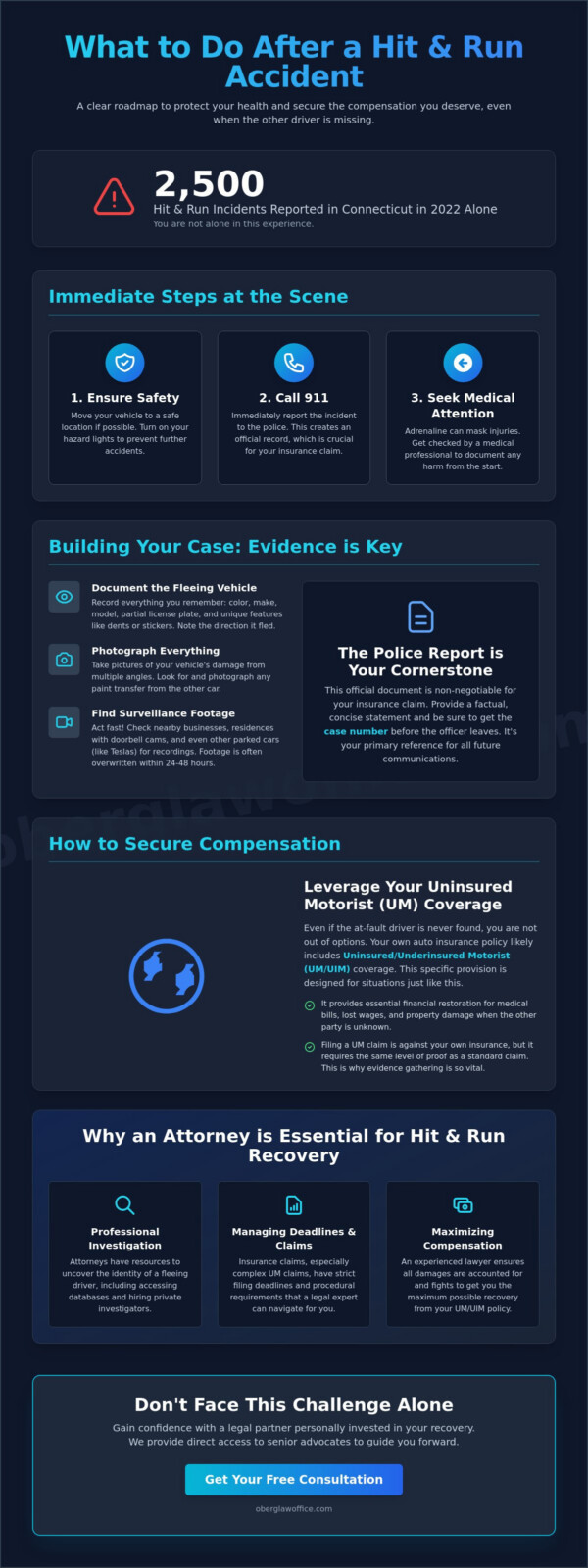
A missing driver doesn’t mean a missing case; it’s a strategic hunt for the coverage and justice you deserve. You’re likely feeling a mix of anger and fear as you wonder what to do after a hit and run accident, especially with medical bills mounting and no one to hold accountable. It’s a heavy burden to carry, and with 2,500 hit and run incidents reported in Connecticut in 2022 alone, many of your neighbors have felt this same uncertainty and frustration.
We’re here to ensure you don’t face this challenge alone. This guide provides a clear roadmap to protect your health and secure compensation even when the at-fault driver flees the scene. You’ll learn how to preserve vital evidence, how to leverage Uninsured Motorist coverage, and how to navigate the 2026 insurance requirements that affect your recovery. Our goal is to move you logically from a state of uncertainty to a position of absolute confidence in your legal recourse.
Key Takeaways
- Prioritize your safety and establish an official record by notifying local authorities immediately after the impact.
- Master what to do after a hit and run accident by identifying neighborhood surveillance cameras and securing witness statements to build a robust evidence file.
- Understand how specific policy features like Uninsured Motorist coverage provide essential financial restoration even if the other driver is never found.
- Learn how a professional investigation can uncover the identity of a fleeing party and manage the strict insurance deadlines required for a successful claim.
- Gain confidence through a partnership that offers direct access to senior legal advocates who are personally invested in your car accident representation.
Immediate Steps to Take at the Scene of a Hit and Run
The moments following a collision are often a blur of adrenaline and confusion. One second you’re driving, and the next, you’re left standing among debris while the other vehicle speeds away. It’s a jarring experience that leaves you feeling vulnerable and angry. However, the actions you take in the next few minutes are vital. Knowing exactly what to do after a hit and run accident can be the difference between a stalled claim and a successful recovery. Your first priority is safety. If your vehicle is still operable, move it to the shoulder or a nearby well-lit parking lot to avoid a secondary collision. Turn on your hazard lights and take a deep breath.
Once you’re in a safe spot, call 911 immediately. Even if you think the damage is minor, you need an official record of the flight. This call establishes the time and location of the incident, which is a critical data point for your insurance provider. While you wait for help, seek medical attention. Adrenaline is a powerful mask; it can hide the pain of whiplash, internal bruising, or concussions for hours or even days. Getting checked out by a professional creates a direct link between the accident and your physical health, ensuring your injuries are documented from the start.
Documenting the Fleeing Vehicle
Memory is fragile under stress. Grab your phone and record a voice note or type out every detail you can recall while it’s fresh. Focus on the vehicle’s color, make, and model. Did you catch a partial license plate? Even two or three characters can help investigators narrow down the search. Look for unique markers that set the car apart, such as a dented fender, a specific bumper sticker, or aftermarket wheels. Note the direction the driver was heading when they left the scene. Did they turn at a specific intersection or merge onto a highway? These small details act as breadcrumbs for law enforcement.
The Importance of a Police Report
A police report is the cornerstone of your insurance claim. Without it, many carriers will struggle to process a hit and run filing. When the officer arrives, provide a statement that’s factual and concise. Stick to the details you’re certain about and avoid guessing. Understanding local hit-and-run laws is helpful, but your primary role is to provide the raw data for the official record. Before the officer leaves, ensure you obtain the case number. This number is your primary reference for all future insurance and legal communications, keeping your recovery organized and moving forward.
Gathering Critical Evidence When the Other Driver Is Missing
When the person responsible for your injuries disappears into traffic, it’s easy to feel like justice has vanished with them. It hasn’t. While the previous steps focused on your immediate safety, this phase is about building a solid foundation for your recovery. Knowing what to do after a hit and run accident means becoming an active participant in the search for truth. Your smartphone is your most powerful tool in these moments. Start by photographing the damage to your vehicle from multiple angles. Look closely for “paint transfer” where the fleeing car’s color might have rubbed off on yours. These tiny flakes are physical proof of contact that can help investigators identify the other vehicle later.
Don’t overlook modern technology like dashcams. If your car isn’t equipped with one, look at the vehicles parked nearby. Many modern cars, especially Teslas, have cameras that record surroundings even when the vehicle is stationary. If you see a car with a visible camera lens, consider leaving a polite note for the owner or asking nearby businesses if they know who the vehicle belongs to. When seeking compensation for a hit-and-run, your insurance provider will require clear evidence that the incident occurred as you described. If the task of collecting this data feels overwhelming while you’re in pain, reaching out for professional car accident representation can provide the investigative support you need to move forward.
Identifying Third-Party Surveillance
Digital evidence is often the key to solving a hit and run, but it’s incredibly time-sensitive. Most commercial security systems “loop” their footage, meaning they might overwrite the recording of your accident within 24 to 48 hours. Approach local business owners or managers as soon as possible. Be neighborly and explain the situation; most are willing to help a member of their community. In residential areas, doorbell cameras have become a goldmine for evidence. A neighbor’s Ring or Nest camera might have captured the fleeing car’s license plate or a clear shot of the driver even if the collision happened a block away.
Working with Witnesses
Witnesses are vital when physical evidence is scarce because they provide a neutral perspective that validates your version of events. If anyone stopped to help, secure their names and phone numbers immediately. Ask them specific questions while the memory is fresh. Did they see the driver’s face? Can they describe the driver’s age, gender, or clothing? Neutral third parties carry significant weight with insurance adjusters because they have no financial stake in the outcome of your claim. Their testimony can transform a “he-said, she-said” situation into a clear-cut case for restoration and fairness.
How to Secure Compensation When the At-Fault Party Is Unknown
It feels fundamentally unfair to pay for someone else’s recklessness. While the earlier stages of your recovery focused on gathering proof, the true challenge of what to do after a hit and run accident often begins when you open your insurance policy. If the other driver is never found, your own insurance provider effectively steps into the shoes of the at-fault party. This transition is a critical moment for your financial security. Your Uninsured Motorist (UM) coverage and Personal Injury Protection (PIP) become the primary tools for restoration, ensuring that a missing driver doesn’t leave you with a mountain of debt.
As of June 2026, 22 states require UM coverage because it specifically protects victims when the responsible party remains unidentified. Similarly, if you’re in one of the 12 “no-fault” states, your PIP coverage acts as an immediate safety net. It pays for your medical expenses and lost wages regardless of who caused the crash. These benefits are designed to provide a sense of fairness, yet accessing them isn’t always straightforward. You might encounter “phantom vehicle” rules, where your insurer requires proof of physical contact or a neutral witness to confirm another car caused the accident without touching your vehicle.
Your insurance company may have a neighborly reputation, but they often become an adversary during a hit and run claim. They’re a business focused on minimizing payouts. They might question the severity of your injuries or the circumstances of the flight to protect their bottom line. This is a difficult shift to manage while you’re still in pain. Recognizing this dynamic early allows you to approach every conversation with the caution and clarity needed to protect your future.
Uninsured Motorist Coverage Explained
UM coverage acts as a substitute for the liability insurance the fleeing driver failed to provide. It’s divided into two parts: bodily injury and property damage. While bodily injury coverage is common, some policies require a separate endorsement to cover the repairs to your car. You must act quickly. Most insurance contracts have strict notification windows, sometimes requiring you to report a hit and run within 30 days to remain eligible for benefits. Missing these deadlines can jeopardize your entire path to restoration.
Dealing with Insurance Adjusters
Adjusters are trained to look for inconsistencies that can justify a claim denial. A simple statement like “I’m doing okay” during a recorded call can be used later to argue that your injuries aren’t serious. It’s a common tactic that catches many people off guard. You deserve a steadfast protector in these moments. Utilizing professional car accident representation ensures that an expert handles all communications, preventing the insurance company from using your words against you while you focus on your physical recovery.
Why an Attorney Is Essential for Hit and Run Recovery
Recovering from a collision is a full-time job, but you shouldn’t have to be your own investigator, paralegal, and negotiator while you’re trying to heal. When you’re weighing what to do after a hit and run accident, the most impactful decision you can make is to bring a steadfast protector onto your team. An attorney doesn’t just fill out forms; they act as a knowledgeable guide through a system that is often designed to be confusing and exclusionary. This partnership allows you to focus on your physical restoration while we handle the formidable task of securing your future.
The administrative burden of a hit and run is uniquely heavy. Between strict insurance notification windows and the complex requirements of Uninsured Motorist claims, a single missed deadline can derail your entire case. We step in to manage these timelines with unwavering determination. This includes meticulously documenting your injuries and negotiating with adjusters who may try to minimize your experience. Having professional car accident representation means you have someone personally invested in your result, ensuring that no detail is overlooked and no right is waived.
The Investigative Power of a Law Firm
While local police departments do their best, they’re often stretched thin by the sheer volume of traffic incidents. In 2024, for example, Connecticut recorded more than 103,000 vehicle crashes. A dedicated law firm has the resources to conduct an independent investigation that goes far deeper than a standard police report. We work with private investigators to canvass neighborhoods and use subpoenas to secure footage from commercial cameras that might have been denied to you. Legal discovery allows your representative to compel the production of records and high-definition footage that are otherwise shielded from public view. By tracing partial license plates and identifying vehicle owners through specialized databases, we work to unmask the driver who fled the scene.
Maximizing Your Financial Recovery
Securing a settlement is about more than just paying off current hospital bills; it’s about securing your long-term security. We look at the true cost of your “pain and suffering,” acknowledging the emotional trauma that follows a hit and run. This includes calculating future medical expenses, potential lost earning capacity, and the ongoing support you may need. If you’re unsure how to choose the right partner for this journey, refer to our guide to hiring a car accident lawyer for more on the selection process. Our goal is to provide the peace of mind you need to move from a state of uncertainty to a feeling of total empowerment.
Partnering with Oberg Law Office for Your Recovery
Navigating the aftermath of a collision is exhausting, especially when the person responsible has vanished. You shouldn’t have to spend your energy arguing with adjusters or chasing down lead after lead. Our firm operates on the “Steadfast Protector” philosophy. This means we don’t just process your paperwork; we stand as a formidable barrier between you and the institutions that might try to minimize your suffering. When you’re deciding what to do after a hit and run accident, remember that you deserve a partner who is personally invested in your restoration and fairness.
We provide a level of personal attention that is rare in the legal industry. You won’t be handed off to a support staff member or an automated system. Instead, you’ll have direct access to senior legal professionals who understand every nuance of your case. This collaborative partnership ensures your voice is heard and your specific needs are prioritized. We’ve seen the physical and emotional toll these events take on our neighbors; we’re committed to providing the steady, comforting guidance you need to move toward a state of empowerment.
A Neighborly Approach to Tough Legal Battles
Large insurance companies have vast resources, but they lack the personal connection we have with our community. We treat you like a person, not a case number. Our history is defined by fighting these large institutions on behalf of victims who feel they’ve been forgotten. We understand that a hit and run is more than just property damage; it’s a violation of your security. For a broader look at your rights and the recovery process, you can explore our personal injury guide. This resource helps clarify the path forward when you’re facing significant challenges.
No Recovery, No Fee
Financial barriers should never stand in the way of justice. We believe in accessibility and shared risk, which is why we utilize a performance-based fee structure. You don’t pay us unless we secure a recovery for you. This commitment ensures that our goals are perfectly aligned with yours. It’s a signature promise that allows you to pursue the compensation you deserve without the stress of upfront costs. If you’re ready to take the first step toward securing your future, we invite you to book your free strategy session today. It’s a low-pressure opportunity to discuss your situation and discover how we can help you achieve the results you need.
Take the First Step Toward Your Strategic Recovery
You’ve gained the knowledge to turn a chaotic event into a manageable path forward. By understanding what to do after a hit and run accident, you’ve moved from a state of uncertainty to a position of strength. You know how to preserve digital evidence from doorbell cameras and how to leverage your own insurance policy for the restoration you deserve. This journey is about more than just medical bills; it’s about reclaiming your sense of security and fairness in your own community.
You don’t have to navigate this complex legal landscape alone. With over 25 years of experience, Attorney Gregg Oberg provides the personalized representation you need to stand firm against large insurance institutions. We operate on a contingency-based fee structure, which means you only pay if we win. This shared risk is our promise of accessibility to every neighbor facing a difficult recovery. Get Your Free Hit and Run Strategy Session Today and let us act as your steadfast protector. You’ve been through enough; it’s time to focus on healing while we handle the rest.
Frequently Asked Questions
Is a hit and run considered a felony or a misdemeanor?
The classification depends entirely on the severity of the crash and the laws in your specific state. In Washington, for example, a hit and run causing property damage is a misdemeanor, but an injury elevates the charge to a Class C felony. Florida mandates a minimum of four years in prison for leaving the scene of a fatal accident. These strict penalties reflect a growing trend toward holding fleeing drivers accountable for their actions.
What happens if the police never find the driver who hit me?
You can still secure financial restoration through your own insurance policy even if the at-fault party remains unidentified. This is exactly why Uninsured Motorist (UM) coverage exists in 22 states. Your insurer effectively steps into the role of the missing driver’s insurance, providing the funds needed for medical bills and vehicle repairs. It’s a vital safety net that ensures you aren’t left holding the bill for someone else’s mistake.
Can I still file an insurance claim if there were no witnesses?
Yes, you can file a claim by relying on physical evidence and modern digital records. While a neutral third party is helpful, adjusters also look at paint transfer on your vehicle, debris at the scene, and footage from nearby dashcams or doorbell cameras. Clear documentation is the key to proving your case. This is a primary part of what to do after a hit and run accident to ensure your claim remains viable.
How long do I have to report a hit and run accident to my insurance?
You should notify your insurance provider as soon as possible, as many policies have strict notification windows. While some states have long statutes of limitations for lawsuits, your specific insurance contract might require a report within 24 to 72 hours. Missing these internal deadlines can sometimes jeopardize your ability to use Uninsured Motorist benefits. Checking your policy early helps protect your right to a fair recovery.
Will my insurance rates go up if I file a hit and run claim?
Your rates shouldn’t necessarily increase if you aren’t at fault for the collision. Many states have specific protections that prevent insurance companies from raising premiums for accidents caused by a fleeing driver. These laws are designed to be fair to victims who are already dealing with physical and emotional trauma. It’s always a good idea to review your local regulations to see how these protections apply to your situation.
Do I need to stay at the scene if the other driver already left?
You must stay at the scene until the police arrive and you’ve completed an official report. Leaving prematurely can make it look like you were also trying to evade responsibility or could lead to a loss of vital evidence. Staying put allows you to identify nearby cameras and speak with anyone who might have seen the vehicle leave. This patience is a critical step in building a strong foundation for your future car accident representation.
What if I was a pedestrian in a hit and run accident?
Pedestrians have the same rights to compensation and can often access benefits through their own auto insurance or a policy held by a household member. Features like Personal Injury Protection (PIP) and Uninsured Motorist coverage typically follow the policyholder even when they aren’t inside a vehicle. This provides an essential layer of security for people walking or cycling in the community. It ensures that medical expenses are covered during a difficult recovery.
How much does a hit and run lawyer cost?
Most attorneys in this field use a contingency-based fee structure, meaning they only receive payment if they successfully recover money for you. This model is built on shared risk and accessibility, ensuring that financial barriers don’t stop you from seeking justice. You won’t have to worry about hourly bills while you’re trying to heal. Instead, the firm’s interests are perfectly aligned with your goal of achieving a fair and full restoration.