
What if the scary legal notice you just received in the mail wasn’t a threat to your recovery, but the very tool that ensures you get the medical care you deserve? Most people feel a wave of panic when they first ask, what is a medical lien in a personal injury case, especially when a “Notice of Lien” arrives while they are still healing. It’s completely natural to worry that a hospital or insurance company will swoop in and take your entire settlement. You’ve already endured the trauma of an accident; you shouldn’t have to face the fear of being left with nothing.
We understand the confusion that sets in when your own health insurance doesn’t cover every bill or when providers demand payment from your future compensation. This guide will help you understand how these legal claims work in 2026, including the current $750 Medicare recovery threshold and how new laws in states like Texas and Florida affect your rights. You’ll learn that liens are often negotiable and that your legal team acts as your protector during billing disputes. We’ll walk through exactly how to safeguard your settlement so you can focus on your physical restoration while we handle the fine print.
Key Takeaways
- Understanding what is a medical lien in a personal injury case is the first step toward protecting your settlement and ensuring your doctors are paid fairly for your care.
- Learn which healthcare providers and insurance companies have the right to place a claim on your recovery and why this process acts as a bridge to your physical restoration.
- Discover how medical liens interact with your total settlement amount and why higher medical costs can sometimes increase the overall value of your pain and suffering claim.
- Find out how to leverage the “cost of litigation” to negotiate significant discounts on what you owe, leaving more money in your pocket for your future needs.
- See how professional legal advocacy shields you from aggressive billing departments, allowing you to focus on healing while we manage the complex paperwork for you.
Understanding Medical Liens: A Bridge to Your Physical Recovery
You’ve been hurt, and the bills are piling up. It’s a heavy weight to carry while you’re trying to heal. You might wonder how you’ll pay for surgery or physical therapy when the insurance company is still dragging its feet. This is where a medical lien steps in. Essentially, a lien is a legal claim held by a healthcare provider or insurer against your future settlement. It acts as a financial bridge, allowing you to get the treatment you need today without paying a single dollar out-of-pocket until your case is resolved.
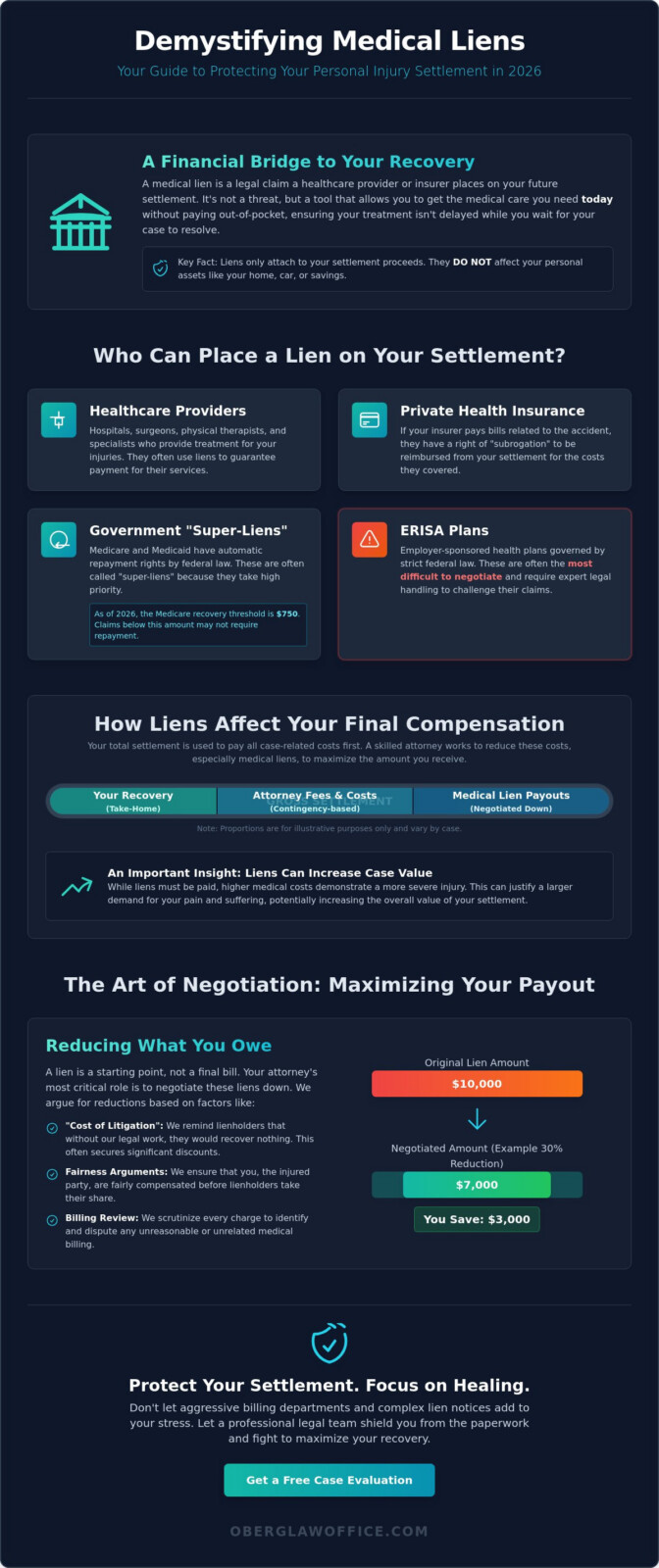
Understanding the legal concept of a lien is vital because it protects your access to high-quality care. When doctors see that a lien is in place, they feel secure knowing they’ll be reimbursed once the responsible party pays up. Crucially, these liens only attach to the proceeds of your legal case. They don’t touch your home, your car, or your savings account. It’s a focused agreement meant to facilitate your restoration, not to threaten your personal assets.
So, what is a medical lien in a personal injury case in practical terms? It’s a guarantee. Hospitals and specialists use these tools when insurance coverage is disputed or simply absent. By using a lien, you shift the financial pressure away from your daily life and onto the final outcome of your claim. This ensures that a lack of immediate cash doesn’t stand between you and your recovery.
The ‘Letter of Protection’ (LOP) vs. Statutory Liens
Not all liens are created equal. A Letter of Protection, or LOP, is a contract your attorney signs with a doctor to defer payment. It’s a personal promise of payment from the settlement. Statutory liens are different; they are rights granted to hospitals by law. For instance, as of April 15, 2026, Texas law under House Bill 2929 has expanded these rights, allowing hospitals to file a lien if you receive care in any department, even without formal admission. Your attorney will choose the right path based on your specific injuries and the providers involved.
Why You Can’t Simply Ignore a Medical Lien
Ignoring a lien isn’t an option, and your attorney won’t let you fall into that trap. We have a legal obligation to satisfy these debts before sending you your portion of the recovery. If a lien is left unresolved, it can damage your credit or even lead to collections if the case doesn’t succeed. There’s also the “double recovery” rule. You can’t keep settlement money that was specifically awarded to cover bills that a lienholder is still owed. We work to ensure these balances are handled correctly so your financial future remains secure.
Who Can Place a Lien on Your Personal Injury Settlement?
Understanding what is a medical lien in a personal injury case starts with identifying exactly who is sending those “Notice of Lien” letters to your home. When you’re recovering from a car accident or a slip and fall, the mailbox often becomes a source of stress. While it feels like every company is reaching into your pocket, these claims are usually categorized into four main groups:
- Healthcare Providers: The hospitals, surgeons, and specialists who provided your emergency or ongoing care.
- Private Health Insurance: Companies seeking reimbursement for bills they already covered on your behalf.
- Government Entities: Medicare and Medicaid programs that hold automatic rights to repayment under federal and state law.
- ERISA Plans: Employer-sponsored health plans that operate under strict federal rules and are often the most difficult to negotiate.
Demystifying the legal definition of a lien helps you see these claims as a standard part of the recovery process rather than a personal attack. A particularly complex category involves ERISA plans. These are self-funded employer plans that often claim they have a right to your entire settlement, regardless of whether you’ve been fully compensated for your pain and suffering. Because these plans are governed by federal law, they require a skilled personal injury attorney who knows how to challenge their specific terms and protect your portion of the recovery.
Government Super-Liens: Medicare and Medicaid
Medicare and Medicaid hold what we call “super-liens.” Federal law gives these programs priority over almost every other claim on your settlement. The government tracks your case through a “Notice of Intent” process, ensuring they are paid back for any “conditional payments” made for your treatment. For 2026, the Centers for Medicare and Medicaid Services (CMS) will not pursue recovery for liability settlements of $750 or less. If your settlement exceeds this amount, the government expects its share. These liens can be frustrating because they often delay the final distribution of your check while the government verifies the final balance. We stay on top of these agencies to keep your case moving forward.
Subrogation: When Your Own Insurance Wants Money Back
Subrogation is a legal term that essentially means your insurance company is “stepping into your shoes.” If they paid for your treatment, they believe they have the right to recover those costs from the at-fault driver’s settlement. This often causes confusion when people ask, what is a medical lien in a personal injury case, because it feels like the insurance company is taking back benefits you’ve already paid for through your premiums. Some states utilize the “Made Whole” doctrine, which suggests the insurer shouldn’t get a dime until you are fully compensated for all your losses. We fight to ensure that insurance companies don’t take more than their fair share.
Calculating the Impact: How Liens Affect Your Final Compensation
Think of your personal injury settlement as a pie. While the total number on the check might look large, that pie is divided into several slices before you receive your portion. Understanding what is a medical lien in a personal injury case is essential for setting realistic expectations about your final check. The slices typically include attorney fees, litigation costs, and medical liens. Whatever remains is your “take-home” compensation, designed to cover your future needs and your pain and suffering.
It’s a common misconception that high medical bills only serve to shrink your slice of the pie. In reality, these bills often act as a double-edged sword. While they must be repaid through a lien, they also serve as powerful evidence of the severity of your injuries. Larger medical expenses typically justify a higher demand for non-economic damages, such as emotional distress and physical pain. We use these documented costs to argue for a bigger overall “pie,” which can ultimately result in a larger final recovery for you.
Sometimes, we face “upside-down” cases. This happens when the total medical bills exceed the available insurance policy limits of the at-fault driver. If a defendant only carries a $30,000 policy but your hospital stay cost $50,000, the math simply doesn’t work at first glance. We don’t let our clients walk away with nothing in these situations. We aggressively negotiate with providers to accept a “pro-rata” distribution, ensuring that everyone takes a haircut so you still receive a meaningful recovery.
The Math of a Typical Personal Injury Recovery
Let’s look at a hypothetical $100,000 settlement to see how the math works in practice. First, attorney contingency fees (often around 33.3%) and litigation expenses, like filing fees or medical record costs, are deducted. If your medical liens totaled $40,000 in “billed charges,” we don’t just pay that full amount. We negotiate. If we successfully reduce those liens to $20,000, your final check grows significantly. In this scenario, after fees and costs, you might walk away with over $40,000 for your personal use. Our goal is always to maximize your portion of the settlement.
What Happens If Your Settlement Doesn’t Cover All Your Bills?
When the money is tight, we utilize the Common Fund Doctrine. This legal principle suggests that since your attorney did the work to secure the settlement, the lienholders shouldn’t get a “free ride.” We often argue that the hospital or insurance company should contribute a proportional share of the attorney fees. This effectively reduces the amount you owe them. If gaps still remain, we look to your own Underinsured Motorist (UIM) coverage. This acts as a vital safety net, providing extra funds when the at-fault party’s insurance falls short of covering your full medical debt.
The Art of Negotiation: Reducing Liens to Maximize Your Recovery
When clients ask what is a medical lien in a personal injury case, they are often relieved to find out that the initial bill is rarely the final price paid. The number you see on a hospital statement or a “Notice of Lien” is often an opening bid, not a final verdict. We view these claims as negotiable debts. Because we understand the complexities of the law, we use several leverage points to whittle down those balances, ensuring a larger portion of the settlement stays where it belongs; in your pocket.
Our negotiation strategy relies on several powerful legal tools. First, we argue for a “Cost of Litigation” discount. Since the lienholder didn’t pay for the investigators, experts, or the attorney who secured the funds, it’s only fair they contribute to those costs by reducing their claim. We also look at comparative negligence. Under rules like Florida’s 2026 modified comparative fault standard, if your recovery is reduced because you were partially at fault, we demand the lienholder take a proportional “haircut” on their bill. Additionally, many jurisdictions have statutory caps that limit how much a hospital can collect from a settlement, regardless of what their “Chargemaster” says you owe.
Finally, we lean on the “Made Whole” doctrine. This principle dictates that you must be fully compensated for your losses, including your pain, suffering, and lost wages, before an insurance company can take a slice for reimbursement. If the settlement isn’t large enough to cover everything, you come first. If you’re feeling overwhelmed by mounting bills after an accident, contact our team today so we can start fighting to reduce your medical debt.
Why an Attorney Is Essential for Lien Resolution
We act as your shield against aggressive billing departments. Our team performs a rigorous “Audit” of every claim, verifying that the charges are directly related to the accident and not an attempt to sneak in costs for pre-existing conditions. We manage all “Notice of Lien” correspondence so you never have to speak with a bill collector. When providers know we are ready to take a case to trial, they become much more willing to accept a lower, reasonable settlement rather than risking a long wait for nothing.
Common Defenses Against Excessive Medical Liens
Hospitals often bill at “Chargemaster” rates, which are significantly higher than what they accept from private insurance or Medicare. We challenge these as “unreasonable” and demand they accept the fair market value for their services. We also hunt for “Double Billing” or administrative errors that inflate your debt. The collateral source rule ensures that the at-fault party cannot pay you less simply because you were responsible enough to have your own health insurance or other benefits. By combining these defenses, we protect your financial restoration and your peace of mind.
Protecting Your Future: How Oberg Law Office Manages Your Medical Debt
Navigating the aftermath of an accident is exhausting. You’re trying to heal, but the “paperwork war” with hospitals and insurance companies never seems to end. At Oberg Law Office, we take that burden off your shoulders from day one. We don’t just answer the question of what is a medical lien in a personal injury case; we actively manage every single claim filed against your settlement. Our priority is ensuring you walk away with the compensation you need to move forward with your life, free from the shadow of medical debt.
We know that getting the right care is half the battle. Because we’ve built deep roots in our community, we can connect you with specialists who understand the legal process and are willing to accept Letters of Protection. This means you get top-tier treatment without the stress of upfront costs. Throughout this process, you’ll have direct access to our senior legal professionals. You aren’t just a file number assigned to a case manager; you’re a neighbor who deserves our personal investment and protection.
From Strategy Session to Final Settlement
Your journey with us begins with a free initial strategy session. During this meeting, we evaluate your medical needs and identify every potential lienholder that might try to claim a portion of your recovery. We perform a rigorous audit of your medical records to ensure that every charge is accurate and directly related to your accident. This detailed oversight is how we maximize your “take-home” recovery. For more on how we approach these challenges locally, see our Personal Injury Lawyer in Mesquite, TX: Your Guide to Local Justice & Recovery.
Why the ‘Performance-Based’ Fee Model Works for You
Our firm operates on a shared-risk basis. This means we don’t get paid unless we win your case and successfully resolve your liens. This performance-based model perfectly aligns our motivations with your goals. We’re driven to reduce your medical debt as much as possible because every dollar saved is a dollar that goes back to you. We fight for fairness against large institutions so you can focus on restoration. You can learn more about our commitment to the community by reading our Mesquite Personal Injury Lawyer: Your 2026 Guide to Accident Recovery.
Secure Your Path to Restoration and Justice
Managing the financial fallout of an accident is about more than just paying bills; it’s about reclaiming your peace of mind. Now that you understand what is a medical lien in a personal injury case, you can view these legal claims as manageable tools rather than overwhelming obstacles. Whether you are dealing with a hospital lien or a private insurance subrogation claim, these balances are not set in stone. They are points of negotiation that we handle with determination to protect your final compensation and your future security.
You don’t have to navigate this complex legal landscape alone. With over 25 years of Texas legal experience, our team provides the compassionate advocacy and professional authority you deserve. We operate on a contingency-based model, which means there is no fee unless we win your case and resolve your liens. You will work directly with our senior attorneys to ensure your voice is heard and your recovery is maximized. Take the first step toward securing your financial restoration today. Schedule Your Free Injury Strategy Session with Oberg Law Office Today. You have the strength to heal, and we have the experience to protect you.
Frequently Asked Questions
Can a medical lien be more than my total settlement?
It is possible for total medical bills to exceed the available insurance coverage, especially if the at-fault driver has low policy limits. We call these “upside-down” cases. In these situations, your attorney negotiates with providers to accept a pro-rata distribution, which ensures everyone takes a reduction so you still receive a meaningful portion of the recovery for your pain and suffering.
Does health insurance have a right to my personal injury settlement?
Yes, most health insurance policies include a subrogation clause that gives them a legal right to reimbursement. If they paid for your accident-related care, they are entitled to recover those costs from your final settlement. This is a standard part of what is a medical lien in a personal injury case, and we work to ensure these companies don’t take more than their fair share.
What happens to medical liens if I lose my personal injury case?
If your case doesn’t result in a settlement or judgment, the lien is no longer attached to a recovery, but you still owe the underlying debt to the healthcare provider. The hospital or doctor may seek payment directly from you or eventually send the bill to collections. This is why we focus on strong case preparation and clear communication about the risks involved from day one.
How long does it take to settle medical liens after the case is over?
Resolving liens typically takes between 30 and 90 days after the settlement papers are signed. Private healthcare providers often resolve their claims quickly, but government agencies like Medicare or Medicaid can take several months to provide a final payoff figure. We stay in constant contact with these entities to speed up the process and get your check into your hands as soon as possible.
Can I negotiate a medical lien myself without a lawyer?
You can attempt to negotiate yourself, but providers are often less willing to offer significant discounts to individuals than to established law firms. Attorneys use specific leverage, such as the “cost of litigation” discount, to force providers to accept a lower amount. Without professional advocacy, you might end up paying the full “Chargemaster” rate, which is much higher than the fair market value.
What is the difference between a medical lien and subrogation?
A medical lien is a claim for unpaid bills held directly by a provider like a hospital or surgeon. Subrogation is a claim by your health insurance company to be paid back for bills they have already covered on your behalf. Both impact your final recovery, but they involve different legal rules and negotiation strategies depending on whether the plan is private or government-sponsored.
Are there laws that limit how much a hospital can take from my settlement?
Yes, many jurisdictions have statutory caps that prevent hospitals from taking an unfair portion of your recovery. For example, certain laws limit a hospital’s recovery to a specific percentage of the settlement after attorney fees and costs are deducted. We use these legal protections as a shield to ensure that the healthcare facility doesn’t walk away with the money intended for your restoration.
Will a medical lien affect my credit score while my case is pending?
A properly managed medical lien usually protects your credit score because the provider agrees to wait for payment until your case resolves. If a bill isn’t placed under a lien or a Letter of Protection, the provider might eventually send it to collections. We intervene early to ensure all accident-related bills are correctly flagged so your credit remains secure while you focus on healing.
