What if the biggest threat to your recovery isn’t the injury itself, but the mounting stack of bills sitting on your kitchen table? You’re likely exhausted from answering calls from debt collectors while trying to decode insurance jargon that feels designed to confuse you. It’s a heavy burden to carry, especially when you’re already dealing with physical pain. Understanding how to get medical bills paid after an accident is the first step toward reclaiming your peace of mind and protecting your family’s future. With the average cost of medical treatment after a crash reaching approximately $15,000, you can’t afford to leave your financial health to chance.
We believe you deserve a steadfast protector who handles the paperwork so you can focus on healing. This guide walks you through the entire process, including how to use your own insurance as an immediate shield and how to leverage legal tools like Letters of Protection to delay payments until your case settles. You’ll also learn about critical 2026 updates, such as Florida’s transition away from the no-fault system. We’ll show you exactly who pays and when, giving you the confidence that your credit score is safe while we fight for the full restoration you deserve.
Key Takeaways
- Understand why the at-fault driver’s insurance doesn’t pay your doctors directly and how to manage your immediate financial obligations.
- Learn how to layer your coverage, using Personal Injury Protection (PIP) or private health insurance to shield your credit while your case is pending.
- Discover how to get medical bills paid after an accident even without upfront cash by using a Letter of Protection to secure the care you need.
- Identify how your specific state’s at-fault or no-fault laws change the timeline and process for your medical reimbursement.
- See how a dedicated advocate fact-checks every invoice to ensure insurance companies don’t undervalue your treatment or your future health needs.
The Immediate Reality: Who is Responsible for Medical Bills Right Now?
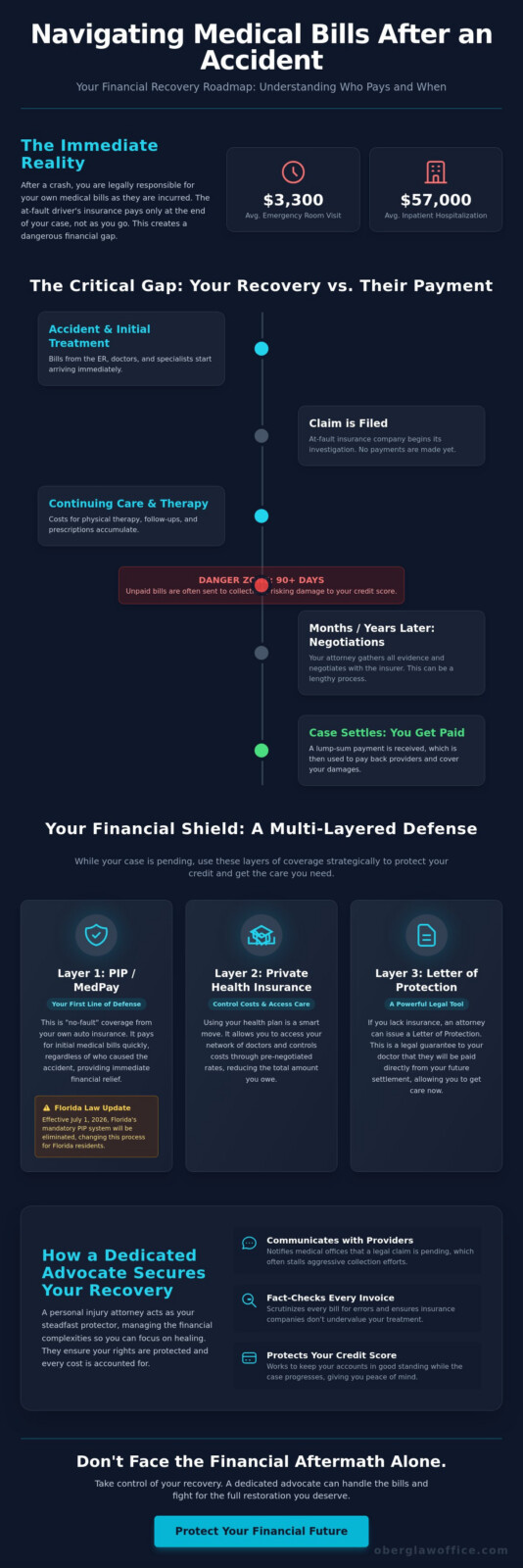
Receiving a stack of medical bills while you’re still in pain is a jarring experience. You might naturally assume that because the other driver caused the crash, their insurance company should be writing checks to your doctors today. Unfortunately, the legal system doesn’t work that way. A primary hurdle in understanding how to get medical bills paid after an accident is accepting the difficult truth that you are legally responsible for your own medical expenses as they are incurred. The at-fault driver’s insurance company has no contractual obligation to pay your doctors directly or provide incremental payments for your physical therapy or ER visits.
Instead, the system relies on a final settlement. This means you won’t see a dime from the other side until your case is completely resolved. With the average emergency room visit costing $3,300 and inpatient hospitalizations averaging $57,000, these costs can feel like an impossible weight. The goal of personal injury law is to make you “whole” again, but this restoration happens at the end of the journey, not at the beginning. You need a plan to manage these costs in the meantime so your credit remains intact while you recover.
Why Hospitals Expect Payment Immediately
When you sign the intake forms at a hospital, you’re entering a direct financial contract with that provider. The hospital’s priority is getting paid for the services they provide, regardless of who caused your injuries. They won’t accept “the other guy is at fault” as a reason to keep your account in good standing. In this context, the delayed reimbursement model is a legal framework where the injured party manages their own immediate costs and then seeks a single, lump-sum repayment from the negligent party once the full extent of the damages is known.
The Problem with Waiting for a Settlement
Legal cases take time. While approximately 95% of personal injury lawsuits are resolved through a pre-trial settlement, reaching that agreement can take months or even years. Medical billing departments rarely have that kind of patience. We act as a steadfast protector during this stressful window, working to communicate with providers and billing offices to signal that a legal claim is pending. This professional intervention often helps stall aggressive collection efforts, giving you the breathing room you need to focus on your health without the constant fear of a falling credit score.
Navigating Your Insurance Layers: From PIP to Private Health Plans
Managing the aftermath of a crash feels like solving a puzzle with missing pieces. You likely have several insurance cards in your wallet, but knowing which one to hand over at the hospital is a critical decision. Learning how to get medical bills paid after an accident requires a strategic look at every policy you own. Think of these policies as layers of a shield. The first layer is designed to act quickly, while the secondary layers provide deep coverage for more significant injuries.
The Role of Auto Insurance Add-ons (PIP and MedPay)
In many states, your own auto insurance provides the first line of defense through Personal Injury Protection (PIP) or Medical Payments (MedPay) coverage. These are “no-fault” benefits. They pay out regardless of who caused the wreck. If you’re in one of the 12 states that currently require PIP, such as Michigan or New York, your insurer handles a portion of your bills immediately. It’s vital to stay updated on local laws. For example, effective July 1, 2026, Florida will eliminate its mandatory PIP system, shifting how residents there manage initial costs. Filing a claim under these add-ons typically doesn’t raise your rates if you weren’t at fault, but it provides the immediate liquidity needed to keep collectors at bay. The legal definition of personal injury encompasses more than just physical pain; it includes these immediate financial disruptions that PIP is designed to soften.
Using Health Insurance to Control Costs
Many people hesitate to use their private health insurance after a car wreck, fearing it’s “not their responsibility.” Using your health plan is actually one of the smartest moves you can make. Health insurers have pre-negotiated “contracted rates” with hospitals. If a hospital charges $5,000 for a scan, your insurance might have a deal to pay only $1,500. This significantly reduces the total “debt” tied to your name. If you’re feeling overwhelmed by these overlapping policies, consulting a Personal Injury Lawyer in Mesquite, TX can provide the clarity you need to move forward.
You should be aware of a process called subrogation. This is the insurance company’s way of saying: “We paid for your care now, but if you get a settlement from the person who hit you, we want our money back.” This is standard practice for private plans, as well as Medicare and Medicaid. These government programs have a statutory right to place a lien on your final settlement. We step in to “fact-check” these liens. We ensure you aren’t overpaying the insurance company and that more of the settlement stays in your pocket for your long-term recovery.
At-Fault vs. No-Fault Systems: How State Laws Impact Your Bills
Your geographical location dictates the playbook for your financial recovery. While the physical pain of an injury is the same everywhere, the legal rules for how to get medical bills paid after an accident change the moment you cross state lines. As of early 2026, the United States remains divided into two primary systems: at-fault and no-fault. Understanding which system governs your accident is the only way to ensure you don’t miss critical filing deadlines or leave money on the table.
In an at-fault state, the person who caused the wreck is responsible for the damages. In a no-fault state, your own insurance pays for your medical treatment regardless of who was to blame. This distinction determines which insurance company you call first and how quickly you can expect relief. Because these laws are complex and frequently updated, such as Florida’s major transition away from the no-fault system on July 1, 2026, having a knowledgeable guide is essential to protecting your rights.
Living in an At-Fault State
If your accident happened in one of the 38 states that use a tort or at-fault system, like Texas or California, the burden of proof rests on your shoulders. You must prove the other driver was negligent before their insurance company is required to pay. This creates a dangerous “gap period.” You might receive treatment in January, but the at-fault insurer won’t settle until the following year. During this time, you’re stuck in the middle. Third-party adjusters often use this delay to pressure you into a low settlement, hoping your mounting bills will make you desperate. We help you manage these expectations and keep your focus on recovery while we build the evidence needed for your final restoration.
The No-Fault Framework
In the 12 states that currently require Personal Injury Protection (PIP), the process for the first few thousand dollars of care is streamlined. Your own insurer pays your bills quickly, which helps prevent immediate credit damage. However, these policies have strict limits. If your injuries are catastrophic or exceed a certain monetary “threshold,” you can step outside the no-fault system to sue the negligent driver for additional damages. This is particularly relevant in high-stakes cases involving commercial vehicles. If you’ve been involved in a collision with a semi-truck, our truck accident lawyer texas guide explains how these state rules interact with federal trucking regulations. Whether you’re navigating PIP limits or proving negligence in a tort state, our role is to act as your steadfast protector against institutions that prioritize their profits over your health.
Strategic Solutions for Unpaid Bills: Liens and Letters of Protection
Facing a mountain of medical debt without health insurance or after your PIP benefits are exhausted is a terrifying position. You might feel like your recovery has hit a dead end because you can’t afford the next specialist visit or surgery. It’s a common struggle, but there are specialized legal tools designed to bridge the gap between your injury and your final settlement. Understanding how to get medical bills paid after an accident when you lack immediate funds is about using your legal claim as a form of credit. This approach ensures you don’t have to choose between your physical health and your financial stability.
Doctors and hospitals are often more flexible than they appear. If a medical provider knows that a reputable law firm is handling your case, they’re frequently willing to wait for payment. They understand that while you don’t have the cash today, a successful settlement will eventually provide the funds to cover their services. This collaborative arrangement keeps your treatment on track and keeps your accounts out of collections.
The Letter of Protection (LOP) Explained
A Letter of Protection is a powerful document that functions as a legal “I.O.U.” to your doctor. It’s a binding contract between you, your attorney, and the medical provider. By signing an LOP, your lawyer guarantees that the provider will be paid directly from the proceeds of your settlement or jury award. This is a vital lifeline for uninsured victims, allowing them to receive high-quality care without paying a single dollar out of pocket upfront. Because this is a serious legal commitment, it’s essential that an experienced attorney drafts and manages these documents to ensure your rights are protected throughout the process.
Negotiating Medical Liens
A medical lien is a legal claim a provider or insurance company places on your future settlement. It’s important to understand that a lien is a claim against your settlement, not your house, your car, or your personal savings. There are two primary types you might encounter:
- Statutory Liens: These are created by state law and often apply to public hospitals or government programs like Medicaid.
- Consensual Liens: These are voluntary agreements, like an LOP, where you agree to pay a provider out of your recovery.
Our role as your advocate doesn’t end when the settlement is reached. We work to negotiate these liens down at the end of your case. If we can convince a provider to accept a lower amount, that extra money goes directly into your pocket for your long-term restoration. If you’re struggling to access care because of costs, reach out to us to discuss how we can secure your treatment through these strategic legal tools.
How a Personal Injury Attorney Secures Your Final Recovery
You have navigated the immediate chaos, decoded your insurance layers, and understood the state laws governing your case. Now, you face the final and most critical stage of the journey. This is where all the documentation, medical records, and billing statements must be forged into a single, persuasive demand for justice. Determining how to get medical bills paid after an accident is not just about looking at what you owe today; it is about ensuring every dollar of your past, present, and future care is accounted for in the final settlement.
We act as your personal auditor and advocate during this phase. Insurance adjusters often try to “lowball” victims by claiming certain treatments were not medically necessary or that hospital charges were “above the reasonable and customary rate.” We don’t accept these excuses. Our team fact-checks every invoice and defends the necessity of your care. We believe that a specialized, person-oriented practice should handle the heavy lifting so you can focus on your life. Because we work on a performance-based fee structure, you don’t pay us anything until we secure the funds to cover your bills. This shared risk ensures we are as invested in your victory as you are.
Maximizing the Value of Your Claim
Your current medical bills are often just the beginning of the story. If you have suffered a life-altering event, your future needs might include ongoing physical therapy, medications, or even home modifications. When we build a “demand package” for the insurance company, we include expert projections of these long-term costs. For those facing permanent changes, our catastrophic injury lawyer mesquite expertise is vital for long-term care planning. We ensure the settlement reflects the true cost of your restoration, not just the initial emergency room visit. Approximately 95% of personal injury lawsuits are resolved through a pre-trial settlement, but that settlement is only successful if it covers every cent of your medical debt.
Ending the Stress of Medical Debt
The ultimate goal of this process is a clean slate. Once a settlement is reached, we handle the final distribution of funds. This includes paying off medical liens, reimbursing your health insurance for subrogation claims, and settling any outstanding balances with your doctors. We negotiate with these providers to reduce the final amounts owed, which puts more of the settlement money directly into your pocket. You deserve the peace of mind that comes from knowing your credit is protected and your bills are gone. You don’t have to face the insurance companies alone. Schedule your free strategy session with Oberg Law Office today.
Take the First Step Toward Financial Restoration
You have learned that medical bills don’t have to ruin your future or your credit score. By layering your insurance coverage and using strategic tools like Letters of Protection, you can keep aggressive collectors at bay while you focus on your physical recovery. We have covered the complex 2026 legal landscape and the reality of how to get medical bills paid after an accident, but you don’t have to manage these hurdles alone. You deserve a steadfast protector who understands the local Texas courts and the specific tactics insurance companies use to minimize your claim.
At Oberg Law Office, we bring over 25 years of experience to your side. You won’t be handed off to support staff. Instead, you’ll benefit from direct interaction with Attorney Gregg Oberg. We believe in accessibility and shared risk, which is why we offer a performance-based fee structure; you don’t owe us a dime unless we win your case. Get a Free Strategy Session to Discuss Your Medical Bills and let us start building your shield today. Your recovery is the only thing that should be on your mind. We’ll handle the rest with the determination and compassion you deserve.
Frequently Asked Questions
Who pays my medical bills if the accident wasn’t my fault?
You are initially responsible for your medical bills as they arrive, even when someone else caused the crash. The at-fault driver’s insurance company won’t pay your doctors incrementally. Instead, they provide a single, lump-sum settlement at the very end of your case. In the meantime, you should use your own Personal Injury Protection (PIP) or health insurance to keep your accounts current while we build your claim for final restoration.
Should I use my own health insurance after a car accident?
Yes, using your health insurance is a strategic move that protects your financial health. Health insurers have pre-negotiated rates with hospitals that are much lower than the retail price. This significantly reduces the total amount of medical debt tied to your name. While your insurer may seek reimbursement later through subrogation, starting with these lower rates keeps your final repayment obligation manageable and prevents your credit from being damaged.
What happens if my medical bills are higher than the at-fault driver’s insurance limits?
If your costs exceed the other driver’s policy limits, you may need to turn to your own Underinsured Motorist (UIM) coverage. In Texas, the minimum liability requirement is $30,000 per person, which can be exhausted by a single day in the hospital. We also investigate if other parties, such as a vehicle manufacturer or an employer in truck accident cases, share responsibility for your recovery to find additional sources of coverage.
Can medical providers put a lien on my house because of accident bills?
No, a medical lien is a claim specifically against your legal settlement, not your home or personal property. These liens ensure the hospital gets paid directly when your case resolves. They don’t give the doctor a right to your house, car, or bank account. We review these liens carefully to ensure they are legally valid and often negotiate them down before you receive your final check, ensuring more money stays with you.
What is a Letter of Protection (LOP) in a personal injury case?
An LOP is a legal agreement where your attorney guarantees a medical provider will be paid from your future settlement. This allows you to receive necessary treatment without paying anything out of pocket today. It’s a vital tool for those without health insurance or those who have exhausted their PIP benefits. We use LOPs to ensure our clients get the high-quality care they need to recover without the stress of upfront costs.
Will my car insurance rates go up if I use my PIP or MedPay coverage?
Generally, your insurance rates shouldn’t increase for using PIP or MedPay if you weren’t at fault for the accident. These are no-fault benefits you have already paid for through your monthly premiums. They are designed to be used exactly when you’re wondering how to get medical bills paid after an accident. You should check your specific policy or ask us to review it for you to be certain of your rights.
How do I stop debt collectors from calling me while my lawsuit is pending?
The most effective way to stop harassment is to have your attorney send a formal notice of representation to the billing offices. Once they know a legal claim is pending and a Letter of Protection is in place, most providers will cease collection efforts. This professional shield allows you to focus on your physical therapy and healing rather than screening calls from aggressive debt collectors who don’t understand your legal situation.
What is subrogation and how does it affect my settlement check?
Subrogation is the legal right of an insurance company to be paid back for the medical bills they covered on your behalf. If your health insurance paid $10,000 for your surgery, they will want that money back from your final settlement with the at-fault driver. We act as your advocate by negotiating these subrogation claims, often reducing the amount you have to pay back. This ensures your settlement covers your actual losses and future needs.