
Did you know that 95% of personal injury cases here in Texas never actually reach a jury? While the average settlement for slip and fall in texas typically ranges from $15,000 to $85,000, your specific recovery depends on far more than just a general statistic. You’re likely dealing with the heavy burden of rising medical debt and the daily frustration of limited mobility. It’s exhausting to face aggressive insurance adjusters who want to settle your claim for as little as possible while you’re still trying to heal.
We believe you deserve a partner who sees the person behind the paperwork. This 2026 guide will help you understand the real factors that determine settlement values and how to maximize your recovery. We’ll explore how the 51% modified comparative fault rule affects your case and outline the critical steps you must take within the two-year statute of limitations. From documenting negligence to standing firm against low-ball offers, we’re providing the clarity you need to move from a state of uncertainty to a feeling of empowerment.
Key Takeaways
- Learn how the severity of your injuries and the property owner’s knowledge of the hazard work together to shape your ultimate recovery.
- Explore the real-world factors that move the average settlement for slip and fall in Texas from a general range into a specific number for your situation.
- Understand the “51% bar” rule and how Texas liability laws can reduce your compensation if you are found even partially at fault.
- Get a clear roadmap of the legal process, including the two-year deadline and the crucial evidence needed to secure a fair outcome.
- See how a dedicated advocate can handle the pressure from insurance corporations while ensuring you face no upfront legal costs through a contingency fee model.
Understanding the Average Slip and Fall Settlement in Texas
When you’re hurt on someone else’s property, a “settlement” is more than just a check; it’s a legal agreement that brings your case to a close. In exchange for a specific sum of money, you agree to release the property owner from further liability. This process is governed by the principles of Premises liability, which holds owners responsible for injuries caused by dangerous conditions they should’ve fixed. While data suggests the average settlement for slip and fall in texas typically ranges from $15,000 to $85,000, these figures can be misleading. A minor sprain that heals in weeks results in a much smaller payout than a traumatic brain injury that requires lifetime care. Every case is a unique puzzle of medical facts and legal evidence.
Timing is just as critical as the facts of your fall. Under Texas Civil Practice & Remedies Code § 16.003, you generally have exactly two years from the date of the incident to file a lawsuit. If you let this deadline pass, you lose your right to seek compensation forever. We’ve seen how quickly evidence can disappear; surveillance tapes are erased and witnesses move away. Starting your claim early isn’t just about meeting a deadline. It’s about preserving the truth of what happened to you.
Why There Is No “Standard” Payout
Your injury profile is personal to you. A broken hip might cost a 30-year-old a few months of work, but for an older Texan, it could mean a permanent loss of independence. Insurance policy limits also act as a “ceiling” for most settlements. If a small business only carries a $100,000 policy, recovering more than that amount can be difficult regardless of your injury’s severity. Even the location of your accident matters. Juries in different Texas counties view responsibility differently, and insurance companies adjust their offers based on these local trends.
Economic vs. Non-Economic Damages
We look at your recovery through two lenses: what you’ve lost financially and what you’ve endured physically. Economic damages, often called “special damages,” are the easy-to-calculate costs like ER bills, pharmacy receipts, and the wages you lost while recovering at home. Non-economic damages, or “general damages,” cover the intangible parts of your recovery. This includes your physical pain, mental anguish, and the loss of enjoyment in your daily life. While insurance adjusters often use a multiplier of your medical bills to estimate these values, we focus on the real impact the injury has had on your family and your future.
Key Factors That Determine Your Texas Settlement Value
Calculating the potential value of your claim involves more than just adding up medical bills. While the average settlement for slip and fall in texas provides a helpful benchmark, the specific details of your accident act as the true needle-movers. Insurance companies look for any reason to devalue your experience. They scrutinize the severity of your injuries, the permanence of your physical limitations, and whether your life will ever truly return to normal. A fractured wrist that heals perfectly carries a different weight than a spinal injury that limits your ability to pick up your children or return to your career. Evidence collected at the scene, such as clear photos of the hazard and witness contact information, forms the bedrock of a successful recovery.
Your Legal Status: Invitee, Licensee, or Trespasser
Texas law categorizes visitors into three groups, and your category determines how much protection you had at the time of the fall. Most people injured in stores or restaurants are “Invitees.” As a customer, you’re owed the highest duty of care; owners must actively inspect the property and fix or warn you about dangerous conditions. If you were a “Licensee,” such as a social guest at a friend’s home, the owner only had to warn you of hidden dangers they already knew about. Trespassers have the least protection, as owners generally only need to avoid intentional harm. Understanding these distinctions is vital because your legal status can make or break your ability to secure Premises Liability Representation that holds the right parties accountable.
The “Notice” Requirement in Texas
To win your case, we must prove the property owner had “notice” of the danger. This comes in two forms: actual and constructive. Actual notice means an employee saw the spill or someone reported the broken tile before you fell. Constructive notice is often more common; it means the hazard existed for such a long time that the owner should’ve discovered it through reasonable care. We often use surveillance footage or maintenance logs to show that a puddle sat on a floor for thirty minutes without being mopped. Proving this “unreasonable risk of harm” is a high bar in Texas, but it’s the key to shifting the financial burden from your shoulders back to the negligent party.
Your financial recovery also hinges on your lost income and future earning capacity. If your injuries prevent you from performing your specific job duties, we calculate not just what you’ve lost today, but what you would’ve earned over the next decade. This data-driven approach ensures the settlement covers the full scope of your hardship rather than just the immediate crisis.
How Texas Liability Laws Impact Your Financial Recovery
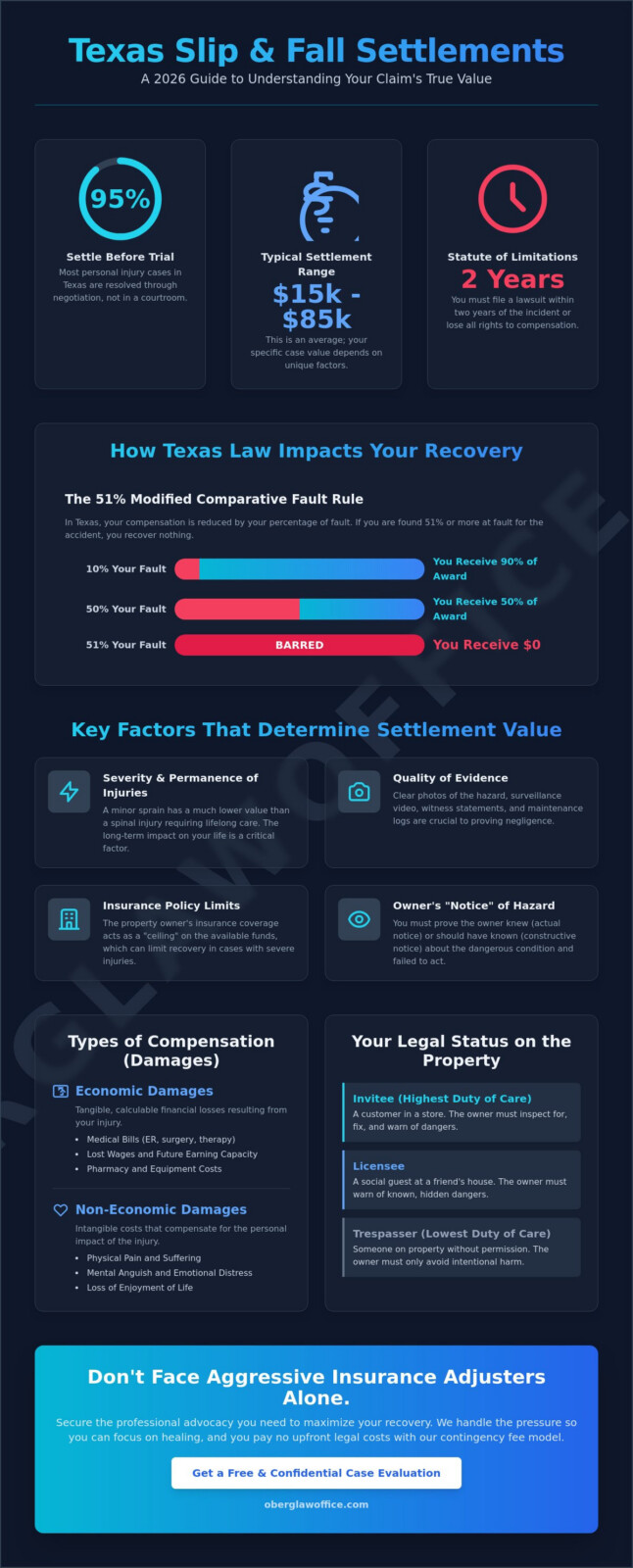
Proving a property owner was negligent is only half the battle in a Texas courtroom. Even when a hazard is clearly documented, the defense will turn the spotlight on your own actions during the incident. Modified Comparative Fault is the legal standard in Texas that determines how much of a settlement you actually keep based on your level of responsibility for the fall. Understanding these rules is essential for anyone curious about the average settlement for slip and fall in texas, as your own percentage of fault directly dictates the final check you receive. If a jury or adjuster decides you were partially to blame, your total compensation is reduced by that exact percentage.
The 51% Bar Rule Explained
Texas follows what is known as the “51% Bar Rule,” a high-stakes mathematical hurdle for injured people. Under this rule, you can only recover damages if you are 50% or less at fault. If a court finds you are 51% or more responsible for your own fall, your recovery drops to zero, regardless of how severe your injuries are. For example, in a claim worth $100,000, being found 20% at fault would result in an $80,000 payout. However, if the insurance company successfully argues you were 51% at fault because you were looking at your phone, you receive nothing. This is why insurance adjusters fight so hard to shift even a small majority of blame onto you; it’s a “winner take all” strategy designed to protect their bottom line.
Defeating the “Open and Obvious” Defense
One of the most common tactics used by property owners is the “Open and Obvious” defense. They’ll argue that the puddle, broken step, or loose rug was so visible that any reasonable person would have seen and avoided it. Closely related is the “Failure to Maintain Lookout” claim, where they suggest you weren’t paying enough attention to your surroundings. These arguments are meant to make you feel like the accident was your fault, but they don’t account for the owner’s primary duty to keep the premises safe.
Defeating these defenses requires a deep understanding of Texas case law and a steady hand during negotiations. There are many exceptions to these rules, such as when a hazard is unavoidable or when the owner’s negligence created a trap that couldn’t be easily seen. Having a skilled personal injury lawyer on your side is vital to countering these aggressive tactics. We focus on gathering the evidence needed to prove the owner was the primary cause of your injury, ensuring your percentage of fault stays as low as possible so your recovery stays as high as possible.
The Timeline and Process of a Texas Premises Liability Claim
The path to recovery is rarely a straight line. It begins the moment you hit the ground and continues through months of physical therapy and legal maneuvering. While you might be anxious to see the average settlement for slip and fall in texas hit your bank account, rushing the process is a mistake that insurance companies count on. They want you to sign a release before you truly understand the long-term impact of your injuries. Your journey typically moves from medical stabilization to a formal investigation, eventually leading to a demand for justice.
The Importance of Maximum Medical Improvement (MMI)
Maximum Medical Improvement (MMI) is the point where your doctor determines your condition has stabilized as much as it’s going to. Settling your claim before you reach this milestone is a massive financial risk. If you accept an offer while you’re still in active treatment, you’re essentially gambling that you won’t need more surgery or specialized care later. Consulting with a slip and fall lawyer ensures you time your demand letter perfectly. We wait until we have a clear picture of your future medical costs so we don’t leave money on the table that you’ll need for long-term recovery.
Modern Evidence Collection in 2026
Proving a case in 2026 requires more than just a few grainy photos. We now utilize smart-watch data to prove the exact second of physical impact and document the heart rate spikes that occur during a traumatic fall. This digital footprint makes it much harder for insurance adjusters to claim you weren’t actually hurt. We also move quickly to secure digital incident reports and store surveillance logs before they’re overwritten. In complex cases, we work with expert witnesses like floor safety professionals who can measure the slip-resistance of the surface. This high-tech approach builds a wall of evidence that’s difficult for the defense to tear down.
Once your medical records and evidence are gathered, we send a formal demand letter to the insurance company. This starts the negotiation phase where we aim for a recovery that reflects the true average settlement for slip and fall in texas for injuries of your severity. If we can’t reach a fair agreement through direct talks, we may move to mediation. This is a structured meeting where a neutral third party helps both sides find common ground. If the insurance company refuses to offer what is fair, we’re fully prepared to move into litigation. We handle every step of this process so you can focus entirely on your health. If you’re ready to see how we can protect your future, contact us today for Premises Liability Representation that puts your needs first.
Why Professional Advocacy is Vital for Full Compensation
Facing a billion-dollar insurance company on your own is a daunting task. These corporations use sophisticated software and aggressive adjusters to protect their profits, and their goal is simple: pay you as little as possible. When you have a dedicated protector by your side, the power dynamic shifts. Professional advocacy isn’t just about filing paperwork; it’s about signaling to the opposition that you have the resources and the determination to fight for what’s fair. We believe everyone deserves a fair shot at justice, which is why we operate on a contingency fee model. You won’t face any upfront costs or hourly bills. We share the risk with you, ensuring our interests are perfectly aligned with your recovery.
Unlike high-volume settlement mills where you might feel like just another file number, we prioritize a personal touch. You deserve to interact directly with the senior professionals handling your future. This collaborative approach allows us to build a strategy that reflects the specific impact your injury has had on your life. Understanding the average settlement for slip and fall in texas is just the beginning; we look at your unique medical needs, lost wages, and emotional hardship to seek a result that truly restores your security. Having a knowledgeable guide also provides a psychological benefit, allowing you to focus on your physical healing while we handle the heavy lifting of the legal process.
Fighting Insurance “Low-Ball” Tactics
Insurance companies often reach out within days of an accident with a quick cash offer. This first offer is rarely the best offer. It’s usually a tactic to get you to settle before you realize the full extent of your injuries or the cost of future care. By initiating a personal injury lawsuit, you show the defense that you understand the value of your claim. This pressure often leads to more realistic negotiations and higher settlement offers because the insurance company knows we’re prepared to take the case as far as necessary to protect your rights.
Your Path Forward: Free Strategy Sessions
Taking the first step toward legal action can feel overwhelming, but it doesn’t have to be. We invite you to sit down with us for a low-pressure strategy session where we can discuss your accident in detail. We’ll evaluate the evidence, discuss the property owner’s liability, and give you a clear-eyed assessment of the merit of your claim. This is a time for you to get answers and feel empowered about your choices. If you’re ready to move forward with a partner who cares about your results, Schedule your free strategy session with Oberg Law Office today.
Secure Your Financial Recovery Today
You’ve learned that while the average settlement for slip and fall in texas provides a baseline, your specific recovery is built on the strength of your evidence and the severity of your injuries. Texas laws like the 51% bar rule make it essential to have a guide who understands how to protect your interests against aggressive insurance tactics. You don’t have to face this transition from injury to restoration alone. We believe in providing a clear path forward that focuses on your physical and financial well-being.
With over 25 years of Texas legal experience, our firm provides the steady hand you need during this difficult time. You’ll work directly with senior legal professionals who are personally invested in your success. Our contingency-based fee structure ensures that you only pay if we win, removing the financial stress of seeking justice. Your journey toward fairness starts with a single conversation. We’re ready to help you turn the page and reclaim your security.
Get Your Free Slip and Fall Case Review Now
Frequently Asked Questions
What is the average settlement for a slip and fall in Texas?
The average settlement for slip and fall in texas typically ranges from $15,000 to $85,000 for most typical injury cases. If your injuries are catastrophic, such as a spinal cord injury or traumatic brain damage, the recovery can reach $500,000 or more. These figures are benchmarks; your actual check depends on your specific medical bills, lost wages, and the clarity of the property owner’s negligence.
How long do I have to file a slip and fall lawsuit in Texas?
You generally have two years from the date of the injury to file a lawsuit under Texas Civil Practice & Remedies Code § 16.003. This deadline is a strict cutoff. If you’re filing a claim against a government entity, you must act much faster, as you often need to provide a formal notice of the claim within six months of the incident to preserve your rights.
Can I still get a settlement if I was partially at fault for my fall?
Yes, you can still recover compensation as long as you are not 51% or more at fault for the accident. Texas follows a modified comparative fault rule, which means your total settlement is reduced by your percentage of responsibility. For example, if you’re found 20% at fault for being distracted, you’ll still receive 80% of the total damages awarded in your case.
What do I need to prove to win a slip and fall case in Texas?
You must prove that the property owner knew or should’ve known about a dangerous condition and failed to fix it or warn you. This requires showing that the hazard posed an unreasonable risk of harm and that the owner’s failure to act was the direct cause of your injuries. Strong evidence like surveillance footage, maintenance logs, and witness statements is vital to establishing this proof.
Will my slip and fall case have to go to court?
Most slip and fall cases are resolved through settlements and never reach a trial. Approximately 95% of personal injury claims in Texas are settled out of court during the negotiation or mediation phases. While we prepare every case with the determination to go to trial, litigation is usually only necessary when an insurance company refuses to offer a fair and just amount for your recovery.
How much does a slip and fall lawyer cost in Texas?
Most attorneys in this field work on a contingency fee structure, which means there are no upfront costs to start your case. You don’t pay hourly fees or retainers out of your own pocket. Instead, the firm’s payment is a percentage of the final settlement or jury award. This ensures that everyone has access to high-quality legal representation regardless of their current financial situation.
What happens if I slipped on a wet floor with no “Caution” sign?
The lack of a warning sign is a powerful piece of evidence that the property owner breached their duty of care. If an owner or employee knew the floor was wet but didn’t alert visitors, they’ve failed to protect you from a foreseeable hazard. This failure to warn is a primary factor that can increase the average settlement for slip and fall in texas by clearly establishing the owner’s negligence.
Should I give a recorded statement to the insurance company after my fall?
You should avoid giving a recorded statement until you’ve spoken with your own legal advocate. Insurance adjusters often use these recordings to look for inconsistencies or bait you into admitting fault. Their goal is to protect their company’s bottom line, not your health. It’s best to let your attorney handle all communications to ensure your words aren’t used against you later in the process.