
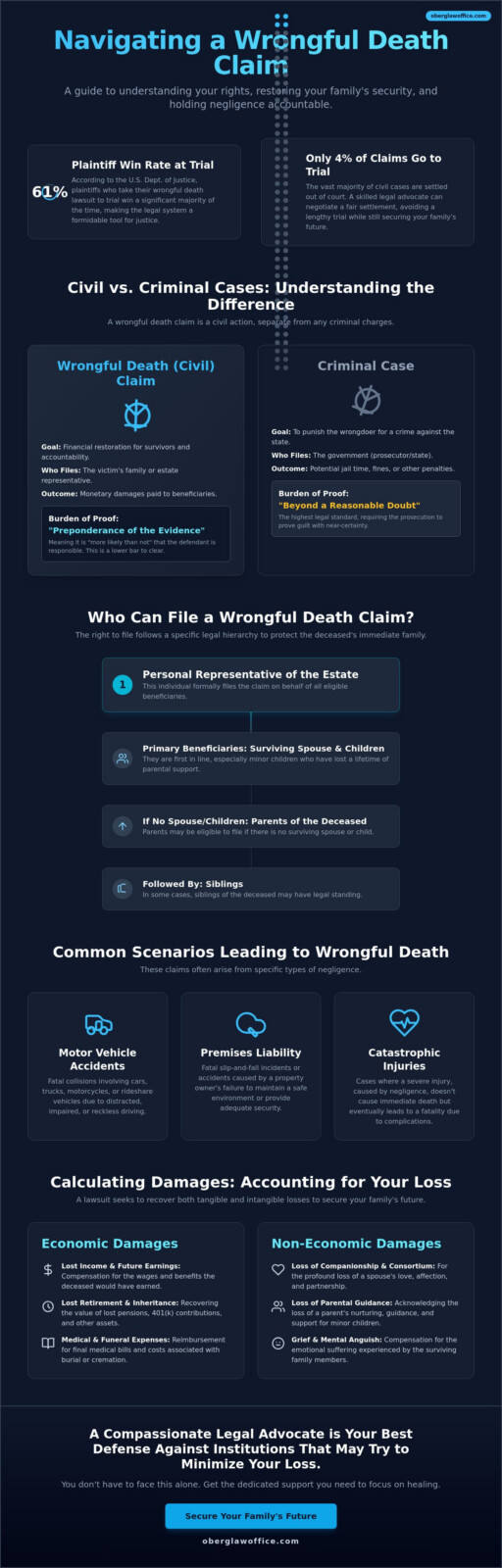
Did you know that while only 4% of civil negligence claims ever reach a courtroom, plaintiffs who take a wrongful death lawsuit to trial win approximately 61% of the time according to the U.S. Department of Justice? This statistic highlights a powerful truth; the legal system is a formidable tool for justice when you have the right support. Losing a loved one is an earth-shattering experience that leaves you balancing heavy grief with sudden financial fears. You shouldn’t have to decode complex legal jargon or fight aggressive insurance companies alone while you’re trying to heal.
We understand that no amount of money can replace your loss, but securing your family’s future is a vital step in the restoration process. This guide serves as a compassionate roadmap to help you understand your legal rights, pursue financial recovery, and hold negligence accountable. You’ll learn about state-specific filing deadlines, the types of damages available to survivors, and how a dedicated legal partner can handle the heavy lifting so you can focus on your family’s security.
Key Takeaways
- Understand how a civil claim serves as a vital tool for restoring your family’s security and ensuring a legacy of accountability.
- Identify the specific legal standing required to bring a claim forward and see where you fit within the hierarchy of beneficiaries.
- Discover how a wrongful death lawsuit accounts for both immediate financial losses and long-term impacts like lost retirement benefits.
- Learn the essential steps of the legal process, starting with a comprehensive investigation to gather the evidence needed for your case.
- See why a compassionate legal advocate is your best defense against large institutions that may try to minimize your loss.
Understanding the Wrongful Death Lawsuit: A Path Toward Accountability
When you lose someone because of another person’s mistake, the world feels tilted. A wrongful death lawsuit is a specific type of civil legal action brought when a person dies due to the legal fault of another person or entity. It’s a civil remedy intended to provide financial security for surviving family members while holding the responsible party accountable for their actions. Essentially, a wrongful death lawsuit is a civil legal action that allows surviving family members to seek financial restoration and formal accountability after a loved one’s life is taken by another party’s negligence.
This process differs from a standard personal injury claim because the injured party can no longer speak for themselves. Instead, the law allows you to step into their shoes to seek the justice they deserve. Every case hinges on the “duty of care.” This is the legal obligation to act with the same caution and prudence that any reasonable person would use in similar circumstances. When a driver speeds or a property owner ignores a broken railing, they breach this duty. If that breach leads to a fatality, the law provides a pathway for survivors to seek restoration and closure.
Civil vs. Criminal Cases: Knowing the Difference
Many people believe they must wait for a criminal trial to end before seeking help. That isn’t true. Civil cases and criminal trials operate on two completely different tracks. In a criminal case, the state seeks to punish a defendant with jail time, requiring proof “beyond a reasonable doubt.” This is a very high bar to clear. In a wrongful death claim, you only need to prove liability by a “preponderance of the evidence.” This means it’s more likely than not that the defendant’s actions caused the harm. This lower burden of proof is why families often find justice in civil court even if a criminal jury returns a “not guilty” verdict.
Common Scenarios Leading to Wrongful Death Claims
Tragic losses happen in many ways, but they often stem from a few specific types of negligence. We see families struggling after these common events:
- Motor Vehicle Accidents: Fatal collisions involving cars, trucks, motorcycles, or rideshare vehicles are the most frequent grounds for these claims.
- Premises Liability: This covers fatal slip and fall incidents where a property owner failed to fix a known hazard or provide adequate security.
- Catastrophic Injuries: Sometimes a severe injury doesn’t cause immediate death, but the long-term physical damage eventually leads to a loss of life.
Whether the harm was caused by a distracted driver or an unsafe building, the goal remains the same. We help you hold the negligent party accountable so your family can find a sense of peace and long-term financial stability.
Who Can File a Wrongful Death Claim and When?
The law doesn’t allow just anyone to seek damages after a tragedy. To bring a wrongful death lawsuit forward, you must have “legal standing,” which means you have a direct and recognized interest in the case. This legal framework ensures that the people most impacted by the loss are the ones who receive the support. While every situation is unique, the right to file usually follows a specific order of priority designed to protect the immediate family first. If you aren’t sure who should lead the claim in your family, speaking with a professional who provides wrongful death representation can offer the clarity you need during this uncertain time.
In many jurisdictions, the legal process is coordinated by a “personal representative” or executor of the deceased person’s estate. This individual acts as the formal voice for the family in court. Even if one person files the paperwork, they often do so on behalf of all eligible beneficiaries. This group includes people who relied on the deceased for financial support or emotional guidance, such as minor children or a spouse who stayed at home to care for the family.
Identifying Eligible Family Members and Beneficiaries
Surviving spouses and children are almost always at the top of the hierarchy. For minor children, the law is especially protective, recognizing that they’ve lost a lifetime of parental guidance and financial stability. If there’s no surviving spouse or child, the right to file often moves to parents or siblings. It’s helpful to distinguish between “heirs,” who inherit property through a will, and “beneficiaries,” who are eligible to receive compensation from a legal claim. Understanding the elements of a wrongful death lawsuit helps clarify how these roles function within the legal system.
The Critical Role of the Statute of Limitations
Timing is perhaps the most rigid part of the legal process. Every state sets a “statute of limitations,” which is a strict deadline for filing your claim. As of March 2026, these timelines vary significantly across the country:
- One Year: Families in Kentucky, Louisiana, and Tennessee have the shortest window to act.
- Two Years: This is the most common deadline, applied in 25 states including Texas, Florida, California, and Arizona.
- Three Years: 16 jurisdictions, such as Michigan and North Carolina, allow a bit more time.
- Longer Windows: A few states like Missouri (five years) or Maine (six years) offer extended periods.
Missing this deadline usually results in the court dismissing your case permanently. While some rare exceptions might “toll” or pause the clock, such as when the claimant is a minor, you should never count on an extension. Acting quickly allows your legal team to preserve evidence before it disappears, ensuring your family’s right to accountability remains protected.
Calculating Damages: The Financial and Emotional Impact of Your Loss
How do you put a price on a human life? It’s a question no family wants to face, yet it’s the central focus when determining the value of a wrongful death lawsuit. The legal system doesn’t pretend that money replaces a person. Instead, it uses a structured framework to calculate the financial and emotional support your family has lost. By looking at the legal definition of wrongful death, courts aim to restore your family to the financial position you would’ve held if the tragedy hadn’t occurred. This process requires a blend of hard data and deep empathy to ensure every aspect of your loss is acknowledged.
Quantifying these losses isn’t a simple task. It involves a strategic mix of economic experts, life-care planners, and vocational specialists who project what the future should’ve looked like. We look at the “whole person,” considering not just their current paycheck, but their potential for growth, their contributions to the household, and the intangible guidance they provided to their children and spouse. This comprehensive approach is designed to build a wall of financial security around your family during your most vulnerable time.
Economic Damages: Covering Tangible Financial Losses
These damages are the measurable costs that hit your bank account immediately. They include medical bills for the care your loved one received prior to their passing and the expenses for a dignified funeral and burial. The most significant portion, however, is the loss of expected lifetime income. We calculate what your loved one would’ve earned until retirement, including bonuses, health insurance benefits, and pension contributions. This ensures that your family’s standard of living is protected for years to come.
Non-Economic Damages: Addressing the Intangible
Your loss goes far beyond a missed paycheck. Non-economic damages address the emotional void left behind, such as the loss of companionship, protection, and parental guidance. Juries often place a high value on these human connections. For instance, research shows that in California, the median award for successful civil cases reached $2.3 million between 2015 and 2020. In rare cases involving gross negligence or intentional harm, the court may also award punitive damages. These aren’t meant to compensate you; they’re designed to punish the wrongdoer and prevent similar tragedies from happening to other families in our community.
The Step-by-Step Process of Pursuing a Wrongful Death Claim
The legal journey begins long before a judge ever sees a file. When you initiate a wrongful death lawsuit, you’re starting a rigorous process designed to uncover the truth and secure your family’s future. It’s a collaborative path where your legal team acts as a shield, handling the complex procedures so you can focus on your emotional recovery. Most cases settle through negotiation or mediation before ever reaching a jury.
After the formal filing of the complaint, the case enters the discovery phase. This is the stage where both sides exchange evidence, review records, and conduct depositions. It’s often the most critical part of the process because it forces the opposing party to reveal their evidence. By carefully navigating this phase, we can often identify the exact moment the “duty of care” was breached, strengthening your position before negotiations even begin.
Investigation and Evidence Gathering
Proof is the foundation of every successful claim. We begin by collecting accident reports, medical records, and witness statements to build a clear picture of what happened. Modern cases often rely on digital evidence, such as cell phone records or data from a vehicle’s “black box,” which provides unbiased facts about speed and braking. In many instances, we work with accident reconstruction experts to visually demonstrate how the negligence occurred. This thoroughness ensures that when we present your case, the responsible party has nowhere to hide.
Negotiation and the Path to Resolution
Insurance adjusters are trained to protect their company’s bottom line, not your family’s well-being. They may use aggressive tactics to minimize your loss, but we stand firm as your protector during these high-stakes discussions. Mediation serves as a powerful tool to reach a fair settlement without the stress of a public trial. Research indicates that well over 90% of wrongful death lawsuits settle out of court. However, if an insurance company refuses to offer a fair settlement, we’re prepared to take the fight to a jury. While only about 4% of civil negligence claims go to trial, plaintiffs win approximately 61% of those trials according to the U.S. Department of Justice.
If you’re ready to hold the responsible party accountable, our team is here to provide the wrongful death representation your family deserves. We handle the legal burden so you can focus on healing.
Why Compassionate Legal Advocacy Matters in Your Time of Need
Losing a loved one is a heavy burden to carry, and the legal system can feel cold when you’re at your most vulnerable. A wrongful death lawsuit isn’t just about paperwork; it’s about finding a steadfast protector who stands between your family and the large institutions that may try to minimize your loss. You deserve more than being just another case number on a spreadsheet. We provide personalized representation where leadership is personally invested in every outcome, ensuring your voice is heard in a system that often feels indifferent.
Professional advocacy changes the dynamic of your recovery. While you focus on healing and supporting your family, your legal team manages the exhausting logistical weight of the case. We handle the aggressive insurance adjusters, track every court deadline, and organize the complex evidence needed to prove liability. This partnership is built on a “no-fee-unless-we-win” promise. This performance-based structure removes the financial barriers to justice, ensuring that your access to high-quality legal help doesn’t depend on your current bank balance. It’s a shared risk that proves our commitment to your family’s success.
The Value of Decades of Personal Injury Experience
Success in these complex cases requires more than just general knowledge. It demands a deep understanding of personal injury lawyer principles that have been refined over decades of practice. For example, when a tragedy involves a commercial vehicle, having a specialized truck accident lawyer is vital to navigate federal trucking regulations and corporate insurance policies. Our firm is dedicated to providing catastrophic injury representation for families whose lives have been permanently changed, bringing the same level of unwavering determination to every case we lead.
Your Next Steps: A Strategy for Recovery
Taking the first step toward accountability shouldn’t feel like a high-pressure sales pitch. Your journey begins with a free strategy session where we listen to your story and explain your rights in plain English. We’ll outline a clear path forward, helping you understand what to expect from the legal process and how we can protect your family’s financial future. This collaborative partnership is rooted in integrity and a genuine desire to see you find restoration. You don’t have to face this challenge alone. Professional advocacy provides the peace of mind you need to move from a state of uncertainty to a feeling of empowerment.
Moving Forward with Confidence and Clarity
You’ve seen how the legal system provides a specific path for survivors to seek justice and long-term financial security. From understanding the hierarchy of eligible beneficiaries to uncovering evidence in the discovery phase, every step of a wrongful death lawsuit is designed to uncover the truth. You now have the knowledge to protect your rights. However, you shouldn’t have to manage complex court procedures while you’re grieving. Our firm offers more than just legal advice; we provide a partnership rooted in integrity and results.
With over 25 years of dedicated experience, we ensure you interact directly with a senior attorney who is personally invested in your case. Our contingency-based fee structure means you pay nothing unless we win, removing the financial risk during your time of need. We’re ready to stand as your advocate against large institutions to ensure your family’s legacy is protected.
Schedule your free wrongful death strategy session today. You deserve a knowledgeable guide to help you find the peace and accountability your loved one deserves.
Frequently Asked Questions
What is the difference between a wrongful death claim and a survival action?
A wrongful death claim focuses on the losses you and other survivors suffer, while a survival action addresses the damages the deceased person experienced before they passed away. Think of wrongful death as compensation for your lost financial support, funeral expenses, and companionship. A survival action allows the estate to recover for the deceased’s medical bills and pain and suffering incurred between the moment of injury and their death.
How long does a typical wrongful death lawsuit take to resolve?
The timeline for a case typically ranges from several months to a few years depending on the complexity of the evidence and the willingness of insurance companies to negotiate fairly. Simple cases with clear liability may settle relatively quickly through mediation or direct negotiation. If your case requires extensive accident reconstruction or proceeds to a full trial, the process will take longer to ensure every detail is documented and your rights are protected.
Can I file a wrongful death lawsuit if the person responsible was not criminally charged?
You can absolutely file a civil claim even if the responsible party was never criminally charged or was acquitted in a criminal court. Civil courts use a lower burden of proof called the “preponderance of the evidence.” This standard only requires proving it’s more likely than not that the defendant’s negligence caused the death. This allows families to seek accountability for fatal mistakes that might not meet the strict criteria of a criminal conviction.
What happens to the settlement money in a wrongful death case?
Settlement funds are typically distributed among the eligible beneficiaries, such as a spouse and children, or paid into the deceased person’s estate for allocation according to state law. In 2026, many families choose structured settlements for a wrongful death lawsuit, which provide regular payments over time rather than a single lump sum. This approach helps ensure long-term financial stability and security for dependents who relied on the deceased’s income.
How much does it cost to hire a wrongful death lawyer?
Hiring our firm for a wrongful death lawsuit involves no upfront costs because we work on a contingency-fee basis. You won’t pay any attorney fees unless we successfully recover compensation for your family. This shared-risk model ensures that every family has access to high-quality legal representation and a steadfast protector, regardless of their current financial situation or immediate ability to pay legal costs.
Can more than one family member file a wrongful death lawsuit for the same person?
While multiple family members may be eligible for compensation, most states require a single legal action to be filed by a personal representative on behalf of all beneficiaries. This prevents the court system from being overwhelmed by separate cases for the same incident. The representative acts as a coordinator to ensure the interests of the spouse, children, and parents are all represented in one collective pursuit of justice.
What if the deceased person was partially at fault for the accident?
You may still be able to recover compensation if your loved one was partially at fault, though the total award is usually reduced by their percentage of responsibility. This is known as comparative negligence. If a jury determines the deceased was 20% responsible for a fatal incident, the final settlement would be reduced by that same 20%. Each state has different rules regarding the specific threshold of fault allowed before a claim is barred.
Is a wrongful death settlement taxable under federal law?
Federal law generally treats compensatory damages from these settlements as non-taxable because they are intended to restore a loss rather than provide new income. This includes money for lost wages, medical bills, and emotional distress. However, if the court awards punitive damages specifically to punish the defendant for gross negligence, those specific funds are typically considered taxable income by the IRS. You should always verify the specifics of your award with a tax professional.