
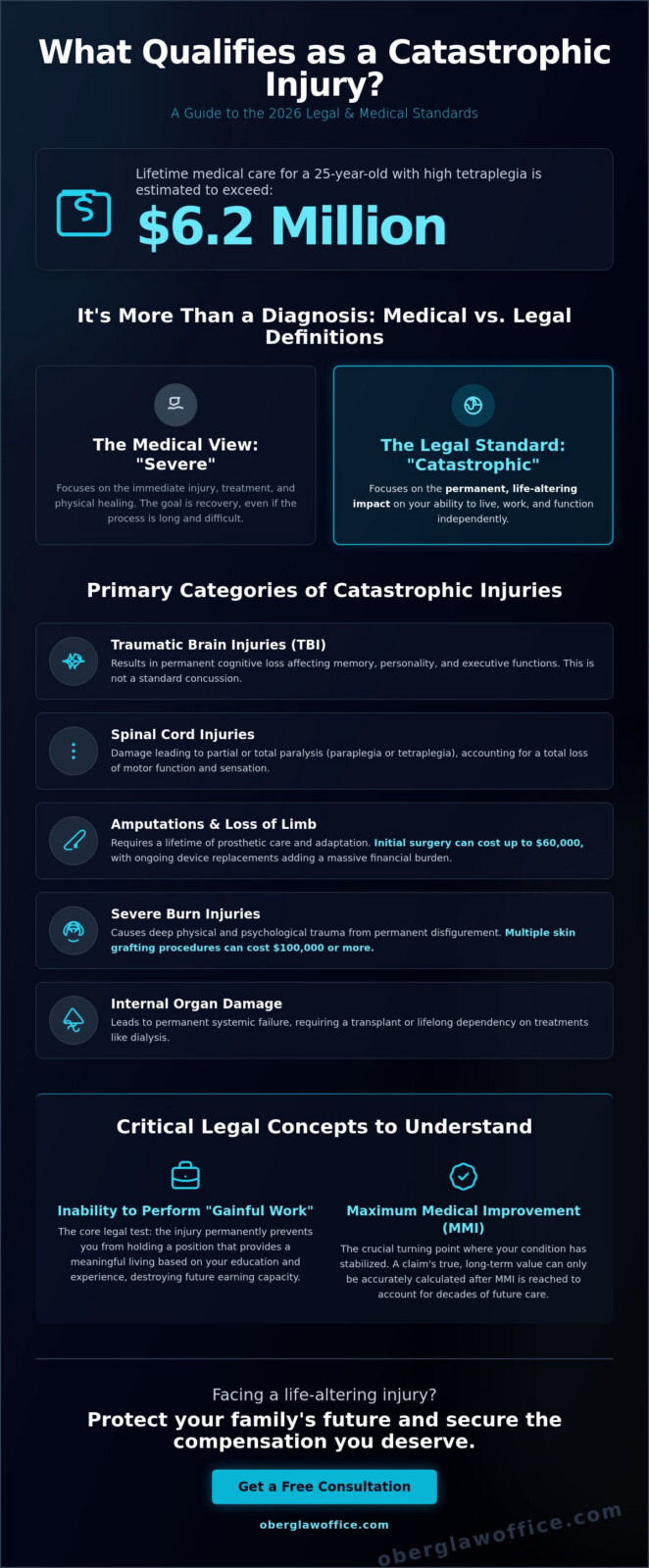
Did you know that the lifetime medical care expenses for a 25-year-old living with high tetraplegia are now estimated to exceed $6.2 million? When you are facing a recovery that spans decades, understanding what qualifies as a catastrophic injury becomes the most important step in protecting your family’s future. You aren’t just dealing with a typical accident. You are managing a permanent shift in how you live, work, and move through the world; one that requires specialized care and significant resources.
We understand the heavy weight of the uncertainty that follows a life-altering event. It is natural to feel overwhelmed by mounting bills and the fear that your quality of life has been permanently diminished. You deserve validation for your suffering and a clear path toward restoration. This comprehensive guide details the specific legal criteria and medical categories that define these high-stakes claims in 2026. We will explore how recent legal reforms impact your rights and provide a roadmap for securing the long-term financial stability you need to move forward with confidence.
Key Takeaways
- Learn why a medical diagnosis is only the starting point and how federal legal standards define your specific path to recovery.
- Understand exactly what qualifies as a catastrophic injury by focusing on the long-term functional impact on your daily life and earning capacity.
- Discover how to calculate the true cost of your claim, ensuring your family’s financial security by accounting for lifetime care and the restoration of your quality of life.
- Identify the critical legal differences in these cases, such as the need to navigate high-limit commercial insurance policies and prove the permanence of your condition.
- Follow a clear roadmap of the immediate actions you must take to protect your future, starting with specialized medical documentation from day one.
Defining ‘Catastrophic’: The Legal Standard vs. Medical Reality
You might think a severe injury is obvious, but the legal system uses a very specific lens to evaluate your claim. While your doctor focuses on your immediate stabilization and physical healing, the courts look at your entire future. Understanding what qualifies as a catastrophic injury requires looking beyond the initial trauma to the permanent changes in your life. It is the difference between an injury you recover from and one you must learn to live with forever.
Federal law provides a rigorous benchmark for these cases. Specifically, 42 U.S. Code § 3796h and its related provisions set a high bar, often defining a catastrophic injury as one that permanently prevents an individual from performing any gainful work. While this statute is frequently used to determine benefits for public safety officers, its core logic influences how insurance companies and courts view private claims in 2026. The law isn’t just concerned with the severity of the accident; it’s concerned with the “permanence” of the resulting disability.
There is often a significant gap between a medical diagnosis and a legal conclusion. A physician might label an injury “severe” because it requires surgery and months of physical therapy. However, if you eventually return to your baseline health, that injury likely won’t meet the legal threshold. This Catastrophic injury definition hinges on long-term disability, significant disfigurement, or the loss of a vital bodily function. If an injury is temporary, no matter how agonizing the recovery process feels, it rarely qualifies for the specialized legal protections and higher compensation limits reserved for catastrophic cases.
The Role of Gainful Employment in Legal Definitions
Legal success in these high-stakes cases often depends on proving you cannot perform “any gainful work.” This doesn’t mean you are incapable of performing any task at all. Instead, it means you can no longer hold a position that provides a meaningful living based on your education and experience. We work closely with vocational experts to analyze your specific skill set. They help us demonstrate to the court that your injury has stripped away your career and your future earning capacity, not just a few weeks of wages.
Maximum Medical Improvement (MMI) and Your Claim
You shouldn’t rush into a settlement shortly after your accident. We typically wait until you reach Maximum Medical Improvement, or MMI. This is the point in your recovery where your condition has stabilized and no further functional improvement is expected. It’s a turning point because it allows us to see the “new normal” of your life. Filing a claim before reaching MMI is a mistake; we need a long-term medical prognosis to ensure your settlement covers the next thirty or forty years of care.
Primary Categories of Injuries Classified as Catastrophic
While every injury is painful, those that fall under the catastrophic umbrella share a common trait: they fundamentally alter your future. When determining what qualifies as a catastrophic injury, legal professionals look for physical or cognitive damage that prevents you from returning to the life you knew. These cases don’t just involve temporary medical bills; they involve a complete restructuring of your world. We often see these life-altering events categorized into five primary areas of trauma.
- Traumatic Brain Injuries (TBI): These go far beyond a standard concussion. A severe TBI can result in permanent cognitive loss, affecting your memory, personality, and executive function.
- Spinal Cord Injuries: Damage to the spinal cord often leads to partial or total paralysis. Whether it is paraplegia or tetraplegia, the legal weight of these claims accounts for the total loss of motor function.
- Amputations and Loss of Limb: Losing a limb requires a lifetime of prosthetic care. The initial surgery might cost up to $60,000, but the ongoing adaptation and device replacements create a massive financial burden.
- Severe Burn Injuries: Burns are uniquely devastating. Beyond the physical pain, they cause deep psychological trauma through permanent disfigurement and often require multiple skin grafting procedures costing $100,000 or more.
- Organ Damage: Internal injuries can lead to permanent systemic failure. When an accident results in the need for a transplant or lifelong dialysis, it meets the threshold for a catastrophic claim.
Traumatic Brain Injuries and Cognitive Function
TBIs are particularly complex because they are often “invisible.” You may look the same, but your ability to process information or manage your emotions has changed forever. Proving these shifts in court requires expert testimony to link the trauma to your new reality. For instance, if you were injured in a collision with a commercial vehicle, a truck accident lawyer texas can help demonstrate how the impact led to permanent cognitive deficits. According to a March 2026 CDC report, inpatient care for TBIs averages over $51,000 in medical expenses alone within just the first year.
Spinal Cord Trauma and Permanent Disability
A spinal cord injury creates a ripple effect of health complications. Legal claims must account for secondary issues like respiratory infections or chronic nerve pain, which significantly increase the value of your case. For a 25-year-old living with high tetraplegia, lifetime care costs are now estimated to exceed $6.2 million. This includes the necessity of home modifications and specialized vehicles. If you are facing these overwhelming changes, you don’t have to walk this path alone. You can consult with a dedicated advocate to begin building your roadmap toward financial security.
The Ripple Effect: Calculating the True Cost of a Life-Altering Injury
Calculating the true cost of a life-altering event is about more than just adding up your current hospital bills. When we evaluate what qualifies as a catastrophic injury, we look at the “ripple effect” that touches every corner of your existence. These injuries don’t just hurt; they change your family’s financial trajectory for decades. To protect your future, we must account for both the visible bills and the hidden costs of a diminished quality of life.
A Life Care Plan is the backbone of your case. This document is a comprehensive projection of every medical and non-medical need you will have for the rest of your life. It moves your claim from guesswork into concrete, professional analysis. We include everything from recurring surgeries and specialized equipment to 24/7 nursing care and home modifications. Without this plan, you risk accepting a settlement that runs out long before your needs do.
Future Medical Needs and Life Care Planning
We work with certified Life Care Planners whose testimony is vital in court. They don’t just look at today’s prices; they factor in inflation and the rising cost of healthcare over thirty or forty years. For example, lifetime medical care for a spinal cord injury can range from $1.1 million to over $4.7 million. If you’re a 25-year-old with high tetraplegia, that cost can exceed $6.2 million. We ensure your claim accounts for the annual medical expenses that can reach $250,000 every single year after the initial trauma.
The Emotional and Psychological Toll
Non-economic damages quantify the “loss of enjoyment of life.” This is where we address the pain, suffering, and mental anguish that a cold spreadsheet cannot capture. If you can no longer pick up your children, enjoy a hobby, or maintain an intimate relationship with your spouse; known legally as loss of consortium; those losses deserve validation. Proving the impact of PTSD or severe depression is challenging but necessary. We often use personal journals and family testimony to show the jury the human story behind the medical codes. Your suffering is real, and the law provides a way to hold the responsible parties accountable for that emotional burden.
Critical Legal Differences in Catastrophic vs. Standard Injury Claims
You might be familiar with how a typical car accident claim works, but when you are dealing with what qualifies as a catastrophic injury, the legal landscape shifts entirely. Standard injury cases often focus on immediate medical bills and a few weeks of lost wages. In contrast, catastrophic claims are defined by the permanence of the damage. The burden of proof rests on your ability to demonstrate that you will never return to your pre-accident health. This requires a level of evidence that goes far beyond a simple doctor’s note.
Timing has become even more critical in 2026. Recent legal reforms across the country, such as those in Florida that reduced the statute of limitations for personal injury claims to just two years, highlight a growing trend of tighter deadlines. You cannot afford to wait while you heal. Establishing the long-term impact of your injury requires immediate coordination with a team of experts. We bring in neurologists, vocational specialists, and economic life-care planners to build a foundation that can withstand the scrutiny of a courtroom.
The insurance limits involved are another major differentiator. A standard policy rarely covers the millions of dollars required for lifetime care. We look for commercial policies, corporate liability, and umbrella coverage that provide the necessary depth. Identifying these multiple layers of coverage is the only way to ensure your family’s financial security isn’t capped by a low-limit individual policy.
Navigating High-Stakes Insurance Negotiations
Insurance companies fight catastrophic claims with aggressive determination because the financial stakes are so high. They may try to tempt you with a “quick settlement” offer that seems large at first glance. However, a personal injury lawyer mesquite tx knows that these early offers are often designed to save the insurer money at your expense. We peel back the layers of their defense to protect your right to a full restoration. If you are feeling pressured by an adjuster, speak with our advocates first to ensure your future is protected.
The Necessity of Litigation and Trial Readiness
Most catastrophic cases require filing a formal lawsuit to get the insurance company’s attention. We prepare every case as if it is going to a jury from day one. One of our most powerful evidentiary tools is the “Day in the Life” video. These recordings show the jury the reality of your daily struggle, from the difficulty of getting dressed to the specialized equipment required for your mobility. It moves your story from a medical chart to a human experience, making the permanent nature of your injury impossible to ignore.
Navigating the Recovery Process with Professional Legal Advocacy
After a life-altering accident, your first priority is survival and medical stabilization. However, the actions you take in the initial days and weeks often dictate the strength of your future claim. Understanding what qualifies as a catastrophic injury is only half the battle; you must also document the evidence that proves your condition meets this high legal standard. This begins with seeking specialized care from neurologists or orthopedic surgeons who understand the long-term nature of permanent trauma. Their detailed medical records serve as the primary evidence for your physical and cognitive limitations.
Our firm manages the investigation phase with unwavering determination. We don’t just wait for police reports; we secure “black box” data from commercial trucks, preserve physical evidence from the scene, and interview witnesses while their memories are fresh. This proactive approach is essential because evidence can disappear quickly. We take the burden of this investigation off your shoulders so you can focus on your medical treatments and your family.
Access to justice should never depend on your current bank balance. We operate on a performance-based fee structure, which means you pay nothing upfront and we only receive a fee if we successfully recover compensation for you. This model allows you to go head-to-head with large insurance institutions without the stress of hourly legal bills. We share the risk with you, which reinforces our commitment to securing the maximum possible restoration for your life.
Selecting the Right Legal Representative
Choosing an attorney is a deeply personal decision that will impact your family’s security for decades. You need a partner who understands the local courts and has a proven track record as a catastrophic injury lawyer mesquite. During your initial strategy session, ask about their experience with life care planners and their willingness to take a case to trial. You deserve direct communication with senior professionals who are personally invested in your outcome, rather than being passed off to support staff.
Focusing on Healing While Your Attorney Fights
The “paperwork war” with insurance companies is exhausting, especially when you are managing a permanent disability. We handle every phone call, deadline, and negotiation on your behalf. This professional case management provides the peace of mind you need to navigate the emotional aftermath of your accident. By moving from a state of uncertainty to a feeling of empowerment, you can take the first step toward a secure future. We are here to act as your steadfast protector, ensuring that the legal system works for you, not against you.
Securing Your Future and Restoring Your Peace of Mind
A life-altering accident changes everything in an instant. You’ve learned that what qualifies as a catastrophic injury is defined by its permanence. It’s about the loss of your career, your independence, and your previous quality of life. Whether you are managing a traumatic brain injury or a spinal cord trauma, the road ahead requires a specialized Life Care Plan. This strategy must account for decades of medical needs and the rising costs of specialized care. You shouldn’t have to face aggressive insurance companies alone while you are trying to heal.
At Oberg Law Office, we’ve spent over 25 years acting as a steadfast protector for our neighbors. You will receive direct, personalized attention from Attorney Gregg Oberg. This ensures your case is never treated like a distant transaction. We work on a contingency-based model, so you pay nothing unless we win your case. This gives you access to justice without any financial risk. Schedule your free initial strategy session with Oberg Law Office today. Your journey toward restoration starts with a single, supportive conversation. We are ready to stand by your side and fight for the security you and your family deserve.
Frequently Asked Questions
What is the legal definition of a catastrophic injury?
A catastrophic injury is legally defined as a permanent functional impairment that prevents you from performing gainful work or living as you did before the accident. While specific definitions vary by state, the core requirement is the permanence of the disability or disfigurement. Unlike standard injuries where you eventually return to your baseline health, these cases involve life-altering shifts that require long-term medical intervention and significant daily adaptation.
How does a catastrophic injury claim differ from a standard car accident claim?
The primary difference lies in the scale of the damages and the burden of proving long-term permanence. A standard car accident claim usually covers immediate medical bills and a brief period of lost wages. When determining what qualifies as a catastrophic injury, the legal system looks at your needs over the next several decades. These cases involve much higher insurance policy limits and require specialized experts to project millions of dollars in lifetime care costs.
Can I recover compensation if my injury is only partially disabling?
You can still recover compensation even if you are only partially disabled, provided the injury has a permanent impact on your quality of life or earning capacity. For example, losing the full use of a hand or suffering from chronic cognitive deficits after a TBI may not leave you completely immobile, but it still meets the threshold for a significant claim. We focus on how the loss of function specifically limits your future career and personal independence.
What types of damages are available in a catastrophic injury lawsuit?
Damages are split into economic and non-economic categories to cover every aspect of your loss. Economic damages include your past and future medical bills, lost earning capacity, and the cost of home modifications. Non-economic damages address the human side of the accident, such as physical pain, mental anguish, and loss of consortium. Because these injuries are permanent, these figures are often calculated to cover your needs for thirty or forty years into the future.
How long do I have to file a catastrophic injury claim?
The time you have to file, known as the statute of limitations, varies by state and is subject to recent legislative changes. For instance, as of 2026, recent tort reforms in Florida have reduced the statute of limitations for personal injury claims to two years. It’s critical to act quickly because evidence can disappear and memories fade. Starting your claim early allows your legal team to secure vital data from the accident scene and preserve your right to recovery.
Why do I need a life care planner for my injury case?
A life care planner is essential because they translate your medical prognosis into a concrete financial roadmap. They identify every future need you’ll have, from microprocessor-controlled prosthetics that cost $70,000 to 24-hour attendant care that can exceed $220,000 annually. Without this professional documentation, it’s almost impossible to convince an insurance company or a jury of the true lifetime cost of your care. They provide the backbone of our demand for a full restoration.
What if the insurance company denies that my injury is catastrophic?
If an insurance company denies the severity of your condition, we move the case into the litigation phase to prove the impact of the trauma. We use specialized medical testimony, vocational experts, and “Day in the Life” videos to demonstrate the reality of your daily struggle. Insurers often use their own doctors to downplay your disability, but our job is to present a formidable wall of evidence that validates your suffering and forces them to acknowledge the truth.
How much does it cost to hire a catastrophic injury lawyer?
We use a performance-based fee structure, so there are no upfront costs or hourly fees for you to worry about. We only receive a fee if we successfully recover compensation through a settlement or a jury verdict. This model ensures that you have access to high-level legal advocacy regardless of your current financial situation. We share the risk of the case with you, which allows us to focus entirely on securing the maximum financial stability for your future.