
What if the true traumatic brain injury lawsuit value isn’t found in your past medical bills, but in the future opportunities you’ve lost? When you’re facing personality changes or the fear that you’ll never return to your career, a simple reimbursement for yesterday’s doctor visit isn’t enough. You likely feel overwhelmed by the sudden shift in your life’s trajectory and the mounting pressure of long-term care costs. We understand that this isn’t just a legal case. It’s about restoring a sense of security for your family and making sure you aren’t left behind by a system that often feels cold and detached.
You deserve to know exactly how these claims are valued in 2026 so you can hold the negligent party accountable. In this guide, we’ll explain how factors like California’s comparative negligence rules or New York’s strict filing deadlines impact your recovery. You’ll learn why the average TBI settlement reached $540,000 this year and how experts calculate the non-economic damages that reflect your true pain and suffering. We provide a clear breakdown of settlement ranges by severity to help you understand what a fair outcome looks like for your specific situation.
Key Takeaways
- Discover the three pillars that define your traumatic brain injury lawsuit value, ensuring you don’t overlook critical factors like insurance limits or liability.
- Learn the difference between quantifiable medical bills and the non-economic human cost of your injury, which often accounts for the largest portion of a settlement.
- Understand how medical classifications like mild, moderate, or severe TBIs set the foundation for your legal recovery and potential seven-figure compensation.
- Identify the risks of accepting quick insurance settlements before delayed-onset symptoms appear, protecting your right to long-term financial security.
- Find out why working directly with a senior attorney is essential for navigating the legal maze and securing a fair outcome.
What Factors Determine Traumatic Brain Injury Lawsuit Value?
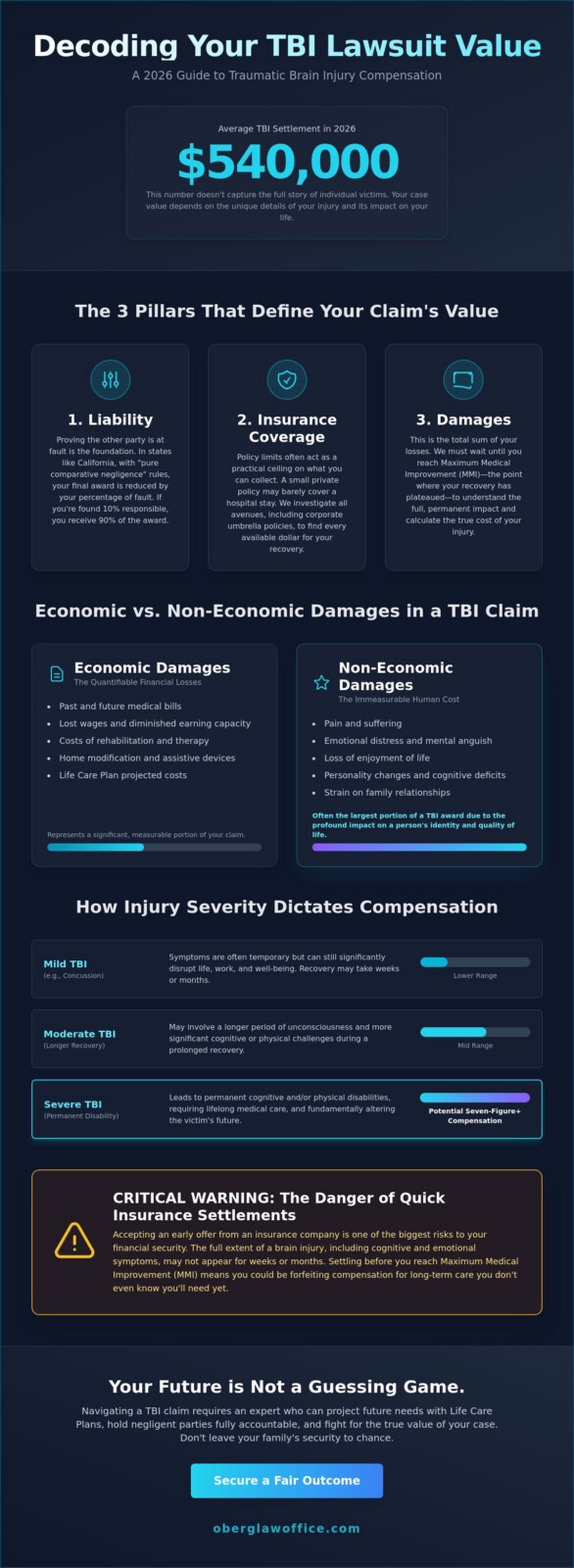
Determining your traumatic brain injury lawsuit value isn’t as simple as adding up a few receipts. It’s a comprehensive look at how your life has been altered. The value of your claim is the total sum of financial compensation required to restore what was taken from you, covering everything from immediate surgery to decades of specialized care. While reports from early 2026 indicate an average TBI settlement of $540,000, these numbers often fail to capture the reality of individual victims. A mild concussion and a permanent cognitive disability are both brain injuries, yet their impact on a family’s security is vastly different.
We build your case on three essential pillars: liability, insurance coverage, and damages. To establish a baseline for these damages, we often wait until you reach Maximum Medical Improvement (MMI). This is the stage where your recovery has plateaued and the permanent effects of a Traumatic Brain Injury (TBI) become clear. Without reaching MMI, we risk settling your case before we truly know if you’ll need lifelong assistance or if you can ever return to your previous job. We refuse to guess when your future is on the line.
The Role of Liability and Comparative Negligence
Proving the other party is entirely at fault is the first step toward maximizing your recovery. Whether you were involved in a motorcycle accident or a slip and fall, clear evidence like witness statements and surveillance footage acts as the bedrock of your claim. In states like California, the rule of pure comparative negligence applies. This means your final check is reduced by any percentage of fault assigned to you. If a jury decides you were 10% responsible, you only receive 90% of the award. We fight to ensure the negligent party is held fully accountable so your traumatic brain injury lawsuit value isn’t unfairly diminished by shared blame.
Insurance Policy Limits: The Practical Ceiling
Insurance coverage often acts as a ceiling on how much you can actually collect. A private driver might have a policy that barely covers a hospital stay, which is a terrifying prospect for someone facing a long-term disability. In these cases, we look for alternative paths to justice. This might involve identifying corporate umbrella policies in truck accident representation or pursuing the personal assets of a negligent business owner. With medical service costs rising by 3.2% this year, finding every available dollar of coverage is vital for your long-term peace of mind and financial restoration.
Economic vs. Non-Economic Damages in a TBI Claim
Your traumatic brain injury lawsuit value isn’t a single number pulled from a hat. It’s the sum of your measurable financial losses and your immeasurable human suffering. Economic damages cover the “out-of-pocket” costs that come with a clear paper trail. This includes every ER visit, every prescription, and the 3.2% increase in medical service costs we’ve seen throughout 2026. Non-economic damages, however, are designed to restore a sense of fairness by compensating you for the emotional and physical toll that no receipt can capture.
Brain injuries are unique because they don’t just affect your body; they affect who you are. This is why TBIs often command higher non-economic awards than other types of personal injury claims. When your personality changes or you lose the ability to enjoy your favorite hobbies, our local courts recognize this as a significant loss. We often suggest that our clients keep a “pain journal” to record these daily struggles. Writing down your frustrations with memory loss or the strain on your family relationships helps us build a compelling narrative for your recovery. If you need help organizing this evidence, our catastrophic injury representation team is ready to step in as your guide.
Projecting Future Medical Needs with Life Care Plans
A Life Care Plan is a comprehensive document that projects the lifetime costs of a catastrophic injury. Because medical inflation is a reality, we can’t just look at what care costs today. We must account for the likelihood that you’ll need home modifications, 24-hour nursing, or specialized medications for thirty years or more. Life Care Planners use detailed medical information on TBI to build a roadmap for your future. This ensures your settlement doesn’t run out when you need it most, providing the long-term security your family deserves.
Quantifying Loss of Earning Capacity
There’s a critical difference between lost wages and lost earning capacity. Lost wages cover the paychecks you’ve already missed while recovering in the hospital. Lost earning capacity addresses the career you can no longer pursue. If a specialized professional can only work part-time in an entry-level role after their injury, the financial gap over a lifetime is massive. We work with vocational experts to calculate this loss, including your missed 401k contributions, health insurance benefits, and the career advancement you likely would have achieved. This ensures your traumatic brain injury lawsuit value reflects your entire life’s potential, not just your current salary.
The Impact of Injury Severity on Your Compensation Range
Medical classification is the starting point for your legal valuation. Doctors generally categorize brain injuries as mild, moderate, or severe. While these terms sound clinical, they translate directly into your traumatic brain injury lawsuit value. Severe TBIs, often involving comas or permanent paralysis, regularly command seven-figure settlements. In fact, current 2026 data shows that severe cases in New York frequently result in seven and even eight-figure verdicts. These awards reflect the total life-altering nature of the injury, providing the financial foundation needed for 24-hour care and specialized medical equipment.
Moderate TBIs occupy a middle ground that requires a sophisticated legal strategy. These cases often involve visible brain damage on an MRI alongside significant cognitive deficits. Proving the value of a moderate TBI usually involves extensive neuropsychological testing to document memory loss, executive dysfunction, or speech impediments. In California, moderate TBI settlements typically range between $150,000 and $500,000; however, this can climb significantly if the victim can no longer work. We focus on the details that insurance companies try to ignore, ensuring every cognitive deficit is documented and compensated.
Proving the “Invisible” Injury in Mild TBI Cases
Don’t let the word “mild” lead you to believe your claim is worth less. A mild TBI, such as a concussion with post-concussion syndrome, can be just as debilitating as a physical wound. The challenge is that standard CT scans often miss microscopic axonal shearing, which is the tearing of brain fibers that causes long-term symptoms. We utilize advanced imaging like Diffusion Tensor Imaging (DTI) or PET scans to show the physical damage that traditional tests overlook. Beyond the scans, we rely on testimony from your friends and family. Their stories about your personality changes or sudden irritability provide the human context that a computer scan cannot, proving your life has truly changed.
Permanent Disability and Quality of Life
A permanent disability changes your daily experience in ways that are hard to quantify but essential to include in your traumatic brain injury lawsuit value. Juries look at your “loss of enjoyment of life,” which covers everything from no longer being able to play with your children to losing the ability to drive. This also includes “loss of consortium” claims, which compensate for the damage done to your relationship with your spouse. Your age plays a significant role here. Younger victims often receive higher valuations because they face more “lost years” of healthy living and career growth. We advocate for a result that honors the decades of life you have ahead of you, ensuring you have the resources to live with dignity.
Why Accepting an Early Insurance Offer Can Devalue Your Case
You’re likely receiving calls from insurance adjusters just days after your accident. They might sound friendly and concerned, offering a check that seems helpful for your immediate bills. This is a strategic move to lock in a low traumatic brain injury lawsuit value before the true extent of your damage surfaces. Brain injuries are notoriously unpredictable. What feels like a lingering headache today could evolve into chronic executive dysfunction or debilitating vertigo six months from now. If you take that money today, you’re gambling with your future financial security.
We’ve seen insurance companies push for quick signatures because they know the long-term costs of a TBI are massive. With healthcare inflation rising, a settlement that feels adequate today might not even cover your prescriptions in three years. We advise our clients to wait until they reach Maximum Medical Improvement. This ensures we aren’t guessing about your future needs. You deserve a settlement that reflects the permanent shift in your life’s trajectory, not just a quick fix for your current stress.
The “Full and Final” Release Trap
When you accept a check, you’ll be asked to sign a settlement release form. This isn’t just a receipt. A signed release is a permanent waiver of all future claims related to that accident. This means if you discover you need specialized neuro-therapy next year, or if your symptoms prevent you from ever working again, you cannot go back and ask for more money. The insurance company’s goal is to “close the file” as cheaply as possible, shifting the financial risk of your recovery from their shoulders to yours. Before you sign anything, let our catastrophic injury representation team review the offer to ensure you aren’t being lowballed.
How Insurance Companies Undervalue Brain Injuries
Adjusters often use specific tactics to downplay the severity of your injury. They might label your TBI as a “minor concussion” because you didn’t lose consciousness or because your initial CT scan appeared normal. They may even try to blame your memory loss or mood swings on your age or pre-existing conditions. We counter these attempts with hard medical evidence and specialized testing. By documenting the microscopic damage that traditional scans miss, we force the insurance company to face the reality of your situation. This persistence is how we protect your traumatic brain injury lawsuit value from being unfairly diminished by corporate tactics.
How a Dedicated Injury Attorney Maximizes Your Recovery
You don’t have to face this legal maze alone. An experienced attorney acts as your steadfast protector, ensuring you aren’t overwhelmed by aggressive insurance adjusters or complex court filings. At our firm, we believe in a personal touch that starts with direct communication. You’ll interact with a senior professional who is personally invested in your recovery, rather than being passed off to support staff. This direct partnership is essential for accurately capturing the nuances of your case and maximizing your traumatic brain injury lawsuit value.
Proving a brain injury requires more than just showing a medical bill. A catastrophic injury lawyer builds a narrative that helps a jury see the person behind the clinical diagnosis. We translate complex medical data into a story of lost opportunities, personality shifts, and altered lives. This human connection is often what drives the highest settlements. To make this level of representation accessible to everyone, we operate on a contingency fee model. You only pay us if we win your case, which means we share the risk and are fully committed to your success.
Building the Case with a Network of Experts
We don’t just rely on our own legal experience. We build your case with a dedicated network of respected experts, including neurologists, economists, and accident reconstructionists. These professionals help us quantify the long-term impact of your injury. For instance, an economist can calculate how the 3.2% increase in medical service costs we’ve seen in 2026 will affect your care needs thirty years from now. Oberg Law Office invests heavily in these resources to prove the maximum value of your claim. We prepare every case as if it’s going to trial. This aggressive preparation signals to insurance companies that we’re formidable opponents, which often forces them to offer a higher settlement before we ever step into a courtroom.
A Compassionate Approach to a Difficult Journey
We know that your primary focus should be on your physical and emotional recovery. Our compassionate approach is designed to reduce your anxiety by handling the complex legal logistics on your behalf. We act as your knowledgeable guide, moving you from a state of uncertainty to a feeling of empowerment. Personalized legal representation means we listen to your fears and advocate for your specific family needs. It’s about restoring your security and ensuring fairness in a system that can often feel cold. When you’re ready to take the next step toward financial restoration, schedule a free strategy session to discuss your unique situation and protect your traumatic brain injury lawsuit value.
Securing Your Future and Restoring Your Peace of Mind
You’ve navigated the complexities of how settlements are calculated and why your medical classification is just the starting point for your recovery. Understanding that your traumatic brain injury lawsuit value is built on long-term care needs and lost earning capacity ensures you don’t settle for less than you deserve. We’ve explored why waiting for Maximum Medical Improvement is the only way to protect yourself from the “full and final” release trap. This journey is about more than just a legal outcome. It’s about restoring the security your family needs to move forward.
At Oberg Law Office, we’ve spent over 25 years fighting insurance companies to secure justice for our neighbors. You’ll always have direct access to senior legal counsel who is personally invested in your restoration. We believe in shared risk, so there are no fees unless we recover money for you. Let us act as your steadfast protector while you focus on healing. Get Your Free TBI Case Strategy Session Today. You don’t have to carry this burden alone; we’re here to guide you toward the accountability and fairness you deserve.
Frequently Asked Questions
What is the average settlement for a traumatic brain injury?
The average TBI settlement in May 2026 is approximately $540,000, but your specific traumatic brain injury lawsuit value depends heavily on the severity of your condition. Mild cases may range from $5,000 to $150,000, while severe injuries involving permanent disability often exceed $1 million. We look beyond these averages to calculate your unique losses, including future medical inflation and your lost earning capacity over a lifetime.
Can I sue for a mild concussion if I still have symptoms?
You can certainly pursue a claim for a mild concussion if you’re suffering from persistent symptoms like post-concussion syndrome. These “invisible” injuries are often undervalued by insurance companies, but they can be just as debilitating as a physical wound. We use advanced diagnostic tools and witness testimony to prove how these cognitive changes impact your daily life, ensuring you receive a fair settlement for your suffering.
How long does a brain injury lawsuit typically take to settle?
Most brain injury cases take between 12 and 24 months to reach a final resolution. This timeframe is necessary because we must wait for you to reach Maximum Medical Improvement to understand your long-term needs. Rushing into a settlement before your doctors can project your future care costs is a mistake that could leave you with significant unpaid medical bills years down the road.
What if the insurance company denies that I have a brain injury?
If an insurance company denies your claim, we fight back by providing objective medical evidence and expert testimony. Adjusters often try to blame your symptoms on pre-existing conditions or claim that a normal CT scan means you aren’t hurt. We counter these tactics by utilizing specialized neurologists and advanced imaging that can detect microscopic damage, forcing the insurer to acknowledge the reality of your injury.
Will I have to go to court for my TBI claim?
Most TBI claims are resolved through out-of-court negotiations or mediation without the need for a trial. However, we prepare every case as if it’s going before a jury to maximize your traumatic brain injury lawsuit value. This level of preparation shows the insurance company that we’re serious about your recovery, which often leads to better settlement offers before a court date is even scheduled.
How much does it cost to hire a brain injury lawyer?
We work on a performance-based fee structure, meaning you don’t pay anything unless we win your case. There are no hourly fees or upfront costs to worry about while you’re trying to recover. This shared-risk approach ensures that you have access to senior legal counsel and a network of medical experts regardless of your current financial situation following your accident.
What is the statute of limitations for a TBI lawsuit?
In states like New York and North Carolina, you generally have three years from the date of the injury to file a lawsuit. It’s vital to act quickly, as claims against government entities often require a notice of claim within just 90 days. If you miss these strict deadlines, you’ll likely lose your right to seek any financial compensation for your medical needs and lost wages.
Can I still recover compensation if I was partially at fault for the accident?
You can still recover compensation even if you were partially at fault in states like California that follow pure comparative negligence rules. Your final award is simply reduced by your percentage of responsibility for the incident. If a jury finds you were 25% at fault, you would still receive 75% of your total damages. We work to minimize the fault assigned to you to protect your recovery.