On a clear Tuesday in 2024, a Mesquite family found their lives changed in seconds when a semi-truck failed to brake on Highway 80. You might be facing a similar nightmare right now, feeling like an underdog against a massive corporation while medical bills pile up. It’s frustrating to realize that according to the Texas Department of Transportation, over 15,000 commercial vehicle crashes occurred in our state in a single recent year. You’re likely wondering who is liable in a commercial truck accident when so many different companies and contractors are involved.
We agree that the legal complexity shouldn’t stand in the way of your family’s justice. This 2026 legal guide helps you untangle the web of corporate and individual liability so you can understand exactly who is responsible for your recovery. We’ll show you how to identify the right parties to sue to ensure you receive fair compensation for your long term care. We will explore the four specific entities that Texas law often holds accountable for these life-altering wrecks.
Key Takeaways
- Learn how to navigate the complex “web of liability” to identify exactly who is liable in a commercial truck accident, ensuring every responsible party is held accountable.
- Understand the doctrine of vicarious liability and how it allows you to seek justice from the trucking company for the mistakes of its driver.
- Uncover the “hidden” defendants, such as third-party cargo loaders or maintenance contractors, who may share fault for your wreck even if they weren’t at the scene.
- Discover why the “Golden Hour” after a crash is critical for preserving “Black Box” data and other vital evidence before it is lost or destroyed.
- See how working directly with a dedicated attorney—not a paralegal—provides the personalized support and aggressive advocacy needed to take on corporate insurance companies.
The Complexity of Trucking Liability vs. Passenger Car Crashes
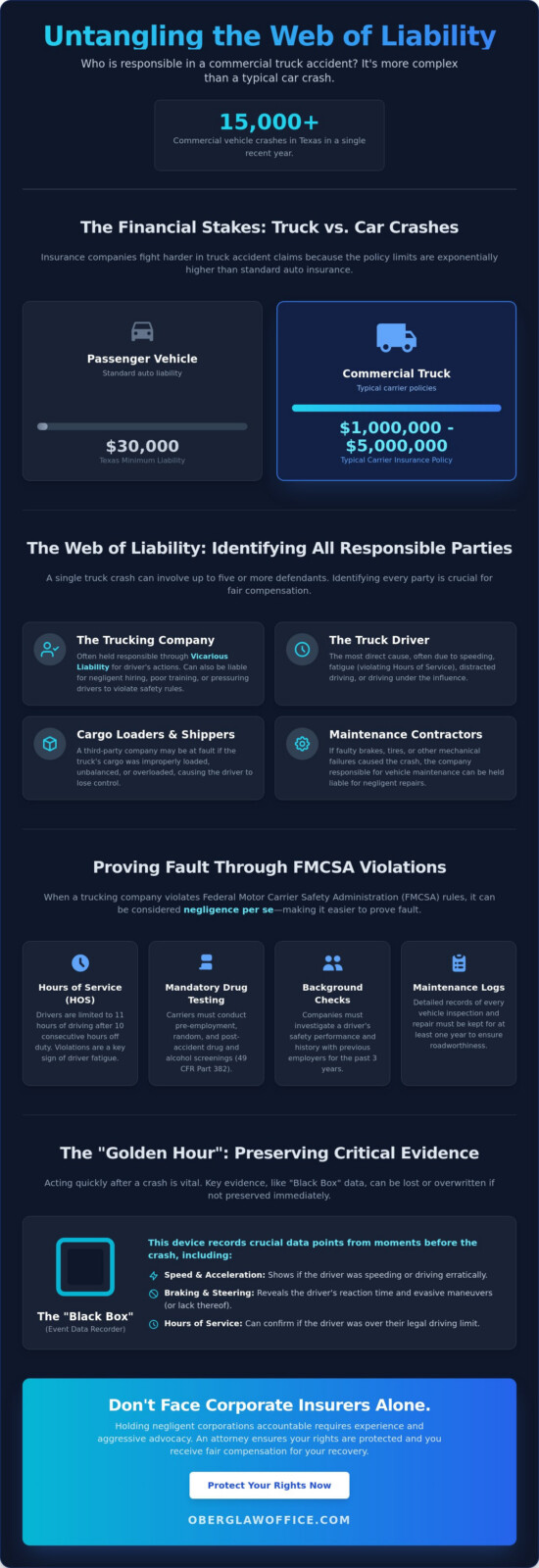
If you’ve been hit by a semi-truck, you’re likely feeling overwhelmed by more than just physical pain. You’re facing a legal battle that’s vastly different from a typical fender-bender. While a car crash usually involves two drivers and their respective insurers, determining who is liable in a commercial truck accident requires untangling a complex web of corporate relationships and federal mandates. The financial stakes are also much higher. While Texas law only requires a $30,000 minimum for personal injury liability in passenger vehicles, commercial carriers often carry policies worth $1 million to $5 million. This means insurance companies will work twice as hard to deny your claim because they have much more to lose.
Why One Accident Can Involve Five Different Defendants
In a standard car accident, the person behind the wheel is usually the only one you’d hold responsible. Commercial trucking operates on a supply chain model where multiple entities share the road. You might find that the driver, the trucking company, the trailer owner, the cargo loaders, and even the maintenance contractor all played a part in your collision. Identifying these parties is the first step a truck accident lawyer texas takes to protect your recovery. Most often, we rely on the doctrine of vicarious liability to hold the employer responsible for the driver’s actions during their shift. This legal bridge ensures that a company cannot simply blame a “rogue driver” to escape its financial obligations to you and your family.
The Role of Federal Regulations in Proving Fault
The Federal Motor Carrier Safety Administration (FMCSA) sets strict standards that don’t apply to everyday drivers. When we investigate who is liable in a commercial truck accident, we look for violations of these specific safety rules. For example, Hours of Service (HOS) regulations limit drivers to 11 hours of driving after 10 consecutive hours off duty. If a driver exceeds these limits to meet a deadline, they’re not just tired; they’re breaking federal law. Other critical regulations include:
- Mandatory Drug Testing: Carriers must conduct pre-employment, random, and post-accident drug and alcohol screenings under 49 CFR Part 382.
- Background Checks: Companies are required to investigate a driver’s safety performance history with previous employers for the past three years.
- Maintenance Logs: Detailed records of every repair and inspection must be kept for at least one year to ensure the vehicle is roadworthy.
When a carrier violates these FMCSA rules, it often constitutes negligence per se. This means the court may automatically consider the company negligent because they broke a law designed to protect public safety. We use these violations to build a solid foundation for your case, showing that your injuries weren’t just an accident, but the result of systemic corner-cutting by a professional transportation company. This shift in the conversation moves the focus from a simple mistake to a clear violation of the trust we place in commercial operators on our Texas highways.
The Trucking Company’s Role and the Doctrine of Vicarious Liability
When you are injured in a collision with a semi, your first thought is usually the driver. However, determining who is liable in a commercial truck accident often leads directly to the company’s front office. Under a legal doctrine called “Respondeat Superior,” an employer is legally responsible for the actions of their employees while they are on the job. This means you aren’t just fighting a single driver; you are seeking justice from the corporation that put them on the road.
Respondeat Superior: Holding the Boss Accountable
If the driver was “on the clock” and performing duties for their employer, the company is usually on the hook for your medical bills and lost wages. This concept is tied to the “scope of employment.” When a driver is acting within this scope, the law views their actions as the company’s actions. You don’t have to prove the corporation was “bad” or intentionally harmful. You only need to show the driver was negligent while working. This legal pathway is vital because trucking companies carry much larger insurance policies than individual drivers, ensuring there are resources available for your full recovery.
Trucking companies often try to avoid this responsibility by labeling their drivers as “independent contractors.” They do this to create a shield between your claim and their bank account. Our team looks past these labels. If the company controls the driver’s schedule, routes, and equipment, the law often considers them an employee regardless of what their contract says. We don’t let paperwork get in the way of your protection.
Negligent Training and Supervision
A trucking company has a strict duty to ensure every person behind the wheel can safely handle an 80,000-pound vehicle. When they cut corners on training or ignore a driver’s history of safety violations, they are being negligent. Many companies utilize “forced dispatch” tactics, where they pressure drivers to ignore federal rest requirements to meet tight deadlines. According to IIHS truck crash statistics, factors like braking capability and driver fatigue are significant contributors to fatal crashes, often stemming from these high-pressure environments.
Identifying these systemic failures is a core part of how a personal injury lawyer builds a strategy for maximizing your recovery. We dig into hiring logs, black box data, and internal emails to see if the company prioritized profits over your safety. If you feel overwhelmed by the complexity of your case, reaching out for a personal consultation can help clarify your next steps toward justice.
- Negligent Hiring: Hiring a driver with a history of DUIs or reckless driving.
- Lack of Supervision: Failing to monitor electronic logging devices (ELDs) for hours-of-service violations.
- Inadequate Maintenance: Sending a truck out with worn brakes or faulty lights to save time.
Third Parties That Share Responsibility Beyond the Driver
You might feel that the police report tells the whole story after a crash. It usually focuses on the driver’s immediate actions, like speeding or a sudden lane change. However, when our team investigates who is liable in a commercial truck accident, we often find “hidden” defendants who never even stepped foot on the highway. These third parties can be just as responsible for your injuries as the person behind the wheel. We look past the obvious to ensure every negligent party is held accountable for the disruption they’ve caused in your life.
Cargo Loaders and Shippers
A truck’s stability relies on the laws of physics. If a loading company fails to secure a 40,000-pound load properly, the results are often deadly. Improper weight distribution makes a massive vehicle impossible to stop in an emergency. When cargo shifts during a turn, it can pull the entire trailer over, causing a rollover or a jackknife accident that the driver cannot prevent.
We look closely at “Shipper’s Liability” in these cases. Sometimes the company requesting the haul demands a delivery window that’s physically impossible to meet safely. This pressure leads to cutting corners. We use forensic evidence and bills of lading to prove that a shift in cargo, rather than driver error, caused the loss of control. If a shipper ignored safety protocols to save twenty minutes, they’re responsible for the harm they caused you.
Maintenance Facilities and Parts Manufacturers
Your safety depends on every bolt and brake pad functioning perfectly. When they don’t, product liability enters the legal picture. If a manufacturer produced defective tires that blew out or steering components that snapped, they’re legally responsible for the resulting wreckage. These companies have deep pockets and aggressive legal teams, but we don’t let them hide behind their corporate status.
Third-party maintenance contractors also share this burden. These facilities often handle fleet repairs for multiple trucking companies. If a mechanic failed to identify worn brake pads or ignored a steering fluid leak during a routine check, their negligence put you in danger. We cross-reference all repair logs with Federal Motor Carrier Safety Administration (FMCSA) regulations to see where the system broke down. These regulations require strict, documented inspections that many contractors skip to increase their profit margins.
Uncovering these shortcuts is a vital part of what a catastrophic injury lawyer does to build a strong case for your recovery. We take this burden off your shoulders so you can focus on healing. Identifying these additional layers of insurance coverage is often the only way to ensure your family receives the full compensation needed for long-term medical care and lost wages.
Gathering the Evidence Needed to Prove Fault After a Wreck
The moments following a crash on a Texas highway are chaotic. You’re likely focused on your injuries and your family, but the first 60 minutes after a collision represent the “Golden Hour” for your legal case. This is the window when physical evidence is most visible and digital data remains untouched. To determine who is liable in a commercial truck accident, we must act quickly before the trucking company’s defense team can control the narrative or scrub the scene.
Every modern commercial rig carries an Event Data Recorder (EDR), often called a “Black Box.” This device captures technical data from the seconds before impact, including your exact travel speed and whether the driver ever applied the brakes. We also secure data from Electronic Logging Devices (ELDs). These systems track a driver’s hours of service with precision. If a driver violated the mandatory 10-hour rest period required by federal law, the ELD serves as the ultimate witness to driver fatigue.
Trucking companies often “lose” or overwrite this data within a 14 to 30-day cycle unless they’re legally stopped. Our team sends a “Spoliation Letter” immediately after you hire us. This formal notice creates a legal obligation for the carrier to preserve all logs, dashcam footage, and maintenance records. If they destroy evidence after receiving this letter, the court can apply severe penalties against them, which strengthens your position during negotiations.
Digital Evidence: The Silent Witnesses
GPS data and dashcam footage provide an unbiased account of the crash that no witness testimony can match. We also look at “Driver Vehicle Inspection Reports” (DVIRs) and maintenance logs to see if the company ignored a mechanical issue, like worn brake pads or tire tread depth below the 4/32-inch legal limit. Trucking companies often claim data was “lost” during a routine system reset unless a lawyer intervenes to secure the hardware.
The Power of Accident Reconstruction
Forensic engineers are our secret weapon in complex cases. They study skid marks and crush patterns to calculate impact speed with mathematical precision. This expert testimony bridges the gap between your memory of the crash and the legal proof of who is liable in a commercial truck accident. These specialists are necessary in high-stakes truck accident lawyer cases where the insurance company tries to shift the blame onto you.
Don’t let the evidence disappear while you’re focused on your recovery. Reach out to the Oberg Law Office today so we can start protecting your rights and securing the facts before they’re gone.
How an Advocate Holds Corporate Negligence Accountable
The aftermath of a collision is chaotic. You are dealing with doctors, repair shops, and physical pain. The Oberg Advantage is designed to lift that weight. Unlike large factory firms where you are just a file number, our practice ensures you have direct access to an attorney. You won’t be handed off to a legal assistant or a junior staffer. We believe your story deserves professional legal attention from day one.
Determining who is liable in a commercial truck accident requires a blend of compassionate support for you and aggressive action against the carrier. We treat our clients like neighbors because we are part of this community. When we step into the negotiation room, that neighborly approach shifts into a formidable defense of your rights. We know how to push back when corporate lawyers try to minimize your suffering.
Standing Up to Big Insurance Adjusters
Insurance companies use sophisticated tactics to protect their profits. They often try to shift 100% of the blame onto the victim to avoid a payout. One common trap is the “friendly” phone call requesting a recorded statement shortly after the crash. These adjusters aren’t your friends; they are looking for any slip of the tongue to ruin your claim. We step in to handle all communication immediately. Our team protects you from these predatory strategies, ensuring your words aren’t twisted against you during settlement talks.
- We block adjusters from pressuring you into lowball settlements before you know the full extent of your injuries.
- We gather black box data and driver logs to prove corporate negligence was the true cause.
- We provide a shield so you can focus on healing while we handle the legal battle.
Your Path to Justice and Recovery
You are a family in need of protection, not a case number on a spreadsheet. Our goal is to secure full compensation that covers every aspect of your loss. This includes current medical bills, future rehabilitation costs, lost earnings, and the profound pain and suffering you’ve endured. We understand the local Texas courts and the specific regulations that govern the trucking industry in 2026. This expertise is vital when identifying who is liable in a commercial truck accident and holding them to account.
Financial barriers shouldn’t keep you from elite legal help. We operate on a “No Fee Unless We Win” model. This means we take on all the financial risk of your case. You don’t pay a dime in attorney fees unless we successfully recover money for you. It’s a partnership built on trust and shared goals. If you’re ready to identify the parties responsible for your crash, Schedule your free consultation with the Oberg Law Office today.
Take Control of Your Recovery Today
Navigating the wreckage of a collision is exhausting, but you don’t have to face corporate legal teams alone. Determining who is liable in a commercial truck accident involves more than just looking at the driver; it requires a deep dive into vicarious liability and third-party maintenance logs. With over 25 years of experience in Texas law, the Oberg Law Office focuses on uncovering the truth behind corporate negligence. We know how to analyze black box data and safety records to ensure every responsible party is held accountable.
You deserve a legal partner who treats you like a neighbor, not a case number. When you reach out, you’ll get direct access to Attorney Gregg Oberg to discuss your path forward. We believe everyone should have access to high-quality representation, so we charge no fees unless we win your case. Let us shoulder the legal burden while you focus on your family’s health and healing. You’re stronger than this tragedy, and we’re here to help you prove it.
Get Your Free Truck Accident Strategy Session Now
Your journey toward justice is just one conversation away, and we’re ready to stand by your side every step of the way.
Frequently Asked Questions
Can I sue the trucking company if the driver was an independent contractor?
Yes, you can hold a trucking company responsible even if they claim the driver is an independent contractor. Under Federal Motor Carrier Safety Administration regulation 49 CFR § 376.12, the company that leases the truck is often legally liable for its operation on the road. We look at how much control the company had over the driver’s schedule to ensure the right people are held accountable for your recovery.
What happens if the truck driver was under the influence of drugs or alcohol?
If a driver is under the influence, they violate strict federal laws and face immediate disqualification from the road. The Federal Motor Carrier Safety Regulations Part 382 sets a 0.04% blood alcohol limit for commercial drivers, which is exactly half the limit for standard drivers in Texas. This evidence is a powerful tool when determining who is liable in a commercial truck accident, as it proves gross negligence.
How long do I have to file a lawsuit after a commercial truck accident?
In Texas, you generally have two years from the date of the collision to file a personal injury lawsuit. This timeline is strictly set by Texas Civil Practice and Remedies Code Section 16.003. Missing this 24 month window means you lose your right to seek compensation forever. We act quickly to preserve evidence before the trucking company’s insurance team can hide or destroy it.
What is the “black box” and how does it help my case?
The black box is an Electronic Control Module that records vital data like speed and braking patterns. According to the National Highway Traffic Safety Administration, these devices capture critical data in the 5 seconds before a crash occurs. This data helps us prove the driver was speeding or failed to brake, making it much harder for the insurance company to deny your claim or blame you.
Will I have to go to court to prove who is liable?
Most truck accident cases reach a settlement without you ever stepping foot in a courtroom. Statistics from the Bureau of Justice Statistics show that about 95% of personal injury cases are resolved through settlements before trial. However, we prepare every case as if it’s going to a jury. This aggressive approach ensures the insurance company takes your claim seriously and offers the full compensation you deserve.
What if I was partially at fault for the truck accident?
You can still recover compensation in Texas as long as you are 50% or less at fault for the crash. Texas uses a legal standard called modified comparative negligence under Chapter 33 of the Civil Practice and Remedies Code. If a jury finds you 20% responsible, your total award is simply reduced by that 20%. We work to protect your interests and minimize any blame the trucking company tries to shift.
How much does it cost to hire a truck accident lawyer?
You don’t pay anything upfront because our firm works on a contingency fee basis. This means we only get paid if we win a settlement or jury verdict for your family. This model is standard across Texas and ensures that every neighbor in Mesquite has access to high quality legal protection regardless of their current financial situation. We take the financial risk so you can focus on your physical recovery.
What kind of compensation can I recover in a multi-party liability case?
You can recover damages for medical bills, lost wages, and emotional distress from every party that contributed to the crash. Determining who is liable in a commercial truck accident might involve the driver, the trucking firm, and even the cargo loader. If three different entities share 100% of the blame, we pursue all of them to maximize your total recovery and ensure your future is fully protected.