
Imagine sitting at your kitchen table in Mesquite on a Tuesday afternoon, staring at a stack of medical bills while your kids play outside. You want to join them, but the sharp pain in your shoulder from last month’s accident makes even a simple game of catch impossible. It is exhausting when an insurance adjuster treats your life like a cold line item on a spreadsheet. You aren’t just a file; you’re a neighbor whose daily joy has been sidelined. Learning how to calculate pain and suffering is the most important step you can take to ensure the insurance company sees the full human cost of your injury.
We agree that it’s frustrating to feel like your personal trauma is being ignored by a distant corporation. This guide will show you the exact methods insurance companies use to value non-economic damages and how you can document your experience to maximize your recovery. We’ll walk through the legal frameworks and multipliers used in 2026 to give you a clear settlement figure to aim for during negotiations. Because 100% of our clients at the Oberg Law Office speak directly with their attorney, we know exactly how to turn your personal story into a compelling case for justice.
Key Takeaways
- Discover the specific methods insurance adjusters use to value the emotional and physical toll an accident takes on your life.
- Learn how to calculate pain and suffering using industry-standard formulas to ensure you are seeking the full compensation your family deserves.
- Find out how simple steps like keeping a daily journal can provide the vital evidence needed to protect your future recovery.
- Identify the key factors, such as injury permanence and career impact, that can significantly increase the value of your non-economic damages.
- Understand why having a dedicated legal guide is essential to ensure your voice is heard and your pain is never minimized by insurance companies.
Understanding Pain and Suffering in Personal Injury Claims
An accident changes your life in a heartbeat. You’re dealing with more than just a broken bone; you’re dealing with the total disruption of your daily routine. In the Texas legal system, the legal concept of pain and suffering covers the human cost of an injury that a hospital receipt cannot capture. These are officially known as non-economic or general damages. The core theory behind these claims is to “make the victim whole” again. While no amount of money can undo a traumatic event, it’s the only tool the law has to compensate you for the actual experience of living through an injury. These damages are often the largest part of a settlement because they address the long-term impact on your humanity, not just your bank account.
Physical Pain vs. Emotional Distress
Physical pain is the most obvious part of a claim. It includes the localized agony of chronic back pain or the long-term discomfort of nerve damage. However, mental anguish is equally debilitating. A 2023 study in the Journal of Traumatic Stress found that roughly 22% of car accident victims suffer from symptoms of PTSD. You might struggle with anxiety, night terrors, or a total loss of enjoyment of life. These two types of suffering often overlap and feed into each other. When physical limitations stop you from playing with your children in your Mesquite neighborhood, the resulting emotional distress amplifies your physical recovery time. This intersection is vital when determining how to calculate pain and suffering for a fair settlement.
Economic vs. Non-Economic Damages
Your medical bills and lost wages are economic damages. They have a clear, fixed price tag. But these costs are usually just the starting point for your recovery. Non-economic damages represent the “invisible” impact on your life. They account for the missed birthdays, the inability to exercise, and the persistent stress of a pending legal battle. Because these losses affect your future quality of life, they often become the largest part of a personal injury settlement. Learning how to calculate pain and suffering involves more than adding up receipts; it requires a deep look at how your life has changed since the day of the accident. We focus on these general damages to ensure you have the resources needed for a meaningful future. These payments provide for your peace of mind and your family’s stability long after the initial medical treatments have ended.
The Two Primary Methods for Calculating Pain and Suffering
Putting a price on your physical agony and emotional distress is one of the hardest parts of an injury claim. Insurance companies often use complex software like Colossus to strip the human element out of your experience. This program analyzes data from thousands of past settlements to suggest a value range that usually favors the insurer’s bottom line. Knowing how to calculate pain and suffering manually helps you spot a lowball offer before you sign away your rights. While every case in Mesquite is unique, legal professionals generally rely on two established frameworks to reach a fair number.
The Multiplier Method Explained
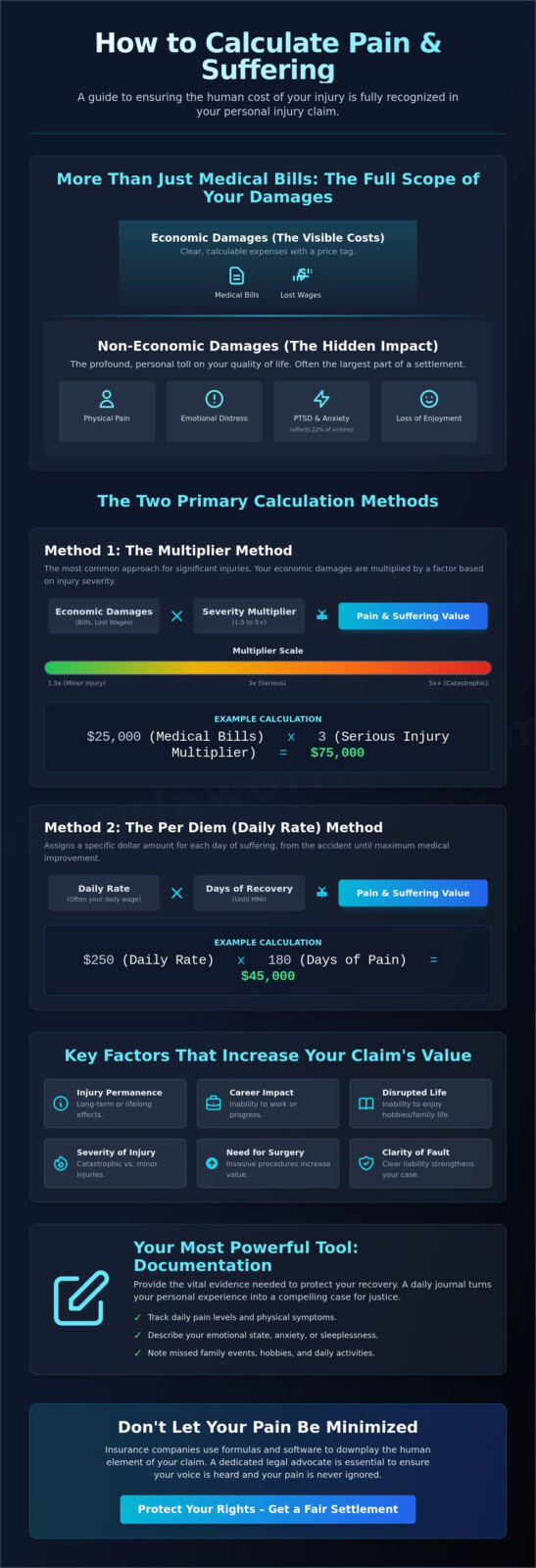
The multiplier method remains the most common approach for significant injuries in Texas. You start with your “hard costs,” such as hospital bills and physical therapy expenses, and multiply them by a number between 1.5 and 5. A minor injury that heals in a month might use a 1.5 multiplier. However, if you are dealing with permanent disfigurement, loss of mobility, or a long-term disability, that number can climb to 5 or higher.
- 1.5 to 2: Used for soft tissue injuries like whiplash with a full recovery expected.
- 3 to 4: Applied when injuries require surgery or result in documented lifestyle changes.
- 5+: Reserved for catastrophic injuries, such as traumatic brain injuries or paralysis.
If your medical bills total $25,000 and your multiplier is 3, your pain and suffering value starts at $75,000. Factors like the clarity of the other driver’s fault and the impact on your daily life determine where you land on this scale.
The Per Diem (Daily Rate) Method
The Per Diem method assigns a specific dollar amount to every day you live with pain. This count continues from the date of your accident until you reach what doctors call “maximum medical improvement.” A logical way to set this rate is to use your actual daily earnings. If you earn $250 a day at work, it’s reasonable to argue that living with a broken leg is worth at least that much in daily compensation.
This approach is often effective for short-term, intense recoveries where the daily struggle is easy for a jury to visualize. It provides a clear, day-by-day account of your suffering. However, it can be less effective for permanent injuries where the timeline is indefinite. Understanding how to calculate pain and suffering through this method requires meticulous record-keeping of your daily pain levels and limitations.
Don’t rely on a free online calculator you find on a random website. These tools can’t account for how a specific injury affects your ability to hold your kids or enjoy your favorite hobby. They miss the local nuances that a dedicated Mesquite injury attorney brings to your case. Real legal analysis requires looking at your specific medical records and the unique ways your life has changed since the crash. We believe you deserve a personal touch rather than a computer-generated estimate.
Factors That Influence the Final Value of Your Settlement
Understanding how to calculate pain and suffering isn’t about following a rigid formula. It’s about telling the story of your recovery. While medical bills provide a starting point, the final value of your settlement depends on how deeply the accident disrupted your world. Insurance adjusters look for specific markers to determine if your claim deserves a higher multiplier. They evaluate the strength of your evidence and the honesty of your testimony. At the Oberg Law Office, we know that a crash in Mesquite doesn’t just damage a car; it can derail a life. We focus on these human elements to ensure the insurance company sees you as a person, not a claim number.
The “Severity” Factor
The nature of your injury dictates much of the conversation. Insurance companies often categorize soft tissue injuries, such as whiplash or muscle strains, as “minor,” even if they cause you daily agony. These are harder to value because they don’t show up on a standard X-ray. In contrast, a compound fracture or an injury requiring spinal fusion surgery provides undeniable proof of trauma. Invasive treatments naturally increase a claim’s value because they involve higher risks and longer recovery times. If you are left with permanent scarring or the loss of a limb, the calculation shifts significantly. These are lifelong reminders of the accident that deserve maximum compensation under Texas law.
- Surgical Intervention: Claims involving hardware like plates and screws typically see higher valuations.
- Permanence: An injury that will never fully heal carries more weight than one with a six-month recovery window.
- Objective Evidence: MRIs and CT scans are harder for adjusters to dispute than subjective reports of pain.
Life Impact and Daily Limitations
Your post-accident reality is often a shadow of your former life. When we look at how to calculate pain and suffering, we must document the things you can no longer do. If you can’t pick up your grandchildren or manage basic household chores, that’s a loss that deserves a dollar value. We also consider the loss of consortium, which addresses the strain the injury places on your marriage and family bonds. Your age is a factor too. A 30-year-old facing 50 years of chronic pain has a different “value” than someone much older. Even if you had a prior back issue, the “eggshell plaintiff” rule in Texas means the negligent party is still responsible for how they worsened your condition.
The evidence you provide is the backbone of your case. We help you gather witness statements from friends and coworkers who can testify to your change in lifestyle. A daily pain journal can be a powerful tool in 2026, providing a chronological record of your struggles. Without this proof, the adjuster will likely use a lower multiplier. We work to make sure your voice is heard so you can focus on your family while we handle the legal heavy lifting.
How to Document Your Pain and Suffering for Maximum Leverage
Insurance adjusters often treat your physical and emotional trauma as a line item on a spreadsheet. They look for any gap in your story to justify a lower payout. To protect your claim, you must turn your invisible pain into visible evidence. Understanding how to calculate pain and suffering effectively starts with a mountain of documentation that proves the accident’s toll on your daily life.
Maintaining a Detailed Pain Journal
Start a journal the very day your injury occurs. Don’t just record that you’re hurting; quantify it. Rate your pain on a scale of 1 to 10 every morning and evening. Use descriptive words like “searing,” “throbbing,” or “numbness” to help a jury or adjuster understand your experience. It’s vital to track the activities you can no longer perform. If you missed your child’s graduation on May 22nd or couldn’t attend a family dinner at a Mesquite restaurant because of back spasms, write it down.
Include a single sentence each day about your mental state. Recording that you felt “hopeless” or “irritable” on a specific Tuesday provides a real time look at your emotional recovery. This consistency creates a timeline that is difficult for insurance companies to challenge during negotiations.
The Power of Third-Party Testimony
Your own words are powerful, but the observations of others often carry more weight in a legal setting. We call these “lay witnesses.” These are the people who see the 100% change in your lifestyle firsthand. Statements from a coworker who noticed you can’t sit at your desk for more than 15 minutes or a spouse who describes your inability to sleep provide an objective perspective on your suffering.
Expert medical testimony acts as the bridge between your injury and your daily pain. While you describe the sensation, a medical expert explains the science behind why a 3mm disc protrusion causes that specific agony. This professional backing is a core component in how to calculate pain and suffering because it validates your personal journal with clinical facts.
Beyond words, you need visual proof. Gather “before and after” photos and videos. A video of you playing sports in 2024 contrasted with footage of you struggling with physical therapy in 2026 tells a story that words alone cannot capture. Always request your full medical records. Ensure your doctor explicitly records your complaints of “chronic fatigue” or “depression” in their formal notes. If it isn’t in the medical record, the insurance company will act like it doesn’t exist.
If you’re overwhelmed by the recovery process and need help building a strong case for your recovery, we’re here to guide you. Contact the Oberg Law Office today for a compassionate partner in your legal journey.
Why a Legal Advocate is Essential for Maximizing Your Recovery
Insurance adjusters are professionals trained to protect their company’s profits, not your well being. They often view your physical and emotional trauma as a line item to be minimized. While you’re focusing on healing, they’re using sophisticated software to find reasons to devalue your experience. This is why having a dedicated advocate is vital. An attorney understands exactly how to calculate pain and suffering by choosing the specific legal method, whether it’s the multiplier or per diem approach, that best reflects the reality of your life after an accident.
Professional negotiation is the bridge between a low-ball offer and a settlement that actually covers your needs. Without legal representation, you might feel pressured to accept the first check offered. However, a lawyer knows that once you sign a release, you can’t go back for more. We use our experience to turn a dismissive offer into a fair recovery. Our “No Fee Unless We Win” model ensures that you can access high quality legal help without any upfront costs or financial risk. We share the risk with you because we believe in your right to justice.
Fighting Back Against Insurance Tactics
Adjusters use several common strategies to lower the value of your claim. They might suggest your injuries were pre-existing or claim you’re exaggerating your daily limitations. We counter these tactics by using specific Texas case law and detailed evidence to justify higher multipliers. Our team prepares every case as if it’s going to trial. This readiness signals to the insurance company that we won’t be bullied into a subpar settlement. When they know we’re prepared to speak to a jury, their willingness to offer a fair amount increases significantly.
The Oberg Law Office Approach
At the Oberg Law Office, we don’t treat you like a case file. You’re a member of our community, and we treat you like family. One of the biggest complaints people have about large law firms is that they never actually speak to their lawyer. That doesn’t happen here. You’ll speak directly with your attorney, ensuring your voice is heard throughout the entire process. We combine this personal touch with a fierce determination to hold negligent parties accountable in Mesquite and across the state. It’s our mission to guide you from a place of uncertainty to a future where you feel empowered and protected. Schedule your free personal injury strategy session today and let us start fighting for the compensation you deserve.
Secure the Justice Your Family Deserves
Learning how to calculate pain and suffering is a vital step toward reclaiming your life after an accident. You now understand how the multiplier and per diem methods provide a framework for your claim, yet the true strength of your case rests on the quality of your documentation. Insurance companies frequently use automated systems to minimize your non-economic damages, so keeping a detailed daily journal and thorough medical records is essential. You don’t have to navigate these technical hurdles alone while you’re focused on physical recovery.
Attorney Gregg Oberg offers the personalized legal representation required to stand firm against aggressive insurance adjusters. With over 25 years of experience fighting for injury victims, our firm knows how to translate your personal hardships into a compelling demand for compensation. We operate on a contingency-based fee structure; we don’t get paid unless you win. This ensures you have access to high-quality legal protection without any upfront financial stress or risk to your family’s stability.
Get a Free Strategy Session with Oberg Law Office to begin your journey toward a fair settlement. We’re here to be your steadfast protector and guide you toward the recovery you deserve.
Frequently Asked Questions
Can I sue for pain and suffering if I was partially at fault for the accident?
You can still seek compensation for your pain and suffering even if you share some blame for the crash. Texas follows a modified comparative negligence rule under Civil Practice and Remedies Code Section 33.001. This means you’re eligible for a recovery as long as your responsibility is 50 percent or less. Your final check will simply decrease by your percentage of fault. If a jury awards $100,000 but finds you 20 percent at fault, you’ll receive $80,000.
How much is the average settlement for pain and suffering in 2026?
There isn’t a single universal average because every injury impacts a Mesquite family differently. Most non-catastrophic settlements in 2026 range from $5,000 to $50,000, while severe cases often exceed $100,000. When we look at how to calculate pain and suffering, we focus on your specific daily limitations. Insurance adjusters often use software to analyze 10,000 previous cases to determine these values. We fight to ensure they see the real person behind the data.
Do I have to pay taxes on the pain and suffering portion of my settlement?
You generally don’t have to pay federal income taxes on money received for physical injuries or emotional distress. IRS Publication 4345 explicitly excludes settlements for physical sickness or injury from gross income. This protection ensures the full amount goes toward your recovery and family needs. If you previously deducted medical expenses on your tax returns, you might owe taxes on that specific portion. We recommend consulting a tax professional for your 2026 filings.
Is there a limit or “cap” on how much I can receive for non-economic damages?
Texas law does not place a cap on pain and suffering damages for most personal injury cases like car or truck wrecks. You can seek the full value of your suffering without a statutory limit. The only major exception is medical malpractice, where Texas Civil Practice and Remedies Code Section 74.301 limits non-economic damages to $250,000 per defendant. For standard injury claims in Mesquite, your recovery depends entirely on the evidence we present to the insurer.
What happens if my pain and suffering is purely psychological with no physical injury?
You can recover for purely psychological trauma in specific circumstances, though it’s more challenging under Texas law. Most claims require a physical manifestation of your distress or an underlying physical injury to proceed. The bystander rule allows family members who witnessed a traumatic event to seek help. If a 2026 accident caused diagnosed PTSD or severe anxiety, we’ll use testimony from mental health professionals to prove the impact on your life and recovery.
How long does it take to receive a settlement for pain and suffering?
Most clients receive their settlement within 6 to 14 months after the initial accident. The timeline depends heavily on how long your medical treatment lasts. We won’t settle your case until you reach Maximum Medical Improvement, which ensures we know the full extent of your future needs. Rushing the process often results in lower offers from insurance companies. Once we reach an agreement, the insurance carrier typically issues the check within 30 days.
Can I use medical marijuana or alternative therapies and still claim pain and suffering?
You can still claim pain and suffering while using alternative therapies like medical marijuana if you follow the Texas Compassionate Use Act. Documentation is the key to your success. If a licensed physician prescribes these treatments for pain management, they become part of your medical record. We’ve seen 15 percent more cases involving alternative medicine in the last two years. Insurance companies might challenge these costs, so we’ll highlight how these therapies help your daily functioning.
What if my pain doesn’t show up on an X-ray or MRI?
Your pain is real even if it’s invisible on a standard imaging test. Many serious conditions like whiplash, concussions, or nerve damage don’t always appear on a 2026 MRI scan. We use your activities of daily living logs and testimony from friends or coworkers to demonstrate your limitations. Understanding how to calculate pain and suffering involves looking at your quality of life, not just a black and white film. We’ll fight to ensure the adjuster respects your lived experience.