
A deposition is not a memory test; it’s a test of discipline where your primary job is to be a truthful, concise witness. It’s completely natural to feel a knot in your stomach when you think about being questioned by a defense lawyer. You might worry about forgetting a detail or falling for a trick question that could jeopardize your claim. We understand that this process feels intimidating, especially when you’re still recovering from a car accident or a serious fall. Our goal is to replace that anxiety with a sense of control by showing you exactly what to expect in a personal injury deposition.
You don’t have to face the defense’s legal team alone. We’ve spent over 25 years acting as a steadfast protector for our neighbors, ensuring they feel prepared and supported every step of the way. This guide breaks down the physical setup of the conference room and the specific categories of questions you’ll encounter. You’ll also learn the essential strategies for answering truthfully without giving away more than is necessary. By the time we’re finished, you’ll see the deposition as a manageable part of your journey toward restoration rather than a source of fear.
Key Takeaways
- Understand the “discovery” phase so you can approach the session as a tool for sharing facts rather than a high-pressure trial.
- Learn exactly what to expect in a personal injury deposition, including who will be in the room and how your attorney acts as your steadfast protector.
- Prepare for detailed questions about your background and the mechanics of the accident to ensure your testimony stays consistent and truthful.
- Master simple strategies like the “two-second pause” to help you stay calm and give your legal team time to defend your rights.
- See how the transcript review process works and how your testimony helps determine the final value of your personal injury claim.
Understanding the Purpose of a Personal Injury Deposition
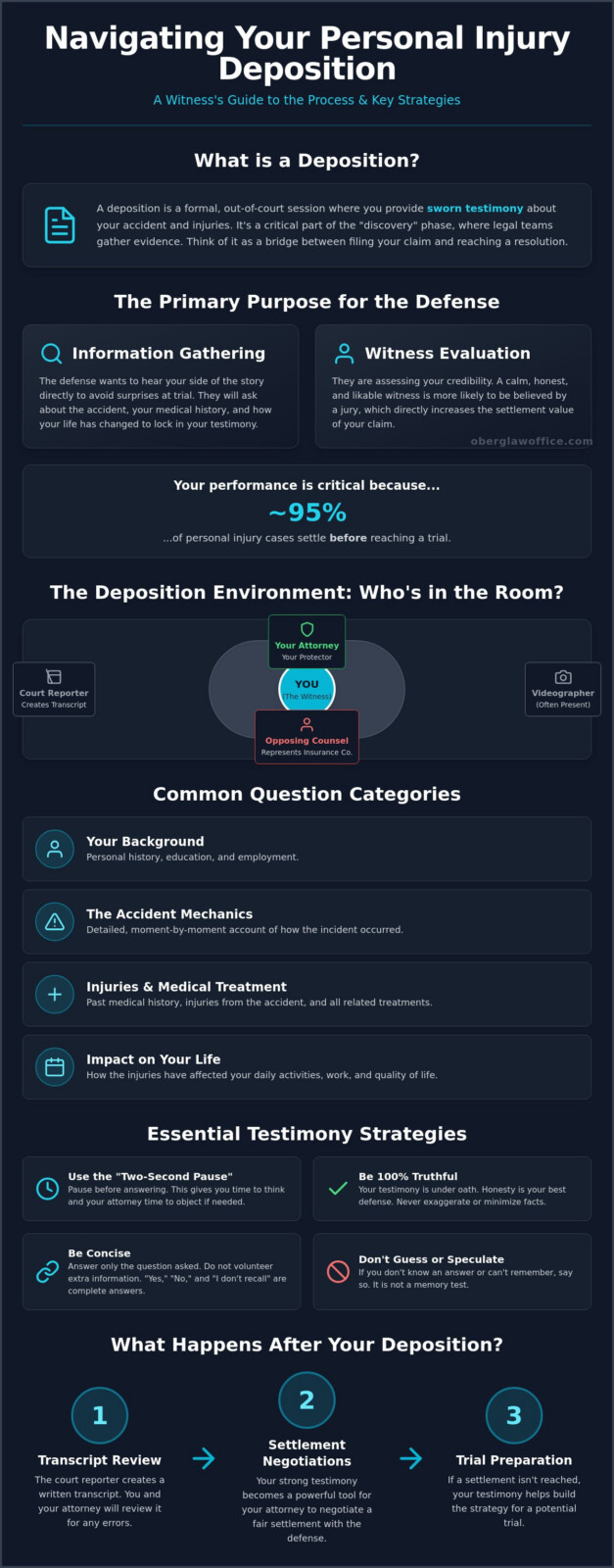
A deposition is a formal, out-of-court session where you provide sworn testimony about your accident and your injuries. It usually takes place in a professional conference room rather than a traditional courtroom, but you shouldn’t let the casual setting lower your guard. It’s a critical part of the “discovery” phase of your case. This is the period where both legal teams gather evidence to build their arguments and understand the strengths of the opposing side. When you’re wondering what to expect in a personal injury deposition, think of it as a bridge between filing your claim and reaching a final resolution.
The primary goal for the defense is information gathering. They want to hear your side of the story directly so they aren’t surprised by new details during a trial. They’ll ask about the day of the accident, your medical history, and how your life has changed since the event. This process helps everyone identify the undisputed facts, such as the date and location of the incident, while highlighting the contested issues, like who was truly at fault or the severity of your physical limitations.
Beyond just the facts, this session serves as a dress rehearsal for a potential trial. The insurance company’s lawyer is watching you closely. They’re evaluating how you present yourself, whether you’re likable, and if a jury would find you believable. Your credibility directly impacts the “value” the insurance company places on your claim. A witness who is honest and calm is much more likely to secure a fair settlement than one who seems evasive. Since approximately 95% of personal injury cases settle before reaching a trial, your performance here is often the most important part of your entire legal journey.
Why Is a Deposition Necessary?
This step is essential because it prevents “trial by ambush.” By locking in your testimony now, both sides can prepare their strategies based on a fixed set of facts. It’s also a powerful tool for settlement negotiations. When the defense sees that you’re a strong, credible witness with a clear story, they often realize that a trial would be risky for them. This realization frequently leads to meaningful settlement offers that help you move toward restoration and financial security sooner.
The Legal Weight of Your Testimony
Even though there isn’t a judge in the room, you’re still bound by the law. You’ll be placed under oath by a court reporter, making your words a formal Deposition (law) record. A sworn statement is a written or recorded account of your testimony that carries the same weight as if you were standing in front of a jury. If you intentionally lie, you could face the consequences of perjury in a civil context. This might include the dismissal of your case or other legal penalties. Being truthful and precise is your best defense against the tactics of opposing counsel.
The Deposition Environment: Who Will Be in the Room?
Walking into a law office for the first time often feels overwhelming. Understanding what to expect in a personal injury deposition begins with recognizing the faces around the table. You aren’t entering a lions’ den alone. Instead, you’re entering a controlled environment where specific professionals have very different goals. Knowing their roles helps strip away the mystery and reduces the anxiety of the unknown.
Your attorney is there as your steadfast protector. Their primary job is to ensure the rules of evidence are followed and to defend you against unfair or misleading questioning. With over 25 years of experience, Gregg Oberg personally guides clients through this process, providing the direct interaction you need to feel secure. Across the table sits the opposing counsel. This lawyer represents the insurance company or the person you’re suing. While they may be polite, their goal is to find inconsistencies that might lower the value of your claim.
Two other professionals play vital roles in the room. The court reporter captures every word to create a verbatim transcript. In many 2026 cases, a videographer is also present to record your demeanor and body language. These visual cues are powerful, as they show how you carry yourself under pressure. This is often why Depositions in Car Accident Cases are so influential in settlement talks; they give the insurance company a preview of how you would appear to a jury.
The Logistics of the Meeting
Most depositions happen in a neutral law office conference room. However, remote depositions via video platforms have become a standard, convenient option in 2026. A typical session lasts between 30 minutes and 2.5 hours, though complex cases can stretch longer. You aren’t expected to sit for hours without relief. You have a right to take breaks for water, a quick stretch, or a private consultation with your lawyer. If you ever feel overwhelmed, speaking with an experienced attorney can help you regain your footing and stay focused on your recovery.
The Role of Objections
During the questioning, you might hear your lawyer say “Objection.” Don’t let this startle you. These objections are usually made to protect the written record for future use. In most cases, you’ll still be required to answer the question unless your attorney specifically instructs you to remain silent. It’s a technical part of the process designed to ensure fairness, not to stop the conversation entirely. Staying calm during these moments shows the defense that you’re a disciplined and prepared witness.
Common Questions Asked During a Personal Injury Deposition
Defense lawyers aren’t just curious about your life; they’re looking for leverage. When you’re preparing for what to expect in a personal injury deposition, you should anticipate a deep dive into your personal history. They’ll start with the basics, such as your education, your employment record, and even any past legal or criminal history. This isn’t meant to embarrass you. They’re establishing a baseline for your credibility and looking for any past events that could be used to cast doubt on your current claims. Being prepared for these questions allows you to answer with confidence rather than being caught off guard.
Once the basics are out of the way, the focus shifts to the incident itself. You’ll likely provide a second-by-second breakdown of the accident. They’ll ask where you were looking, how fast you were moving, and exactly what you saw before the impact. If it was a truck or car accident, they might ask about your lane position or the weather conditions. Being precise here is vital because the defense will compare your answers to the police report and any available surveillance footage. We work with you to review the facts of your case so that your memory is clear and your testimony remains consistent.
Navigating these technical questions requires careful preparation; you can explore Car Accident Legal Representation to understand how specialized legal support helps victims articulate the details of a collision effectively.
Questions About Your Medical History
The defense will scrutinize your medical records to find “pre-existing conditions.” They want to argue that your current pain isn’t from the accident, but from an old injury. You must be honest about your past. If you had a back injury ten years ago, say so. Our role is to help you explain how this accident caused a “new” or “aggravated” injury that is distinctly different from your past health issues. Knowing your current medications and your specific treatment plan is essential for showing that you’re committed to your recovery. Honesty about your medical history prevents the defense from using your past against you later.
The “Before and After” Comparison
To understand the full scope of your damages, the lawyer will ask “day in the life” questions. This is where you describe how the injury changed your daily routine and relationships. Instead of just saying “my back hurts,” use concrete examples of limitations. You might say, “I can’t lift my child into their high chair anymore,” or “I used to walk my dog two miles every evening, but now I can’t make it to the end of the block.” These specific details help demonstrate non-economic damages like pain and suffering. For more information on how these losses are calculated, you can consult a Mesquite personal injury lawyer who understands the local legal landscape. Providing these vivid comparisons makes the impact of your injury real to the insurance company and their legal team.
Essential Tips for Giving Truthful and Effective Testimony
A deposition is a test of discipline rather than a test of memory. While you might feel a natural urge to explain every detail to make the other side understand your pain, the most effective testimony is often the most concise. When you are preparing for what to expect in a personal injury deposition, you should view yourself as a focused witness whose primary job is to provide short, truthful answers. This disciplined approach prevents you from accidentally giving the defense “extra” information they can use to twist your words later. We see our role as your guide through this process, ensuring you feel confident in your ability to protect your claim.
One of the most powerful tools in your arsenal is the two-second pause. After the defense attorney finishes a question, wait for a full two seconds before you open your mouth. This brief window isn’t just for you to think. It gives your attorney time to identify any legal issues and voice an objection. If you rush to answer, you might provide information that shouldn’t be part of the record. This simple habit turns a high-pressure interrogation into a controlled conversation where you remain in the driver’s seat.
You’re only required to answer the specific question asked. If a question can be answered with a simple “yes” or “no,” do so and then stop talking. You don’t need to justify your answer or fill the silence that follows. If you don’t know an answer or can’t recall a specific date, saying “I don’t know” or “I don’t recall” is perfectly acceptable. Guessing is dangerous. It creates inconsistencies that the defense will use to attack your credibility later. Stick to the facts you’re certain of, and let your legal team handle the rest.
Managing the “Trick” Questions
Defense attorneys often use the “pregnant pause” to lure you into talking. They’ll wait silently after you finish your answer, hoping you’ll feel uncomfortable and keep talking to fill the void. Don’t fall for it. Simply wait for the next question. You should also be wary of absolute words like “always” or “never.” Using these terms makes it easy for the defense to find a single exception and make you look dishonest. If they ask a compound question that packs multiple inquiries into one, ask them to break it down so you can answer each part clearly and accurately.
Demeanor and Body Language
Your attitude is just as important as the facts you share. The insurance company is evaluating how a jury would perceive you, so staying calm, polite, and professional is essential. If you become angry or defensive, you’re giving the defense exactly what they want: a witness who seems unreliable or difficult. Think of your deposition as a professional meeting where your credibility is the most valuable asset in the room. If you want to feel truly ready, working with a dedicated personal injury attorney ensures you have a steadfast protector by your side throughout the entire process.
What Happens After Your Deposition is Over?
Once you step out of that conference room or close the video call, you’ll likely feel a massive sense of relief. The hardest part of your testimony is behind you, but the legal work is just entering a new, high-stakes phase. Knowing what to expect in a personal injury deposition aftermath is just as important as the preparation itself. Your testimony is now a permanent record, and it serves as the catalyst for the next major steps in your claim. We don’t just leave you at the door; we continue to analyze every word to ensure your path to restoration remains clear.
The first tangible result is the transcript review. A court reporter will take several weeks to produce a verbatim written record of everything said during the session. You have a legal right to read this document and correct any “typos” or transcription errors. It’s not a chance to change your story, but it’s a vital safety net to ensure the record is 100% accurate. While this happens, both legal teams are performing a deep-dive evaluation. They’re looking at your credibility, the strength of the facts, and how a local jury might react to the evidence.
This evaluation period often triggers a shift in the insurance company’s stance. Before the deposition, you were just a name on a file. Now, you’re a real person with a compelling story. If your testimony was strong and consistent, the defense lawyer will report back to the insurance adjuster that you’re a credible plaintiff. This often leads directly to mediation or a renewed settlement offer. In many cases, the deposition is the “tipping point” that finally forces the other side to take your injuries and your future security seriously.
The Impact on Your Financial Recovery
A successful deposition is one of the most powerful tools for increasing the value of your settlement. When you present yourself as honest and disciplined, you reduce the insurance company’s confidence in winning at trial. They’d rather pay a fair settlement now than risk a much larger verdict in front of a jury later. If you’re looking for more details on the phases following your testimony, consulting a Mesquite injury attorney can provide the specific guidance you need for your local jurisdiction. Your credibility is the engine that drives your financial recovery forward.
Moving Toward a Resolution
The timeline from deposition to resolution can vary, but it typically moves toward a milestone like mediation within a few months. If a fair settlement can’t be reached, your deposition serves as a roadmap for trial preparation. It helps us refine our arguments and prepare to defend your rights in court. Gregg Oberg and our team remain personally invested in your result, fighting with the same determination we’ve shown for over 25 years. You don’t have to wonder about the next steps; you can talk to your car accident lawyer to get a personalized update on your case’s progress and your timeline for justice.
Take Control of Your Legal Journey
Navigating the legal system is often a daunting experience, but you don’t have to walk this path alone. By focusing on concise, truthful answers and utilizing the “two-second pause,” you transform a stressful interrogation into a powerful tool for your claim. Knowing exactly what to expect in a personal injury deposition empowers you to stand firm against the tactics of insurance companies. This process is ultimately about restoration and ensuring you have the resources needed to move forward with your life after a difficult event.
Gregg Oberg brings over 25 years of experience to your side, acting as a steadfast protector who handles your case personally. You will never be handed off to support staff; you get direct, personalized attention from a professional who is truly invested in your success. Because we work on a contingency fee basis, there are no upfront costs, and we don’t get paid unless we recover money for you. Let us help you prepare for this milestone with confidence. Get a Free Strategy Session with Oberg Law Office today and take the next step toward a fair resolution. You have the strength to see this through, and we have the experience to guide you home.
Frequently Asked Questions
Is a deposition the same as a trial?
No, a deposition is an out-of-court discovery tool used to gather facts before a trial ever begins. While a trial takes place in a courtroom with a judge and jury, a deposition usually happens in a law office conference room. You are still under oath and your testimony carries legal weight, but the atmosphere is less formal and no judge is present to make immediate rulings.
Can I change my answers after the deposition is finished?
You have a limited right to correct the written transcript for typos or transcription errors, but you cannot fundamentally change your testimony. After the session, you’ll review the record to ensure your words were captured accurately. If you try to change the substance of your story later, the defense will use those inconsistencies to attack your credibility and damage your claim’s value.
How long does a personal injury deposition usually last?
A typical deposition lasts between 30 minutes and 2.5 hours, though complex cases can take much longer. For instance, a session involving catastrophic injuries or multiple parties might extend to seven hours or more. We always advocate for your comfort, ensuring you can take breaks for water or private consultations whenever the process feels overwhelming or exhausting.
What should I wear to my deposition?
You should wear professional, conservative clothing that shows you take the legal process seriously. Business casual attire, such as a collared shirt or a modest blouse, is usually the best choice for making a strong impression. The insurance company’s lawyer is evaluating how you’ll look to a jury, so appearing neat and respectful helps establish you as a credible plaintiff.
What happens if I don’t remember the answer to a question?
It is perfectly acceptable to say “I don’t know” or “I don’t recall” if you truly do not have the information. You should never guess or speculate about specific details like speeds, distances, or exact dates. Honesty about a memory lapse is far better than providing an inaccurate answer that the defense can later use to make you appear untruthful.
Can the other lawyer ask about my personal life or social media?
Yes, defense attorneys often ask about your lifestyle and online activity to see if it contradicts your injury claims. They are looking for any evidence that suggests your injuries aren’t as severe as you’ve stated. Part of what to expect in a personal injury deposition is this scrutiny of your daily habits, so we prepare you to answer these questions truthfully and concisely.
Will my attorney be with me the whole time?
Yes, your attorney will be by your side from the moment the session starts until it concludes. We serve as your steadfast protector, ensuring the opposing counsel follows the rules and stays within the bounds of fairness. You are never left alone to face the defense’s questioning; we are there to defend your rights and provide the support you need during the process.
Can a deposition lead to an immediate settlement?
While an immediate settlement in the room is rare, a strong performance often leads to serious negotiations shortly after the session. When the insurance company sees that you are a prepared and believable witness, their risk level increases. This often triggers a reassessment of your case value, moving you closer to the fair recovery and restoration you deserve without the need for a trial.