
To an insurance adjuster, your life-altering accident is often just a claim number on a digital spreadsheet. It feels cold and unfair because it is. When you’re the one dealing with the physical pain and the emotional weight of a crash, you deserve to be seen as a person, not a liability. If you’re currently negotiating a personal injury settlement in texas, you’ve likely felt the pressure of the state’s two-year statute of limitations or the confusion of trying to put a dollar amount on your daily struggles. We understand that this isn’t just about money; it’s about restoring your sense of security and fairness.
You shouldn’t have to face these massive institutions alone or feel unsure about what your case is truly worth. We’ve created this guide to help you master the art of the demand letter, which is your most powerful tool in seeking justice. You’ll learn a clear framework for drafting a persuasive letter that compels insurance companies to pay what you actually deserve. We’ll walk through how to value your pain and suffering with confidence, ensuring you have a roadmap to a fair settlement without the exhaustion of a protracted court battle.
Key Takeaways
- Understand why a well-crafted demand letter acts as the linchpin of your claim, turning your accident details into a compelling case for compensation.
- Learn to identify and document the five essential components of a strong demand, including a clear statement of facts and a precise liability analysis.
- Gain clarity on valuing your claim by accurately totaling medical expenses and assigning a fair dollar amount to your pain and suffering.
- Discover strategic communication tips for negotiating a personal injury settlement in texas that rely on objective evidence rather than raw emotion.
- See how professional advocacy can help you secure a higher settlement by leveraging expert resources and a deep understanding of insurance company tactics.
What is a Personal Injury Demand Letter and Why is it the Linchpin of Your Texas Claim?
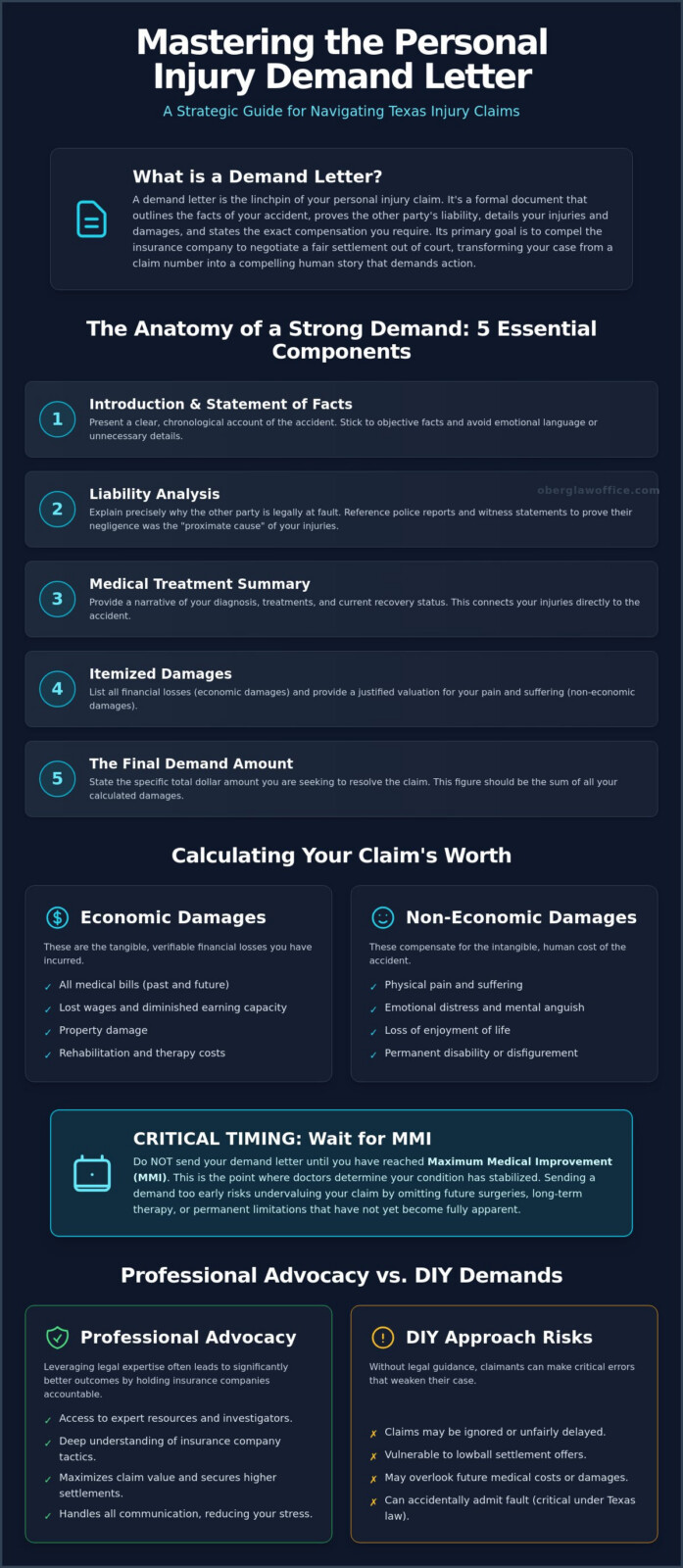
When you’re dealing with the aftermath of an accident, the legal process can feel like a maze of paperwork and phone calls. At its core, What is a Personal Injury Demand Letter? It’s a formal document that serves as your voice. It outlines the specific facts of your accident, explains why the other party is legally liable, details your injuries, and states the exact compensation required to settle your claim. Think of it as your opening statement in a conversation about fairness and restoration.
The primary goal of this letter is to resolve your claim out of court. By clearly proving the financial and personal costs of another person’s negligence, you provide the insurance company with a reason to settle fairly. This document is the linchpin because it forces the insurance company to take action. Once they receive a formal demand, they must assign a professional adjuster to your file and begin the process of valuing your claim. Without it, you run the risk of being ignored. Adjusters may overlook verbal requests or offer “lowball” settlements that don’t even cover your initial medical bills because there isn’t a formal record of your losses.
The Role of the Demand Letter in the Texas Legal Process
This letter serves as the foundation for all future settlement discussions. It’s the baseline from which you’ll negotiate. It’s vital to recognize the difference between this preliminary demand and a final settlement offer. You shouldn’t send this letter the moment you leave the hospital. Instead, you must wait until you reach Maximum Medical Improvement (MMI). This is the point where your doctors believe your condition has stabilized. If you send a demand before reaching MMI, you might accidentally leave out the costs of future surgeries, long term therapy, or permanent limitations that haven’t fully surfaced yet.
Setting the Right Tone with the Insurance Adjuster
When you’re negotiating a personal injury settlement in texas, the way you present your story matters. You need to balance firm legal professionalism with a relatable human narrative. While it’s natural to feel frustrated, using aggression or anger in your letter often leads to delays. Adjusters are more likely to respond to a clear, objective account of how your life has changed. By establishing yourself as a prepared claimant who understands the personal injury lawyer Mesquite TX landscape, you signal that you’re serious about your recovery. You’re showing them that you’ve done the work, you know your rights, and you’re ready to secure the justice you deserve.
The Anatomy of a Strong Demand: 5 Essential Components
A demand letter is more than a simple request for payment. It is a structured, persuasive argument designed to move your claim from a file on a desk to a check in your hand. When you are negotiating a personal injury settlement in texas, your letter must follow a logical hierarchy to be effective. A well-organized document shows the insurance adjuster that you are prepared and that your claim has merit. Every strong demand includes these five pillars:
- Introduction and Statement of Facts: A clear, chronological account of the accident that avoids unnecessary fluff.
- Liability Analysis: An explicit statement explaining why the other party is legally at fault.
- Medical Treatment Summary: A narrative of your diagnosis, the treatments you’ve endured, and your recovery status.
- Itemized Damages: A transparent list of every financial loss and a justification for your personal suffering.
- The Final Demand: The specific total amount you’re seeking to resolve the claim today.
Establishing Liability: Proving Fault Under Texas Law
In Texas, the burden of proof rests on you. You must demonstrate that the other party’s negligence was the “proximate cause” of your injuries. This means their specific action, or lack of action, led directly to your harm. Use police reports and witness statements as the anchor for this argument. These objective third-party accounts carry significant weight with adjusters. Be careful during this phase; avoid the trap of admitting any comparative negligence. Under Texas law, if you’re found to be 51% or more at fault, you’re barred from recovering any damages. Keep your demand focused on the other driver’s failures. If you’re feeling overwhelmed by the technicalities of proving fault, our team can help you build a stronger case.
Documenting Your Injuries and Recovery Journey
Medical records are essential, but they don’t tell the whole story. An adjuster sees medical codes and billing numbers, but they don’t see your sleepless nights or your struggle to return to your normal routine. When documenting your recovery, move beyond the technical jargon. Describe the daily reality of your physical therapy or the limitations you face at home. It’s equally important to include your long-term prognosis. If your doctor anticipates future surgeries or permanent limitations, these must be part of your demand. Using Strategic Writing Tips: How to Handle the Insurance Adjuster can help you frame these medical facts in a way that resonates with the person reviewing your file. You’re not just a patient; you’re a neighbor whose life was disrupted, and your demand should reflect that truth.
Proving Your Worth: Evidence and Damage Calculations
Once you’ve established who is at fault, the focus shifts to the true cost of the accident. When you’re negotiating a personal injury settlement in texas, the insurance company will look for any reason to lower the value of your claim. To prevent this, every single dollar you request must be backed by concrete evidence. You cannot simply guess what your recovery is worth; you must prove it through a meticulous tally of your losses.
Economic damages are the starting point because they have a clear paper trail. This category includes your total medical bills, out-of-pocket pharmacy expenses, and any costs for medical equipment like crutches or braces. If you’ve had to pay for transportation to doctor appointments or hire help for household chores you can no longer perform, these are also reimbursable. The rule here is simple: if there isn’t a receipt or an invoice, the insurance adjuster likely won’t pay for it. Keeping a dedicated folder for every accident-related expense ensures nothing slips through the cracks.
Non-economic damages present a different challenge because they don’t come with a price tag. To bridge this gap, adjusters often use the “multiplier method.” They take your total medical expenses and multiply them by a number, typically between 1.5 and 5, to estimate the value of your pain and suffering. A higher multiplier is used for more severe, life-altering injuries. Understanding the nuances of Texas personal injury claims is essential here, as the strength of your evidence directly influences which multiplier the adjuster chooses to apply.
Calculating Lost Wages and Future Earnings
Your paycheck isn’t the only thing you lose when you’re forced out of work. A comprehensive demand accounts for missed bonuses, used-up PTO, and even the loss of career advancement opportunities. If your injuries are so severe that you cannot return to your previous profession, you must document your “loss of earning capacity.” This involves calculating the difference between what you would have earned over your lifetime and what you can earn now. Loss of consortium is a legal damage category that compensates a spouse for the loss of companionship and intimacy caused by the injury.
The Power of the Pain and Suffering Narrative
While the numbers provide the foundation, your story provides the heart of the claim. A “Day-in-the-Life” description can be incredibly persuasive. Instead of just stating you have back pain, describe how that pain prevents you from lifting your children or participating in a hobby you’ve loved for years. Documenting the loss of physical independence and family time helps the adjuster see the human being behind the medical codes. In many successful cases, these non-economic damages end up being the largest portion of the recovery because they represent the true weight of what was taken from you. When negotiating a personal injury settlement in texas, never underestimate the value of your personal experience.
Strategic Writing Tips: How to Handle the Insurance Adjuster
When you shift from gathering evidence to actually negotiating a personal injury settlement in texas, your mindset must change. You are no longer just a victim; you are a claimant presenting a professional business case. Adjusters handle hundreds of files. To make yours stand out, you must remain strictly objective. While your anger and frustration are valid, they don’t move the needle in a demand letter. Instead, rely on medical facts and undisputed evidence. When the adjuster sees a calm, fact-based argument, they realize they’re dealing with someone who can’t be easily intimidated or brushed aside.
One of the most effective ways to frame your story is through the “Reasonable Person Standard.” This legal concept asks if a sensible person would have acted the same way you did. By framing your actions as logical and cautious, you minimize the adjuster’s ability to shift blame onto you. Additionally, always include the phrase “for settlement purposes only” at the top of your letter. This is a vital legal shield. It ensures that if negotiations fail, nothing you’ve written in the spirit of reaching a compromise can be used against you later in a courtroom.
Common Pitfalls That Tank Texas Settlement Negotiations
Even the strongest claims can be undermined by simple mistakes. A major error is over-asking for a settlement amount that isn’t supported by your documentation. If you request a massive sum but only provide a few thousand dollars in medical bills, you lose credibility immediately. Another common trap is the urge to apologize. In a social setting, saying “I’m sorry” is polite; in a demand letter, it can be twisted into an admission of fault. Finally, never lose sight of the clock. In Texas, the statute of limitations for personal injury claims is generally two years from the date of the accident. If you haven’t reached a settlement or filed a lawsuit by that deadline, your right to recover anything is likely gone forever.
Organizing Your Evidence Package
A messy demand letter is an easy target for an adjuster to ignore. You want to create a Demand Package that is exceptionally easy to navigate. Label every medical bill, police report, and witness statement as a numbered exhibit. When you eventually get the adjuster on the phone, you can say, “Look at Exhibit 4, page 2,” and they’ll see exactly what you’re referencing. This level of organization signals that you are prepared, diligent, and ready for trial if they refuse to be fair. If the process of cataloging your bills and records feels overwhelming, you can reach out for professional guidance to ensure your package is bulletproof.
Why Professional Advocacy Outperforms DIY Demand Letters
While drafting your own letter is possible, there is a measurable “Attorney Premium” that often results in higher settlements. Insurance companies use sophisticated software to assess risk. When they see a claimant without a lawyer, their risk assessment remains low because they know a pro se individual is unlikely to navigate the complexities of a courtroom. Having a professional advocate changes the math for them immediately. It signals that you have the resources to fight for the full value of your claim rather than accepting the first low offer they throw your way.
We bring more than just legal knowledge to your case; we provide access to a specialized network of experts. For example, accident reconstructionists can analyze skid marks, electronic data recorders, and vehicle damage to provide scientific proof of liability. This expert evidence turns a disputed story into a factual certainty, making your demand letter much harder to ignore. At Oberg Law Office, we treat you like a neighbor rather than just another case number. You will work directly with senior professionals who are personally invested in your restoration and security.
How an Experienced Attorney Evaluates Your Case
A skilled lawyer looks beyond your immediate medical bills to find hidden avenues for compensation. We investigate for commercial insurance policies, umbrella coverage, or third-party liability that a DIY approach might miss. Our partnership is built on a contingency-based structure, which means we only get paid if you win. This shared risk ensures we are as motivated as you are to secure every dollar you deserve. For a deeper look at the path ahead, you can read our personal injury recovery guide.
Final Steps: Sending the Letter and What to Expect Next
Once your demand package is sent, the insurance company typically has 30 days to respond. Don’t be surprised if their first move is to deny liability or offer a “nuisance settlement” that barely covers your initial costs. This is a standard tactic used to test your resolve and see if you’re desperate for a quick check. When negotiating a personal injury settlement in texas, staying patient and firm is your greatest advantage. If the adjuster refuses to offer a fair amount, we are fully prepared to transition from negotiation to litigation to protect your rights. Schedule your free strategy session with Oberg Law Office today to start your journey toward a fair recovery.
Secure Your Future with a Strategic Demand
Your recovery is about more than just paying medical bills; it’s about reclaiming your sense of security after a traumatic event. By mastering the anatomy of a demand letter and backing your claim with hard evidence, you’ve taken the first step toward justice. Negotiating a personal injury settlement in texas requires both strategic precision and a deep understanding of how insurance companies operate. You’ve learned how to frame your human story and set firm deadlines to ensure you aren’t treated like just another number on a spreadsheet.
You don’t have to carry this burden alone. At Oberg Law Office, we provide over 25 years of Texas legal experience to help you navigate this complex process. You’ll have direct access to senior legal professionals who treat you like a neighbor, and our contingency-based fee structure means we only get paid if you win. Get your free personal injury strategy session with Oberg Law Office today to ensure you receive the full compensation you deserve. We’re here to protect your rights and help you move forward with confidence.
Frequently Asked Questions
How long should a personal injury demand letter be?
A professional demand letter typically spans three to five pages. It needs to be long enough to detail the facts of the accident and your medical journey without becoming repetitive. Adjusters appreciate conciseness, so focus on high-impact evidence rather than fluff that might distract from your core message.
Can I write my own demand letter without a lawyer in Texas?
You have the legal right to represent yourself and draft your own letter. While this is possible, keep in mind that insurance companies often offer lower amounts to unrepresented claimants. They understand that without an attorney, you’re less likely to file a lawsuit if negotiations stall, which reduces their financial risk.
What happens after I send my demand letter to the insurance company?
The adjuster will review your evidence package and usually provides a response within 30 days. They might accept your demand, offer a lower counter-proposal, or deny liability altogether. This response marks the official start of the active negotiation phase of your claim.
Is there a specific template I should use for my demand letter?
Texas law doesn’t mandate a specific form, but following a standard professional hierarchy is vital for success. Your letter should always include a statement of facts, a liability analysis, a medical summary, and an itemized list of damages. Consistency helps the insurance company process your file more efficiently.
Should I include my lowest acceptable settlement amount in the letter?
You should never include your bottom-line number in the initial demand. It’s essential to leave room for the back-and-forth process that defines negotiating a personal injury settlement in texas. If you start with your lowest acceptable amount, you’ll have no room to move when the adjuster makes a lower counter-offer.
What if the insurance company ignores my demand letter?
If the insurance company misses your deadline, you should follow up with a phone call or a formal letter. Continued silence is often a tactic used to see if you’ll give up or accept a smaller check out of desperation. If they continue to ignore you, it’s usually time to escalate the matter by filing a lawsuit.
How do I calculate pain and suffering in my demand?
Most adjusters use a multiplier between 1.5 and 5 times your total medical bills to estimate these non-economic losses. When negotiating a personal injury settlement in texas, the specific multiplier depends on the severity of your injuries and how much they’ve disrupted your daily life. Clear documentation of your recovery helps justify a higher multiplier.
What documents should I attach to my demand letter package?
You must attach every medical record, billing statement, police report, and pay stub mentioned in your letter. Every dollar you request needs a corresponding piece of paper to prove the loss. A well-organized package with labeled exhibits signals to the adjuster that you’re prepared and serious about your recovery.