
Most personal injury cases aren’t won in a dramatic courtroom showdown. They’re won months earlier in the quiet, methodical exchange of evidence. If you’re feeling a knot in your stomach about being questioned by an insurance company’s lawyer or handing over your private records, you aren’t alone. It’s natural to feel overwhelmed by the sheer volume of paperwork and the fear of being “grilled” during a deposition. Understanding what is the discovery process in a personal injury case is the first step toward replacing that anxiety with a sense of control.
We know you’re looking for clarity during a time that feels anything but clear. You deserve to know how your personal information is protected and how this phase leads to a fair settlement. This 2026 guide explains the updated rules for initial disclosures and the standard use of remote depositions in modern litigation. You’ll learn exactly what to expect from interrogatories and document requests, ensuring you’re prepared for every step of your journey toward restoration. We’ll show you why discovery is a strategic tool we use to build the strongest possible foundation for your financial recovery.
Key Takeaways
- Learn exactly what is the discovery process in a personal injury case and how this formal evidence exchange sets the stage for your financial recovery.
- Gain confidence by understanding the four primary tools used to uncover facts, which helps take the mystery out of depositions and document requests.
- Discover how the information gathered during this phase creates the leverage needed to secure a fair settlement before ever stepping into a courtroom.
- Understand your vital role as a partner in the process, from reviewing records to sharing your story with clarity and poise.
- Learn why a strategic discovery plan is essential for countering insurance company tactics and protecting your rights throughout the litigation process.
Defining the Discovery Process in Your Personal Injury Case
After the initial shock of an accident, the legal path forward can feel like a series of closed doors. Discovery is the key that opens those doors. It’s the formal legal process of exchanging evidence between you and the party that caused your harm. This phase begins shortly after your initial complaint is filed and the defendant has provided their response. Think of it as the fact-finding bridge that connects the initial filing of your lawsuit to the final resolution at trial.
To truly understand what is the discovery process in a personal injury case, you have to see it as a search for transparency. It’s a time when we pull back the curtain on the insurance company’s defense. You aren’t alone in this. We walk beside you as a knowledgeable guide to ensure the truth is documented and your rights are protected against large institutions that would rather keep the facts hidden.
The Legal Purpose of Information Exchange
The primary goal of this phase is to ensure both sides have access to the same set of facts. This prevents what lawyers call “trial by ambush,” where one side reveals a surprise witness or a hidden document at the last second to win a case. Under the rules of Discovery (law), both legal teams must disclose relevant evidence. This requirement creates a level playing field. It allows us to evaluate the strengths of your claim and identify any weaknesses the defense might try to exploit. By establishing a factual record early, we create a foundation for fairness that cannot be easily shifted later in court.
Timeline: How Long Does Discovery Last?
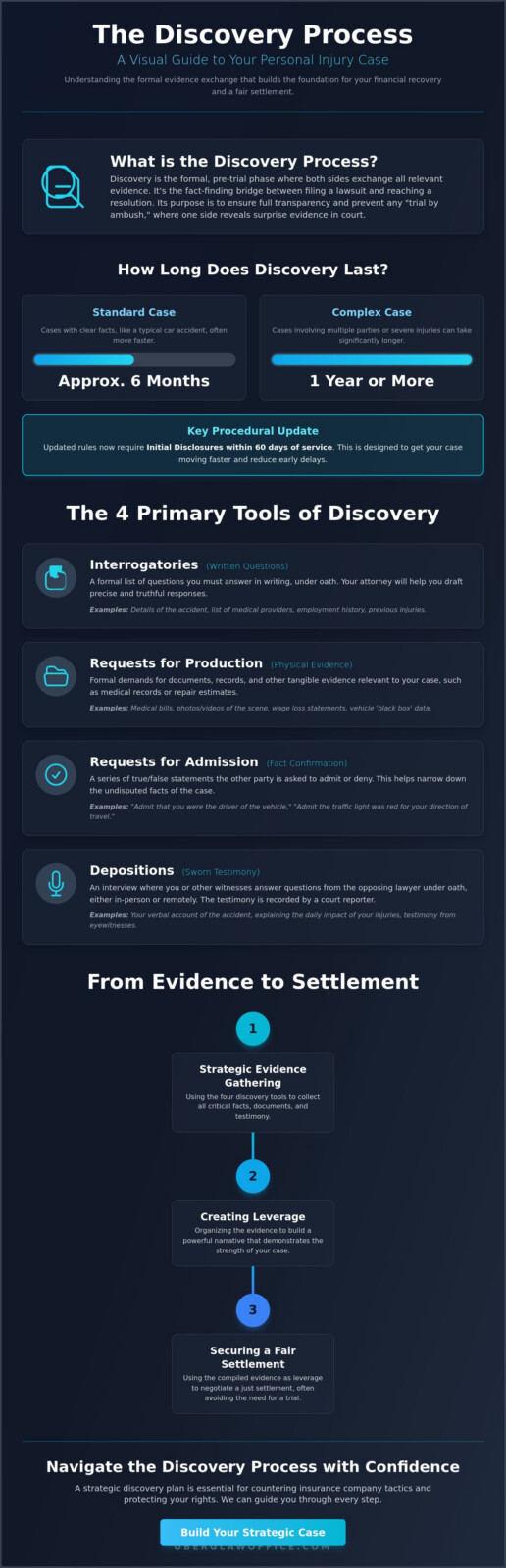
The duration of this phase isn’t set in stone. It depends on the complexity of your situation, the number of witnesses involved, and the specific court’s schedule. For example, a standard car accident case might move through a “streamlined” track, while a catastrophic truck accident involving multiple corporate entities will take much longer. Recent updates to the Florida Rules of Civil Procedure, which became effective January 1, 2025, now require initial disclosures within 60 days of service. This change is designed to get your case moving faster and reduce early delays.
Courts now emphasize the principle of proportionality. This means discovery requests must be proportional to the actual needs of the case. It’s a vital protection that prevents the defense from burying you in irrelevant document requests just to stall your recovery. While a simple case might finish discovery in six months, complex litigation can stretch for a year or more as we coordinate with experts and schedule depositions. We manage every deadline with unwavering determination, keeping your case moving forward toward the restoration you deserve.
The Tools of Discovery: How Evidence Is Uncovered
Building a case that stands up against big insurance companies requires a methodical approach. We don’t rely on guesswork; we use specific legal instruments to extract the truth. Understanding what is the discovery process in a personal injury case involves mastering the four primary methods lawyers use to gather information. These tools include interrogatories, requests for production, requests for admission, and depositions. Each one serves a unique purpose in making sure no detail is left to chance as we build the foundation for your financial recovery.
If you’re feeling overwhelmed by a stack of legal papers or complex demands, speaking with an experienced attorney can provide the clarity you need to move forward with confidence. We act as your steadfast protector, ensuring the defense doesn’t overstep their bounds while we secure the evidence necessary for your restoration.
Written Discovery: Interrogatories and Production
Written discovery is often the first phase of the exchange. Interrogatories are a list of written questions that you must answer under oath. You might be asked about the specific moments leading up to the crash, your employment history, or any previous injuries. Honesty is your greatest asset here. Even a minor mistake can be used by the defense to question your credibility later in the case.
Requests for production are demands for physical proof. This isn’t just about medical bills. It includes photos of the scene, repair estimates, and even data from a vehicle’s “black box” in truck accident cases. While insurance companies often demand every record from your entire life, we protect your privacy. We ensure they only receive documents that are truly relevant to your claim.
The Power of Requests for Admission
Requests for admission are a powerful, often overlooked tool that can significantly shorten your path to a settlement. We send these to the defense to force them to admit or deny specific, narrow facts. For example, we might ask them to admit their driver was speeding at the time of the collision.
If they admit the fact, it is settled. We no longer have to spend time or money proving that specific point at trial. This narrows the scope of the case to the real issues in dispute, such as the full extent of your damages. If the defense fails to respond to these requests within the legal deadline, the court typically considers those facts “admitted.” This can be a total disaster for their side and a major win for your security.
Depositions: Oral Testimony Under Oath
The final major tool is the deposition. This involves out-of-court oral testimony where a court reporter records every word. In 2026, remote depositions have become a standard practice, often conducted via video link to save time and travel costs. While the idea of being questioned by a defense lawyer can cause anxiety, you won’t be alone. We prepare you for every possible question so you can tell your story with poise and accuracy. This testimony is a critical moment where the insurance company finally sees the human impact of the injury, often moving the needle toward a fair settlement.
The Strategic Role of Discovery in Reaching a Fair Settlement
Most personal injury cases don’t end in front of a jury. They end at a conference table because of the work done during the evidence exchange. This phase isn’t just a procedural hurdle; it’s a strategic hunt for the leverage needed to restore your security. When you understand what is the discovery process in a personal injury case, you see it as a way to shift the balance of power. Approximately 95% of personal injury lawsuits reach a settlement before trial because discovery makes the courtroom outcome highly predictable for both sides. Once both legal teams have the same facts, the focus shifts from fighting over what happened to finding a fair value for your recovery.
Insurance companies often start with a “deny and delay” tactic. Discovery is the tool we use to break that cycle. By uncovering “bad facts” for the defense, such as a history of safety violations or clear evidence of negligence, we increase your bargaining power. We move the case from a state of uncertainty to a position where the defense realizes that losing at trial is a near certainty.
Using Evidence as Leverage
Evidence is the only language insurance companies truly respect. We look for the “smoking gun” that proves the other party was at fault without any doubt. For instance, dashcam footage or black box data obtained by a truck accident lawyer texas can immediately dismantle a driver’s claim that they were following the rules of the road.
Expert witness reports also play a massive role in this phase. We work with medical professionals and accident reconstructionists to validate your long-term needs and the mechanics of the crash. When we present a documented record of your injuries and future medical costs, it forces the defense to reconsider their low-ball offers. We turn their initial denials into serious settlement proposals by showing them exactly what a jury would see.
The Role of Mediation After Discovery
Once the evidence is on the table, the conversation often transitions toward mediation. This is a structured negotiation where a neutral third party helps both sides reach an agreement. Because we’ve already done the heavy lifting during discovery, we enter these meetings from a position of unwavering determination. We don’t have to guess what the defense knows because we’ve already seen their files.
We use our discovery findings to justify every dollar of your compensation demand. When the defense sees that we’re fully prepared for trial with concrete proof, they’re much more likely to offer a fair settlement to avoid the risk of a larger verdict. A well-executed discovery phase is your best path to avoiding a long court battle. It provides the clarity needed to reach a resolution that truly supports your future.
Navigating Your Role: What to Expect During the Discovery Phase
The legal system can feel cold and detached, especially when it starts prying into your personal affairs. It’s natural to feel a sense of unease when you’re asked to recount a traumatic event or hand over years of medical records. However, understanding what is the discovery process in a personal injury case helps you see that these steps are actually the building blocks of your recovery. You aren’t just watching from the sidelines. You’re a vital partner in this journey. Your honesty and cooperation are the fuel that powers our strategy as we work toward your restoration.
Preparing for Your Deposition
Forget what you’ve seen on television. A deposition isn’t a dramatic courtroom scene with a judge and a jury. It’s usually a professional meeting in a conference room or, as is common in 2026, a secure video call. While it is formal, it’s meant to be a straightforward gathering of facts. We’ll spend plenty of time with you beforehand, reviewing the details of your case so you aren’t caught off guard by the defense attorney’s questions.
Our goal is to make sure you feel confident and prepared. During your testimony, keep these simple rules in mind:
- Listen to the entire question before you start to answer.
- Speak clearly and stick to the facts you know for certain.
- Don’t guess or speculate about things like speed, distance, or time.
- Remember that “I don’t recall” is a perfectly valid and necessary answer.
If you don’t remember a specific detail, it’s better to say so than to guess. Guessing gives the defense an opening to claim you’re being inconsistent later in the case. We’ll be sitting right next to you, ensuring the questions remain fair and respectful.
Managing Document Requests and Privacy
The defense will likely demand a mountain of paperwork. They want to see your medical bills, employment files, and even tax returns to verify your lost wages. It can feel like an invasion of privacy, but we act as your shield. We gather these records for you and review every request to ensure the insurance company doesn’t overreach into areas of your life that have nothing to do with your accident.
We act as a filter, making sure only relevant information is shared. This protects your security and keeps the focus where it belongs: on the harm you’ve suffered and the compensation you deserve. If you’re feeling pressured by aggressive tactics from an insurance company, reach out to us for a consultation so we can step in as your protector and take that burden off your shoulders. Maintaining steady communication with us helps ensure we have what we need to meet court deadlines without adding to your stress.
Partnering with Oberg Law Office for a Formidable Discovery Strategy
Discovery can feel like a mountain of paperwork designed to bury your claim. We don’t let that happen. When you’re asking what is the discovery process in a personal injury case, you’re really asking how you can survive it without losing your peace of mind. At Oberg Law Office, we’ve spent over 25 years navigating these complex legal waters. Gregg Oberg knows the insurance companies’ playbooks because he’s seen them used against families like yours for decades. He understands the specific tactics they use to overwhelm you. Our neighborly approach ensures you feel supported while we remain formidable against the institutions trying to minimize your harm. We aren’t just managing a file; we’re protecting a neighbor.
A Steadfast Protector in Your Corner
We believe in a personal touch that is rare in the legal world. You won’t be handed off to support staff; you’ll interact directly with senior legal professionals who understand the nuances of your case. We meticulously prepare you for every document request and every question a defense lawyer might throw your way. This level of thoroughness is the reason for our success as a car accident lawyer mesquite residents trust. We handle the heavy lifting of gathering evidence and managing deadlines so you can focus entirely on your physical restoration and emotional healing. We take the stress of the legal process off your shoulders so you can breathe easier.
No Upfront Costs for Expert Advocacy
High-quality discovery requires resources that many individuals simply cannot afford on their own. Expert witnesses, accident reconstructionists, and court reporters are essential for building a winning case, but their hourly rates can be quite high. We remove that financial barrier through our contingency-based fee structure. We take on the entire financial risk of your litigation from start to finish. You don’t pay us anything unless we successfully recover money for you. This commitment allows us to hire top-tier experts to validate your claims and secure the documented proof needed for a fair settlement. It’s a partnership where our success is tied directly to yours.
Take the first step toward reclaiming your security and fairness. We invite you to a free strategy session to discuss your case and see how we can guide you through the discovery process with integrity and experience. You deserve a legal team that is personally invested in your outcome. Don’t face the insurance companies alone. Let us be your knowledgeable guide and your steadfast protector. We are ready to stand up for you and fight for the restoration you deserve.
Securing Your Future Through Strategic Advocacy
You’ve learned that discovery is far more than a simple exchange of paperwork; it’s the engine that drives your case toward a fair resolution. By understanding what is the discovery process in a personal injury case, you can replace the fear of the unknown with the confidence of an informed partner. Whether we’re uncovering hidden evidence or preparing you for a modern remote deposition, every strategic step is designed to build a foundation for your financial recovery. You aren’t just a number in a file; you’re a neighbor whose security and restoration matter to us.
Navigating this complex legal timeline requires a steadfast protector in your corner. Attorney Gregg Oberg provides personalized representation backed by over 25 years of Texas legal experience. We offer a contingency-based fee structure, which means you won’t face any upfront costs; we only get paid if you win. This shared risk ensures you have access to the highest level of advocacy without adding to your financial stress. Your journey toward fairness is within reach.
Schedule Your Free Strategy Session with Oberg Law Office Today to discuss your rights and start building your case. We’re here to guide you with integrity and determination until you receive the results you deserve. You’ve been through enough; let us take it from here.
Frequently Asked Questions
How long does the discovery process usually take in a personal injury case?
The discovery phase typically lasts between six months and over a year depending on the complexity of your claim. Understanding what is the discovery process in a personal injury case helps you manage expectations regarding this timeline. While a straightforward car accident might conclude quickly, cases involving catastrophic injuries require more time for expert coordination and thorough evidence gathering to ensure your restoration.
Do I have to give a deposition during the discovery phase?
You will likely be required to give a deposition if your case moves into the formal litigation phase. This is a standard part of what is the discovery process in a personal injury case, where the defense has the right to hear your testimony under oath. We prepare you extensively for this meeting so you feel confident and protected throughout the questioning by the insurance company’s lawyers.
What happens if the other side refuses to provide requested information?
We file a Motion to Compel with the court if the defense refuses to provide the requested information. This asks the judge to order the other side to produce the missing documents or answers. If they still refuse, the court can issue sanctions or even strike the defendant’s legal defenses, ensuring they don’t benefit from hiding facts that belong in the open during your lawsuit.
Can my social media posts be used as evidence during discovery?
Your social media activity is considered discoverable evidence and can be used by insurance companies to challenge your claim. Defense attorneys often look for photos or comments that might contradict the severity of your physical injuries or emotional distress. It’s best to adjust your privacy settings and avoid posting about your accident or daily activities until your case is fully resolved to protect your security.
Will the discovery process reveal my entire medical history?
The discovery process will only reveal medical history that is relevant to the injuries you sustained in the accident. While insurance companies often try to dig into your entire life history, we act as a shield to block overreaching requests. We review every demand to ensure your privacy is protected and that the focus remains on the specific harm caused by the defendant’s negligence.
What is the difference between a deposition and a trial?
A deposition is an out of court meeting where you answer questions under oath, whereas a trial takes place in a courtroom before a judge or jury. Depositions are part of the fact finding phase and help both sides evaluate the strengths of a case. Most personal injury claims settle after depositions are completed because the evidence makes the likely trial outcome clear to all parties involved.
How much does the discovery phase cost the plaintiff?
The discovery phase costs you nothing upfront because we cover all litigation expenses on your behalf through our contingency fee structure. This includes costs for court reporters, transcripts, and expert witness testimony. We only get reimbursed for these expenses if we successfully recover a settlement or verdict for you, which ensures you have access to top tier advocacy without any personal financial risk.
Can a personal injury case settle before the discovery phase ends?
A personal injury case can settle at any time, even before the discovery phase is completed. If the initial evidence is overwhelming, an insurance company might choose to settle early to avoid the rising costs of litigation. However, we often find that completing discovery reveals the necessary leverage to secure the maximum compensation you deserve for your long term recovery and financial security.