
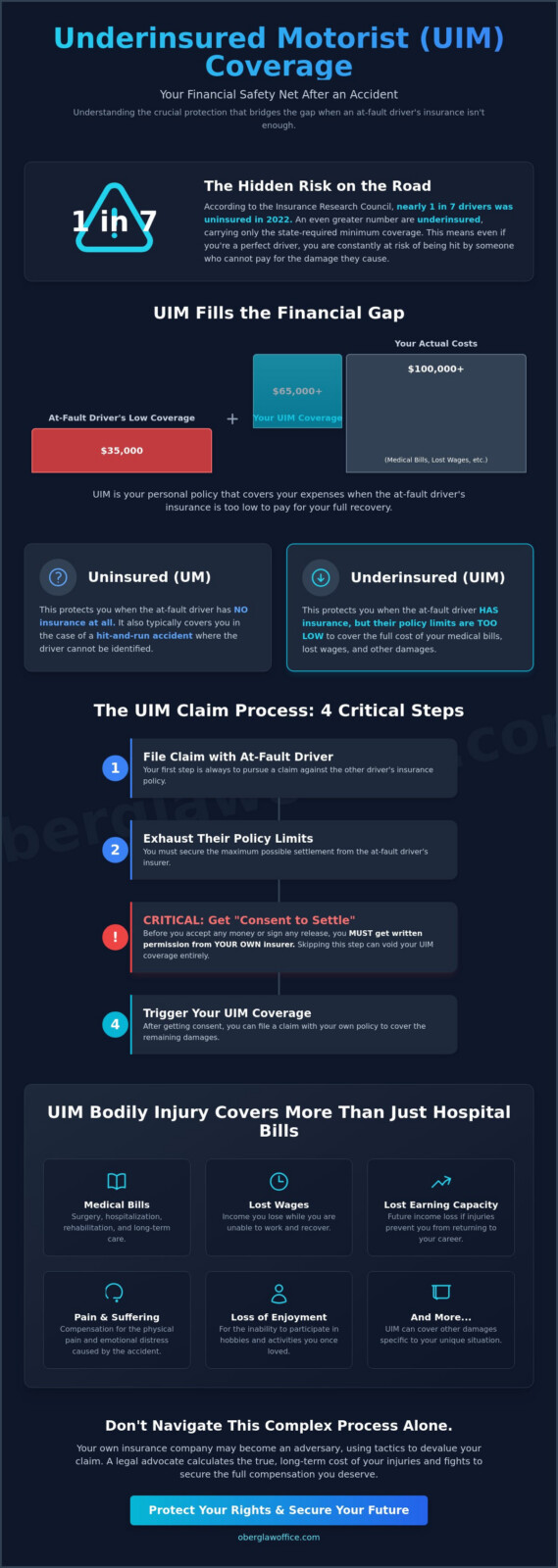
Did you know that 14% of drivers on the road were completely uninsured in 2022, according to the Insurance Research Council? This means that even if you’re a perfect driver, you’re constantly at risk of being hit by someone who lacks the resources to pay for the damage they cause. It’s a frightening reality, but having underinsured motorist coverage explained is the first step toward protecting your family from the consequences of someone else’s negligence.
We understand the anxiety that follows a serious accident. You’re likely facing growing medical bills and wondering how you’ll make ends meet while you recover. It’s deeply frustrating to realize that an at-fault driver’s low policy limits might leave you footing the bill for your own injuries. You deserve a partner who stands up for your rights and cuts through the insurance jargon that adjusters often use to confuse you.
In this guide, we’ll show you how underinsured motorist coverage fills the gap between a small settlement and your actual financial needs. You’ll gain a clear understanding of how these claims work, giving you the confidence to navigate the recovery process and know exactly when it’s time to bring in a legal advocate to fight for the fairness you deserve.
Key Takeaways
- Get underinsured motorist coverage explained in plain language to see how it fills the gap when an at-fault driver’s insurance isn’t enough to cover your bills.
- Understand the “trigger” process for a UIM claim, including the essential steps you must take with the at-fault driver’s policy first.
- Learn why relying on health insurance alone can leave you vulnerable and how UIM provides the specific protection you need after a serious wreck.
- Discover why your own insurance company might become an adversary during a UIM claim and how to protect yourself from common devaluing tactics.
- Find out how a compassionate legal advocate calculates the true, long-term cost of a catastrophic injury to secure your financial future.
Underinsured Motorist Coverage Explained: The Safety Net You Didn’t Know You Needed
Imagine you’re recovering from a serious car accident. You did everything right, but the driver who hit you only carried the bare minimum insurance required by law. In states like Hawaii or New Jersey, that might only be $40,000 or $35,000 for bodily injury. If you’ve suffered a catastrophic injury, those funds will likely vanish before you even leave the hospital. This is where having underinsured motorist coverage explained becomes essential for your peace of mind. It serves as a personal safety net that pays for the difference between the at-fault driver’s low liability limits and the actual cost of your recovery.
The emotional toll of discovering a “coverage gap” is heavy. You’re already dealing with physical pain and the stress of a disrupted life. Learning that the person who caused your suffering can’t pay for the damage they’ve done feels like being victimized a second time. Relying solely on the other driver’s insurance is a high-stakes gamble you can’t afford to lose. We believe you deserve better than a financial shortfall when you’re at your most vulnerable.
The Difference Between Uninsured (UM) and Underinsured (UIM)
It’s common to see these two terms grouped together, but they serve different roles in your protection. Uninsured Motorist (UM) coverage protects you if you’re hit by someone with no insurance at all or if you’re the victim of a hit-and-run. On the other hand, Underinsured Motorist (UIM) coverage applies when the at-fault driver has a policy, but the dollar amount isn’t enough to cover your total medical bills and lost wages. Most insurance companies bundle these into a single Uninsured motorist clause because both situations leave you facing unpaid expenses through no fault of your own.
Why “Minimum Coverage” is Often Not Enough
Many drivers believe that being “legally insured” means they are “fully insured.” This is a dangerous misconception. A single complex surgery or a week in intensive care can easily exceed $100,000. When you factor in the hidden costs like months of lost income, specialized physical therapy, and potential long-term care, state minimums look incredibly small. The underinsured gap is the financial shortfall between a policy limit and a victim’s actual recovery needs. Without UIM, that gap becomes a debt you’re forced to carry. We’re here to help you understand how your own policy can step in to provide the security and fairness you need to move forward with your life.
How Underinsured Motorist Coverage Works in a Real-World Claim
Understanding the sequence of a claim is just as vital as knowing the definition. When we have underinsured motorist coverage explained in a practical sense, it follows a specific order of operations. You don’t start by filing with your own company. Instead, you must first pursue the at-fault driver’s insurance. Only after you’ve successfully collected the maximum amount available from the negligent party’s liability policy does your own coverage “trigger” to address the remaining balance of your damages.
This process contains a significant legal hurdle known as “consent to settle.” If you sign a release and accept a check from the other driver’s insurer without getting written permission from your own insurance company, you could accidentally waive your right to UIM benefits. They want the chance to evaluate the claim themselves first. Managing these timelines while you’re trying to heal is exhausting. If you’re feeling overwhelmed by the paperwork, reaching out for professional car accident representation can ensure you don’t miss these critical deadlines.
UIM Bodily Injury: More Than Just Hospital Bills
UIM Bodily Injury (UIMBI) is designed to restore your life, not just pay for a surgery. While it covers immediate medical costs, it also addresses the human side of a wreck. This includes compensation for physical pain, emotional distress, and the loss of enjoyment of life. If your injuries prevent you from returning to your career, UIMBI helps cover your lost earning capacity. According to Uninsured Motorist Coverage data from Forbes, these limits are often set to match your standard liability amounts, providing a vital cushion for your family’s financial stability during a long recovery.
UIM Property Damage: Protecting Your Vehicle Investment
Your physical health is the priority, but your vehicle is often your second largest investment. UIM Property Damage (UIMPD) steps in when the at-fault driver’s property damage limit can’t cover the cost of your car. This is common in multi-vehicle accidents where a small policy must be split among several victims. UIMPD can cover:
- The full cost of repairs or the fair market value if the car is totaled.
- Loss of use, which pays for a rental car while yours is in the shop.
- Lower deductibles, as UIMPD often carries a smaller out-of-pocket cost than your standard collision coverage.
By using this coverage, you aren’t stuck paying for someone else’s mistake. It ensures your car is back on the road without draining your savings. It’s a straightforward way to protect your transportation while you focus on getting better.
UIM vs. Other Insurance: How to Maximize Your Recovery
After a serious wreck, you might feel like you’re drowning in a sea of policy numbers and insurance jargon. You have health insurance, perhaps you have Personal Injury Protection (PIP), and you’ve likely pursued a settlement from the at-fault driver. It’s easy to assume these pieces will naturally fit together to cover your losses. However, without having underinsured motorist coverage explained in the context of these other benefits, you could still end up with significant debt. Each type of insurance serves a specific purpose, and understanding how they interact is the key to your financial restoration.
Personal Injury Protection (PIP) usually acts as your first line of defense, paying for immediate medical bills and a portion of lost wages regardless of who caused the crash. But PIP limits are often low. Once those funds are gone, you transition to the at-fault driver’s liability coverage, and finally, to your UIM policy. It’s a ladder of protection designed to ensure you aren’t left behind. One thing to prepare for is that your own insurance company, which usually feels like a neighborly partner, can suddenly become an adversary. When you file a UIM claim, they’re essentially stepping into the shoes of the person who hit you. They may try to minimize your injuries to protect their bottom line, which is why having a steadfast protector on your side is so important.
Why Health Insurance Isn’t a Substitute for UIM
While health insurance is vital, it’s a poor substitute for Uninsured and underinsured motorist coverage. Health insurance only pays for medical treatment. It won’t give you a dime for the months of income you lost while you couldn’t work. It provides nothing for the physical pain or emotional trauma you’ve endured. Most importantly, many health plans include a “subrogation” clause. This means if you get a settlement from the other driver, your health insurer may demand you pay them back for the medical bills they covered. UIM helps you keep more of your recovery in your own pocket by covering those out-of-pocket deductibles and co-pays that health insurance leaves behind.
Stacking Coverage: A Strategic Approach
If you live in a multi-car household, you might have access to a powerful tool called “stacking.” This allows you to combine the UIM limits of multiple vehicles to increase your total pool of available funds. There are two main types:
- Intra-policy stacking: Combining limits for different cars listed on the same policy.
- Inter-policy stacking: Combining limits from two or more separate policies in your name or household.
Stacking laws vary significantly from state to state. Some jurisdictions allow it by default, while others require you to opt-in or may prohibit it entirely. It’s a strategic way to leverage the premiums you already pay to ensure your family has the highest level of security possible after a catastrophic event. We can help you look through your policy to see if this option is available to you, ensuring no stone is left unturned in your pursuit of fairness.
The Challenge of Filing a UIM Claim: Why It Isn’t Always Simple
You’ve paid your premiums on time for years, trusting that your insurance company will be there when you need them most. However, the moment you file a UIM claim, the relationship shifts. In this phase of underinsured motorist coverage explained, it’s vital to recognize that your insurer’s interests are no longer aligned with yours. They essentially step into the shoes of the at-fault driver. Their goal moves from helping a loyal customer to protecting their financial bottom line by minimizing your payout.
Insurance adjusters use several tactics to devalue your claim. They might question the severity of your injuries or suggest that your medical treatment was unnecessary. They may even argue that your pain is related to a pre-existing condition rather than the wreck. To combat these tactics, you need more than just medical bills. You need a mountain of medical evidence and, in many cases, expert testimony from doctors or vocational specialists who can prove exactly how this accident has altered your future. If an insurer ignores this evidence and refuses a fair payout without a valid reason, they may be acting in bad faith, which opens up additional legal remedies for you.
When Your Own Insurer Fights Back
Adjusters are highly trained professionals who know how to steer a conversation. They may ask for a recorded statement early in the process, appearing helpful while actually looking for any inconsistency to use against you later. You aren’t required to give these statements without legal guidance. To trigger your UIM policy, the burden of proof rests on you. You must demonstrate that your damages exceed the at-fault driver’s limits, which requires a meticulous calculation of both your current expenses and your future needs.
Preserving Your Rights After an Accident
Time is a critical factor. You must notify your insurance carrier about a potential UIM claim immediately after the accident, even if you think the other driver has enough coverage. Waiting too long can give the insurer a reason to deny your claim based on a failure to notify clause. Perhaps the most dangerous trap is signing a general release from the at-fault driver’s insurance company. If that release isn’t worded correctly, it could legally bar you from ever collecting a dime from your own UIM policy. A personal injury lawyer mesquite tx can help navigate these complex insurance traps and protect your right to a full recovery. If you’re facing resistance from your carrier, it’s time to seek catastrophic injury representation to ensure you’re treated with the fairness you’ve already paid for.
Protecting Your Future: How Legal Advocacy Maximizes Your UIM Recovery
Managing a UIM claim alone is like trying to find your way through a storm without a compass. You’ve already had underinsured motorist coverage explained as your safety net, but actually pulling that net into place requires a firm hand and deep experience. At Oberg Law Office, we bring decades of experience to your corner, ensuring that your own insurance company treats you with the respect and fairness you deserve. We are here to help.
Calculating the true value of a catastrophic injury is one of the most complex parts of the process. It isn’t just about the bills on your kitchen table today; it’s about your future. We look at your long-term rehabilitation needs, the impact on your career, and the emotional weight of your physical limitations. By standing up to large institutions, we take the legal burden off your shoulders. This allows you to focus entirely on your physical and emotional healing.
We believe that justice should be accessible to everyone, regardless of their current financial situation. That’s why we work on a contingency fee basis. You don’t pay any upfront costs for our legal fight. We share the risk with you, which means we only get paid if we successfully recover compensation for you. It’s our promise of accessibility and a signal that we are personally invested in your restoration.
Personalized Representation When It Matters Most
When you call our office, you won’t be handed off to a rotating door of support staff. You’ll interact directly with senior professionals who are personally invested in the outcome of your case. We build a comprehensive case by investigating every detail of the accident and your policy. No stone is left unturned because we know that for you, this isn’t just a file; it’s your life and your future security.
Taking the Next Step Toward Recovery
The path to restoration begins with a single step. Our free strategy session ensures you have underinsured motorist coverage explained as it applies to your unique situation. While you focus on your rehabilitation and spending time with your family, we handle the adjusters and the legal deadlines. If you’ve been hurt, don’t face the insurance companies alone; contact Oberg Law Office for a free consultation today. We are here to be your steadfast protector and your knowledgeable guide through this difficult time.
Secure Your Path to Full Recovery
A serious accident doesn’t just damage your vehicle; it threatens your long-term financial security. Now that you’ve had underinsured motorist coverage explained, you can see why this protection is your best defense against another driver’s lack of preparation. You’ve learned that your own insurer might fight to minimize your claim and that navigating the “consent to settle” process is critical. You don’t have to carry the weight of these complex legal battles on your own while you’re trying to heal.
With over 25 years of experience fighting insurance companies, Attorney Gregg Oberg provides the personalized advocacy you need during this difficult time. We operate on a contingency-based fee structure, which means we only get paid if you win your case. This promise ensures you have access to high-quality legal support without any upfront costs. You deserve a partner who acts as both a compassionate guide for your family and a formidable protector against large institutions.
Schedule your free strategy session with Oberg Law Office today. Let’s work together to restore your peace of mind and secure the fairness you deserve. You’ve already taken the first step by getting informed; now, let us help you finish the journey toward a full recovery.
Frequently Asked Questions
What is the difference between uninsured and underinsured motorist coverage?
Uninsured Motorist (UM) coverage protects you when the at-fault driver has no insurance at all or flees the scene of a hit-and-run. Underinsured Motorist (UIM) coverage applies when the other driver is insured but their policy limits are too low to cover your total medical bills and damages. Most insurance policies bundle these together because they both serve as a safety net when the negligent party lacks sufficient resources to pay for your recovery.
Do I really need UIM coverage if I have a good health insurance plan?
Yes, you still need UIM even with excellent health insurance. Health insurance only pays for medical treatments; it won’t replace your lost income or compensate you for physical pain and emotional distress. Additionally, many health insurers have subrogation rights, meaning they may take a portion of your settlement to pay themselves back. UIM coverage ensures you have funds for the human side of your recovery that health insurance ignores.
Is underinsured motorist coverage required by law in every state?
No, underinsured motorist coverage is not required in every state. As of 2023, only 21 states and the District of Columbia mandate this coverage. However, many states are increasing their protection for drivers. For example, Hawaii increased its minimum liability requirements on January 1, 2026. Regardless of whether your state requires it, having underinsured motorist coverage explained as an essential part of your policy helps protect your financial future.
Can I file a UIM claim if I was involved in a hit-and-run accident?
Typically, a hit-and-run accident falls under your Uninsured Motorist (UM) coverage rather than UIM. Since the at-fault driver cannot be identified, they are legally treated as having no insurance at all. It’s important to report these incidents to the police and your insurer immediately to preserve your rights. We can help you look through your policy to determine which coverage applies so you can focus on your rehabilitation.
How much underinsured motorist coverage should I actually carry?
You should generally carry UIM limits that match your own bodily injury liability limits. If you carry $100,000 in liability to protect others, you should have at least $100,000 in UIM to protect yourself. Many drivers find that the cost is surprisingly affordable, often around $50 to $75 annually for both UM and UIM according to 2026 data. This small investment provides significant security if you’re involved in a catastrophic accident.
Will my insurance rates go up if I file an underinsured motorist claim?
In many states, insurance companies are prohibited from raising your rates for a claim where you weren’t at fault. Since a UIM claim is only triggered when another driver causes the accident, your insurer shouldn’t penalize you for using the protection you’ve paid for. We understand the fear of rising costs, but your physical and financial restoration is far more valuable than a potential minor premium adjustment. Your safety is the priority.
What happens if the at-fault driver has no insurance at all?
If the at-fault driver has no insurance, your Uninsured Motorist (UM) coverage steps in to pay for your injuries and damages. This is a common problem, as 14% of U.S. drivers were uninsured in 2022. Without this coverage, you would be forced to pay for your own medical bills and vehicle repairs out of pocket. We advocate for our clients to ensure their own insurance carriers fulfill their promises in these difficult situations.
How long do I have to file a UIM claim after a car accident?
The timeframe depends on your state’s statute of limitations and the specific language in your insurance policy. While personal injury lawsuits often have a two or three year window, your insurance policy may require “prompt notice” of a potential claim. Waiting too long can give the insurer an excuse to deny your benefits. It’s best to consult with us early so we can protect your rights and handle the complex timelines for you.
For those navigating the legal landscape in New York, Yakov Mushiyev & Associates, P.C. provides experienced counsel for accident victims seeking to recover damages after an injury and ensure all insurance requirements are met.