In the aftermath of a collision, the clock isn’t just ticking on your recovery; it’s ticking on the digital data that proves what really happened. You’re likely feeling overwhelmed by physical pain while worrying that the trucking company is already working to bury the truth. It’s a heavy burden to carry when you’re just trying to get back on your feet. We understand that fear because we’ve seen how quickly critical proof can vanish. This guide is designed to give you clarity on exactly what evidence is needed for a truck accident claim to hold these large corporations accountable.
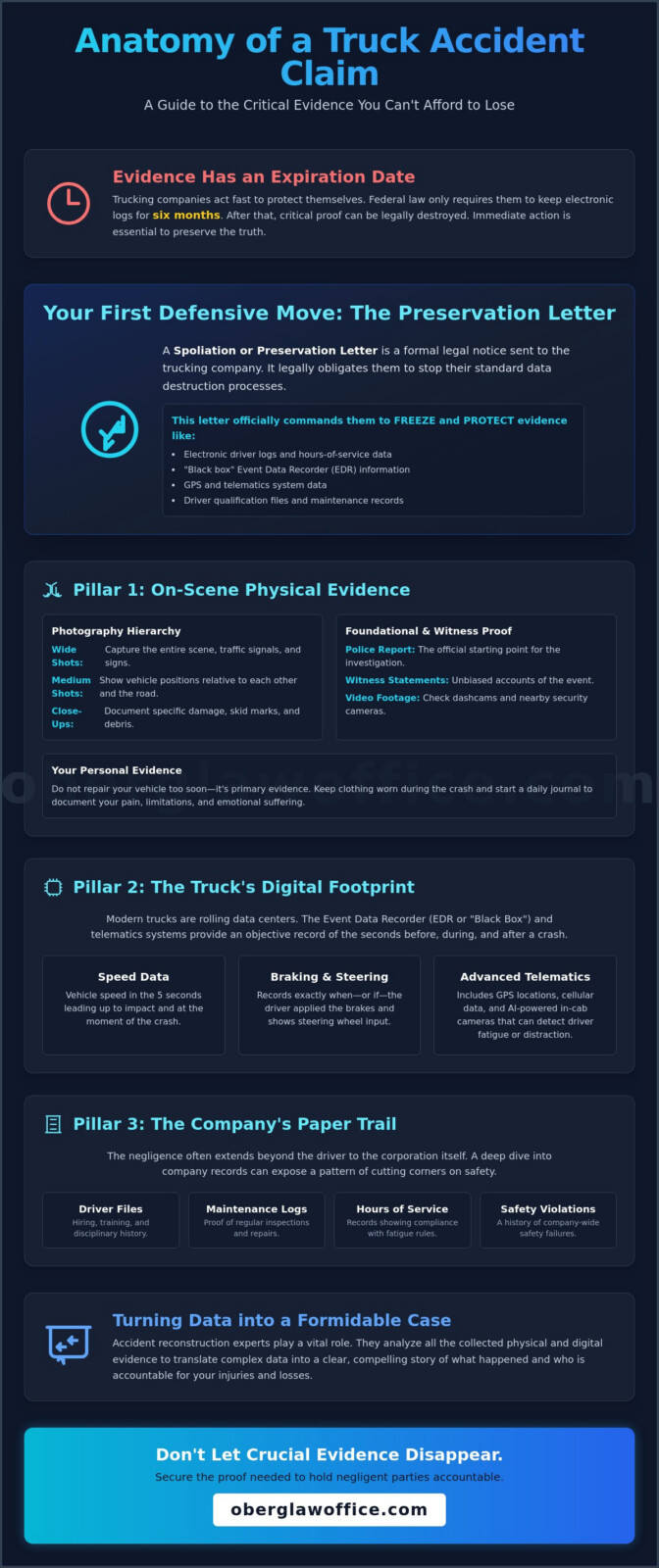
You deserve to know that federal law only requires carriers to keep electronic logs for six months, and with the FMCSA’s recent March 2026 crackdown on non-compliant ELD models, some data might be lost even sooner if not properly preserved. We’ll show you how to use a spoliation letter to freeze that evidence in place immediately. You’ll discover a clear checklist of physical and digital proof, from black box data to driver qualification files, and learn how we handle the heavy lifting of expert investigations so you can focus on your healing. This is about restoration, fairness, and making sure you have a steadfast protector in your corner.
Key Takeaways
- Learn how to document the crash scene immediately, ensuring you capture the physical evidence that proves fault before the road is cleared.
- Discover exactly what evidence is needed for a truck accident claim, specifically the “black box” data that reveals speed and braking in the seconds before impact.
- Uncover the internal corporate “paper trail” that can expose a trucking company’s history of neglected maintenance or safety violations.
- Understand the power of a formal preservation letter to legally stop the trucking company from overwriting or destroying critical digital logs.
- See how accident reconstruction experts translate complex data into a clear, formidable story of accountability to help you secure the restoration you deserve.
Immediate Physical Evidence: Capturing the Scene of the Crash
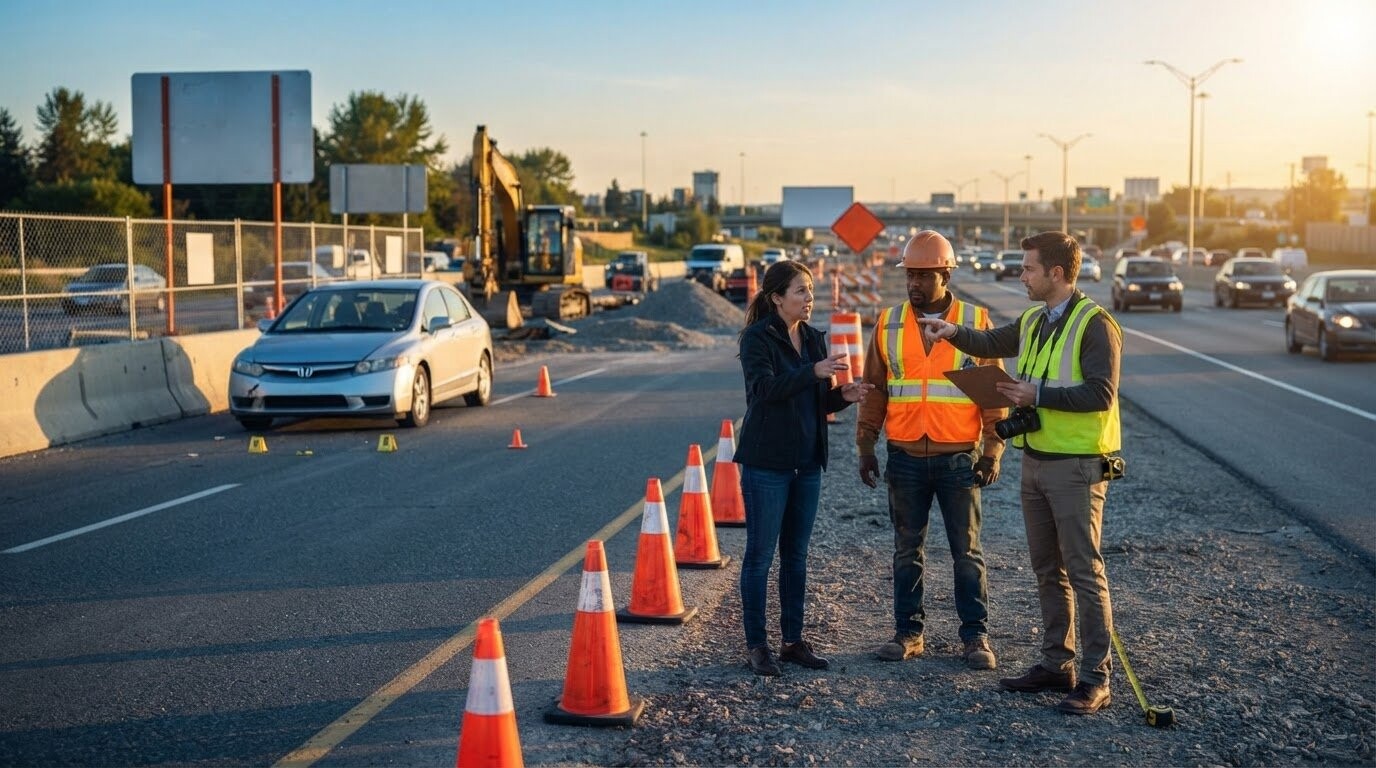
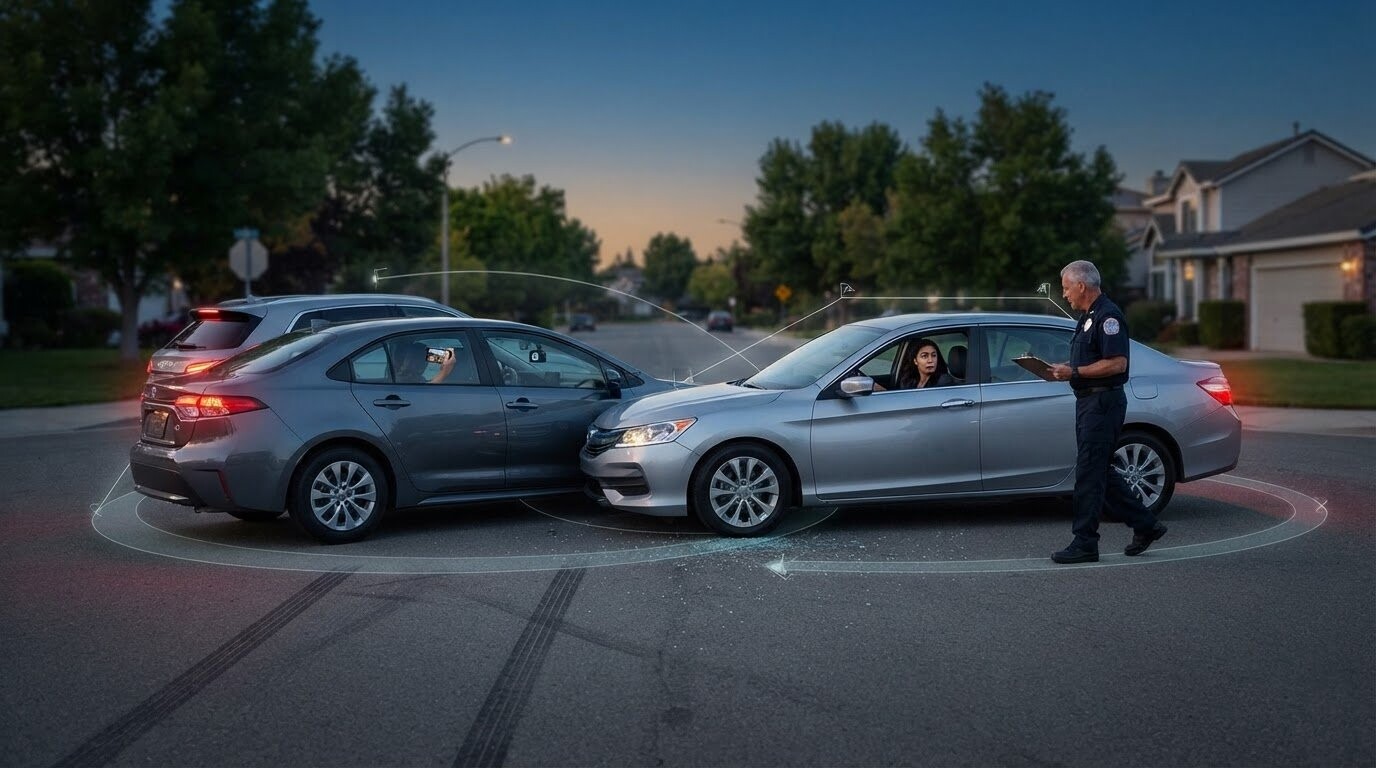
The moments following a collision are chaotic, but they are also the most critical for your future recovery. Within the first 24 hours, the physical evidence at the scene begins to vanish. Rain washes away fluid spills. Other vehicles wear down skid marks. Road crews sweep up debris fields that could have proven the angle of impact. When you’re wondering what evidence is needed for a truck accident claim, the answer starts with what you can see on the pavement before it’s gone forever. We know how overwhelming this feels, but acting quickly ensures the truth isn’t buried under a layer of fresh asphalt.
You should prioritize a hierarchy of photographs to tell a complete story. Start with wide-angle shots that show the entire intersection or stretch of highway, including traffic lights and signage. Then, move to medium shots showing the positions of the vehicles relative to each other. Finally, take close-up photos of the damage, tire treads, and any broken parts on the road. This visual record acts as a permanent anchor for your claim, preventing the trucking company from changing the narrative later. It’s about creating a scene that can’t be argued away by corporate lawyers.
The official police accident report serves as the foundation for this effort. It documents the officer’s initial findings, identifies the parties involved, and often includes a preliminary diagram of the crash. While physical evidence on the road tells a powerful story, it often works alongside the data retrieved from the truck’s “black box” to prove exactly how the driver was operating the vehicle. This combination of physical and digital proof is what creates a formidable case against negligent parties.
The Power of Witness Statements and Video Footage
Third-party witnesses are invaluable because they have no financial interest in the outcome of your case. Their unbiased accounts can confirm if a driver was speeding or ran a red light. We also look for silent witnesses, such as dashcam footage from nearby cars or surveillance video from local businesses. In our modern world, a Ring camera or a storefront security system often captures the impact from an angle that photos simply cannot match. Securing this footage before it’s overwritten is a top priority for our team.
Preserving Your Own Physical Evidence
It’s tempting to get your life back to normal quickly, but repairing your vehicle too soon can be a mistake. Your car is a primary piece of evidence that shows the force and direction of the hit. We recommend keeping the clothing you wore and every medical receipt you receive. You should also start a daily journal. Documenting your pain levels and the activities you’ve missed provides the specific, human details needed to seek fair compensation for your emotional and physical suffering. This journal serves as evidence of the non-economic damages that a simple repair bill can’t capture.
Digital Evidence: The Role of the Truck’s “Black Box”
While photos of the wreckage are powerful, they only tell part of the story. To truly understand the cause of a collision, we must look at the digital trail left behind by the vehicle itself. This technological footprint is a massive part of what evidence is needed for a truck accident claim in 2026. Modern semi-trucks are essentially rolling computers, constantly recording data that can either confirm or contradict a driver’s testimony. We use this data to build a wall of proof that prevents trucking companies from dodging responsibility.
According to official government statistics, hundreds of thousands of crashes involving large trucks occur every year. In many of these cases, the determining factor in a legal claim is the Event Data Recorder (EDR). Unlike older systems, today’s EDRs work in tandem with advanced telematics. These systems track GPS locations, cellular pings, and even AI-powered in-cab cameras that monitor for driver distraction or fatigue. If a driver was looking at a phone or nodding off, these systems likely caught it. Our firm knows how to secure this data before it is overwritten or lost.
What the EDR Reveals About the Moments Before Impact
The EDR acts as a silent witness that never forgets. It captures specific data points like the vehicle’s speed five seconds before impact compared to the speed at the moment of the crash. It records exactly when the driver hit the brakes, or if they hit them at all. We also look at steering input and throttle position to see if the driver attempted to avoid the collision. This data is objective and doesn’t rely on memory, making it a cornerstone of our truck accident representation.
Auditing Digital Logbooks for Fatigue Violations
Fatigue is a silent killer on the road, often caused by drivers pushing past legal limits to meet tight deadlines. Federal law requires Electronic Logging Devices (ELD) to track Hours of Service (HOS). You should know that federal regulations only require motor carriers to retain these records for six months. We audit these digital logs against fuel receipts and toll road data to find discrepancies. If a truck was “pinged” in two different cities faster than the speed limit allows, we have proof of a violation. In March 2026, the FMCSA even revoked several non-compliant ELD models, adding another layer of complexity to these audits. We ensure the data being used is accurate and admissible.
Corporate Records: Proving Trucking Company Negligence
The driver’s actions at the wheel are only one piece of the puzzle. When we investigate your case, we look beyond the road to the trucking company’s headquarters. Their internal files are often a goldmine for proving corporate negligence. Understanding what evidence is needed for a truck accident claim means looking at the “paper trail” that shows if a company prioritized profits over your safety. We’ve seen how these corporations try to hide behind layers of paperwork, but we know exactly where to find the proof of their systemic failures.
Cargo manifests and weight logs are essential documents we pull during discovery. An overloaded truck is a dangerous truck. If a trailer exceeds weight limits, it puts immense strain on the braking system and tires, drastically increasing the distance needed to stop. This isn’t just a simple mistake; it’s a violation of federal safety standards that changes how the vehicle handles in an emergency. We analyze these manifests to see if the company allowed a truck to leave the warehouse in a condition that made a crash on our local highways inevitable.
To make sense of these complex corporate records, we use the same rigorous standards as professional investigators. This often involves Expert Witness Testimony to connect the dots between a company’s internal decisions and the event on the road. We show the jury that the crash wasn’t just “bad luck,” it was the logical result of a company’s failure to follow the rules that keep our community safe.
Personnel Files and Hiring Practices
We dig deep into the driver’s history through their Driver Qualification File. This includes checking their Commercial Driver’s License (CDL) standing and whether their medical certifications were current at the time of the crash. If a company hired a driver with a history of safety violations or failed to provide proper training, they may be guilty of negligent hiring. We hold them accountable for putting an unqualified or dangerous individual behind the wheel. Your safety was their responsibility, and hiring an unfit driver is a direct breach of that trust.
Maintenance and Equipment Failure Evidence
Expert Witness Testimony: Turning Data into Proof
Data is just a collection of numbers and technical logs until a professional interprets it for a judge and jury. While we’ve discussed the physical and digital trails left behind, understanding what evidence is needed for a truck accident claim often requires a team of specialized experts who can speak with authority. These professionals bridge the gap between complex engineering data and the human story of your accident. You don’t have to worry about the cost or complexity of finding these experts on your own. We manage this entire investigative team to ensure your case is built on a foundation of scientific truth.
The trucking company will have their own experts trying to minimize their liability. To counter this, we employ specialists who can translate the “language” of the crash into clear, undeniable proof. This expert intervention is what turns a pile of documents into a formidable legal strategy. It’s about more than just showing what happened; it’s about proving why it happened and who is legally responsible for the restoration of your life.
Accident Reconstruction and 3D Modeling
Accident reconstructionists are forensic engineers who use the laws of physics to reverse-engineer the collision. They utilize high-resolution drone footage and laser scanning to create a precise digital map of the scene, capturing every gouge mark and debris location with millimeter accuracy. Through “crush analysis,” they measure the depth of vehicle deformation to calculate the exact speed and force of the impact. Reconstructionists use EDR data to create highly accurate visual simulations that show a jury exactly how the collision unfolded from multiple perspectives. These simulations make it impossible for the trucking company to hide behind a false version of events.
Proving the Full Scope of Your Losses
Proving fault is only half the battle; we must also prove the true cost of what you’ve lost. When a client suffers a catastrophic injury, medical experts are vital for projecting “Life Care” costs that cover decades of specialized treatment and home modifications. Economic experts then take these projections and adjust them for future inflation, ensuring your settlement doesn’t run out when you need it most. Vocational experts provide testimony on how your injuries permanently alter your ability to work and earn a living in your career.
Sometimes, the most critical proof is hidden deep within corporate hardware. Digital forensic experts can often retrieve data that a trucking company attempted to delete or overwrite on their internal servers, such as emails or dispatch logs. This level of deep-dive investigation is part of the unwavering determination we bring to every case. If you’re feeling overwhelmed by the technical side of your case, we invite you to reach out for truck accident representation that handles the heavy lifting for you.
Securing Your Claim: The Preservation Letter and Legal Strategy
Your case depends on proof that is often held by the very company you’re suing. This creates a dangerous conflict of interest. While we’ve detailed what evidence is needed for a truck accident claim, knowing what you need is only half the battle. You must also ensure that evidence still exists when your case goes to court. Trucking companies are well aware that digital logs can be “accidentally” overwritten or hardware can be replaced. This is why the first step our firm takes is sending a formal Spoliation Letter. It’s a shield for your rights.
A Spoliation Letter is a powerful legal notice that informs the carrier they’re under a legal obligation to preserve all data related to the crash. This includes the truck’s black box, ELD records, and internal maintenance files. Without this document, a company might follow their standard data purge policy after six months, which is the federal minimum for many records. Waiting even a week to send this notice can be fatal to your case. The Discovery phase of a truck accident claim is a complex battleground where we force these companies to turn over their secrets. We don’t let them hide behind corporate bureaucracy.
What Happens if Evidence Is Destroyed?
If a company ignores our notice and destroys evidence, they face severe legal consequences. A judge may issue “adverse inference” instructions to the jury. This means the jury is told to assume the missing evidence would’ve proven the trucking company was at fault. It’s a heavy penalty that can turn the tide of a case. As your personal injury lawyer, our job is to hold carriers accountable for every byte of data they lose or delete. We’ve seen these tactics before, and we know how to counter them in court.
The Oberg Law Office Approach to Evidence
At Oberg Law Office, we treat your case as a partnership. You won’t be handed off to a paralegal or support staff; you’ll work directly with a senior attorney who understands the high stakes of your recovery. We also believe that justice shouldn’t depend on the size of your bank account. Our performance-based fee structure means we fund the expensive expert investigations and digital forensics upfront. You only pay us if we win. This approach allows us to act as your steadfast protector against large institutions. Schedule a free strategy session today to ensure your evidence is protected before it’s too late.
Taking the First Step Toward Restoration
The path to recovery after a collision is paved with the proof you gather today. From securing the truck’s digital data before it’s purged to using expert reconstructionists to tell the true story of the crash, every piece of evidence matters. You’ve learned that understanding what evidence is needed for a truck accident claim is about more than just photos; it’s about holding a corporation accountable for their choices. We know the weight you’re carrying, and we’re here to help you lift it.
Attorney Gregg Oberg offers over 25 years of experience in Texas personal injury law to protect your interests. When you work with us, you’ll have direct access to Gregg’s expertise, ensuring a senior professional is personally invested in your case. We operate on a contingency-based fee structure, meaning you only pay if we win. This is our promise of shared risk and accessibility during your most difficult moments. Contact Oberg Law Office for a Free Truck Accident Strategy Session today. You don’t have to navigate this complex legal landscape alone; let us be your steadfast guide and protector.
Frequently Asked Questions
How long do I have to collect evidence after a truck accident?
You should start collecting evidence immediately because physical proof begins to fade the moment the road is cleared. While the statute of limitations for filing a claim is typically two years in Texas, digital records like ELD logs are only required to be kept for six months by federal law. Acting within the first few days ensures that tire marks, debris, and surveillance footage aren’t lost to time or overwritten by the trucking company.
Can I get the truck’s black box data myself?
No, you generally cannot access a commercial truck’s Event Data Recorder (EDR) without a court order or the company’s consent. This hardware requires specialized software and cables to download the data, which is proprietary to the manufacturer. We use the legal discovery process to compel the trucking company to provide this information, ensuring the data is downloaded by a qualified forensic expert to maintain its integrity for court use.
What if the trucking company says the data was “accidentally” deleted?
If a company deletes data after receiving a formal notice to preserve it, they may face a spoliation of evidence charge. A judge can then issue an adverse inference instruction, which tells the jury to assume the deleted data would’ve been unfavorable to the trucking company. This legal mechanism protects you when corporations try to hide the truth behind technical glitches or claims of accidental deletions during the discovery phase.
Is a police report enough evidence to win a truck accident claim?
A police report is a foundational document, but it’s rarely enough to win a complex claim on its own. While it provides an officer’s initial perspective and identifies the involved parties, it doesn’t include the deep technical data found in a truck’s black box or internal maintenance logs. To build a formidable case, we combine the police report with expert analysis and corporate records to show a complete picture of negligence.
What is a spoliation letter and why is it necessary?
A spoliation letter is a formal legal notice sent to the trucking company demanding that they preserve all evidence related to the crash. It’s necessary because it creates a legal obligation for the carrier to stop their routine data purging practices. This document specifically covers what evidence is needed for a truck accident claim, such as GPS pings, dashcam footage, and driver qualification files that might otherwise be destroyed in the normal course of business.
How much does it cost to hire an accident reconstruction expert?
Hiring these experts can be expensive, but under our contingency based fee structure, you don’t pay these costs out of pocket. Our firm funds the entire investigation, including the fees for reconstructionists, medical specialists, and digital forensic experts. We take on the financial risk of building your case, and we’re only reimbursed for these expenses if we successfully secure a settlement or verdict for you. This ensures you have access to top tier experts regardless of your current financial situation.
Can my cell phone records be used as evidence against me?
Yes, the opposing party’s lawyers will often try to subpoena your cell phone records to prove you were distracted at the time of the crash. They look for timestamps on texts, calls, or data usage that coincide with the accident. This is why it’s vital to have a steadfast protector managing the discovery process, ensuring that any requests for your personal information are legally valid and not just an attempt to shift blame away from the negligent driver.
What evidence is needed to prove the trucking company is liable for a driver’s error?
Proving company liability requires evidence that shows a link between the carrier’s oversight and the driver’s mistake. We look for proof of negligent hiring, such as a driver qualification file that shows a history of safety violations the company ignored. When determining what evidence is needed for a truck accident claim, we also audit internal training logs and maintenance records to show if the company’s culture of cutting corners directly contributed to the driver’s failure on the road.