
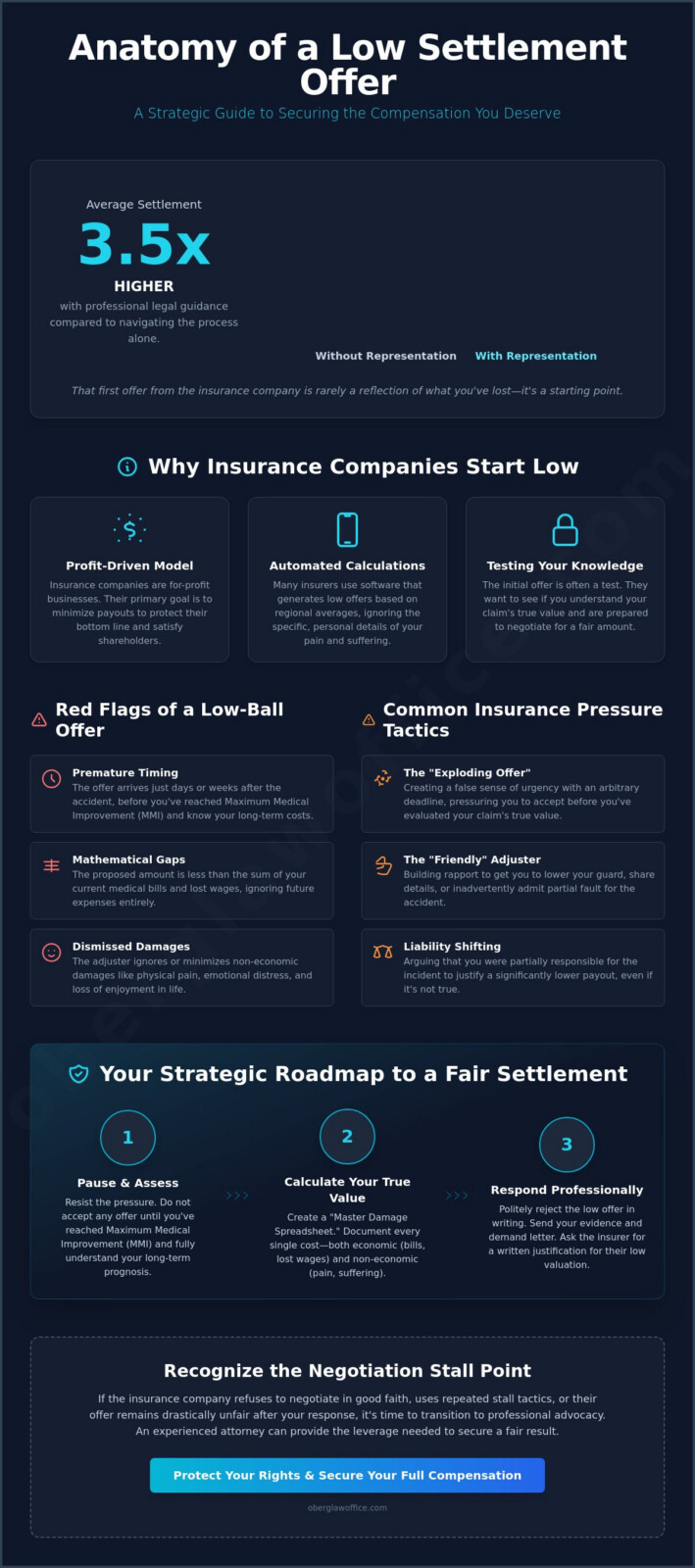
Did you know that individuals who have professional guidance often secure settlements 3.5 times higher than those who navigate the process alone? It is a startling statistic that reveals a difficult truth: that first check the insurance company offered you likely isn’t a fair reflection of what you’ve lost. When you are facing mounting medical bills and the stress of missed work, responding to a low settlement offer can feel like an impossible hurdle. You shouldn’t have to feel pressured by aggressive adjusters or worry that you are leaving your family’s financial security on the table.
We believe you deserve a partner who sees you as a person, not a claim number. This guide provides the strategic roadmap you need to evaluate a low-ball offer and professionally counter it to secure your full compensation. We’ll walk you through how to calculate the true impact of 2026’s rising healthcare costs on your recovery and explain how to build a case the insurance company cannot ignore. You’ll gain the clarity and confidence to negotiate effectively, while learning exactly when a lawyer’s expertise becomes necessary to protect your rights.
Key Takeaways
- Recognize that the insurance company’s first offer is often a strategic “test” of your knowledge rather than a final assessment of what your claim is worth.
- Learn how to accurately calculate your claim’s true value by organizing every out-of-pocket cost and non-economic impact into a Master Damage Spreadsheet.
- Discover the most effective methods for responding to a low settlement offer, including how to request written justifications that expose the insurer’s weak points.
- Identify common pressure tactics like “exploding offers” and arbitrary deadlines so you can stay focused on securing the full restoration you deserve.
- Understand how to recognize a negotiation “stall point” and when transitioning to professional advocacy can provide the leverage needed to secure a fair result.
What is a Low Settlement Offer and Why Does It Happen?
A low settlement offer, often called a “low-ball” offer, is a sum that fails to cover the full spectrum of your accident-related costs. It’s a number that doesn’t account for the reality of your recovery or the long-term impact on your life. In the legal definition of a settlement, the goal is to resolve a dispute and provide closure. However, insurance companies often use this first step to see how much they can save at your expense. When you’re responding to a low settlement offer, it’s vital to recognize that this initial figure is rarely based on the facts of your injury. Instead, it’s often a “test” of your legal knowledge and your patience.
One of the most critical benchmarks for a fair offer is Maximum Medical Improvement (MMI). This is the point where your condition has stabilized and further healing is unlikely. If an insurer pressures you to settle before you reach MMI, they’re asking you to gamble with your future health. You can’t know the true cost of your medical needs until your doctors have a clear picture of your long-term prognosis. A fair offer should be rooted in these medical facts, not in a corporation’s desire to protect its bottom line.
The Reality of the Insurance Business Model
Remember that insurance companies are for-profit corporations. They aren’t social safety nets designed to ensure your well-being; they’re businesses focused on their shareholders. The insurance adjuster assigned to your case is a professional negotiator trained to find reasons to devalue your claim. Many companies now use automated claim software that generates settlement ranges based on regional averages. These programs don’t see your specific pain or the way your injury has disrupted your family’s life. They see a data point to be minimized.
Common Signs Your Offer is Too Low
Recognizing a low-ball offer is the first step toward securing fairness. You’ll know you’re responding to a low settlement offer if you notice these red flags:
- Premature Timing: The offer arrives just days or weeks after the accident, before you’ve even understood the full extent of your injuries.
- Mathematical Gaps: The proposed amount is less than your current medical bills and lost wages, leaving you with out-of-pocket expenses.
- Dismissed Damages: The adjuster ignores “non-economic” damages like your physical pain, emotional distress, or the loss of enjoyment in your daily life.
If the numbers don’t add up to a full restoration of your life before the accident, the offer isn’t fair. It’s simply a starting point for a negotiation that we can help you lead with confidence.
Why Insurance Companies Start with a Low-Ball Figure
When you receive that first phone call or letter from an insurance adjuster, it often feels like a lifeline. However, it’s vital to recognize that this initial figure is usually a calculated financial move. When you’re responding to a low settlement offer, you’re not just looking at a number; you’re navigating a strategy designed to save the company money. One common tactic is the “Take It or Leave It” bluff. The adjuster might imply that if you don’t accept the check today, the offer will disappear entirely. This creates a false sense of urgency. Similarly, the “Exploding Offer” uses arbitrary deadlines to pressure you into making a decision before you’ve had time to consult with an experienced legal advocate.
Another common hurdle is “Liability Shifting.” The insurance company may try to argue that you were partially responsible for the accident. By shifting even a small percentage of the blame to you, they can justify a significantly lower payout. They want you to believe their assessment is the final word on the matter, but it’s often just a negotiation tactic. Knowing how to counter a low settlement offer starts with recognizing these maneuvers for what they are: business decisions, not legal truths.
Psychological Pressure Tactics to Watch For
The “Friendly Adjuster” trap is one of the most effective tools in an insurer’s belt. The adjuster acts like a neighborly guide, building rapport to get you to lower your guard. They might encourage you to share details about your life, hoping you’ll inadvertently admit fault or minimize your injuries. Conversely, some adjusters use the “Silent Treatment.” By delaying responses or leaving your calls unreturned, they hope the mounting pressure of your bills will make you desperate enough to accept any cash flow. An insurance adjuster’s “final” offer is rarely ever truly final; it is simply the last number they are authorized to give before you push back.
The Risk of Signing a Release Too Early
The ultimate goal of the insurance company is “Finality.” They want you to sign a release immediately because, once that document is signed, your case is closed forever. You can never ask for more money, even if your condition worsens. This is particularly dangerous because of “latent injuries.” Issues like internal trauma or soft tissue damage may not fully manifest for weeks or months. With medical costs projected to rise by 8.5% or more in 2026, accepting a quick settlement that doesn’t account for future care can leave you in a deep financial hole. The company’s priority is to close the file cheaply, but your priority must be your long-term security.
How to Evaluate Your Claim’s True Value Before Responding
Before you begin responding to a low settlement offer, you must have a firm grasp of your claim’s actual worth. It isn’t just about the bills sitting on your kitchen table today. It’s about every dollar you’ve lost and will lose because of an event that wasn’t your fault. We recommend building a “Master Damage Spreadsheet” to track your recovery. This tool helps you categorize your losses into two main buckets: economic and non-economic damages. Having this data organized transforms a frustrating phone call into a fact-based negotiation where you hold the power.
Your evaluation must look forward, not just backward. With healthcare costs projected to rise by 9.6% in 2026, a settlement that seems “okay” now might leave you short in six months. You must account for future medical expenses, such as anticipated surgeries, ongoing physical therapy, or long-term prescriptions. If you settle for a number based only on today’s receipts, you’re essentially paying for the insurance company’s savings out of your own pocket.
Quantifying Your Economic Losses
Economic damages are the tangible financial hits you’ve taken. You should document every medical visit, every prescription, and every medical device you’ve had to purchase. If your injuries prevent you from returning to your previous role, you must calculate your lost earning capacity. This isn’t just about current missed paychecks. It’s about the lifetime of income and benefits you may lose. For help with these complex valuations, consulting a personal injury lawyer mesquite tx can ensure no detail is overlooked in your financial restoration.
Proving Non-Economic Damages
Non-economic damages cover the “intangible” parts of your life that have been disrupted. This includes physical pain, emotional distress, and the loss of enjoyment in your daily life. To calculate this, professionals often use the “Multiplier Method,” where your total economic damages are multiplied by a factor (typically between 1.5 and 5) based on the severity of your injury. Another approach is the “Per Diem” method, which assigns a specific dollar value to every single day you’re forced to live in pain.
Proving these losses requires a personal touch. We suggest keeping a “pain journal” to record your daily struggles. Can you still play with your children? Can you sleep through the night? Witness statements from friends or family members can also provide powerful evidence of how your lifestyle has changed. These personal accounts are vital when you’re responding to a low settlement offer, as they humanize your claim in a way that numbers alone cannot.
Strategic Steps for Responding to a Low Settlement Offer
Taking a deep breath is your first strategic move. When you’re responding to a low settlement offer, your tone matters as much as your data. Insurance adjusters are trained to document emotional outbursts as a sign of desperation or instability, which they use as leverage to keep offers low. By staying calm and professional, you signal that you’re a knowledgeable claimant who won’t be bullied into a quick, cheap agreement. Your goal is to move the conversation away from their corporate software’s “averages” and back to the specific reality of your recovery.
Once you’ve processed the initial shock, follow these disciplined steps to regain control of the negotiation:
- Request a Written Justification: Ask the adjuster to provide a detailed breakdown of how they arrived at their number. This forces them to reveal their arguments, such as alleged “pre-existing conditions” or “minor property damage.”
- Analyze Their Arguments: Look for gaps in their logic. Did they miss a specific medical bill? Are they ignoring the projected 8.5% rise in 2026 healthcare costs?
- Draft a Formal Counter-Offer: Write a letter that acknowledges their offer but firmly rejects it based on the facts you’ve gathered.
- Set a Response Deadline: Give the insurer a reasonable window, such as 10 to 14 business days, to respond. This prevents them from using the “silent treatment” to stall your progress.
Drafting the Counter-Offer Letter
Your counter-offer letter should be a structured, professional document that leaves no room for ambiguity. Start with your claim reference number and a clear statement of facts regarding the accident and your injuries. When drafting your response, you must emphasize new medical evidence or diagnostic results that the adjuster did not have access to during the initial review. If the math feels overwhelming, reaching out to a car accident lawyer mesquite can help you structure your demand for maximum impact.
What to Include in Your Rebuttal
A successful rebuttal is built on proof, not just complaints. If the adjuster claims your back pain was a pre-existing condition, provide a letter from your doctor explaining how the accident aggravated that previous injury into a debilitating state. Include updated medical reports that show a longer-than-expected recovery timeline or the need for future specialty care. Providing this level of detail makes it much harder for the insurer to justify a low-ball figure. If the insurance company refuses to acknowledge these facts, it may be time to schedule a professional case evaluation to protect your right to a fair restoration.
When to Transition from Negotiation to Professional Advocacy
There comes a moment in every negotiation where the insurance adjuster stops treating you as a person with a valid claim and starts treating you as a budget item to be managed. We call this the “Stall Point.” If you’ve been responding to a low settlement offer with clear evidence and factual rebuttals, yet the company refuses to budge, they’re likely testing your resolve. They’re betting that you don’t have the resources or the desire to take the matter to court. This is where the dynamic must change. Moving from self-representation to professional advocacy isn’t just about hiring a lawyer; it’s about signaling to the insurance carrier that you’re prepared to fight for a full restoration of your life.
The threat of litigation is often the only leverage that forces a large institution to take a claim seriously. While only three percent of tort cases actually end up in a trial, the mere presence of an experienced attorney changes the math for the insurer. They know that a lawyer understands how to present a case to a jury, and they’d often rather pay a fair settlement than risk a much higher judgment in court. Statistically, this shift in leverage pays off. Research indicates that claimants who are represented by an attorney receive settlements that are, on average, 3.5 times higher than those who navigate the process alone. This is possible because we remove the insurance company’s ability to use “take it or leave it” bluffs against you.
The Limits of Self-Representation
Even if you’re a skilled negotiator, the legal landscape is filled with technical hurdles that can quietly eat away at your recovery. For instance, “subrogation” and medical liens can allow health insurance companies or providers to take a significant portion of your settlement before you ever see a dime. Managing these liens requires specialized knowledge to ensure you keep the maximum amount of your award. Insurance companies are well aware of these complexities and often take lawyers more seriously because they know we can’t be misled by technical jargon. If the process is becoming overwhelming, reaching out to a mesquite personal injury lawyer for a free strategy session can help you identify these hidden traps before they compromise your case.
The Oberg Law Office Approach
At Oberg Law Office, we bring more than 25 years of experience to the table when standing up to major insurance carriers. We don’t believe in the cold, detached formality of large firms. Instead, we offer a specialized, person-oriented practice where you’ll interact directly with senior professionals rather than support staff. We’re personally invested in every case because we understand the physical and emotional weight you’re carrying. Our performance-based fee structure serves as our signature promise: we only get paid if we win for you. This “no recovery, no fee” model ensures that high-quality legal protection is accessible to everyone in our community, regardless of their current financial situation. You’ve fought hard enough on your own. Let us take the lead and provide the steadfast protection you deserve.
Secure the Restoration You Deserve
You’ve seen how insurance companies use pressure and arbitrary deadlines to protect their bottom line. By understanding the true value of your claim and following a disciplined rebuttal process, you’ve already taken the first steps toward fairness. Responding to a low settlement offer doesn’t have to be an intimidating battle. It’s a strategic process of ensuring your medical costs, lost wages, and personal pain are fully recognized in a year where healthcare costs are rising rapidly. You have the right to a settlement that covers your actual needs, not just a corporation’s initial estimate.
You don’t have to carry this burden by yourself. At Oberg Law Office, we provide personalized advocacy backed by over 25 years of experience standing up to major insurance carriers. We work on a contingency-based fee structure, which means there is no recovery and no fee for you. We’re here to act as your steadfast protector so you can focus on your physical healing while we focus on your financial security. Take the next step with confidence. Schedule a Free Strategy Session with Oberg Law Office today. You have the power to demand a fair result, and we’re ready to help you secure it.
Frequently Asked Questions
Is the first settlement offer always the lowest?
In almost every case, the first offer is the lowest amount the insurance company believes you might accept. They use this initial figure to gauge your understanding of your claim’s value and your willingness to negotiate. While it isn’t a legal requirement that the first offer be the lowest, it’s a standard industry practice designed to save the company money. You should view it as a starting point rather than a final destination.
How long do I have to respond to a settlement offer?
You typically have as much time as the statute of limitations allows, though adjusters often set arbitrary deadlines to create a sense of urgency. In states like Texas or California, the statute of limitations for personal injury is generally two years from the date of the injury. Don’t let an adjuster’s “exploding offer” pressure you into a decision before you’ve reached Maximum Medical Improvement or fully evaluated your long-term needs.
Can the insurance company withdraw an offer if I counter it?
Legally, a counteroffer acts as a rejection of the original proposal, which technically allows the insurer to withdraw it. However, in the context of personal injury claims, this rarely happens because the insurance company wants to settle the case to avoid the costs of litigation. When you’re responding to a low settlement offer with a counter-demand, you’re simply continuing the negotiation process rather than ending the possibility of a deal.
What should I do if the adjuster says their offer is ‘final’?
You should remain professional and request a written justification for why they believe the amount is sufficient. An adjuster’s claim that an offer is “final” is often a negotiation tactic intended to see if you’ll back down. If you have documented evidence that your damages exceed their “final” number, you still have the right to push back or seek professional advocacy to break the stalemate.
Do I have to accept a settlement if I already cashed a check for car repairs?
You’re generally not required to accept a bodily injury settlement just because you’ve accepted payment for vehicle repairs. Property damage claims and personal injury claims are typically handled as separate portions of a case. As long as you didn’t sign a global release that covers all known and unknown claims, you can still negotiate for fair compensation regarding your medical bills and your pain and suffering.
What happens if my medical bills are higher than the settlement offer?
You should never accept an offer that doesn’t at least cover your existing medical expenses and projected future care. If the offer is lower than your bills, it’s a clear sign that the insurer is devaluing your claim or ignoring the severity of your injuries. Accepting such an offer would leave you personally responsible for the remaining balance, which defeats the purpose of seeking restoration after an accident.
How much more should I ask for in my counter-offer?
Your counter-offer should be based on the total sum of your economic and non-economic damages, plus a reasonable buffer for negotiation. If your Master Damage Spreadsheet shows your true claim value is $50,000 and they offered $15,000, your counter might start higher than $50,000 to allow for back and forth. This strategy ensures that when you finally reach a middle ground, it still covers your actual financial needs.
Can I hire a lawyer even if I’ve already started negotiating on my own?
You have the right to hire an attorney at any point in the process until you sign a final release. Many people begin the process of responding to a low settlement offer on their own, only to find the adjuster’s tactics overwhelming as the bills mount. A lawyer can step in, take over the communication, and use the threat of litigation to secure a result that reflects the true impact of the injury.