
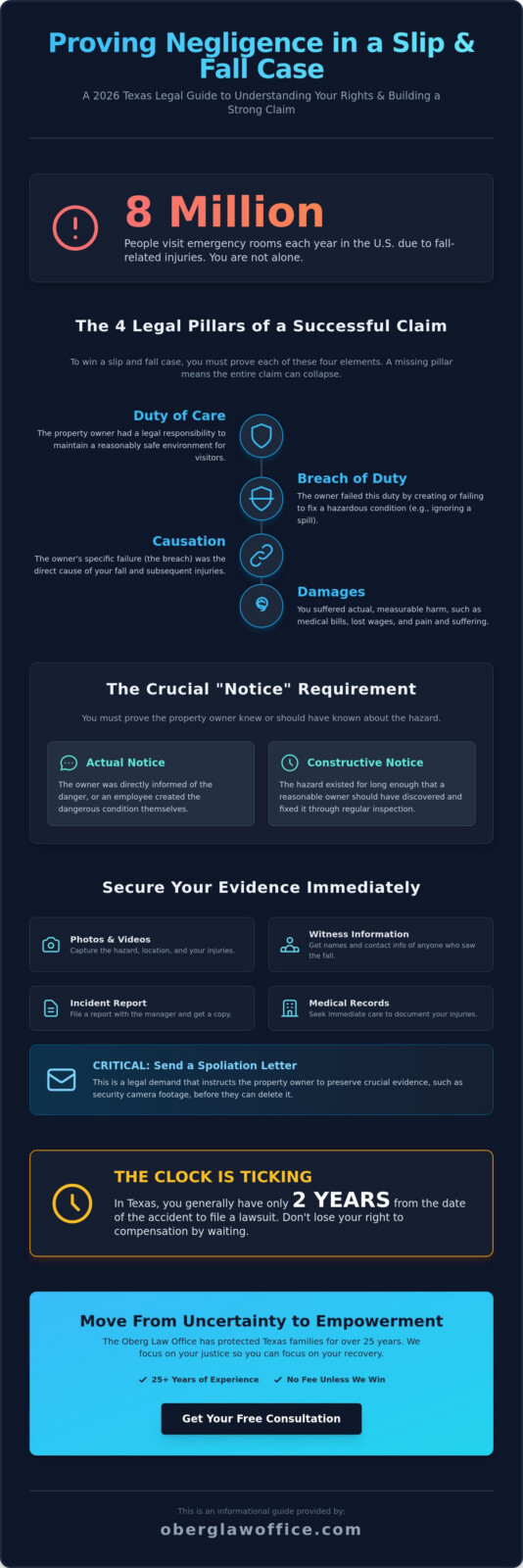
Did you know that roughly 8 million people visit emergency rooms every year because of fall-related injuries? When you’re the one struggling with sudden mobility issues or watching medical debt pile up, it’s easy to feel overwhelmed and alone. You might even feel like the insurance company is trying to blame you for your own pain. We understand that this wasn’t just a simple trip; it was a life-altering event that could have been prevented.
Proving negligence in a slip and fall is the essential first step toward reclaiming your life and your financial security. You shouldn’t have to carry the burden of someone else’s mistake. In this 2026 legal guide, you’ll learn the exact standards and evidence required to hold property owners accountable under Texas law. We provide a clear roadmap for your legal action, from gathering digital records to understanding the two-year statute of limitations. Our goal is to move you from a state of uncertainty to a feeling of empowerment so you can focus on your recovery while we focus on your justice.
Key Takeaways
- Discover how the “reasonable person” standard determines if a property owner is legally responsible for the hazards that caused your injury.
- Learn the four essential legal pillars required for proving negligence in a slip and fall to build a solid foundation for your compensation claim.
- Understand the “notice” requirement and how to prove that a business owner knew, or should have known, about a dangerous condition before the accident.
- Identify the specific types of evidence you must secure immediately, including how “spoliation letters” prevent property owners from deleting critical security footage.
- Find out how the Oberg Law Office uses over 25 years of experience and a “no fee unless we win” model to provide the protection and justice your family deserves.
Understanding Negligence: The Foundation of a Slip and Fall Claim
Negligence is the failure to maintain a safe environment for invited guests. When you walk into a grocery store, a restaurant, or a neighbor’s home, you have a right to expect that the floors are stable and the walkways are clear. Understanding Negligence involves more than just recognizing a mistake; it’s about identifying when a property owner failed to act with the care that the law requires. You shouldn’t have to shoulder the weight of medical bills and lost wages because someone else was careless with your safety.
Think of the legal system’s “Reasonable Person” standard as a yardstick for safety. It asks a simple but vital question: What would a prudent, careful property owner have done in the same situation? If a reasonable owner would have seen a leaking cooler or a torn carpet and fixed it within a few minutes, but the owner of the building where you fell did nothing, they may be legally liable. This standard ensures that owners are held to a consistent level of accountability, protecting everyone in our community from avoidable harm.
You deserve a partner who sees the person behind the case, not just a file number. At Oberg Law Office, we believe that the recovery process begins with validation. It’s not about “bad luck” or being “unlucky.” It’s about a breach of duty that has left you in pain. We are here to help you turn that frustration into a clear path toward justice and financial stability.
The Concept of Premises Liability
Property owners have a legal obligation to keep their premises safe for those they invite onto the land. In Texas, the level of care an owner owes you often depends on your reason for being there. Business customers, known as invitees, are owed the highest duty of care, meaning owners must actively inspect for and repair hidden dangers. Social guests, or licensees, are also protected, though the owner generally only needs to warn them of known hazards. If you are struggling to understand how these rules apply to your specific accident, speaking with a personal injury lawyer mesquite tx can provide the clarity you need to move forward.
Why Proving Fault is Essential
Falling down is a painful experience, but the fall itself isn’t enough to secure compensation. You must demonstrate that the owner’s specific actions, or their failure to act, directly caused your injuries. This is why proving negligence in a slip and fall is the most critical part of your claim. Insurance companies are notorious for using a “lack of evidence” as a reason to deny valid claims or pressure you into a low settlement. They might even try to make you feel like you were just being clumsy to avoid taking responsibility. Don’t let their tactics shake your confidence. We know how to gather the facts that show where the responsibility truly lies, ensuring the negligent party is held accountable for the harm they caused.
The Four Legal Elements Required to Prove Liability
Building a legal case is much like following a recipe; you need every single ingredient for it to work. In the legal world, we call these the “Four Pillars.” To succeed in proving negligence in a slip and fall, you must show that each of these elements exists by what’s called a “preponderance of the evidence.” This doesn’t mean you have to prove it beyond any shadow of a doubt like in a criminal trial. It simply means the evidence shows it’s more likely than not that the owner was at fault. Think of it as a checklist for justice that we complete together to ensure your family is protected.
You can’t skip a step in this process. If one link in the chain is missing, the insurance company will use that gap to deny your claim. We look at your accident through the lens of these four requirements to make sure your story is told clearly and backed by facts. Our job is to bridge the gap between your injury and the compensation you deserve by providing a solid foundation for your claim.
Duty and Breach: The Owner’s Failure
The first step is establishing that the owner owed you a property owner’s duty of care. In Mesquite and throughout Texas, this means businesses must keep their floors dry, their aisles clear, and their property well-maintained for guests. A breach occurs when they fail that duty. For example, if a grocery store employee walks past a crushed grape on the floor and does nothing, or if a landlord ignores a broken handrail for weeks, they’ve breached their promise of safety. We look for specific evidence, like the absence of a “wet floor” sign or outdated maintenance logs, to show exactly where the owner dropped the ball. If you’re unsure if a breach occurred, our team can help you evaluate the details of your accident and determine your next steps.
Causation and Damages: The Link to Your Injuries
Once we show the owner was careless, we have to prove that their carelessness is what actually hurt you. This is called causation. Insurance companies often try to argue that your back pain or knee injury was already there before the fall. We counter this by using medical records and expert testimony to link the accident directly to your new physical struggles. Finally, we must prove damages. This isn’t just about hospital bills; it’s about the missed paychecks, the physical therapy sessions, and the emotional stress of losing your mobility. In cases involving life-altering harm, a catastrophic injury lawyer mesquite can help quantify the long-term costs of specialized care and permanent disability. Every pillar must stand strong to ensure you aren’t left paying for someone else’s mistake.
The ‘Notice’ Requirement: Proving the Property Owner Knew
One of the most common hurdles in proving negligence in a slip and fall is the concept of “notice.” It isn’t enough to show that a hazard existed; you must also prove that the property owner knew about the danger or should have known about it before you were injured. This requirement exists to give owners a fair chance to fix problems. However, it also means they can’t simply put their heads in the sand and ignore their property. We focus on uncovering the evidence that shows the owner had ample opportunity to protect you but chose to look the other way.
The law looks at the “Time and Manner” rule to decide if an owner was truly negligent. This rule asks how long the hazard was present and how the owner handled their responsibility. If a bottle of juice breaks in a grocery store aisle and you slip on it ten seconds later, a court might find the owner didn’t have enough time to react. If that same spill sat there for forty-five minutes without being cleaned, the owner’s delay becomes a clear failure of their legal duty. We work to establish a timeline that proves the owner had more than enough time to make the area safe.
Actual Notice vs. Constructive Notice
Actual notice occurs when there’s direct evidence that the owner or an employee was aware of the danger. This might include an incident report from earlier in the day, witness testimony from someone who saw an employee walk past the spill, or even prior complaints from other customers. We dig deep into company records to find these “smoking guns” that prove the owner ignored a known threat to your safety.
Constructive notice is the most common way to win a slip and fall case. It relies on circumstantial evidence to show that the hazard existed for such a long time that a prudent owner should have discovered it. We look for clues like footprints through a spill, dirt or debris inside a liquid, or even the temperature of a frozen item that has melted on the floor. These details tell a story of neglect, proving that the owner’s lack of supervision led directly to your pain.
The Role of Regular Inspections
To defend themselves, property owners must show they have a reasonable inspection schedule in place. We often find that “reasonable” is a term they use loosely. By examining maintenance logbooks and sweep sheets, we can identify gaps in their safety protocols. If a store’s records show that no one checked the produce section for three hours, they’ve failed to provide the protection you deserve. We use these records to hold them accountable for their laziness.
Property owners often try to use the “Open and Obvious” defense to shift the blame onto you. They’ll claim that the hazard was so visible that you should have seen it and avoided it yourself. We don’t let them get away with this tactic. Just because a hazard is visible doesn’t mean the owner is off the hook for maintaining a safe environment. Our team is dedicated to showing that the owner’s negligence was the primary cause of your accident, ensuring that your right to recovery remains protected despite the insurance company’s attempts to deflect responsibility.
Essential Evidence: How to Build a Strong Compensation Case
Evidence is the voice of your claim. While your memory of the accident is vital, proving negligence in a slip and fall requires physical and digital proof that can stand up against an insurance company’s scrutiny. Think of evidence as the bridge that connects your injury to the property owner’s carelessness. Without it, your case becomes your word against theirs, and large corporations have deep pockets to fight back. We act quickly to secure the facts so your story remains undisputed and your right to recovery is protected.
One of the most critical steps we take is sending a “spoliation of evidence” letter immediately. Many retail stores and businesses in Mesquite overwrite their security footage every 24 to 48 hours. This legal letter forces the property owner to preserve all video, maintenance logs, and digital inspection records related to your fall. We also prioritize gathering witness contact information. A neighbor or another customer who saw the hazard or watched you fall can provide the unbiased testimony needed to break a “he-said, she-said” deadlock. Their perspective adds a layer of community validation that insurance adjusters find difficult to ignore.
Medical documentation is equally important. You must seek a medical evaluation immediately after your accident, even if you think your injuries are minor. This creates a formal record of the “onset” of your injury, linking your physical pain directly to the fall. If you wait several days or weeks to see a doctor, the insurance company will argue that your injuries happened somewhere else or aren’t as serious as you claim. Your medical records serve as the definitive proof of your damages, outlining the exact toll the accident has taken on your life.
Visual Evidence and Documentation
Take photos of everything at the scene if you are physically able. Capture the hazard from multiple angles, the surrounding area, and the specific lack of warning signs or “wet floor” placards. In 2026, courts are placing a much higher emphasis on concrete digital evidence, including time-stamped photos and security camera footage. If the store refuses to show you the video, a slip and fall lawyer mesquite can use a subpoena to legally compel them to hand it over. These visual records often show exactly how long a spill sat on the floor or if employees walked past the danger without fixing it.
Physical and Expert Evidence
Your shoes and clothing are pieces of evidence that many people overlook. Don’t wash the clothes you wore during the fall, as they may contain residues like oil, grease, or wax that prove what caused your slip. We sometimes bring in floor safety experts or engineers to measure the “coefficient of friction” on the surface where you fell. These professionals can provide scientific proof that a floor was dangerously slippery or failed to meet 2026 safety standards. When you combine expert analysis with your medical history, you build a case that is formidable and focused on results. If you need help gathering this evidence, contact our office today for a free evaluation of your claim.
Choosing the Right Advocate: How Oberg Law Office Protects Your Rights
Gregg Oberg has spent over 25 years holding negligent property owners accountable in Mesquite and across Texas. When you’re facing the physical and emotional aftermath of an accident, you need more than just a legal representative. You need a steadfast protector who understands the nuances of proving negligence in a slip and fall. We offer a neighborly approach that prioritizes your well-being while remaining formidable against aggressive insurance adjusters. Our “no fee unless we win” model ensures that financial anxiety never stands in the way of your pursuit of justice.
At many larger firms, you might feel like just another case number passed between various paralegals. We do things differently here. When you choose our office, you speak directly with your attorney. Gregg Oberg stays personally invested in every case, ensuring that you receive the dedicated attention your recovery requires. This direct partnership makes the legal process feel like a collaborative journey rather than a distant transaction. We understand the local landscape and the specific challenges our neighbors face when dealing with corporate negligence.
A Personalized Approach to Recovery
Your journey begins with a free initial strategy session where we listen to your story and outline your legal rights. We handle the heavy lifting of evidence gathering, from subpoenaing surveillance footage to interviewing witnesses, so you can focus entirely on healing. Our firm is built on the belief that every client should be treated like family. We take pride in being a boutique, community-focused practice that fights for the underdog with integrity and experience. You aren’t alone in this; we’re with you every step of the way.
Fighting for Your Maximum Compensation
Securing your financial stability is our primary goal. We work tirelessly to ensure you receive compensation for medical bills, lost wages, and the pain and suffering you’ve endured. Whether your case involves a minor fracture or a life-altering injury, we pursue the maximum recovery possible under the law. We don’t back down when insurance companies try to minimize your experience. If you’re ready to take the next step toward justice, a mesquite personal injury lawyer can guide you through the process. Schedule your free consultation with Oberg Law Office today and let us start building your path to recovery.
Take Charge of Your Legal Journey
You’ve taken a vital step toward justice by learning the standards required for your recovery. From identifying the four pillars of liability to understanding the critical role of constructive notice, you now have a roadmap for action. Successfully proving negligence in a slip and fall is about more than just documenting a hazard; it’s about having a steadfast protector who can turn that evidence into a winning case. You don’t have to carry the burden of someone else’s mistake while you’re trying to heal.
At Oberg Law Office, we’ve spent over 25 years fighting for the rights of our neighbors in Mesquite. We offer a deeply personal touch, ensuring that you speak directly with Attorney Gregg Oberg rather than being passed to a paralegal. Our commitment to your family’s protection is backed by our no fee unless we win promise, which removes the financial risk from your path to recovery. We’re here to handle the heavy lifting so you can focus on your health.
Don’t let the insurance companies dictate your future. Get Your Free Slip and Fall Strategy Session today and start the conversation that leads to your stability. You deserve a partner who is kind to you but formidable against those who caused your pain. We’re ready to help you secure the justice you deserve.
Frequently Asked Questions
Is it hard to prove negligence in a slip and fall case?
Yes, proving negligence in a slip and fall is a complex process because the burden of proof rests entirely on you. You don’t just have to show that you fell; you must prove that the property owner knew about the hazard and failed to fix it. This requires gathering specific evidence like maintenance logs, surveillance footage, and witness statements to show a clear breach of duty.
Can I still recover compensation if I was partially at fault for my fall?
You can still recover compensation in Texas as long as your percentage of fault is 50% or less. Under the state’s modified comparative negligence rule, your total financial recovery is reduced by your portion of the blame. For example, if you’re found 20% at fault for being distracted, your final settlement would be reduced by that 20%. We work to protect you from insurance companies trying to shift more blame than you deserve.
How much is a slip and fall case worth in 2026?
Settlement amounts in 2026 depend on the severity of your injuries and the impact on your family’s life. Minor injuries like sprains often settle between $5,000 and $25,000, while moderate injuries like simple fractures range from $25,000 to $100,000. Severe injuries requiring surgery can result in settlements over $100,000, and catastrophic cases can reach into the millions. We focus on securing the maximum compensation for your medical debt and lost wages.
What happens if there were no witnesses to my slip and fall?
You can still build a powerful case even if no one else saw you fall. We use circumstantial evidence like digital inspection records, security camera footage, and the physical condition of the hazard to tell your story. Sometimes the most reliable “witness” is a time-stamped photo showing a dirty spill that had clearly been on the floor for a long time. Our team knows how to uncover these facts to support your claim.
How long do I have to file a slip and fall lawsuit?
In Texas, the statute of limitations for personal injury claims is generally two years from the date of the injury. If you’re filing a claim against a government entity, such as a city or county, you may have as little as 60 to 180 days to file a formal notice of claim. It’s vital to act quickly so we can preserve evidence and ensure you don’t lose your right to seek justice.
What should I do if the property owner asks me to sign a statement after I fall?
You should politely decline to sign any documents or give a recorded statement until you’ve spoken with an attorney. Property owners and insurance adjusters often use these statements to lock you into a version of events that minimizes their liability or admits fault. Protecting your rights means staying quiet until you have a knowledgeable guide to handle the communication for you. We’ll make sure your words aren’t used against you later.
Can I sue for a slip and fall if I was injured on a residential property?
You have the right to seek compensation if you were injured at a private home due to a homeowner’s negligence. Residential owners have a legal duty to warn social guests about dangerous conditions they know about that aren’t easily visible, such as a loose porch board or a hidden step. These claims are typically handled through the owner’s homeowners insurance policy, allowing you to get the help you need without causing personal financial harm to a friend or neighbor.
What if the hazard was ‘open and obvious’?
The “open and obvious” defense is a common tactic used by property owners to claim you should have seen and avoided the danger yourself. However, this defense doesn’t automatically end your case or excuse the owner’s failure to maintain a safe environment. We look at the specific circumstances to show that the owner still had a duty to protect you, especially if the hazard was in a place where guests were expected to walk. We don’t let these legal theories stop us from fighting for your recovery.