
What if the settlement offer sitting in your inbox is designed to protect an insurance company’s bottom line rather than your family’s future? It’s a heavy burden to carry when medical bills pile up and your regular paycheck suddenly stops. You deserve to know the real texas personal injury claim value of your case, not just the low-ball figure an adjuster hopes you’ll accept out of desperation. We understand that this process feels overwhelming, but you don’t have to face these massive institutions alone.
In this guide, you’ll discover the specific legal factors and calculation methods that determine what your claim is actually worth in 2026. We’ll explore how key legal principles, including comparative fault rules and procedural timelines, directly impact your financial recovery. From understanding how specific situations, such as cases involving minors, can influence potential compensation to learning how to effectively document your pain and suffering, you’ll gain a realistic estimate of your case and the confidence to push back against unfair tactics. This is your first step toward the security and restoration you deserve.
Key Takeaways
- Learn the specific math behind your recovery, including how the Multiplier and Per Diem methods assign a just value to your pain and suffering.
- Understand how the Texas 51% Bar Rule affects your texas personal injury claim value and why insurance companies work hard to shift blame onto you.
- Discover why the first 72 hours following an injury are the most critical for protecting your rights and avoiding common insurance traps like recorded statements.
- See how choosing a steadfast protector over a high-volume firm ensures your case gets the personal attention needed for a full financial restoration.
Understanding the Foundation of Texas Personal Injury Claim Values
When you’ve been hurt in an accident, it feels like more than just a physical injury. It feels like your peace of mind and your financial stability have been stolen. Texas law uses the legal concept of damages to address this loss. The goal isn’t just to provide a payout; it’s to provide compensatory damages. This legal term refers to money awarded to replace what you lost. In essence, the law aims to make you whole again, returning you as closely as possible to the state you were in before the incident occurred.
You might see reports suggesting that the average car accident settlement in Texas is around $95,000, but these numbers can be misleading. Every texas personal injury claim value is unique because every life is unique. A broken leg for an office worker is a different loss than a broken leg for a professional athlete or a local delivery driver. We don’t look at you as a case number. We look at the specific ways your life has been disrupted. Viewing your claim as a recovery of what was stolen helps shift the focus from a “windfall” to a necessary restoration of your security.
The Two Pillars of Compensation: Economic vs. Non-Economic
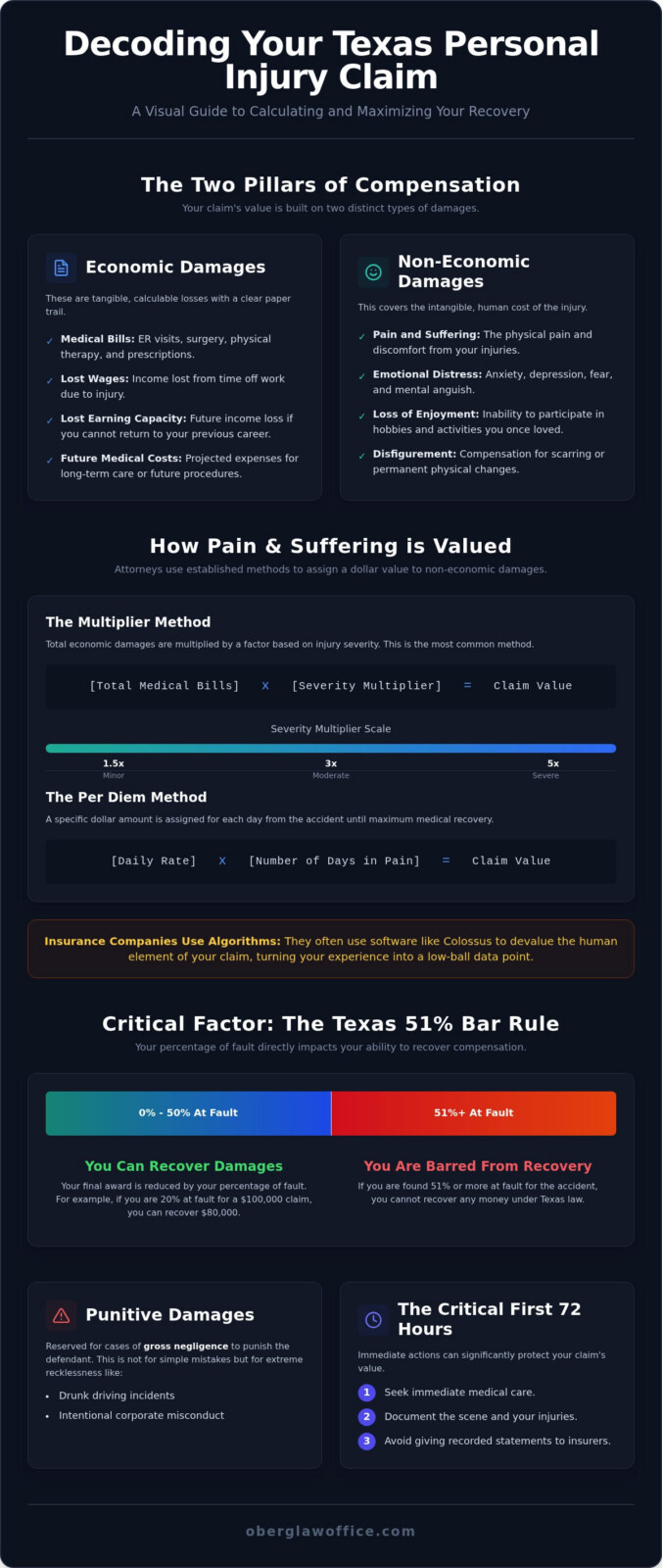
Your recovery rests on two distinct pillars that support your total case demand. Economic damages are the tangible, receipt-based losses that are easy to track with a paper trail. These include:
- Emergency room bills and ongoing physical therapy costs.
- Lost wages from time missed at work and lost earning capacity.
- Future medical expenses if your injury requires long-term care or surgery.
Non-economic damages cover the human cost of the accident. This includes your physical pain, emotional distress, and the loss of enjoyment of life. While these don’t come with a standard price tag, they are often the most significant part of your texas personal injury claim value because they represent the true weight of your trauma. These two pillars interact constantly; often, the more severe the physical injury, the higher the non-economic impact.
Punitive Damages: When Negligence Becomes Gross Negligence
Occasionally, a case goes beyond simple mistakes. In Texas, exemplary damages, also known as punitive damages, are designed to punish a defendant rather than just compensate the victim. These are reserved for cases of gross negligence, where a person or company acted with extreme recklessness and a conscious indifference to the safety of others.
Scenarios involving drunk driving or intentional corporate misconduct often trigger these claims. While the bar for proving gross negligence is high in Texas, these damages can significantly impact high-value cases. They serve as a steadfast protector for the community by sending a clear message that such behavior is unacceptable.
The Math Behind the Money: Calculating Your Potential Recovery
Calculating the true texas personal injury claim value isn’t as simple as plugging numbers into a website. While you might find dozens of settlement calculators online, these tools often fail because they can’t account for the human element of your story. Attorneys typically use two primary methods to estimate non-economic losses. The Multiplier Method takes your total medical bills and multiplies them by a factor, usually between 1.5 and 5, depending on the severity of your injuries. The Per Diem approach assigns a specific dollar value to every day you’ve lived in pain since the accident occurred.
Insurance companies don’t use these methods. Instead, they rely on complex software algorithms like Colossus to devalue your experience. These programs turn your trauma into a data point, often ignoring the nuances of your recovery to keep payouts low. This is why professional guidance is so important. If you’re feeling pressured by an adjuster’s timeline, a free strategy session can help clarify where your case actually stands against these corporate tactics.
Documenting Economic Losses for Maximum Impact
Your recovery starts with a paper trail. Every pharmacy receipt, hospital co-pay, and specialized medical device purchase serves as evidence for your claim. We don’t just look at what you’ve already spent; we look at what you’ll need in the future. If your injury prevents you from returning to your career, we calculate your loss of earning capacity by evaluating your age, skills, and previous income. We frequently collaborate with medical experts to project the cost of lifelong care, ensuring you aren’t left with massive bills years after your case is closed. This detailed approach is grounded in the Texas Civil Practice and Remedies Code, which provides the legal framework for recovering these specific losses.
Quantifying the Intangible: Pain and Suffering
Pain and suffering don’t come with a receipt, but they are often the heaviest part of your burden. To prove these losses, we recommend keeping a daily journal of your recovery. Documenting your pain levels, missed family events, and emotional struggles provides a window into your life that a medical report cannot. We also consider “loss of consortium,” which addresses the strain an injury puts on your relationship with your spouse or children. Ultimately, your texas personal injury claim value depends on your attorney’s ability to tell your story. We transform a cold spreadsheet of medical codes into a compelling narrative of survival and the need for restoration.
Critical Texas Legal Factors That Can Shift Your Settlement Value
You don’t just have to worry about your physical recovery; you have to worry about the clock. In Texas, the statute of limitations for most personal injury claims is exactly two years from the date of the accident. If you miss this deadline, your right to seek compensation vanishes forever. This two-year window sounds long, but it moves quickly when you’re focused on surgeries and physical therapy. Beyond the clock, several state-specific rules can dramatically alter the final texas personal injury claim value you receive.
Defending Your Percentage of Fault
Texas follows a 51% modified comparative fault rule. This means you can recover damages as long as you aren’t more than 50% responsible for the accident. However, your total check is reduced by your percentage of fault. Insurance adjusters know this math well. They’ll often try to pin just 10% or 15% of the blame on you for something minor, like not braking fast enough. On a $100,000 claim, that 10% “minor” blame costs you $10,000. This shift in liability is one of the most common ways a texas personal injury claim value gets slashed before it ever reaches a courtroom.
We use a specific strategy to neutralize these “blame the victim” tactics. By bringing in accident reconstruction experts, we can prove the other party’s total liability through physics and data rather than just opinions. This rigorous approach is necessary because Texas law on personal injury damages is strict about how fault impacts your final restoration.
The Role of Insurance Policy Limits
Even if your case is worth millions, the available insurance coverage often acts as a practical ceiling. Texas requires a minimum liability coverage of $30,000 per injured person and $60,000 per accident. If your medical bills alone exceed $30,000, the defendant’s policy might not be enough to make you whole. We dig deeper to find every possible source of recovery. This might include filing an Underinsured Motorist (UIM) claim on your own policy or identifying “deep pocket” defendants. For example, commercial truck accidents involve much higher policy limits than a standard passenger car, often reaching into the millions. Uncovering these layers is how we ensure you aren’t left holding the bill for someone else’s negligence.
Strategic Steps to Protect and Maximize Your Claim Worth
The choices you make immediately after an accident dictate the trajectory of your recovery. The first 72 hours are often the most expensive if handled incorrectly. During this window, insurance adjusters often reach out for a “recorded statement.” They might sound neighborly, but this is a trap designed to lock you into a version of events before you’ve even seen a specialist. Anything you say can be used to lower your texas personal injury claim value. You should also look beyond the standard police report. Dashcam footage, doorbell camera recordings from nearby homes, and witness videos are powerful tools that preserve the truth before it’s overwritten or deleted.
Gaps in medical care are a primary weapon for defense attorneys. If you wait two weeks to see a doctor because you “hoped the pain would go away,” the insurance company will argue your injury wasn’t severe or happened elsewhere. Consistent treatment isn’t just about healing; it’s about building an undeniable record of your losses. If you’re being pressured to sign documents or give a statement, contact us for a free initial strategy session before you make a move that could cost you thousands.
The ‘Maximum Medical Improvement’ (MMI) Milestone
You shouldn’t even consider a settlement offer until you reach Maximum Medical Improvement (MMI). This is the point where your doctor determines your condition has stabilized as much as it’s going to. Settling before this milestone is dangerous because you don’t yet know if you’ll need a $50,000 spinal surgery three years from now. Once you sign a release, you can’t go back for more money. We wait for a full medical prognosis because we refuse to let our clients get stuck paying for future medical needs out of their own pockets. This patience is a hallmark of the personal touch we provide to every neighbor we represent.
Social Media: The Silent Settlement Killer
Your public profile is a goldmine for insurance adjusters. A single photo of you smiling at a birthday party or carrying a grocery bag can be twisted to disprove your pain and suffering. Even if you’re in agony five minutes after the photo was taken, the “evidence” of you looking happy is enough to damage your texas personal injury claim value. The legal reality is that insurance companies frequently “spy” on public profiles to find any reason to devalue a claim. We advise our clients to “go dark” on social media during the litigation process. It’s a strategic necessity to protect your privacy and your path toward financial restoration.
Why Professional Advocacy Is the Key to Full Recovery
The lawyer you choose to stand by your side can be the most significant factor in your final recovery. Many people fall into the “Billboard Lawyer” trap, hiring high-volume firms that prioritize speed over substance. These firms often operate as settlement mills, pushing cases through as quickly as possible to maintain their business model. This rush to settle frequently results in a lower texas personal injury claim value because these attorneys aren’t willing to put in the exhaustive work required to push back against corporate legal teams. You deserve a partner who sees you as a neighbor in need of restoration, not just another file on a desk.
Insurance companies employ aggressive adjusters and specialized legal teams whose only goal is to minimize payouts. An experienced advocate levels this playing field. We understand their tactics and know how to present evidence that makes it impossible for them to ignore your needs. This professional advocacy provides more than just a legal service; it offers the security you need to focus on your physical healing. Knowing that a steadfast protector is handling the complex negotiations allows you to breathe easier during a difficult time.
The Value of 25+ Years of Texas Legal Experience
Gregg Oberg has spent over 25 years navigating the specific nuances of the Texas legal system. This deep history means he has seen every trick in the insurance company playbook and knows how to counter them effectively. There is a profound difference between a “quick settlement” and a “full settlement.” A quick offer is designed to make you go away; a full settlement is designed to ensure you aren’t left with medical debt five years from now. You can read more about our specific approach to high-stakes cases in our personal injury lawyer Texas guide.
No Upfront Costs, No Risk to You
We believe that every person deserves high-quality representation, regardless of their current financial situation. That’s why we operate on a contingency fee structure. In plain English, this means we only get paid if we successfully recover money for you. There are no hourly fees and no upfront costs to worry about. This partnership ensures that our goals are perfectly aligned with yours; we only succeed when you achieve the restoration you deserve. This approach maximizes your texas personal injury claim value while removing the stress of legal bills.
Your journey toward financial recovery doesn’t have to be a solo effort. We invite you to take the first step by engaging in a supportive, low-pressure conversation about your rights and your future. Schedule your free strategy session with Oberg Law Office today.
Take Control of Your Financial Recovery
Navigating the aftermath of an accident is exhausting, but you don’t have to carry the legal burden alone. We’ve explored how understanding the math of the Multiplier Method and defending against the 51% bar rule are critical to protecting your family’s future. Every decision you make now, from reaching Maximum Medical Improvement before settling to staying off social media, directly impacts your texas personal injury claim value. You deserve a settlement that reflects the true human cost of your trauma, not just what an insurance algorithm dictates.
With over 25 years of Texas legal advocacy, Gregg Oberg is ready to serve as your steadfast protector. You’ll work directly with Gregg, receiving the personal touch and senior expertise your case requires. Because we operate on a contingency fee basis, you pay nothing unless we win your case. This is your opportunity to move from uncertainty to empowerment. Secure Your Future – Get a Free Case Strategy Session Now. We’re here to help you restore what was stolen and build a secure path forward.
Frequently Asked Questions
What is the average car accident settlement in Texas?
Every case is unique, but reports from July 2026 suggest the average car accident settlement in Texas is approximately $95,000. This figure is a broad average that includes everything from minor collisions to significant injuries. Your specific texas personal injury claim value depends on your medical expenses, lost wages, and the long-term impact on your quality of life. We focus on your individual restoration rather than general statistics.
Can I still get money if the accident was partially my fault?
Yes, you can still recover compensation as long as you are 50% or less at fault for the incident. Texas follows a 51% modified comparative fault rule. This means your final settlement check will be reduced by your percentage of responsibility. If a jury finds you 51% or more at fault, you’re legally barred from any recovery. We work hard to ensure insurance companies don’t unfairly shift blame to you.
How long does it take to receive a settlement check in Texas?
Most cases take several months to over a year to resolve. The timeline depends on the complexity of your injuries and the insurance company’s willingness to negotiate fairly. Recent March 2026 updates to Texas court rules aim to accelerate litigation, but we never recommend rushing a settlement. It’s vital to wait until you reach Maximum Medical Improvement so we can account for every dollar of your future care.
Is there a cap on how much I can recover for pain and suffering?
Texas does not place a cap on pain and suffering damages for standard personal injury cases like car or truck accidents. Caps typically only apply to medical malpractice claims or suits against government entities. Notably, as of September 1, 2026, Texas House Bill 4502 eliminated non-economic damage caps in wrongful death cases involving victims under age 18. We help you identify which specific texas personal injury claim value rules apply to your case.
Do I have to pay taxes on my personal injury settlement?
Generally, the portion of your settlement that compensates for physical injuries or physical sickness is not taxable under federal law. This tax-exempt status usually covers medical bills, lost wages, and pain and suffering. However, any interest earned on the settlement or punitive damages meant to punish the defendant are typically considered taxable income. It’s always best to consult with a tax professional to review the specific breakdown of your recovery funds.
What happens if the person who hit me doesn’t have insurance?
You may still have options for recovery through your own insurance policy. Uninsured Motorist (UM) coverage is designed specifically for this scenario, providing a safety net when the at-fault driver is irresponsible. If you don’t have that coverage, we investigate other avenues. This includes identifying “deep pocket” defendants, such as a driver’s employer, or searching for other applicable insurance policies. We leave no stone unturned in seeking your financial security.
Should I accept the first offer from the insurance company?
You should almost never accept the first offer. These initial “low-ball” figures are designed to settle your claim quickly and for as little money as possible. Once you sign a release, you lose the right to ask for more money, even if you discover you need surgery later. We recommend having a professional review any offer to ensure it truly covers your long-term needs and represents a fair restoration of your life.
How much does a personal injury lawyer cost in Texas?
Most Texas personal injury firms, including ours, operate on a contingency fee basis. This means you don’t pay any hourly fees or upfront costs out of your own pocket. We only receive a fee if we successfully recover money for you. This structure ensures that high-quality legal representation is accessible to everyone, regardless of their current financial situation. It allows us to share the risk with you while we fight for your recovery.