You might think that a clear hazard on a shop floor makes your injury claim an open and shut case, but in Texas, the burden of proof rests entirely on your shoulders. It is a heavy weight to carry when you are already dealing with painful injuries and mounting medical bills. We understand how frustrating it feels when insurance adjusters deny your claim because they say you haven’t provided enough proof. Proving negligence in a premises liability case texas requires more than just showing you were hurt; it requires a deep understanding of specific legal duties and evidence.
We believe you shouldn’t have to navigate this complex system alone while you are trying to heal. This 2026 guide is designed to give you the clarity you need to hold a property owner accountable and pursue the compensation you deserve. You’ll learn the exact legal standards and evidence required to build a strong case. We’ll walk through the vital differences between “invitee” and “licensee” status, explain how the 51% comparative fault rule impacts your recovery, and show you exactly what evidence to collect right now to protect your future.
Key Takeaways
- Your legal status as an invitee or licensee determines the specific duty of care a property owner owed you under Texas law.
- We break down the four essential elements required for proving negligence in a premises liability case texas so you can build a solid foundation for your claim.
- Learn how to establish “constructive notice” to prove an owner should’ve known about a hazard even if they claim they didn’t see it.
- Discover why sending a spoliation letter is a critical first step to prevent businesses from destroying vital surveillance footage of your accident.
- Understand how the 51% comparative fault rule and the two-year statute of limitations affect your path to recovering compensation for medical bills.
What Is Premises Liability Negligence Under Texas Law?
Premises liability is the legal framework that holds property owners or occupiers responsible for injuries that happen on their land. In Texas, this doesn’t mean you are automatically entitled to a settlement just because you slipped or fell. To hold someone accountable, you must show they were negligent. This means they failed to act with the care that a person of reasonable prudence would have used under the same circumstances. Proving negligence in a premises liability case texas is the bridge between your injury and your financial recovery.
The law doesn’t expect property owners to be perfect. It does, however, expect them to address foreseeable risks. If a store owner knows a roof is leaking but fails to put up a warning sign or mop the floor, they’ve likely crossed the line into negligence. However, your legal rights change depending on why you were on the property. A shop owner owes a high duty of care to a paying customer, while they owe much less to someone who is trespassing. Understanding these tiers is the first step in your journey toward justice.
The Core Concept of Ordinary Care
In our state, the standard for property owners is “ordinary care.” Think of this as the “common sense” rule. It’s defined as what a person of ordinary prudence would do to prevent a foreseeable injury. For a business, this often includes regular floor inspections and fixing broken stairs promptly. If an owner ignores a loose handrail for weeks, they aren’t exercising ordinary care. It’s a simple standard, but applying it to your specific situation requires a detailed look at the facts.
Texas courts also distinguish between a “condition” on the premises and “contemporaneous” negligent activity. A condition is something like a puddle that has been sitting for an hour. Negligent activity occurs when an employee’s current actions cause you harm, such as a worker dropping a heavy box on your foot while you shop. Knowing which category your accident falls into is vital because it changes the legal requirements for your claim.
Why Proving Negligence Is Essential for Your Claim
Without clear evidence of negligence, a judge will likely dismiss your lawsuit before it ever reaches a jury. The burden of proof rests on you, the plaintiff. You must prove your case by a “preponderance of the evidence.” This means you must show it is more likely than not that the owner’s failure caused your injuries. It’s a lower bar than “beyond a reasonable doubt” used in criminal cases, but it still requires high-quality evidence like photos, witness statements, and maintenance logs.
Time is also a factor you cannot ignore. Under the Texas statute of limitations for personal injury, you generally have two years from the date of the accident to file your claim. If you wait too long, you lose your right to seek compensation forever. We don’t want to see that happen to you. Acting quickly allows us to preserve evidence while it’s still fresh, ensuring your voice is heard and your rights are protected.
The Four Essential Elements of a Texas Premises Liability Claim
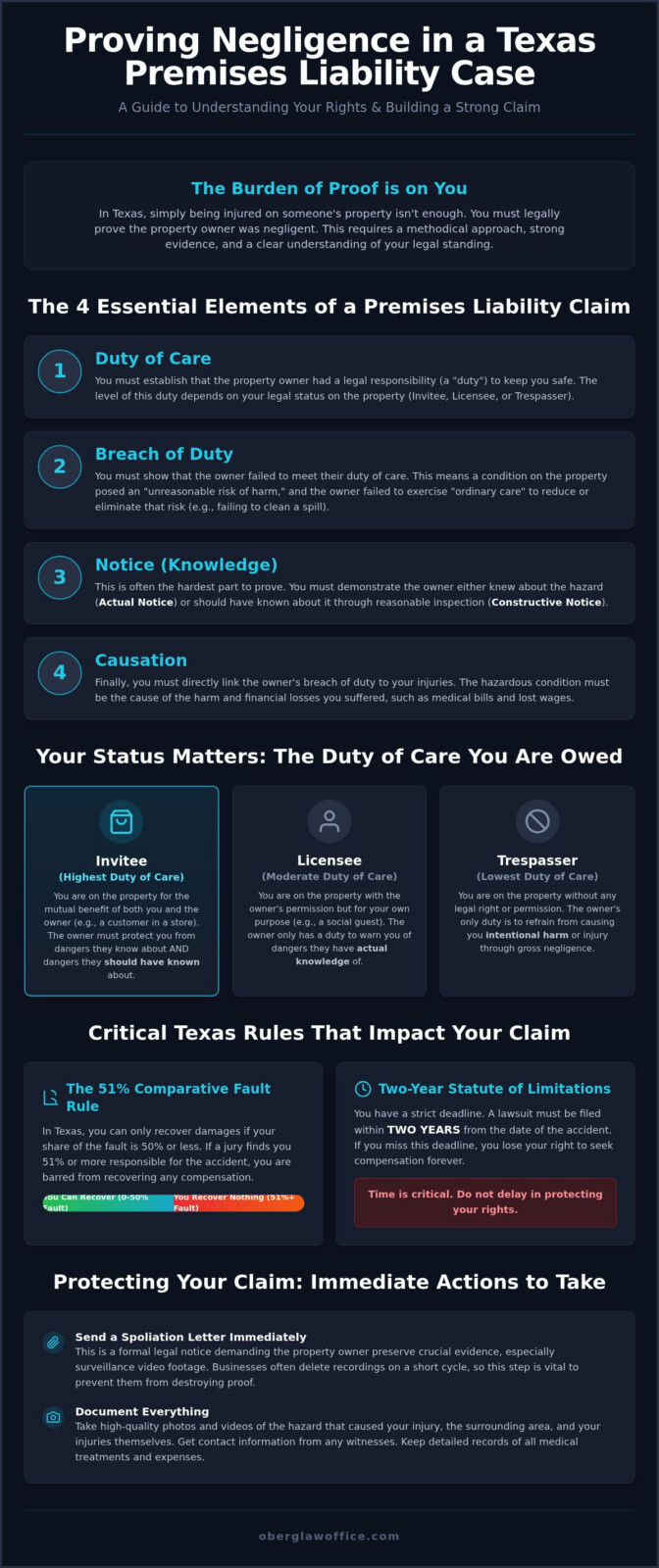
Winning a settlement for your injuries isn’t about luck. It’s about building a structure based on four specific legal pillars. To be successful, we must demonstrate that the property owner failed in their duty to keep you safe. If any of these elements are missing, the insurance company will likely deny your claim. Proving negligence in a premises liability case texas requires a methodical approach to each step of the process.
- Step 1: Duty. We must first establish that the defendant had control over the premises. Under the Texas Civil Practice and Remedies Code Chapter 75, the level of duty owed depends on your reason for being there.
- Step 2: Breach. We show that a condition on the property posed an “unreasonable risk of harm” and the owner failed to exercise ordinary care to reduce or eliminate that risk.
- Step 3: Notice. This is often the most difficult step. We must prove the owner knew about the hazard or should’ve discovered it through a reasonable inspection.
- Step 4: Causation. Finally, we link the owner’s breach directly to your physical and financial injuries. It isn’t enough that you were hurt; we must prove the hazard caused the harm.
Identifying an ‘Unreasonably Dangerous’ Condition
Juries in Texas don’t consider every small puddle or cracked tile “unreasonably dangerous.” A condition must have a high enough probability of causing injury that a reasonable person would’ve fixed it. Examples often include large liquid spills in grocery aisles, rotted wooden stairs, or dim lighting in a parking garage where crime is foreseeable. If you’ve been hurt by a hidden hazard, our specialized legal team can help you document the danger before the owner has a chance to fix it and hide the evidence.
You should also be aware of the “open and obvious” defense. If a hazard was so clear that any reasonable person would’ve seen and avoided it, the owner might argue they had no duty to warn you. We work to counter this by showing why the hazard was deceptive or why your attention was rightfully directed elsewhere.
Proximate Cause: The Link Between Danger and Injury
We use the “but-for” test to establish causation. This means we ask: would your injury have happened but for the hazard? If the answer is no, we have a strong case. We also must prove foreseeability, showing the owner could’ve reasonably anticipated that the hazard would lead to an injury like yours. Proximate cause is the direct link between a property hazard and the resulting harm. By connecting these dots, we ensure the responsible party is held truly accountable for the impact on your life.
Understanding Your Status: Invitee, Licensee, or Trespasser
In Texas, your right to seek compensation isn’t just about the injury you suffered; it’s about why you were on the property in the first place. The law sorts every visitor into one of three categories. Each category carries a different level of legal protection. We often see insurance companies try to “downgrade” a victim’s status to avoid paying a fair settlement. Understanding these labels is a vital part of proving negligence in a premises liability case texas and ensuring your rights are protected.
- The Invitee: You’re a business customer or someone on the property for mutual benefit. This is the highest level of protection.
- The Licensee: You’re a social guest or someone there for your own purposes with the owner’s permission.
- The Trespasser: You’re on the property without any legal right or permission. This offers the lowest level of protection.
Your status acts as a roadmap for the case. It dictates exactly what the property owner was required to do to keep you safe. If you were a shopper at a local grocery store, the owner had a much higher burden than if you were a neighbor stopping by unannounced to borrow a tool.
The High Duty Owed to Invitees
If you were injured while shopping, dining, or staying at a hotel, you were likely an invitee. Texas law requires property owners to go beyond just fixing known problems for invitees. They have an affirmative duty to inspect the premises regularly to discover hidden dangers. If a store manager fails to walk the aisles for hours and misses a leaking freezer, they can be held liable for your fall. In these cases, we don’t just prove they knew about the danger; we prove they should have known about it through reasonable care.
Proving Liability for Licensees and Trespassers
Proving negligence becomes more complex if you were a licensee, such as a guest at a house party. For these claims, you must show the owner had “actual knowledge” of the danger. Unlike the duty owed to invitees, homeowners generally aren’t required to inspect their property for your safety. They only have to warn you about hazards they already know exist, like a loose step or a broken handrail they’ve been meaning to fix.
For trespassers, the duty is minimal. An owner generally only owes a duty not to cause injury willfully or through gross negligence. However, Texas provides a critical exception called the “attractive nuisance” doctrine. This protects child trespassers who are drawn to dangerous features like swimming pools or heavy machinery. If a property owner fails to secure these “attractions” and a child is hurt, the owner can still be held accountable. We are here to help you determine exactly where you stand so we can build the strongest possible path toward your financial recovery.
Proving ‘Notice’: Did the Owner Know About the Hazard?
Proving what was inside a property owner’s mind is often the most challenging part of your case. You don’t just have to show that a danger existed; you must prove the owner had “notice” of it. In Texas, this usually falls into two categories: actual or constructive knowledge. Actual knowledge is straightforward. It means an employee saw the spill, was told about it by a customer, or even created the hazard themselves. Proving negligence in a premises liability case texas often hinges on these small, documented moments of awareness.
When there isn’t a “smoking gun” witness statement, we turn to circumstantial evidence. We look for clues like footprints through a puddle or dirt settled in a liquid spill. These details suggest the hazard wasn’t brand new. The “Time-Notice” rule is a central battleground in Texas courts. We must show the hazard sat there long enough that a reasonable employee should’ve found it during their normal duties. If a grape on a grocery store floor is smashed and dirty, it’s clear it wasn’t dropped seconds ago.
Establishing Constructive Notice
Constructive notice is a legal inference that an owner knew of a danger because of the length of time it existed. To prove this, we look at “proximity” and “conspicuity.” Was the hazard near an employee workstation? Was it large enough to be easily seen? We use surveillance footage and maintenance logs to build a timeline. If a log shows no one checked the area for three hours, that gap in care becomes powerful evidence for your claim. It shows a failure to maintain the “ordinary care” we discussed earlier.
Overcoming the ‘No-Notice’ Defense
Insurance companies love to claim they had “no notice” of a risk. They’ll argue the spill happened seconds before you arrived, making it impossible for them to fix. We fight back by digging into the store’s history. Past incident reports or employee statements can reveal a pattern of ignoring safety protocols. These complex evidence issues are why many victims turn to a slip and fall lawyer in Mesquite to ensure no stone is left unturned.
Don’t let a “we didn’t know” excuse stop you from getting justice. If you’re struggling to find the proof you need to hold a property owner accountable, contact our team today for a free strategy session. We have the experience to uncover the facts that insurance adjusters try to hide.
Gathering Evidence and Taking Action for Your Texas Claim
The moments immediately following an accident are often a blur of pain and confusion. However, the steps you take in those first few hours can make or break your ability to secure a fair settlement. Proving negligence in a premises liability case texas requires concrete evidence that disappears quickly if you don’t act. You should always report the incident to the property manager, take clear photos of the hazard from multiple angles, and gather contact information from any witnesses who saw what happened.
One of the most powerful tools in our arsenal is the “spoliation letter.” This is a formal legal notice we send to the property owner demanding they preserve all surveillance footage and maintenance logs from the day of your injury. Without this, many businesses will simply record over their security tapes within a few days, destroying the very proof you need. In complex cases, we also bring in expert witnesses like safety engineers or floor friction experts to provide scientific proof that the owner breached their duty of care.
Professional inspections and legal advocacy go hand-in-hand when building a strong case to see how these elements are combined to support victims’ rights.
Documentation That Wins Cases
Your medical records serve as the foundation for your claim. They provide an objective timeline of your injuries and the treatment required for your recovery. When you fill out an incident report at a store, be honest but brief. Never sign a document that asks you to admit fault or waive your rights without reading it thoroughly. We also recommend keeping a detailed log of your out-of-pocket expenses and any days you missed work. These records are vital for calculating your total financial damages and ensuring nothing is overlooked during negotiations.
How Oberg Law Office Builds Your Negligence Case
With over 25 years of experience, Gregg Oberg has seen every tactic insurance companies use to deny premises liability & slip and fall claims. We operate on a contingency fee basis, which means you don’t pay us a dime unless we recover money for you. This shared risk ensures we are fully invested in your success from day one. You won’t be passed off to support staff; you’ll work directly with a senior professional who treats you like a neighbor, not a file number. Taking the first step toward restoration is as simple as scheduling a free strategy session with our team to discuss your path forward.
Take the Next Step Toward Justice
Navigating the aftermath of a property injury is exhausting, but you don’t have to carry the legal burden alone. We have explored how your visitor status and the property owner’s knowledge of a hazard are the cornerstones of your claim. Proving negligence in a premises liability case texas requires a meticulous collection of evidence, from surveillance footage to maintenance logs, before it’s lost forever. By acting now, you protect your right to compensation for medical bills and lost wages.
Gregg Oberg brings over 25 years of Texas legal experience to your side, acting as a steadfast protector against insurance companies that want to minimize your pain. You’ll work directly with Gregg, receiving personal attention and a strategy tailored to your specific needs. Our contingency fee model means there are no fees unless we win your case. Schedule your free premises liability strategy session with Oberg Law Office today. We are here to help you move from a state of uncertainty to a feeling of empowerment and restoration.
Frequently Asked Questions
How long do I have to file a premises liability lawsuit in Texas?
You generally have two years from the date of your injury to file a lawsuit in Texas. This deadline is strictly enforced under the Texas Civil Practice and Remedies Code. If you miss this window, you lose your legal right to seek compensation. It’s best to act quickly so we can preserve evidence like security footage before it’s deleted and lost forever.
Can I still win if there were no witnesses to my slip and fall?
Yes, you can still win your case without eyewitnesses. We rely on circumstantial evidence and physical proof to build your claim. This includes things like your medical records, photos of the hazard, and store maintenance logs. Proving negligence in a premises liability case texas often involves showing that a hazard existed long enough that the owner should’ve found it through reasonable care, regardless of who saw you fall.
What happens if I was partially at fault for my own injury in Texas?
You can still recover damages as long as you are 50% or less at fault for the accident. Texas follows a “proportionate responsibility” rule. If a jury finds you 20% responsible for not looking where you were walking, your total settlement will be reduced by that 20%. However, if you are found 51% or more at fault, you are barred from recovering any compensation at all under state law.
Is the property owner responsible if I tripped over an ‘open and obvious’ hazard?
It’s much harder to hold an owner liable for “open and obvious” hazards. Under Texas law, owners generally don’t have a duty to warn you about dangers that are easily seen by a reasonable person. However, exceptions exist if you were forced to encounter the danger or if the hazard was deceptive. We can review the specifics of your accident to see if the “open and obvious” defense can be overcome.
Do I need to prove the owner knew about the spill before I fell?
You must prove the owner had either actual or constructive notice of the hazard. Actual notice means they knew it was there. Constructive notice means the hazard existed for such a long time that they should’ve discovered it through reasonable inspections. Proving negligence in a premises liability case texas often comes down to showing the owner failed their duty to check the property for safety, allowing a dangerous condition to sit for an unreasonable amount of time.
Can I sue an apartment complex for a broken staircase in Texas?
Yes, apartment owners have a legal duty to maintain common areas in a safe condition. This includes staircases, parking lots, and walkways. If the landlord knew about the broken step and failed to fix it, they’ve likely breached their duty of care. We look at your lease agreement and past maintenance requests to prove they were aware of the danger but chose to ignore it, causing your injuries.
What kind of compensation can I recover in a Texas premises liability case?
You can recover both economic and non-economic damages. Economic damages cover tangible losses like medical bills, physical therapy costs, and lost wages from time away from work. Non-economic damages compensate you for pain and suffering, mental anguish, and physical impairment. In rare cases involving gross negligence or malice, you might also be eligible for punitive damages. These are capped under Texas law but serve to punish the defendant for especially reckless behavior that caused your harm.
How much does it cost to hire an attorney for my injury claim?
It costs you nothing out of pocket to hire our firm. We work on a contingency fee basis, which means we only get paid if we successfully recover a settlement or jury award for you. This structure allows you to focus on your physical recovery without worrying about hourly legal fees or upfront costs. We take on the financial risk of the investigation and litigation so you can have access to high-quality legal protection.