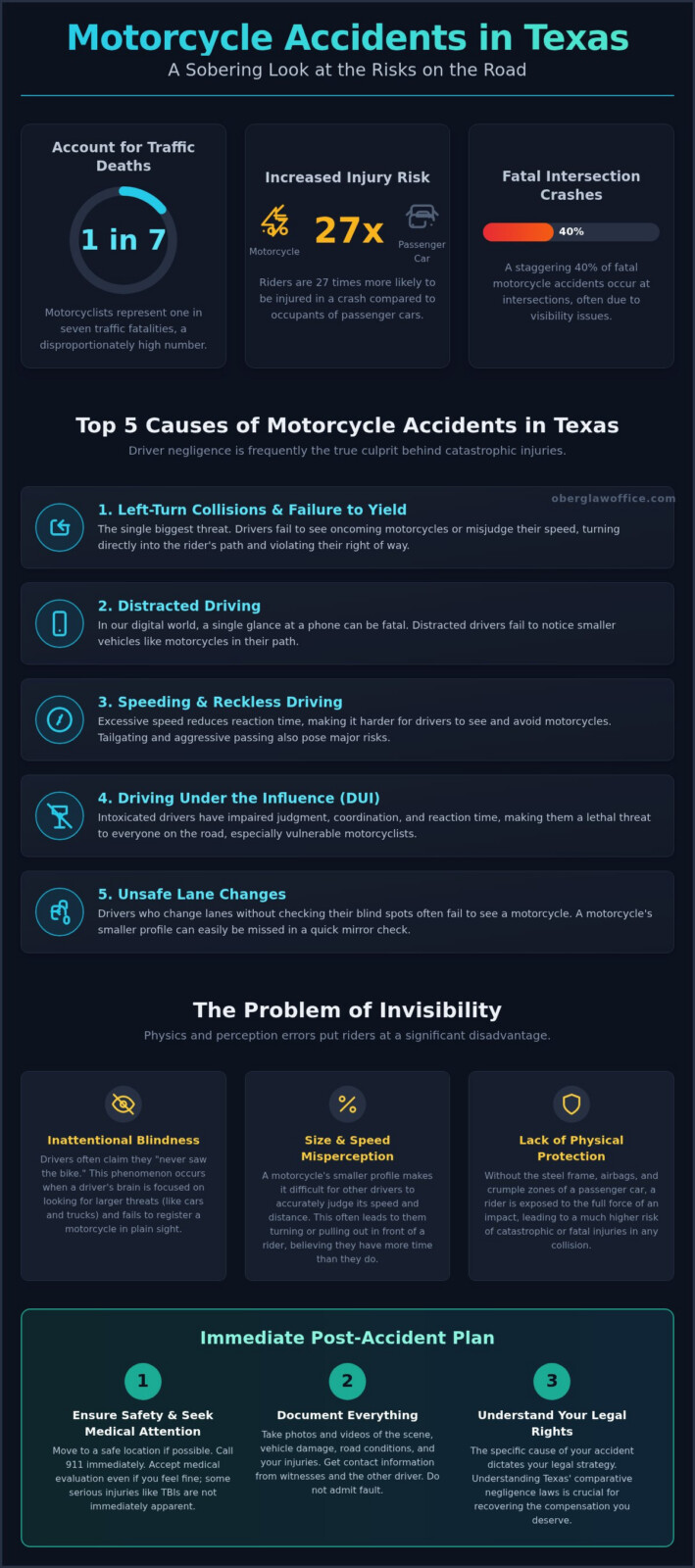
In 2024, Texas motorcyclists accounted for one in seven traffic deaths, even though bikes make up only a tiny fraction of the vehicles on our roads. It’s a sobering reality that you’re 27 times more likely to suffer an injury during a crash than someone in a passenger car. Whether you’re riding on winding country roads or commuting through bustling city streets, the feeling of being invisible to distracted drivers is a constant, heavy burden. We understand the physical and emotional trauma that follows a collision, especially when you’re fighting the common causes of motorcycle accidents in texas like intersection errors or lane sharing mishaps.
You likely feel that insurance companies are ready to blame you by default, but your choice of vehicle shouldn’t strip away your rights. We’re here to promise that you can find a clear path to justice. This guide will show you how the specific cause of your accident dictates your legal strategy for financial recovery. We’ll break down the complexities of Texas comparative negligence laws and provide a plan to help you regain your sense of security. From understanding why 40% of fatal crashes happen at intersections to navigating the 2026 legal landscape, you’ll gain the knowledge needed to move from a state of uncertainty to one of empowerment.
Key Takeaways
- Understand the disproportionate risks on Texas roads, where motorcyclists represent one in seven traffic fatalities despite having fewer vehicles on the road.
- Identify the most common causes of motorcycle accidents in texas, such as driver inattention at intersections, to build a stronger foundation for your legal claim.
- Learn about “inattentional blindness” and how the state’s safety campaigns highlight the frequent failure of drivers to notice riders in their path.
- Discover how the specific cause of your crash directly impacts your ability to prove negligence and recover compensation under Texas law.
- Get a clear plan for immediate post-accident actions, including how to document the scene and identify “hidden” injuries like traumatic brain injuries.
Understanding the Frequency of Texas Motorcycle Crashes in 2026
Texas roads are legendary for their size and speed, but they carry a disproportionate burden for those on two wheels. While motorcycles represent a small portion of registered vehicles, they’re involved in a staggering number of fatal crashes compared to other states. In the context of Texas traffic safety data, a motorcycle accident is defined as any collision involving a rider or passenger that results in property damage, injury, or death. These aren’t just numbers on a TxDOT spreadsheet. They’re our neighbors in Dallas, our friends in Austin, and our family members in Houston. Every statistic represents a child, a spouse, or a friend whose life was changed in an instant. In 2026, the state of Texas motorcycle safety remains a critical public health challenge as fatalities continue to climb despite increased awareness campaigns.
Recent Statistics and Trends
The latest data from TxDOT reveals a 7% increase in motorcyclist fatalities, a trend that demands our attention. This rise is particularly sharp in urban centers where heavy traffic and constant construction create a chaotic environment. You’ll often see these spikes in multi-vehicle collisions at busy city intersections where drivers are distracted or impatient. During National Motorcycle Safety Awareness Month in May, the state makes a concerted effort to educate the public, yet the numbers suggest that awareness alone isn’t enough to curb the common causes of motorcycle accidents in texas. We see more riders on the road than ever, but infrastructure and driver behavior haven’t kept pace with this growth.
Why Riders Are More Vulnerable
Physics simply isn’t on the rider’s side. Drivers often misjudge the speed and distance of a motorcycle because its smaller profile makes it harder for the human brain to track accurately. This “size and speed” perception error means a driver might turn left directly into your path, thinking they have plenty of time. Without the steel frame of a car or the crumple zones of a truck, you’re left exposed to the full force of an impact. This vulnerability is backed by global motorcycle safety statistics, which show that riders face significantly higher risks of catastrophic injury. Many drivers claim they “never saw the bike,” a phenomenon that turns high-speed highways into dangerous ground for even the most experienced riders. Understanding these common causes of motorcycle accidents in texas is the first step toward securing the justice you deserve after a crash.
The Top 5 Leading Causes of Motorcycle Accidents in Texas
Insurance adjusters often search for ways to pin the blame on you the moment a collision occurs. However, official reports frequently show that driver negligence, rather than rider error, is the true culprit behind catastrophic injuries. In our increasingly digital world, distracted driving has become a primary threat. A single glance at a phone can turn a routine commute into a life-altering event. Understanding the common causes of motorcycle accidents in texas is the first step in proving that another’s mistake caused your pain. For 2026, the data points to five primary behaviors: left-turn failures, distracted driving, speeding, intoxication, and unsafe lane changes. These behaviors align with broader NHTSA motorcycle safety guidelines that emphasize the need for drivers to share the road responsibly.
Left-Turn Collisions and Failure to Yield
Cars turning left at intersections remain the single biggest threat to your safety on Texas roads. In these scenarios, a driver often fails to see an oncoming motorcycle or misjudges its speed, crossing directly into the rider’s path. Legally, “Right of Way” dictates that the vehicle traveling straight has priority. Consider a common case: you’re riding through a green light when a driver across the intersection turns left without looking twice. Because they violated your right of way, they are typically liable for the resulting damages. If you’ve been hurt in a similar way, seeking motorcycle accident representation can help you hold that driver accountable.
Speeding and Reckless Driving
Excessive speed kills by stripping away the time needed to react to a hazard. When a passenger vehicle speeds, they often overlook smaller profiles in their mirrors. We also see reckless behaviors like tailgating or aggressive passing that specifically target motorcyclists. It’s also vital to remember that lane splitting remains illegal in Texas. If a crash happens while a rider is filtering through traffic, insurance companies will use that legal status to deny the claim. We focus on showing how the other driver’s speed or aggression was the primary factor in the collision.
Driving Under the Influence (DUI/DWI)
Alcohol remains a persistent factor in crashes, especially in rural parts of the state where law enforcement presence may be thinner. Intoxication severely impairs a driver’s depth perception and their ability to spot a motorcycle’s smaller silhouette. When a drunk driver hits a rider, the legal consequences are severe, often involving both criminal charges and significant civil liability. We stand with victims to ensure that intoxicated drivers face the full weight of the law for the harm they’ve caused. You deserve a partner who understands these common causes of motorcycle accidents in texas and knows how to fight for your restoration.
Visibility Issues and the ‘Look Twice’ Campaign
Drivers often claim they never saw the motorcycle before the impact. This isn’t just an excuse; it’s a psychological phenomenon known as inattentional blindness. Because most drivers look for larger objects like cars or trucks, their brains literally filter out smaller silhouettes. This mental lapse is one of the most persistent and common causes of motorcycle accidents in texas. TxDOT’s “Share the Road: Look Twice for Motorcycles” campaign exists specifically to fight this. It aims to re-train the driver’s brain to scan for bikes at every intersection and before every turn. If a driver tells a police officer they didn’t see you, they’re actually admitting they failed to maintain a proper lookout. In a Texas courtroom, that statement is often a cornerstone of proving negligence rather than a valid legal defense.
Blind Spots and Lane Changes
Modern cars are packed with technology, yet blind-spot monitors frequently fail to detect motorcycles. These sensors are often calibrated for larger vehicle signatures, leaving you vulnerable during a driver’s sudden lane change. Proving a driver failed to check their surroundings requires looking at more than just the basic police report. We look for camera footage or witness statements that show the driver merged without using a turn signal or failed to perform a physical shoulder check. While safety gear is vital for injury prevention, as documented in the Motorcycle Helmet Use in 2023 report, even the best gear can’t stop a crash caused by a driver’s failure to check their mirrors. You shouldn’t have to pay for a driver’s technological over-reliance or simple laziness.
The Role of Road and Weather Conditions
Texas weather can be as unpredictable as the drivers on our highways. Intense summer heat can cause asphalt to soften, while sudden thunderstorms turn dry roads into slick hazards in seconds. These conditions exacerbate the common causes of motorcycle accidents in texas by reducing visibility and traction. Beyond the weather, “silent” hazards like loose gravel, deep potholes, or construction debris can cause even a skilled rider to lose control. When these hazards result from poor road maintenance or a failure to warn of dangers, a municipality or a private contractor might be held liable. We investigate the scene to determine if the road surface itself contributed to your collision, ensuring every responsible party is held to account for your restoration.
How the Cause of Your Accident Impacts Your Legal Claim
The physical facts of your crash serve as the foundation for your legal claim. When we discuss the common causes of motorcycle accidents in texas, we’re really identifying the specific acts of negligence that entitle you to financial recovery. To win your case, you carry the burden of proof. You must show that the other driver had a legal duty to drive safely, breached that duty, and directly caused your injuries. Insurance companies know this well, and they’ll dissect the cause of the accident to find any reason to lower their payout or deny your claim entirely. Under Texas law, you are barred from recovering any financial compensation if the court determines you were 51% or more responsible for the collision.
Proportionate Responsibility in Texas
Texas follows a system of proportionate responsibility. This means that if you’re found partially at fault, your total compensation is reduced by your specific percentage of blame. For example, if a jury decides you were 10% at fault because you were slightly over the speed limit, you can still recover 90% of your damages. Insurance adjusters often lean on the “reckless biker” stereotype to shift blame onto you, even when the driver was clearly at fault. We fight back by using forensic evidence and witness testimony to prove that the driver’s failure to maintain a proper lookout was the true catalyst for the crash.
Texas Helmet Laws and Compensation
In 2026, Texas law continues to require all riders under 21 to wear a helmet. If you’re over 21, you can ride without one only if you’ve completed an approved safety course or carry at least $10,000 in medical insurance coverage. It’s vital to understand that not wearing a helmet doesn’t make you liable for the accident itself. A driver who pulls out in front of you is still the negligent party. However, an insurance company might argue that your choice not to wear a helmet increased the severity of your injuries. This distinction is critical in cases handled by a catastrophic injury lawyer mesquite, where the focus is on securing long-term care for life-altering trauma. We believe that your choice of gear shouldn’t give an insurance company a free pass for their client’s negligence.
If you’re worried about how the details of your crash will affect your legal rights, we’re here to provide the guidance you need. Reach out to us for motorcycle accident representation to discuss your path to restoration.
Taking the Next Steps Toward Recovery and Justice
The moments immediately following a crash are often a blur of adrenaline and confusion. Your first priority must always be your safety and health. If you’re able, move to a safe area away from traffic and call 911. Documenting the scene is vital; take photos of the vehicles, road conditions, and any visible debris. These details help us prove the common causes of motorcycle accidents in texas were at play, such as a driver’s failure to yield or distracted behavior. Even if you believe you’re uninjured, seek medical attention immediately. Traumatic Brain Injuries (TBIs) and internal bleeding often don’t show symptoms right away, and a medical record created shortly after the accident is a cornerstone of your recovery plan.
You’ll likely receive a call from an insurance adjuster within days of the collision. They may seem friendly, but their goal is to protect their company’s bottom line. Never give a recorded statement alone. Adjusters are trained to ask leading questions that can trick you into admitting fault or downplaying your pain. Instead, let us handle the communication. We act as your steadfast protector, ensuring that your words aren’t twisted and that your right to fair compensation remains intact.
Building Your Evidence File
Proving negligence requires more than just your word against theirs. We begin by gathering witness statements, official police reports, and any available surveillance footage from nearby businesses. When you work with a motorcycle accident lawyer mesquite, you’re getting a team that knows how to investigate a scene before the evidence disappears. In complex cases, we bring in accident reconstruction experts who use physics and digital modeling to show exactly how the crash occurred. This level of detail is necessary to counter the common causes of motorcycle accidents in texas that drivers often try to hide, like last-second lane changes or speeding.
The Oberg Law Office Difference
We believe that you deserve more than just a case number. At Oberg Law Office, you won’t be handed off to a junior assistant; you’ll have direct access to Gregg Oberg and our senior legal professionals. With over 25 years of experience in Texas law, Gregg is personally invested in every case we take. Our approach is neighborly and accessible because we know you’re already dealing with enough stress. We’re here to provide clarity and a plan for your restoration, not to add more pressure to your life.
Accessibility is at the heart of our practice. We operate on a contingency fee basis, which is our signature promise to you: we don’t get paid unless we win your case. This ensures that every injured rider has access to high-quality legal representation, regardless of their current financial situation. We’re ready to stand with you against large insurance institutions and fight for the justice you deserve. Schedule your free strategy session with Oberg Law Office today.
Your Path to Recovery and Restored Security
Navigating the aftermath of a crash is overwhelming, but you don’t have to carry that burden alone. We’ve explored how identifying the common causes of motorcycle accidents in texas provides the evidence needed to challenge insurance companies that try to blame the rider. Whether your accident involved a distracted driver or a failure to yield at a busy intersection, understanding your rights under the state’s proportionate responsibility laws is the first step toward justice. You deserve a partner who understands the local roads and the local laws as well as you do.
At Oberg Law Office, we provide the compassionate, neighborly representation you deserve during this difficult time. With over 25 years of Texas legal experience, Gregg Oberg and our senior team are ready to stand as your steadfast protectors against large institutions. We believe in accessibility for every rider, which is why we operate on a no-win, no-fee contingency structure. You can focus on your physical healing while we focus on your financial restoration. Secure your future with a free motorcycle accident strategy session. You’ve faced a significant challenge, but with the right guide, you can move forward with confidence and empowerment.
Frequently Asked Questions
What are the most common causes of motorcycle accidents at Texas intersections?
Left-turning vehicles failing to yield are the most frequent cause of intersection crashes. Drivers often misjudge your distance or speed, leading them to turn directly into your path. These incidents are a primary example of the common causes of motorcycle accidents in texas. We focus on proving the driver violated your right of way by failing to maintain a proper lookout before starting their turn. This evidence is vital for your recovery.
Can I still file a claim if I was partially at fault for the accident?
Yes, you can still recover compensation in Texas as long as you are not more than 50% responsible for the crash. This is known as modified comparative negligence. If a jury finds you were 20% at fault, your final settlement will simply be reduced by that same 20%. We work hard to ensure the insurance company doesn’t unfairly inflate your percentage of responsibility to protect their profits.
How does the Texas ‘Look Twice’ campaign affect my legal case?
The ‘Look Twice’ campaign establishes a clear standard for driver awareness on our roads. While it isn’t a law, we use the campaign’s principles to show that a reasonable driver should have been looking for motorcyclists. If a driver failed to follow these widely publicized safety guidelines, it helps us build a stronger argument that their negligence caused the collision. It reinforces the fact that riders have a right to be seen.
What should I do if a driver says they ‘didn’t see me’ before the crash?
When a driver claims they didn’t see you, they are essentially admitting they failed to keep a proper lookout. This admission is frequent among the common causes of motorcycle accidents in texas. You should document this statement if possible, but avoid arguing at the scene. We use this admission to prove that the driver was negligent by failing to observe the road conditions and other vehicles around them.
Is lane splitting legal in Texas in 2026?
Lane splitting remains illegal in Texas in 2026. This includes filtering through slow or stopped traffic. If you were lane splitting at the time of your accident, the insurance company will likely use this to argue that you were at fault. However, we can still investigate if the other driver’s actions were the primary cause of the crash despite your position on the road. You deserve a fair and honest evaluation.
How long do I have to file a motorcycle accident lawsuit in Texas?
In Texas, the statute of limitations for personal injury claims is generally two years from the date of the crash. If you miss this deadline, you will likely lose your right to seek compensation through the court system. It’s best to start the process early so we can preserve evidence like witness memories and surveillance footage while they are still fresh. Taking action now protects your future legal options.
Will not wearing a helmet prevent me from getting a settlement?
Not wearing a helmet won’t prevent you from seeking a settlement, but it may affect the total amount you receive. If you are over 21 and meet specific safety or insurance requirements, you aren’t legally required to wear one in Texas. However, the defense may argue that your injuries would have been less severe with a helmet. This argument focuses on reducing your damages rather than stripping away the driver’s liability.
What kind of compensation can I recover after a motorcycle accident?
You can recover compensation for both economic and non-economic losses. This includes medical bills, lost wages, and the cost of future care. You are also entitled to seek damages for physical pain, emotional suffering, and the loss of enjoyment of life. Our goal is to secure a settlement that covers every aspect of your recovery so you can focus on moving forward with your life after a collision.