You were staying in your lane and keeping a safe distance, yet you’re the one now facing a mountain of paperwork and a damaged car. It’s deeply unfair to feel like you’re on trial for an accident you didn’t cause, especially when an insurance adjuster tries to downplay the impact as minor. You shouldn’t have to carry the anxiety of being blamed when someone else drifted into your space. Determining who is at fault in a sideswipe accident often feels like a battle of words, but the law provides clear protections for drivers who maintain their right-of-way.
We believe you deserve a knowledgeable guide to help you navigate this confusing process and stand up to large institutions. This guide will show you exactly how insurance companies and legal experts determine liability in these collisions. You’ll learn about the latest 2026 lane-change regulations, how to use vehicle sensor data to your advantage, and which specific pieces of evidence will protect your claim. We’ve designed this resource to move you from a state of uncertainty to a position of empowerment, giving you the tools to pursue a fair settlement for your injuries and restoration.
Key Takeaways
- Learn the specific lane-occupancy rules that determine who is at fault in a sideswipe accident, even when both drivers claim the other drifted.
- Discover why the length and location of a scrape on your vehicle serve as critical forensic evidence that insurance adjusters cannot easily dismiss.
- Find out how to leverage 2026 standards for dashcam footage and lane-departure warning data to provide undeniable proof of your path of travel.
- Identify common merging mistakes and road hazard swerves that shift liability, helping you understand the nuances of right-of-way laws.
- Understand how a steadfast legal protector uses accident reconstruction to overcome the “he-said-she-said” trap and secure your rightful settlement.
Defining a Sideswipe Accident and Why Fault Is Complex
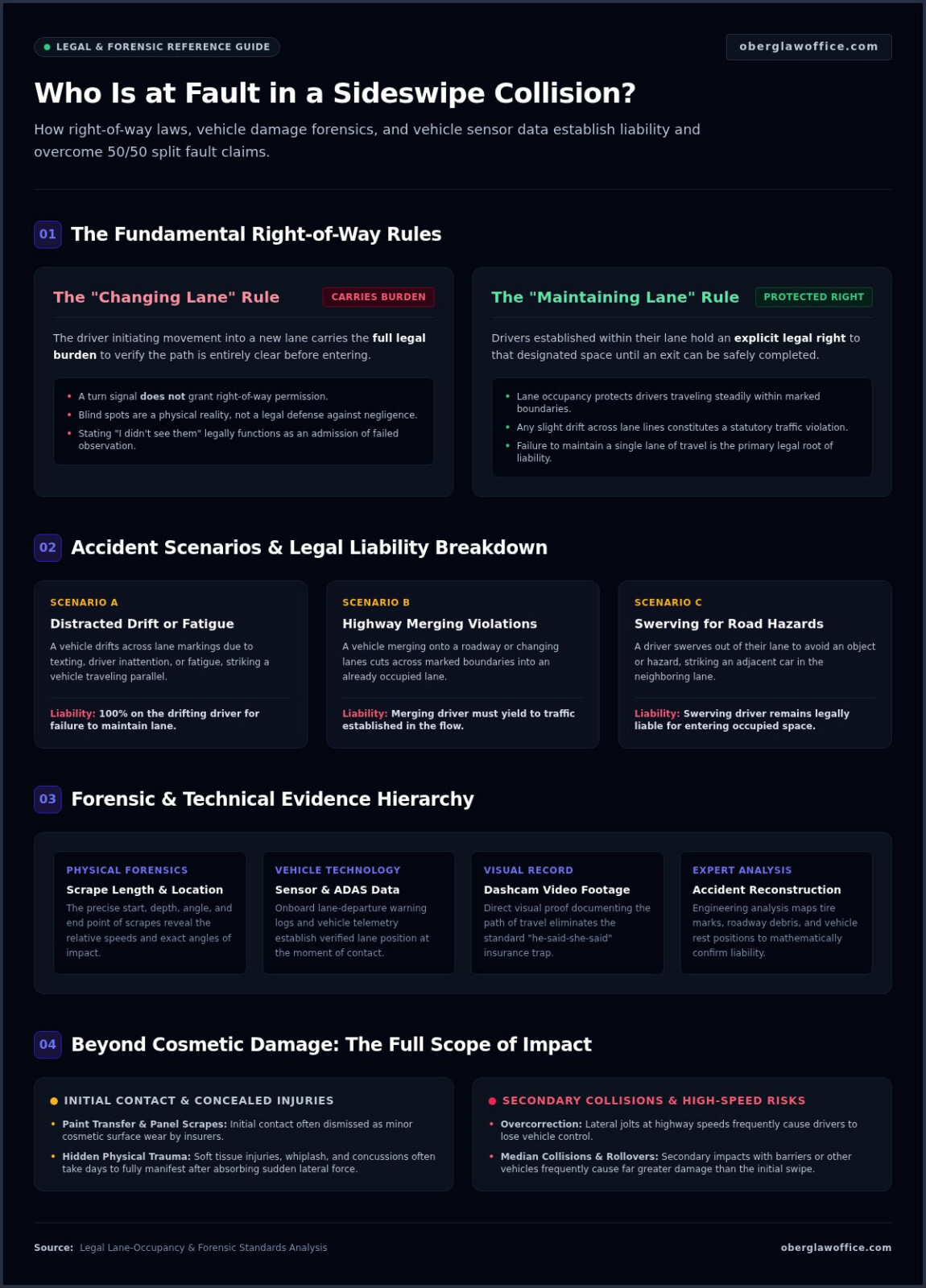
A sideswipe accident occurs when the side of your vehicle makes contact with the side of another vehicle, typically while you’re both traveling parallel in the same direction. It might feel like a minor brush or a loud scrape, but the legal reality is much sharper. Insurance adjusters frequently try to dismiss these cases as “50/50” split liability, claiming they can’t prove who drifted first. This is a common tactic designed to save the insurance company money, not to reflect the truth of what happened on the road. In reality, determining who is at fault in a sideswipe accident comes down to identifying which driver failed their legal duty to stay within their designated boundaries. A sideswipe accident is fundamentally a failure to maintain a single lane of travel.
The Legal Significance of Lane Occupancy
The law is very clear about lane boundaries. If you’re established in a lane, you have a legal right to that space. Any driver wishing to enter your lane must ensure the path is clear and that their movement won’t endanger others. This is a core part of standard right-of-way rules that govern every highway and city street. When a driver fails to check their blind spot or gets distracted by a phone, even a slight drift over the line constitutes a breach of traffic law. We see this often; a driver assumes a blinker gives them permission to move, but the responsibility to change lanes safely rests entirely on the person initiating the move. Determining who is at fault in a sideswipe accident requires looking at who had the right to the pavement at the moment of impact.
Potential Injuries and Damages
Don’t let an insurance company tell you that your accident was just “paint transfer.” While the initial contact might look cosmetic, the physics of a sideswipe are incredibly dangerous. A sudden jolt at highway speeds can cause a driver to overcorrect, leading to a loss of control, a collision with a median, or even a catastrophic rollover. These secondary impacts often cause significantly more damage than the initial scrape. Even if your car stayed on the road, your body absorbed the force of the hit. Hidden injuries like whiplash, soft tissue damage, or concussions can take days to surface. If you’re feeling pain or stiffness, consulting a personal injury lawyer is essential to ensure you aren’t left paying for medical bills that someone else caused. We’re here to help you uncover the full extent of your damages and fight for the restoration you deserve.
Determining Liability: Who Had the Right of Way?
When you’re trying to figure out who is at fault in a sideswipe accident, the law usually looks at two fundamental rules: the “Changing Lane” rule and the “Maintaining Lane” rule. These aren’t just suggestions; they are the legal backbone of road safety. The Changing Lane rule states that the driver initiating a move into a new lane carries the full burden of ensuring that lane is clear. Conversely, the Maintaining Lane rule requires every driver to stay within their marked lines until a move can be made with reasonable safety. If you were hit while staying steadily in your lane, the other driver’s failure to maintain their position is the primary cause of the crash.
Many drivers try to excuse their negligence by claiming they had a blind spot. While blind spots are a physical reality of driving, they don’t provide a legal shield. According to NHTSA’s analysis of lane change crashes, a significant portion of these accidents involve drivers who simply failed to look or misjudged the gap. Whether a driver made an intentional lane change without looking or drifted into you because they were fatigued or checking a text, the result is the same: they breached their duty to you.
Duty of Care and Negligence
In the legal world, negligence is defined as a failure to act with the level of care that a “reasonable person” would use in the same situation. A reasonable driver checks their mirrors, looks over their shoulder, and uses their turn signal. When a driver tells an officer, “I didn’t see them,” they aren’t offering a defense; they’re actually admitting to negligence. It’s an admission that they failed to perform the basic observations required by law. We don’t accept these excuses because your safety depends on every driver’s active attention. If you’re feeling overwhelmed by a driver who refuses to take responsibility, we can help you clear up the confusion about who is at fault in a sideswipe accident during a free strategy session.
Safe Merging Practices and Liability
Merging zones are frequent sites for sideswipe collisions, but the rules of the road remain firm here as well. A driver entering a highway from a ramp has a specific duty to yield to the traffic already on the main road. While highway drivers shouldn’t intentionally speed up to block a merger, the primary responsibility to find a safe gap rests with the person entering. We also see many accidents during multi-lane turns at intersections. A driver in the inside lane might “swing wide” into the outside lane mid-turn, striking the vehicle next to them. This is a clear violation of lane occupancy rights. Even if the impact seems minor, the breach of duty is absolute, and the driver who left their designated path is responsible for the resulting damages.
Common Sideswipe Scenarios and Likely Fault
Accidents rarely happen in a vacuum. The specific context of your crash is the most powerful tool you have when determining who is at fault in a sideswipe accident. While the basic rules of lane occupancy apply, certain scenarios create unique challenges for insurance adjusters and legal teams alike. We’ve seen how these details can change the entire trajectory of a claim.
For instance, consider the “simultaneous merge.” If two vehicles move into a center lane at the same moment from opposite sides, they often share liability under comparative negligence rules. In a dual-lane left turn, fault usually lies with the driver who fails to maintain their specific arc, drifting into the adjacent lane mid-turn. We also see “phantom vehicle” cases, where a third driver cuts you off, forcing you to swerve into another car. In these hit-and-run situations, your own uninsured motorist coverage may become your primary path to restoration since the party that caused the initial swerve is long gone.
The Problem of the Swerving Driver
It’s a terrifying moment when a dog runs into the road or a massive pothole appears. Your instinct is to swerve. However, from a legal perspective, you’re still responsible for the space you enter. If you avoid a hazard but strike a vehicle in the next lane, you’re almost always considered the at-fault party. Understanding the legal definition of right-of-way helps explain why; your duty to avoid hitting a predictable, occupied vehicle outweighs your desire to avoid a road hazard.
Insurance companies rarely accept the “Sudden Emergency Doctrine” as a defense in these cases. This doctrine only applies when a driver is faced with a truly unforeseeable and life-threatening situation where no “reasonable” alternative existed. Most swerves are viewed as reactive rather than necessary, meaning the swerving driver remains liable. If you were hit by a swerving driver, don’t let their excuses stop you from seeking justice.
Sideswiping Parked Vehicles
Hitting a stationary object is one of the few instances where fault is almost absolute. If you’re driving and you sideswipe a legally parked car, you’re at fault. Stationary vehicles don’t have the ability to yield or move, so the entire burden of safety falls on the moving driver. There are rare exceptions if a car is parked illegally in a way that creates a “foreseeable hazard,” such as being left in the middle of a high-speed travel lane at night without lights. If you return to your car to find a fresh scrape and no note, determining who is at fault in a sideswipe accident is the easy part; finding the driver is the challenge. We recommend checking for nearby security cameras or witnesses immediately to identify the responsible party and protect your property.
Proving Fault: Evidence Needed for a Sideswipe Claim
Standing on the shoulder after a collision, you might feel like it’s just your word against theirs. To overcome the “he-said-she-said” trap, you need a mountain of objective proof. Determining who is at fault in a sideswipe accident requires looking past the surface damage to find the technical details that insurance adjusters often ignore. We focus on building a shield of evidence that protects your right to restoration.
Modern vehicles are essentially rolling computers. By 2026, national standards for lane-departure warning data admissibility have become more robust, making Electronic Data Recorders (EDR) a vital resource. This “black box” technology records steering angles, speed, and sensor activation in the seconds before impact. This data provides undeniable proof of which driver failed to keep their vehicle centered, leaving little room for an insurance company to dodge responsibility. Dashcam footage remains the gold standard for proving lane departure, as it captures the exact moment a blinker was used and the precise path of both cars. If you’re struggling to gather this proof, reach out to us to build your case.
Forensic Evidence: Scrapes and Paint Transfer
Scrapes are more than just cosmetic eyesores; they’re a forensic record of the crash. The direction and depth of these scratches can prove which vehicle was moving faster or drifting at a steeper angle. If the other driver denies contact entirely, paint transfer serves as undeniable proof that their vehicle was involved. We also look for debris patterns on the road, such as broken glass or plastic trim. Debris patterns on the road often mark the exact “point of impact” between lanes, acting as a physical map of where the negligence occurred.
The Role of the Police Report
Never let a driver talk you out of calling for help. You must insist on a police report, even if the damage looks minor at first. A responding officer’s neutral assessment carries significant weight, especially if they issue a citation for “failure to maintain lane” or “unsafe lane change.” These citations are powerful tools when determining who is at fault in a sideswipe accident. If the final report contains factual errors or misidentifies you as the lane-changer, don’t panic. You have the right to submit a supplemental statement to correct the record, and we can guide you through that process to ensure the truth is documented.
How a Lawyer Helps When Insurance Denies Your Claim
When an insurance company denies your claim, they’re counting on you to feel defeated and walk away. They often hide behind a “word-against-word” stalemate, claiming their investigation couldn’t determine who is at fault in a sideswipe accident. This is a calculated move to protect their bottom line, not a reflection of the facts. We break this cycle by bringing in professional accident reconstructionists who use physics, tire marks, and forensic evidence to reveal the truth. You don’t have to accept a denial just because the other driver is lying about their lane change.
Fighting Insurance Tactics
Adjusters use specific scripts designed to discourage you from pursuing your rights. They might claim the impact was too “low” to cause injury or dismiss your case because there were no neutral witnesses at the scene. We know these tactics are designed to make you feel powerless. By providing comprehensive car accident representation, we step in as your steadfast protector, handling the aggressive phone calls and the mountain of paperwork. Oberg Law Office uses the threat of litigation to shift the balance of power back in your favor. Insurance companies are far more likely to offer a fair settlement when they realize you have a formidable advocate ready to take them to court.
The Value of a Professional Case Strategy
Navigating “Comparative Negligence” laws is another complex hurdle that requires professional insight. In many states, you can still recover damages even if you’re partially blamed, provided your fault doesn’t exceed a specific threshold, such as the 51% bar rule. We help you understand these rules so you don’t walk away with nothing due to a misunderstanding of the law. Our firm operates on a contingency fee model, ensuring that quality legal help is accessible to everyone. This means you don’t pay us a dime unless we win your recovery. It’s a collaborative partnership where we share the risk because we’re personally invested in your restoration.
A free strategy session is the first step toward clearing up the confusion and reducing your anxiety. It allows you to speak directly with a senior professional who will listen to your story and determine if your claim is worth pursuing. Don’t let an insurance company have the final word on who is at fault in a sideswipe accident. You’ve already been through enough physical and emotional stress; let us take the weight off your shoulders and fight for the tangible results you deserve.
Take Control of Your Recovery Today
You’ve learned that determining who is at fault in a sideswipe accident isn’t just a matter of opinion; it’s a matter of evidence. Whether it involves analyzing paint transfer or securing modern sensor data, the facts are your best defense against insurance companies that try to minimize your pain. You don’t have to carry the burden of these complicated legal rules by yourself. Attorney Gregg Oberg provides personalized attention based on over 25 years of experience fighting for the rights of neighbors just like you.
We believe in your case so strongly that we offer no upfront costs. We only get paid if you win your recovery. This collaborative partnership means you can focus on healing while we handle the formidable institutions standing in your way. Schedule your free legal strategy session with Oberg Law Office today. You have the power to move from uncertainty to restoration, and we’re here to guide you every step of the way.
Frequently Asked Questions
What happens if both drivers claim the other swerved into their lane?
When both drivers disagree, we look to the physical laws of motion and neutral third-party accounts to break the tie. Forensic experts analyze the angle of impact and paint transfer to determine the exact trajectory of both vehicles. If you’re wondering who is at fault in a sideswipe accident during a stalemate, witness statements and nearby business security footage become essential. These objective details often expose the truth, even when the other driver is adamant that you were the one who drifted.
Can I still recover compensation if I was partially at fault for a sideswipe?
You can still recover compensation in most states, provided you aren’t primarily responsible for the crash. Under modified comparative negligence rules used in 22 states, your final award is reduced by your percentage of fault. For example, if you’re 20% at fault, you can still collect 80% of your damages. However, if your fault reaches the 51% bar, you may be barred from recovery entirely. We help you fight for the lowest possible fault percentage to protect your settlement.
Is a sideswipe accident considered a “major” accident for insurance purposes?
Insurance companies categorize accidents based on the cost of repairs and the severity of injuries. With auto repair costs rising 45% over the past five years, even a “minor” scrape often exceeds high-cost thresholds due to advanced safety sensors. If your vehicle requires electronic calibration or structural work, adjusters will treat it as a significant loss. Don’t let them dismiss your claim as minor when your vehicle’s safety and value are clearly at stake during the restoration process.
How do I prove a truck sideswiped me in my blind spot?
Proving a truck is liable requires a deep dive into the driver’s logs and the vehicle’s telematics data. While truckers often cite “no-zones” or blind spots, they still have a professional duty to ensure a lane is clear before moving. We use our experience in Truck Accident Representation to secure electronic records that show steering inputs and braking patterns. These records often prove the trucker initiated a move without verifying your position, regardless of the blind spot excuses they offer.
What should I do if the other driver fled the scene of a sideswipe?
If a driver flees, notify the police immediately to create an official record of the hit-and-run. You should look for nearby traffic cameras or witnesses who might have captured a partial license plate number. In these cases, your own Uninsured Motorist coverage typically acts as the source for your recovery. We guide you through the process of filing a claim against your own policy to ensure your insurance company treats you fairly after a hit-and-run event occurs.
Does dashcam footage always prove fault in a sideswipe accident?
Dashcam footage is a formidable tool, but it isn’t always an automatic win. To prove who is at fault in a sideswipe accident, the video must clearly show the lane markings and the relative positions of both cars. While it captures the “what,” it might not always capture the “why,” such as a third-party distraction. We use this footage alongside other evidence to build a comprehensive narrative that leaves no room for the insurance company to doubt your version of the events.
How long do I have to file a sideswipe accident claim?
The deadline to file a lawsuit, known as the statute of limitations, varies significantly by state, generally ranging from one to six years. For instance, Florida and Louisiana recently set their limits for general negligence at two years, while states like Maine allow up to six years. It’s vital to remember that filing an insurance claim doesn’t pause this legal clock. Missing this deadline means you lose your right to sue forever, so starting your case early is essential for your protection.