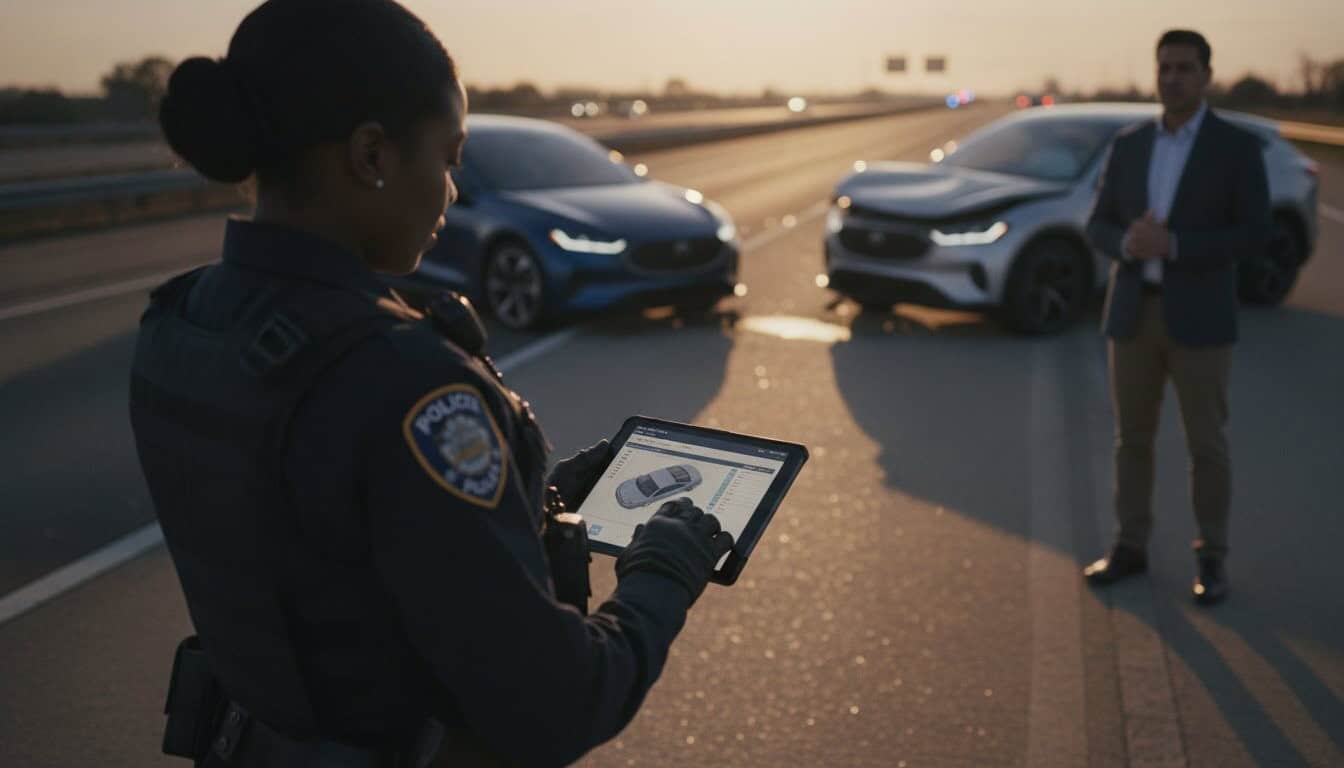
You’re standing on the shoulder of a busy road, still shaken from the impact, while a police officer takes notes on a clipboard. It’s a moment of high anxiety because you know that what’s written in that folder will follow you for months. You might worry that a single mistake by the officer could ruin your chances of recovery, or you may feel confused when an insurance company suddenly disagrees with the official record. Understanding how a police report affects a car accident settlement is the first step toward regaining your peace of mind and securing the justice you deserve.
We know how frustrating it feels to have your side of the story overlooked. With 2026 legal standards like Louisiana’s 51% at-fault bar and Florida’s modified comparative negligence rules, the stakes for accurate reporting are higher than ever. This guide will show you how this critical document influences insurance adjusters, determines fault, and shapes the final value of your injury claim. You’ll learn how to use the report as leverage, the exact steps to correct factual errors, and how to maximize your settlement value even if the officer’s observations seem neutral or incomplete. You don’t have to face the insurance companies alone. We’re here to help you turn that piece of paper into a powerful tool for your restoration.
Key Takeaways
- Understand why insurance adjusters treat the police report as the foundation of your claim. It directly influences the initial financial reserves they set for your recovery.
- Discover how a police report affects a car accident settlement by documenting independent witness statements and critical scene evidence that helps prove your case.
- Learn why an officer’s opinion on fault isn’t the final word. Insurance companies must still perform their own independent investigations regardless of what the report says.
- Identify the specific steps you can take to correct factual inaccuracies in a crash report. You can use your own photos or GPS data to support your side.
- See how a dedicated legal advocate uses the report as a roadmap to locate key witnesses and maximize your final settlement value.
Why the Police Report is the ‘Anchor’ of Your Insurance Claim
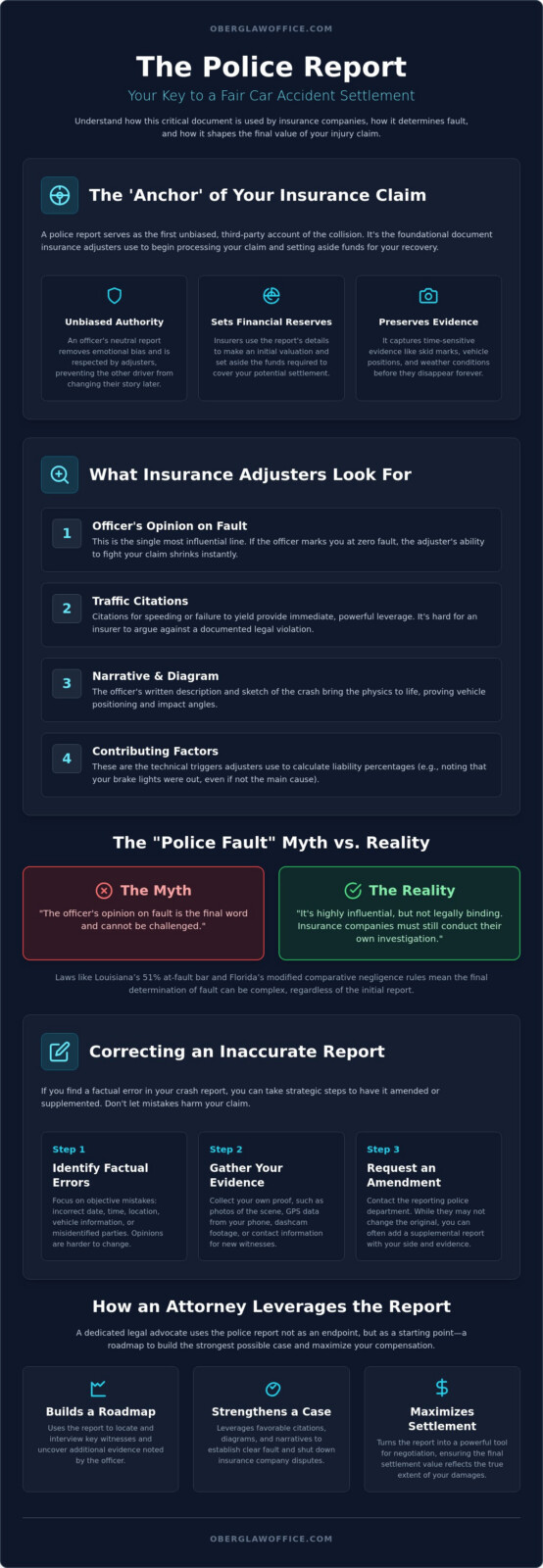
When you’re standing on the side of a road after a collision, everything feels chaotic. Your memories are fuzzy, and the other driver might already be trying to shift the blame. This is where the official crash report becomes your most important ally. It serves as the first unbiased, third-party account of the event, acting as the foundation for your entire recovery process. Insurance adjusters don’t just take your word for it. They use this document to “open the file” and set initial reserves, which are the funds set aside specifically for your claim. If you want to understand how a police report affects a car accident settlement, think of it as a frozen-in-time snapshot. Evidence like skid marks, vehicle positions, and weather conditions can disappear within hours. The report captures these details before they’re gone forever.
The Role of Neutrality in Negotiations
Adjusters are trained to be skeptical. They often view a driver’s statement as self-serving, but they respect the authority of a badge. Having a neutral officer document the “who, what, where, and when” removes emotional bias from the equation. This record is vital for personal injury claims because it prevents the other driver from changing their story three weeks later when they realize their insurance rates might go up. If the report includes a citation against the other driver for speeding or failing to yield, you gain immediate settlement leverage. It’s hard for an insurance company to argue against a legal violation documented by law enforcement. We’ve seen how a clear citation can turn a difficult negotiation into a straightforward path toward fairness.
When a Report is Legally Required
You might wonder if you even need to call the police for a minor “fender bender.” In many states, it’s not just a good idea; it’s the law. For example, in California, you must report an accident within 10 days if property damage exceeds $1,000 or if anyone was injured. In Georgia, the threshold for reporting to police is even lower, at just $500 in damage. Failing to call the police can create a massive headache later. Without an official record, the insurance company might claim the accident never happened or that your injuries were caused by something else. Even a small crash benefits from a formal paper trail to ensure your right to restoration is protected. Don’t risk your future security by skipping this essential step.
An insurance adjuster doesn’t just read your report; they scan it for specific data points that allow them to deny or devalue your claim. Understanding how a police report affects a car accident settlement requires looking past the basic contact info to the specific codes and comments an officer leaves behind. The officer’s opinion on fault is often the single most influential line. If the officer marks you at zero fault and cites the other driver, the adjuster’s ability to fight your claim shrinks instantly. These official traffic crash reports provide the roadmap adjusters use to decide how much money to set aside for your recovery.
Citations for speeding or failure to yield are powerful. They simplify the legal concept of negligence into a black-and-white rule violation. When an officer writes a ticket at the scene, they’re providing you with immediate leverage. This is often the difference between a settlement that barely covers your bills and one that provides true restoration. It’s much harder for an insurance company to argue against a documented law violation than a simple disagreement between drivers.
The narrative section and diagrams are where the physics of the crash come to life. An officer’s sketch of a T-bone impact tells a very different story than a sideswipe. These drawings prove vehicle positioning and impact angles, making it much harder for the other driver to lie about what happened. If you find that the diagram on your report is inaccurate, it’s vital to have a professional review it. You can speak with our team to see how we can help clarify these details for the insurance company.
Decoding ‘Contributing Factors’
Contributing factors are the technical triggers adjusters use to calculate liability percentages. While the other driver might be mostly at fault, an officer might note that your own brake lights weren’t working or that the road was slick from rain. These notes can be used to chip away at your compensation. However, we can also use these sections to identify third-party liability, such as a poorly maintained road or a defective vehicle part, expanding the sources of recovery available to you.
The Importance of Witness Statements
Witnesses are the tie-breakers in every dispute. The report distinguishes between “involved parties” and “disinterested witnesses,” who are people with no stake in the outcome. Their statements are gold. If a bystander saw the other driver texting, and the officer recorded that observation, the “he-said, she-said” deadlock is broken. Officers also often make notes about a witness’s demeanor or credibility, which helps us determine how strong their testimony will be if your case goes to court.
The ‘Police Fault’ Myth: Why an Officer’s Opinion Isn’t the Final Word
Many people believe that if a police officer says the accident wasn’t their fault, the insurance company will automatically cut a check. Unfortunately, it’s not that simple. While we’ve discussed how a police report affects a car accident settlement during the early negotiation phase, you must understand that an officer’s word isn’t the final legal verdict. Officers are trained to identify traffic violations, not to determine who is financially liable for your medical bills and lost wages. They’re looking for broken laws; we’re looking for the resources you need to heal. A “no-citation” crash doesn’t mean you have no case.
One of the most significant hurdles in a legal case is the “Hearsay Rule.” Most people are surprised to learn that in a jury trial, the police report itself is often blocked from being used as evidence. Because the officer usually didn’t witness the crash happen, their written report is considered an out-of-court statement. While the report is a powerful tool to push an insurance adjuster toward a fair settlement, it might never see the inside of a courtroom. This is why we don’t just rely on the paperwork. We build a comprehensive case with experts and evidence that can stand on its own, regardless of what’s in the officer’s folder.
The burden of proof also creates a gap between the report and your recovery. To issue a criminal citation, an officer needs a high level of certainty. In a personal injury lawsuit, however, we only need to show that it’s “more likely than not” that the other driver caused your harm. This lower threshold, known as a preponderance of the evidence, means you can still win your claim even if the officer felt there wasn’t enough proof to write a ticket at the scene.
Civil Liability vs. Criminal Citations
You can still win a settlement even if the other driver didn’t get a ticket. Officers are often busy or arrive late to a scene where evidence has been moved, leading them to leave the “fault” section blank. Under the 2026 modified comparative fault rules in states like Louisiana and Florida, your recovery depends on staying under a specific fault threshold. In Louisiana, you’re barred from recovery if you’re 51% or more at fault; in Florida, the limit is 50%. We dig deeper than the initial report to find the proof that keeps you on the right side of those percentages, ensuring your right to compensation is protected.
Why Insurance Companies Sometimes Disregard Reports
Insurance adjusters are paid to find ways to save their company money. They often look for “policy exclusions,” such as an unauthorized driver or a lapse in coverage, which an officer wouldn’t necessarily know about. They also watch for conflicting statements. If you tell an adjuster something different than what you told the officer at the scene, they’ll use that inconsistency to devalue your claim. Furthermore, the discovery of new evidence like dashcam footage or black box data can completely override an officer’s initial observations. We make sure that any new evidence is used to strengthen your position, not weaken it.
Strategic Steps: How to Correct or Supplement an Inaccurate Police Report
Finding an error on your crash report can feel like a second collision. It’s a heavy burden when you know the official record doesn’t match reality, especially when you realize how a police report affects a car accident settlement. Don’t panic if the document contains mistakes. You have the right to seek corrections, but you must move quickly and strategically. The first step is identifying whether the error is factual or a matter of opinion. Factual mistakes, such as the wrong date, an incorrect license plate number, or a typo in your insurance policy, are usually easy to fix with a simple phone call to the precinct and documented proof.
When the error is more complex, like a mistake in the diagram or a witness statement you know is false, you’ll need to gather your own evidence. Photos from the scene, dashcam footage, or even GPS data from your phone can serve as powerful tools to prove a factual error. We always recommend approaching the reporting officer with a professional and respectful tone. Most officers want the record to be accurate, but they won’t respond well to being challenged aggressively. If you’re unsure how to phrase your request, reach out to our office so we can help you handle these communications safely.
Fact vs. Opinion: What Can Actually Be Changed?
It’s important to distinguish between objective errors and judgment calls. Correcting an objective error, like the make and model of your vehicle, is a standard administrative process. However, changing an officer’s narrative or their determination of fault is much more difficult. Officers are hesitant to admit their professional judgment was wrong once a report is filed. While facts are fixed, opinions are often supplemented rather than erased. This means the original report might stay the same, but your side of the story will be attached as a permanent addendum for the insurance adjuster to see.
Drafting a Supplemental Statement
If the officer refuses to change their original report, you can request to file a “Supplemental Statement.” This is your opportunity to provide a detailed, written account of the accident from your perspective. This statement becomes a permanent part of the official accident file, ensuring that anyone who reads the report also sees your version of events. Before you submit anything, it’s vital to have a personal injury lawyer review your statement. We make sure your words don’t inadvertently create legal pitfalls or accidentally admit to a level of fault that could bar you from recovery under 2026 state laws. Your statement should be clear, factual, and focused on the evidence rather than emotion.
How an Attorney Leverages the Police Report to Maximize Compensation
When you’re dealing with the fallout of a crash, you need more than just paperwork. You need a strategy. We treat the official crash report as a roadmap to find and interview the key witnesses who can validate your story. By cross-referencing the report’s description of the impact with your medical records, we prove that the collision directly caused your injuries. This prevents insurance companies from claiming your pain is a pre-existing condition. We also look for instances where the officer’s conclusions might contradict the physical evidence. If an officer’s narrative doesn’t align with the skid marks or vehicle damage, we’re ready to challenge their expertise to protect your right to recovery.
Insurance adjusters are notorious for “cherry-picking” data. They’ll highlight a single line in the report that suggests you were distracted while ignoring the three paragraphs that prove the other driver was speeding. We step in to aggressively confront these tactics. We ensure the adjuster sees the full picture, not just the parts that save them money. Understanding how a police report affects a car accident settlement means knowing how to fight back when that report is used as a weapon against you. We’ve spent years standing up to large institutions to ensure our neighbors receive the restoration they deserve.
Turning a Neutral Report into a Winning Case
Sometimes a report is vague or lists “no fault determined.” This doesn’t mean your case is over. An experienced car accident lawyer knows how to use accident reconstruction experts to “overrule” a vague police narrative with scientific data. We also look for “hidden” evidence mentioned in the report, such as nearby surveillance cameras or doorbell footage that the officer noted but didn’t actually collect. These details are essential when building a comprehensive demand package that forces the insurance company to take your claim seriously.
The Power of Direct Professional Advocacy
Dealing with complex legal paperwork is exhausting when you’re trying to heal. Having a knowledgeable guide reduces that anxiety and allows you to focus on your physical recovery. We believe in a collaborative partnership, which is why we operate on a contingency-based model. This shared risk means we’re personally invested in your success; we don’t get paid unless you do. You’ll work directly with senior professionals who care about your local community and your specific results. We invite you to engage with us for a free strategy session to review your report. Let us help you move from a state of uncertainty to a feeling of empowerment as we fight for the fairness you deserve.
Take Control of Your Recovery Journey
Navigating the aftermath of a crash is overwhelming, but you don’t have to carry the weight of an inaccurate or confusing report alone. We’ve explored how a police report affects a car accident settlement by acting as a foundational anchor for insurance adjusters, yet it’s vital to remember that an officer’s initial opinion isn’t the final verdict on your case. Whether you need to correct factual mistakes or leverage the report to find hidden evidence, having a steadfast protector by your side makes all the difference. At the Oberg Law Office, we bring over 25 years of experience in Texas law to every case we handle. You won’t be passed off to support staff; you’ll interact directly with senior attorneys who are personally invested in your restoration.
Your path to fairness shouldn’t be a financial burden. We operate on a performance-based structure, meaning there are no fees unless we recover compensation for you. Schedule your free initial strategy session with the Oberg Law Office today to review your specific report and build a roadmap for your future. You deserve a partner who fights for your security with integrity and genuine care. Let’s start the process of making things right together.
Frequently Asked Questions
Is a police report admissible in court in 2026?
Generally, a police report is not admissible as evidence in a jury trial because it’s considered hearsay. Since the officer didn’t witness the crash, their written summary is an out-of-court statement. However, specific facts recorded at the scene, such as vehicle measurements or the location of debris, might be allowed. While the report is vital for settlement negotiations, we build your courtroom case on direct testimony and expert analysis.
Can I still get a settlement if the police report says I was at fault?
You can still recover compensation even if the officer’s report places blame on you. Understanding how a police report affects a car accident settlement involves knowing that insurance adjusters must conduct their own independent investigations. Under 2026 modified comparative fault rules, you can typically seek damages as long as you are not more than 50% or 51% at fault, depending on your specific state’s laws.
How long does it typically take for a police report to be available?
Most police reports are available within five to ten business days after the accident occurs. Larger metropolitan departments may take longer due to high volume, while smaller precincts might have them ready sooner. You can usually obtain a copy through an online portal or by visiting the precinct in person. We recommend checking back regularly to ensure you have the document as soon as it’s finalized.
What should I do if the police officer refused to come to the accident scene?
If an officer doesn’t come to the scene, you should go to the nearest police station to file a counter-report immediately. In 2026, many departments prioritize calls based on injury severity, so minor crashes might not get a response. Take your own photos of the damage, exchange insurance information, and gather witness contacts yourself. This self-filed report creates the necessary paper trail to start your insurance claim.
What happens if the police report is missing a witness I spoke to?
If a witness is missing from the report, you can submit a supplemental statement to include their contact information. It’s common for busy officers to overlook bystanders during the initial chaos. Providing the department with a written addendum ensures that these independent voices are part of the official record. This helps prevent the insurance company from claiming your version of the events is unsupported by outside parties.
Does a police report automatically mean the insurance company will pay?
A favorable police report does not guarantee that an insurance company will pay your claim. The report is a powerful piece of evidence, but adjusters often look for policy exclusions or technicalities to deny coverage. They may also use dashcam footage or black box data that contradicts the officer’s notes. We use the report as a starting point to build an undeniable case for your full restoration.
Can I change a police report after it has been filed?
You can correct factual errors, like an incorrect date or car model, but you generally cannot erase an officer’s opinion on fault. If the officer made a judgment call you disagree with, the best path is to file a supplemental report. This addendum lives alongside the original document. It ensures that your side of the story and any supporting evidence are seen by anyone reviewing the official file.
How much does it cost to get a copy of my car accident police report?
The cost of a police report varies by jurisdiction, but you can typically expect to pay between $5 and $25. Some departments offer digital copies through third-party websites for a small convenience fee. While the cost is minimal, the value this document provides when determining how a police report affects a car accident settlement is immense. It’s an essential investment in protecting your legal rights.