
The adjuster’s aggressive tone isn’t a personality clash. It’s a calculated business tactic designed to make you settle for less than you deserve. You’re likely sitting at your kitchen table, recovering from an accident and feeling bullied by someone who’s supposed to help. It’s deeply frustrating to be treated like a number when you’re in pain. Learning how to deal with an aggressive insurance adjuster is the first step toward regaining your peace of mind and securing the fairness you’re owed.
You deserve to be treated with respect. You have legal rights that protect you from being pressured into a lowball offer. This survival guide will help you identify common manipulation tactics, set firm communication boundaries, and understand your rights under new 2026 regulations like California Senate Bill 876. We’ll walk through how to stop the harassment and when it’s time to let a professional advocate take over the conversation so you can focus on your recovery. From identifying bad faith tactics to understanding the new 30 day claim processing timelines, you’ll find the tools you need to stand your ground.
Key Takeaways
- Protect your claim by moving all communication to written formats and refusing to provide recorded statements that could be used against you.
- Learn how to deal with an aggressive insurance adjuster by recognizing the “Quick Cash” trap designed to settle your case before your injuries are fully diagnosed.
- Identify common verbal traps and broad medical authorization requests that adjusters use to undermine your privacy and settlement value.
- Understand the professional escalation process for when an adjuster acts in bad faith or refuses to acknowledge critical evidence.
- Recognize the “negotiation wall” and know when it is essential to partner with a personal injury attorney for complex or high-value claims.
Recognizing Aggressive Insurance Adjuster Tactics as a Financial Strategy
When you pick up the phone and hear a sharp, demanding voice on the other end, it’s easy to feel like you’ve done something wrong. You haven’t. An aggressive insurance adjuster is a professional trained to minimize corporate liability using psychological pressure. They aren’t there to be your friend or your neighborly helper. They are risk managers whose primary goal is to protect their company’s bottom line by paying you as little as possible.
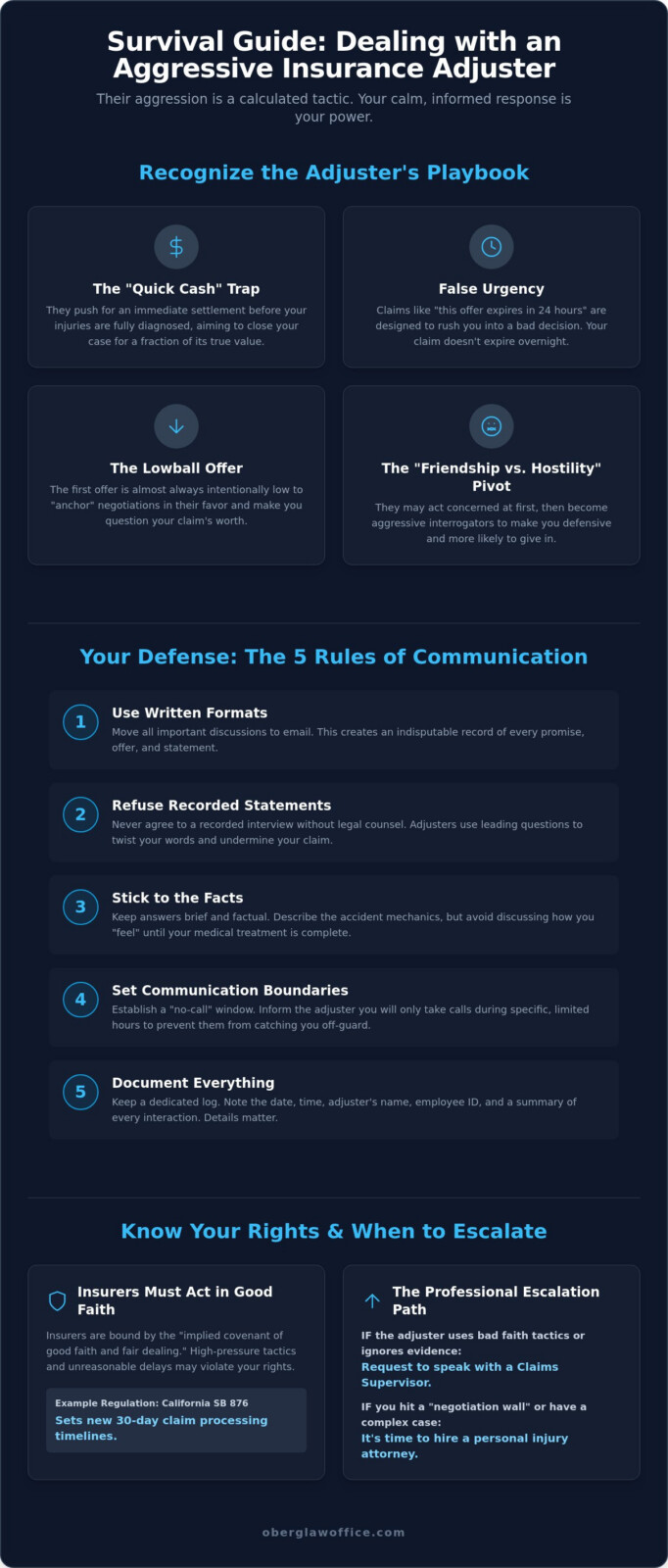
One of the most dangerous moves is the “Quick Cash” trap. Adjusters often push for an immediate settlement within days of an accident, often before you’ve even seen a specialist or received a full diagnosis. They know that if they can get you to sign a release while you’re still in shock, they can save thousands of dollars. This is often paired with “False Urgency,” where they claim an offer is only available for 24 hours. In reality, your claim doesn’t expire in a day. They simply want to prevent you from learning how to deal with an aggressive insurance adjuster or speaking with a legal professional who knows the true value of your case.
You might also experience the “Friendship vs. Hostility” pivot. This happens when an adjuster starts off sounding deeply concerned about your recovery, only to suddenly become an aggressive interrogator the moment you ask for a fair settlement. This shift is a tactic to make you feel defensive and more likely to give in. Under the implied covenant of good faith and fair dealing, insurers are supposed to act honestly. When they use these high-pressure maneuvers, they are often toeing the line of bad faith to force a quick, cheap resolution.
The Psychology of the Lowball Offer
The first offer you receive is almost always intentionally low. It’s designed to reset your expectations and “anchor” the negotiation at a number that benefits the insurance company. Anchoring is a psychological tactic used to fix a low value in the claimant’s mind so that any subsequent small increase feels like a victory. By starting with an insulting figure, they try to make you feel like your case is weak, making a slightly higher, but still unfair, offer seem like a generous compromise.
Performance Metrics: Why Aggression Pays for the Adjuster
It’s helpful to remember that an adjuster’s behavior is business, not personal. They are often evaluated on specific performance metrics like “claim leakage,” which refers to any money paid out that the company thinks could have been avoided. They are also judged on settlement speed. The faster they close a file for a low amount, the better their performance review looks. Aggression is simply a tool they use to hit these corporate targets. Understanding that their hostility is a financial strategy can help you stay calm and focused on your own physical and financial recovery.
The Professional Communication Protocol: 5 Rules for Every Interaction
Taking control of the conversation is the most effective way to protect your claim. When you know exactly how to deal with an aggressive insurance adjuster, their pressure tactics lose their power. You aren’t required to be at their beck and call, nor are you required to endure verbal bullying while you’re trying to heal. By following a strict communication protocol, you move the interaction from an emotional battlefield to a professional transaction.
- Rule 1: Use written formats. Move all substantive discussions to email or certified mail. This creates an indisputable record of every promise, threat, or offer made by the company.
- Rule 2: No recorded statements. Never agree to a recorded interview without a lawyer. Adjusters are experts at phrasing questions that lead you into admitting fault or downplaying your pain.
- Rule 3: Stick to the mechanics. Keep your answers brief and factual. Describe the accident itself, but do not discuss your health or how you’re “feeling” until you’ve reached maximum medical improvement.
- Rule 4: Establish a “No-Call” window. Tell the adjuster you’re only available for calls during specific hours. This prevents them from catching you off guard while you’re resting or at a doctor’s appointment.
- Rule 5: Document everything. Keep a dedicated notebook for your claim. Log every interaction, the adjuster’s name, their employee ID number, and a summary of what was said.
If you find that an adjuster is repeatedly violating these boundaries or acting unprofessionally, you have the right to file a complaint with the Department of Insurance. This official step signals that you understand the regulations and won’t be easily intimidated.
Why Written Communication is Your Best Defense
Phone calls are the adjuster’s preferred weapon because they leave no trail. They can “misremember” a verbal statement or claim they never made a specific promise. Emails provide a timestamped, permanent record that holds significant legal weight. If you’re currently being hounded by phone, use this template: “I prefer to have a clear record of our conversation for my files. Please send all future questions and settlement offers to my email address.” If you find the constant back-and-forth overwhelming, consulting with a dedicated legal team can ensure your responses are handled with professional precision.
Setting Boundaries with “The Script”
You don’t have to be a legal expert to stand your ground; you just need a script. When an adjuster becomes pushy, use the “Broken Record” technique. Simply repeat: “I am not comfortable discussing that at this time, but I will provide a written response soon.” If they become verbally abusive, it’s perfectly acceptable to end the call. Say clearly: “This conversation is no longer productive. I am hanging up now, and we can continue this discussion via email.” This keeps you in the driver’s seat and prevents you from making emotional concessions during a stressful moment.
Countering Common Manipulation Techniques and Verbal Traps
“How are you feeling today?” It sounds like a polite greeting from a neighbor. In the context of an insurance claim, it’s a diagnostic trap. If you reply with a reflexive “I’m fine” or “I’m doing okay,” the adjuster will note that you aren’t actually injured. Later, when you seek compensation for a herniated disc or chronic whiplash, they’ll use your own polite reflex to deny your claim. Learning how to deal with an aggressive insurance adjuster means recognizing that every question they ask has a financial motive behind it.
Beyond the friendly greeting, adjusters often use the “Comparative Fault” shift to trick you into admitting partial blame. They might ask leading questions like, “Was there anything you could have done to avoid the impact?” If you answer “I suppose I could have braked harder,” they’ll slash your settlement by a percentage of fault. They also rely on “Pre-existing Condition” deflections. This is where they dig through your past to blame your current car accident pain on a minor sports injury or a doctor’s visit from ten years ago. It’s a calculated move to devalue your current suffering.
Declining the Recorded Statement Safely
You might feel pressured to give a recorded statement immediately after the accident. It’s vital to know that there is no law requiring you to provide a recorded statement to the other party’s insurance company on the spot. You can say “no” without sounding guilty or uncooperative. Simply state: “I am happy to cooperate, but I will not be giving a recorded statement until I have consulted with my team and fully understood my injuries.” Adjusters use leading questions during these recordings to create contradictions in your story, which they will later use to destroy your credibility.
Protecting Your Medical Privacy
One of the most invasive tactics is the “Medical Authorization” overreach. Adjusters often send a “General Release” form that gives them permission to look at every medical record you’ve ever had. They aren’t looking for accident details; they’re looking for reasons to deny your claim. You should only ever sign a “Limited Medical Release” that is strictly tied to the date and injuries of the current accident. Never sign a blank authorization form. Before you share any records, it’s a good idea to consult a personal injury legal guide to ensure you aren’t signing away your right to privacy. Protecting your history is just as important as documenting your current recovery.
Escalation Paths: When and How to Contact a Claims Supervisor
Communication boundaries are a great start, but sometimes an adjuster refuses to play by the rules. If you find yourself hitting a wall, it’s time to change your strategy. Knowing how to deal with an aggressive insurance adjuster often means knowing when to stop talking to them and start talking to their boss. You have the right to request a claims manager or supervisor if you feel your case is being mishandled or if the adjuster’s behavior has become unprofessional. Learning how to deal with an aggressive insurance adjuster involves recognizing when the person across the table is no longer acting in good faith. You don’t have to tolerate a hostile environment while you’re trying to heal.
When you make this request, keep your tone neutral. Say something like, “I appreciate your time, but I feel we’ve reached a point where a fresh perspective is needed. Please put me in touch with your supervisor.” This approach avoids escalating the conflict while firmly asserting your rights. If the hostility continues, you can even request that a new adjuster be assigned to your file. If the company still refuses to act fairly, your next step is involving the State Department of Insurance or the Insurance Commissioner to review their conduct. In California, for example, 2026 regulations like AB 3275 and SB 876 have established strict timelines and penalties to ensure consumers aren’t left in the dark.
The “Bad Faith” Checklist
Identifying bad faith is about looking at objective facts rather than just feelings. Bad faith is a legal term referring to an insurer’s failure to fulfill its contractual obligations. Use this checklist to see if your claim is being handled improperly:
- Failing to acknowledge receipt of your claim within 15 calendar days.
- Taking more than 40 calendar days to accept or deny a claim after you’ve provided proof of loss.
- Ignoring evidence you’ve provided, such as medical records or witness statements.
- Making a settlement offer that is significantly lower than the documented damages without explanation.
- Using threatening language or “false urgency” to pressure you into a quick settlement.
Documenting these instances creates significant leverage for a higher settlement because it shows the insurer you’re prepared to hold them accountable. It moves the conversation from your “opinion” of their behavior to a documented violation of industry standards.
Drafting the Formal Complaint Letter
If a phone call to a supervisor doesn’t work, put it in writing. A formal complaint letter should be sent via certified mail and include your claim number, a timeline of specific misconduct, and a clear deadline for a response, such as five business days. Staying professional and neighborly while remaining firm is key. You aren’t attacking the person; you’re documenting a failure in their professional process. Being an advocate against large insurance companies often requires this paper trail to prove that you’ve exhausted every internal option. If you’re tired of the runaround and want someone to take over these difficult conversations, speak with a dedicated legal advocate to ensure your rights are protected.
Knowing When to Stop Negotiating and Hire a Personal Injury Attorney
There comes a point in every difficult claim where personal grit and communication scripts reach their limit. You might hit what we call the “Wall.” This is the moment when the adjuster stops moving on their offer, refuses to acknowledge new medical evidence, or simply stops returning your calls altogether. When you’ve exhausted every tip on how to deal with an aggressive insurance adjuster and the company still refuses to be fair, the burden shouldn’t stay on your shoulders. You have a right to step back and let a professional take over the fight so you can focus entirely on your physical recovery.
Handling complex cases alone is particularly risky. If you’re facing a permanent disability, a catastrophic injury, or a high-value claim, the insurance company will fight even harder to protect its profits. They know that an unrepresented claimant is often unaware of the full future costs of their care. By hiring an attorney, you gain a powerful buffer. The moment a lawyer is involved, the insurance company is legally prohibited from contacting you directly. The harassing phone calls and high-pressure emails stop immediately, moving instead to your legal team’s office. This shift is often the only way to ensure you receive a settlement that truly covers your long-term needs.
The Value of an Attorney in High-Conflict Claims
Adjusters often change their tune the second a “letter of representation” hits their desk. They realize they can no longer use psychological traps or false urgency to settle the case for pennies. A law firm brings investigative resources that an individual simply doesn’t have, such as accident reconstruction experts and medical specialists who can testify to the true extent of your injuries. At the Oberg Law Office, we pride ourselves on a personal touch. You won’t be passed off to support staff; you’ll have direct access to senior professionals who are personally invested in your restoration and security. We operate on a contingency fee basis, which means there are no upfront costs to you. We share the risk, and we only get paid if we win your case.
Your Free Strategy Session
If you’re unsure whether the adjuster’s latest offer is fair, a free strategy session is a low-pressure way to gain clarity. Think of it as a way to “test” the insurance company’s numbers against professional experience. We can help you understand how to deal with an aggressive insurance adjuster by evaluating their tactics and determining if they’re acting in bad faith. This consultation is a collaborative partnership designed to move you from a state of anxiety to a feeling of empowerment. You don’t have to navigate this complicated legal landscape alone. Contact Oberg Law Office for a free consultation today and let us stand as your steadfast protector against the insurance company’s tactics.
Take Control of Your Recovery Today
You now have a clear roadmap for protecting your settlement from corporate pressure. By recognizing that aggression is a financial strategy rather than a personal conflict, you can remain calm and focused. You’ve learned the importance of keeping a paper trail and the specific verbal traps to avoid during those high-pressure phone calls. Knowing how to deal with an aggressive insurance adjuster is ultimately about setting firm boundaries so you can heal in peace.
If the insurance company continues to ignore your rights or refuses to offer a fair settlement, you don’t have to face them alone. Attorney Gregg Oberg has over 25 years of experience fighting for families and standing up to big institutions. When you partner with us, you’ll communicate directly with Gregg; you won’t be passed off to support staff. We operate on a performance-based structure, meaning there are no fees unless we win your case. We are here to act as your shield and your guide through this difficult time.
You deserve a partner who is personally invested in your restoration. Get Your Free Accident Strategy Session Now and let us take the burden off your shoulders. You have the strength to see this through, and we have the experience to ensure you aren’t treated like a number.
Common Questions About Handling Insurance Adjusters
Why is my insurance adjuster being so rude and aggressive?
Your adjuster’s aggression is a calculated business tactic designed to pressure you into a quick, low settlement. It isn’t personal; it’s a way for them to meet corporate performance metrics regarding “claim leakage” and settlement speed. By making you feel small or disrespected, they hope you’ll give up and accept whatever offer they put on the table just to end the stress.
Can I request a new insurance adjuster if we don’t get along?
Yes, you have the right to request a new adjuster if the current one is hostile or unprofessional. You should contact the insurance company’s claims department and ask to speak with a supervisor. Calmly explain that the current communication style is preventing a productive resolution of your claim. A supervisor can often reassign the file to a different representative to reset the process.
Is it a bad idea to give a recorded statement to the insurance company?
It is generally a bad idea to provide a recorded statement without legal guidance. Adjusters are experts at using leading questions to find contradictions in your story or trick you into admitting partial fault. You aren’t legally required to give a recorded statement to the other party’s insurer on the spot, and doing so can significantly damage the value of your claim.
What should I do if the insurance adjuster ignores my phone calls?
If your calls are being ignored, move all communication to written formats like email or certified mail. This creates a permanent paper trail that the company cannot easily deny. In California, regulations like the Fair Claims Settlement Practices Act require insurers to acknowledge your communications within 15 calendar days. Documenting their silence is essential if you eventually need to prove the company is acting in bad faith.
How do I know if an insurance adjuster is lying to me about my claim?
You can spot potential lies by cross-referencing the adjuster’s statements with your actual policy language and state laws. If they claim an offer is “final” or that your time has run out without providing proof, they may be using a verbal trap. Learning how to deal with an aggressive insurance adjuster involves verifying every claim they make against the documented facts of your coverage and rights.
Should I accept the first settlement offer if I need the money now?
Accepting the first offer is almost always a mistake because it is usually a “lowball” figure designed to anchor the negotiation. You might need the funds immediately, but settling before you have a full medical diagnosis can leave you paying for future treatments out of your own pocket. It’s better to wait until your doctors have a clear picture of your long-term recovery needs.
What happens if I tell the adjuster I am hiring a lawyer?
Telling an adjuster you’re hiring a lawyer usually stops the harassment immediately. Once you have legal representation, the adjuster is legally prohibited from contacting you directly. All negotiations move to your attorney’s office, which signals to the insurance company that you won’t be bullied. This shift often forces them to take your claim more seriously and offer a fairer settlement value.
Can an insurance adjuster deny my claim if I refuse to sign a medical release?
An adjuster cannot deny your claim simply because you refuse to sign a broad, general medical release. While they are entitled to see records relevant to the accident, they don’t have the right to dig through your entire life history. Understanding how to deal with an aggressive insurance adjuster means knowing you can insist on a “limited” release that only covers the specific injuries and timeframe of your current accident.