
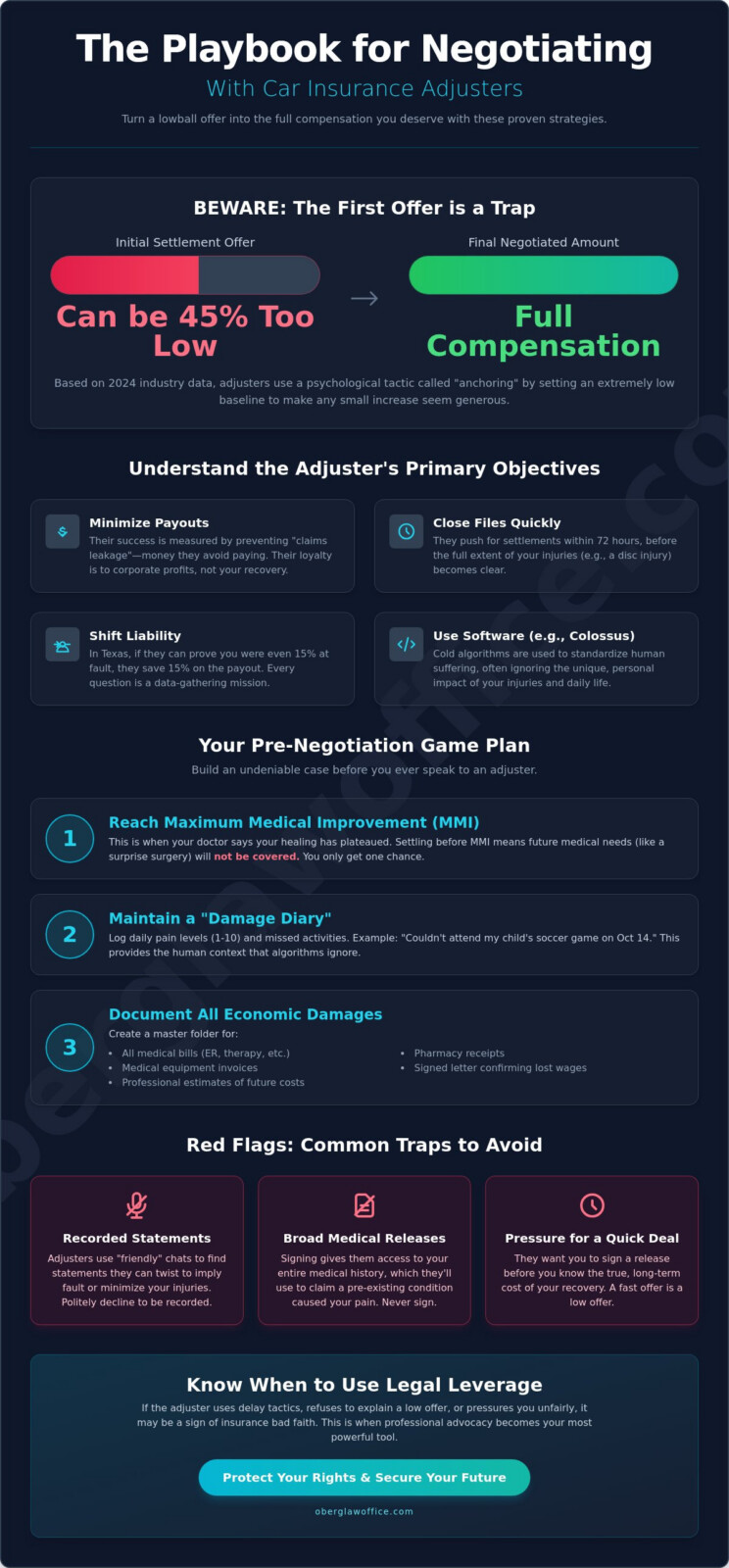
Did you know that according to 2024 insurance industry benchmarks, initial settlement offers can be up to 45% lower than the final negotiated amount? You’re likely feeling the intense pressure to sign a release form today just to get your medical bills covered and move on. It’s normal to feel overwhelmed when a multi-billion dollar corporation pushes for a quick signature while you’re still recovering. We know you want to protect your family and find justice after a traumatic wreck on a Texas highway.
This guide provides the specific strategies you need to learn how to negotiate with car insurance adjuster professionals to ensure your voice is heard. You don’t have to worry about saying the wrong thing or being ignored by a distant claims office. We’ll break down the exact formulas used to calculate “pain and suffering” and outline the evidence needed to secure a settlement that covers your long-term needs. You’ll gain the clarity and confidence to turn a lowball offer into the full compensation you deserve.
Key Takeaways
- Learn how to negotiate with car insurance adjuster experts by understanding their goal of minimizing payouts and using evidence to protect your rights.
- Discover why reaching Maximum Medical Improvement and maintaining a “Damage Diary” are essential steps to valuing your claim accurately before you begin talks.
- Protect your recovery by identifying common traps, such as recorded statements and broad medical releases, that adjusters often use to limit your compensation.
- Master the professional strategies needed to draft a powerful demand letter that commands respect and establishes a firm foundation for your settlement.
- Identify the critical warning signs of insurance bad faith and learn when using legal leverage is the best way to secure the justice your family deserves.
Understanding the Role of the Car Insurance Adjuster
After an accident in Mesquite, your phone will likely ring within 24 to 48 hours. The person on the other end might sound like a concerned neighbor, but they are a professional negotiator hired to protect a multi-billion dollar corporation. They represent the insurance company’s bottom line, not your personal recovery. To protect your family’s future, you must recognize that the adjuster’s success is measured by a metric called “claims leakage.” This is the industry term for any money paid out that the company could have avoided through aggressive negotiation or technical denials.
It is vital to distinguish between your own insurance representative and a “third-party” adjuster. While your own company has a contractual duty to act in good faith, the other driver’s adjuster owes you nothing. They aren’t your guide or your friend. Understanding the Insurance Claim Process reveals that their primary loyalty is to their employer’s profitability. Learning how to negotiate with car insurance adjuster staff begins with the realization that every “friendly” question is a data-gathering mission designed to lower your claim’s value.
The Adjuster’s Primary Objectives
Adjusters work under intense pressure to close files quickly. They often push for a settlement within the first 72 hours after a crash. This happens because they want you to sign a release before you realize that “minor” neck stiffness is actually a disc injury requiring months of physical therapy. They also look for any opportunity to shift liability. In Texas, if they can convince a jury you were even 15% at fault, the company saves 15% on the final payout. Many modern adjusters use software like Colossus to process claims. This program uses cold algorithms to standardize human suffering, often ignoring the specific ways an injury has disrupted your daily life and family responsibilities.
Why the First Offer is Almost Always a Lowball
The first number an adjuster mentions is rarely based on the full reality of your medical bills or lost wages. They use a psychological tactic called “anchoring.” By setting an extremely low baseline, they make any subsequent small increase look like a generous concession. They are also testing your resolve and your knowledge. If you don’t know the true market value of your totaled vehicle or the long-term costs of your treatment, they will capitalize on that uncertainty. A lowball offer is a strategic starting point meant to protect corporate profits. When you understand how to negotiate with car insurance adjuster professionals, you see these offers for what they are: a test of your patience and your legal awareness.
Preparation: How to Value Your Claim Before Negotiating
You cannot effectively learn how to negotiate with car insurance adjuster representatives until you have a clear, evidence-based number in mind. This process begins with patience. You must reach Maximum Medical Improvement (MMI) before sending a demand letter. MMI occurs when your doctor determines your healing has plateaued; it is the point where future medical needs become predictable. If you settle in January 2026 for an injury that requires a surprise surgery in June 2026, the insurance company will not pay another dime. You only get one chance at a final settlement.
While you recover, start a Damage Diary. This is a daily log where you record your pain levels on a scale of 1 to 10 and list specific activities you can no longer perform. Recording that you were unable to attend your child’s soccer game on October 14 or that you needed help getting dressed for three weeks provides the human context adjusters often ignore. For a baseline of what to expect during this early phase, you can consult this official guide on accident claims to ensure your initial documentation is solid.
Documenting Economic Damages
Economic damages are the tangible financial losses that have a specific price tag. You should create a master folder containing every medical bill, from the initial ER visit to physical therapy sessions in Mesquite. Do not forget to include pharmacy receipts for pain medication and invoices for any medical equipment like crutches or braces. To recover 100% of your lost income, obtain a signed letter from your employer. This letter must verify your hourly wage, the 40 or more hours of work you missed, and any performance bonuses you lost because of your absence. If your doctor anticipates you will need treatment for the next 24 months, include a professional estimate of those future costs to protect your long-term financial health.
Quantifying Pain and Suffering
Pain and suffering is a legal right to compensation for your reduced quality of life; it recognizes that your trauma is worth more than just the sum of your medical bills. To calculate this, adjusters often use the multiplier method, multiplying your economic damages by a number between 1.5 and 5, or the per diem method, which assigns a daily dollar amount to your recovery period. You can make these numbers harder to dismiss by providing “before and after” stories from family members who have witnessed your struggle. Use clear photos of your injuries from the day of the accident and throughout the healing process. If the math feels confusing or the adjuster is devaluing your experience, a trusted local injury attorney can help you calculate a figure that truly reflects your loss.
Knowing how to negotiate with car insurance adjuster teams requires standing firm on these valuations. When you approach the table with a precise number backed by 50 pages of documentation, you signal that you are prepared for a serious discussion rather than a quick, lowball settlement.
Step-by-Step Strategies for Effective Negotiation
Learning how to negotiate with car insurance adjuster professionals starts with understanding that they’re looking at a spreadsheet while you’re looking at your life. You need to bridge that gap with cold, hard facts. Your first move is to send a demand letter that sets a high but justifiable price for your recovery. This isn’t a random number. It’s a figure backed by every receipt, medical bill, and repair estimate you’ve gathered since the accident.
Staying calm is your greatest weapon during these phone calls. Adjusters are trained to look for signs of desperation or anger. If you lose your temper, you give them leverage to claim your judgment is clouded. If they present a lowball offer, don’t just feel insulted. Ask them to justify it. Force them to cite specific facts from the police report or medical records rather than hiding behind vague phrases like “company policy” or “regional averages.”
- Never accept a first offer on the spot. Even if it sounds better than expected, tell them you need to review it with your family.
- Get every offer in writing. Oral promises don’t hold weight in a Texas insurance claim.
- Know your “bottom line.” Before you pick up the phone, have a specific number in mind that covers your needs. If they won’t meet it, be prepared to end the call.
Writing the Demand Letter
Your demand letter is the foundation of your case. It should clearly summarize the facts of the accident and explain why the other driver is 100% liable. We use an “Evidence-First” approach at our firm. This means we don’t just ask for money; we attach medical records, witness statements, and clear photos of the scene. Set a firm response deadline, typically 15 to 30 days. This creates a sense of urgency and shows the adjuster you’re organized and serious about your protection.
Handling the Counter-Offer
When the adjuster comes back with a lower number, play the patience game. Waiting three to five days to respond shows you aren’t desperate for a quick check. Look for “pockets of value” during this stage. If they won’t budge on pain and suffering, push for more in categories like future medical care or lost earning capacity. Remember this rule: “Negotiation is not about arguing; it is about presenting an undeniable mountain of evidence.” By focusing on the data, you move the conversation from an emotional plea to a logical necessity.
Common Traps to Avoid During the Claims Process
Insurance adjusters often present themselves as helpful neighbors during your time of need. It’s their job to make you feel comfortable so you’ll let your guard down. However, their primary goal is to protect the company’s bottom line. In 2025, industry reports indicated that initial settlement offers were frequently 40% lower than the actual value of the damages. Learning how to negotiate with car insurance adjuster representatives requires you to recognize the tactics they use to devalue your claim.
Protecting Your Privacy
The adjuster will likely ask for a recorded statement shortly after the crash. You should politely decline this request. They aren’t looking for the truth; they’re looking for inconsistencies. If you say you’re “doing okay” out of habit, they’ll use that statement months later to argue your injuries aren’t serious. Stick to the basic facts of the crash and tell them you’ll provide a written statement when you’re ready.
Another common pitfall is the “General Medical Release.” This document gives the insurance company access to your entire medical history, including records from ten years ago. They’ll search for any old injury to claim your current pain is a pre-existing condition. You should only sign releases that are limited to the specific injuries and dates related to this accident. Additionally, set your social media profiles to private immediately. A single photo of you at a family dinner can be twisted to “prove” you aren’t suffering, even if you were in pain the entire time.
The ‘Quick Check’ Trap
Speed is a weapon for insurance companies. They might offer you a check within days of the accident. This “quick check” usually comes with a “Release of All Claims” document. If you cash that check and sign that paper, you lose your right to ask for more money later. You don’t yet know the full extent of your medical needs. Some spinal injuries don’t show symptoms for weeks, and a $1,000 check won’t cover a $30,000 surgery.
- Never sign a release until you’ve completed all medical treatments.
- Review every document for phrases like “full and final settlement.”
- Don’t let them rush you; Texas law gives you time to file a claim.
Understanding these traps is the first step in how to negotiate with car insurance adjuster teams for the compensation your family needs to recover. Before you sign away your rights, consult a personal injury lawyer to ensure your settlement covers your long-term health. We’re here to stand between you and the insurance company so you can focus on healing.
When to Walk Away: Why Professional Advocacy Matters
Negotiating a settlement isn’t just about numbers; it’s about your peace of mind. You might feel like you’ve done everything right, yet the insurance company refuses to budge. Knowing how to negotiate with car insurance adjuster tactics often means recognizing when the conversation has reached a dead end. If the adjuster uses bad faith tactics, like ignoring your evidence or delaying the process for 60 days without any explanation, they aren’t playing by the rules. These delays are often a calculated move to pressure you into accepting a lower offer out of financial desperation.
Insurance companies are businesses focused on their bottom line. They know that an unrepresented individual is statistically less likely to file a formal lawsuit. When you hire an attorney, the leverage shifts instantly. Adjusters take claims more seriously when they know a trial is a real possibility. This lawsuit leverage often forces a fairer offer because the insurer wants to avoid the high costs of litigation and the risk of a jury verdict that exceeds their initial estimates.
Your recovery should be your priority, not arguing over repair estimates or medical bills. An attorney steps in to handle every phone call, letter, and email. This removes the emotional weight from your shoulders. You won’t have to worry about saying the wrong thing or being pressured into a lowball settlement while you’re still healing from your injuries. We act as your shield, ensuring your rights are protected throughout the entire process.
Many people hesitate to seek help because they worry about legal costs. The contingency fee model removes this barrier entirely. You don’t pay anything upfront. Your legal team only receives a fee if they successfully recover compensation for you. This model ensures that quality representation is accessible to everyone, regardless of their current financial situation, and aligns your attorney’s goals directly with your own.
Signs You Need an Attorney
Sometimes, the complexity of a case makes self-representation a significant risk to your financial future. You should seek professional help if:
- Liability is being contested despite clear evidence of the other driver’s fault.
- Your injuries are catastrophic or will require long-term future care beyond 2026.
- The adjuster has stopped returning your calls or is being intentionally difficult to reach.
The Oberg Law Office Difference
At The Oberg Law Office, we don’t treat you like a case number in a database. You’ll speak directly with an attorney who understands the Mesquite community, not just a paralegal or an intake clerk. With over 25 years of experience fighting insurance company tactics, we know exactly how to negotiate with car insurance adjuster teams to maximize your recovery. We take a personal interest in every family we represent, providing the steadfast protection you need during a difficult time.
If you’re unsure about your next step, read our car accident lawyer guide for more details on finding the right advocate for your specific needs. We are here to guide you toward justice and a fair settlement. Schedule your free strategy session today and let us start building your path to recovery.
Take Control of Your Injury Claim Today
Negotiating a fair settlement requires more than just persistence; it demands a deep understanding of how insurance companies value losses. You’ve learned that preparation is your best defense against common traps and that knowing your claim’s true worth is the first step toward justice. Mastering how to negotiate with car insurance adjuster representatives can feel overwhelming when you’re also trying to heal from your injuries. You deserve a partner who understands the local Texas legal landscape and won’t back down from a fight.
At Oberg Law Office, we provide the steady guidance you need during this difficult time. With over 25 years of legal experience in personal injury, lead attorney Gregg Oberg works directly with you to ensure your voice is heard. We operate on a contingency model, meaning there’s no fee unless we win your case. You can focus on your recovery while we handle the complex legal hurdles. Protect your rights and get a free case review from Oberg Law Office today. You have the power to seek the compensation you deserve, and we’re here to help you every step of the way.
Frequently Asked Questions
Do I have to give a recorded statement to the other driver’s insurance adjuster?
You aren’t legally required to provide a recorded statement to the other driver’s insurance company. Adjusters often use these recordings to find 1 or 2 small inconsistencies that can devalue your claim later. Under the Texas Insurance Code, you have the right to decline this request. It’s better to provide a written statement after consulting with your attorney to ensure your words aren’t twisted against you.
What should I do if the insurance company offers a settlement immediately after the accident?
You should politely decline any settlement offer that comes immediately after your accident. These “early bird” offers typically cover only 20% to 30% of the true value of a claim before you even know the full extent of your injuries. Once you sign a release, you can’t ask for more money even if you need surgery 3 months later. Wait until you finish medical treatment to understand the total cost of your recovery.
How do I calculate a fair amount for pain and suffering in my demand letter?
Most negotiators use a multiplier between 1.5 and 5 times your total medical bills to calculate pain and suffering. If your medical expenses are $10,000, you might seek $30,000 for the physical and emotional toll the crash took on your life. Knowing how to negotiate with car insurance adjuster professionals involves documenting how your injuries prevent you from playing with your kids or attending community events in Mesquite. We help you quantify these personal losses.
Can I still negotiate if I was partially at fault for the car accident?
You can still recover compensation as long as you are 50% or less at fault under Texas proportionate responsibility laws. If a jury finds you 20% responsible for the collision, your final settlement is simply reduced by that 20% margin. We help you gather evidence like the 2026 police report or witness statements to prove the other driver carries the majority of the blame. Don’t let an adjuster convince you that a small mistake bars you from recovery.
What happens if the insurance adjuster refuses to budge from a lowball offer?
If an adjuster refuses to move from a lowball offer, you should request a written explanation for their valuation. This forces them to justify their position under Texas “bad faith” insurance guidelines. If they still won’t offer a fair amount, we move your case into the litigation phase. Filing a formal lawsuit often makes the company reconsider their stance to avoid the high costs of a trial. Our firm stands ready to fight for you in court.
Is it worth hiring a lawyer if my car accident was relatively minor?
It’s beneficial to hire a lawyer even for minor accidents because small dents in a car don’t mean your spine is uninjured. Insurance companies often use the “MIST” (Minor Impact Soft Tissue) defense to deny 90% of claims with low property damage. We protect your rights and handle the paperwork so you can focus on healing. You don’t pay us a dime unless we win your case; this takes the financial pressure off your family.
How long does the negotiation process usually take with an insurance company?
The negotiation process usually takes between 4 and 9 months after you finish your medical treatment. Learning how to negotiate with car insurance adjuster teams takes patience because rushing leads to smaller settlements. We wait until we have every medical record and bill from your doctors before sending a demand. This ensures we fight for the maximum compensation available for your specific situation rather than settling for the first check they offer.
Can an insurance adjuster lower their offer if I reject the first one?
An insurance adjuster can technically lower their offer, but this rarely happens in standard negotiations. Usually, the first offer is their lowest “floor” intended to see if you’ll go away quickly. If you reject it with evidence of your $5,000 in lost wages or ongoing physical therapy, they almost always increase the number. We stand firm against these intimidation tactics to ensure you aren’t bullied into a deal that fails to cover your future needs.