The friendly voice on the other end of the phone isn’t a neutral investigator or a neighbor checking on your health. They are a professional negotiator trained to find reasons to pay you less. When the phone rings, knowing exactly what to say to insurance adjuster after accident is the difference between a fair recovery and a denied claim. You might feel pressured to provide a recorded statement while you’re still in pain or recovering from the shock of the crash. It’s a stressful situation, and it’s completely normal to worry that one wrong word could cost you everything.
We understand the weight on your shoulders, and we’re here to help you navigate this process with confidence. This guide provides a clear script to protect your rights and ensure you don’t fall into common traps that lead to lowball offers. You’ll learn which questions you can legally refuse to answer and how to end the call the moment it becomes tricky. From understanding why the average car accident settlement reached $30,416 in 2026 to mastering the art of silence, you’ll gain the tools needed to stand firm against large institutions and secure the restoration you deserve.
Key Takeaways
- Recognize that an adjuster’s friendly demeanor is a professional negotiation tactic designed to protect the insurance company’s bottom line rather than your recovery.
- Master the “Minimum Necessary Information” framework to ensure you know exactly what to say to insurance adjuster after accident without unintentionally jeopardizing your claim.
- Protect your future medical security by refusing to provide recorded statements or signing blanket medical releases that grant access to your entire health history.
- Understand why early settlement offers are often significantly lower than your claim’s true value and how to politely deflect high-pressure tactics.
- Identify the specific red flags that signal it is time to stop the conversation and allow a professional advocate to act as a protective buffer for your case.
Understanding the Insurance Adjuster’s Role: The “Friendly” Trap
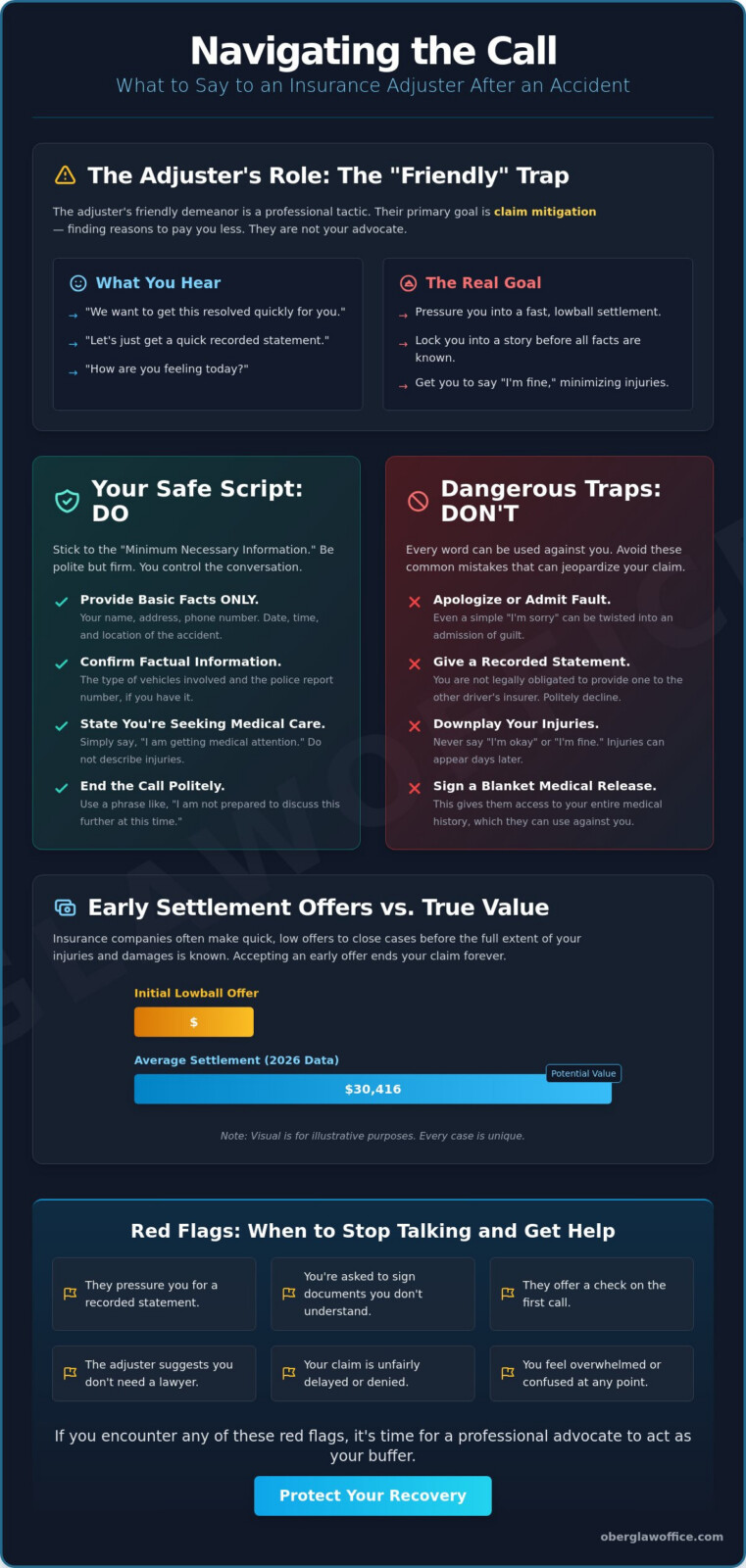
When your phone rings after a crash, the person on the other end often sounds like a helpful ally. They use your first name. They speak with a soft, empathetic tone. They might even say they want to “get this resolved quickly for you.” This neighborly approach is a calculated tactic. This person is a professional claims negotiator whose primary loyalty lies with the insurance company’s shareholders, not your recovery. Their goal is to build a false sense of security so you’ll lower your guard during the conversation.
The insurance industry operates on a model of claim mitigation. Claim mitigation is the process of finding legal reasons to pay less than a claim is worth. Every question they ask is designed to gather evidence that supports a lower payout or a total denial. While you are trying to figure out how to pay for car repairs or medical bills, they are looking for ways to protect their company’s profit margins. It’s a business transaction for them, even if it feels deeply personal to you.
It is also vital to distinguish between your own insurance company and the “adverse” adjuster. Your own policy likely requires you to cooperate with your insurer, but you have no such contract with the other driver’s company. They are your legal adversary. Knowing what to say to insurance adjuster after accident starts with realizing that you are not obligated to help them build a case against you. Understanding Insurance Bad Faith can help you recognize when a company is failing its basic duties, but your first priority is simply staying guarded during that initial call.
Why They Call You So Quickly
Speed is their greatest weapon. They often call within 24 or 48 hours because they know you’re still in shock. They want you to commit to a version of events before you’ve seen a doctor or realized the full extent of your injuries. This urgency is also tied to the clock. In Florida, the statute of limitations for personal injury is now two years. In North Carolina, you generally have three years. By rushing you into an early settlement, they close the file forever, often for a fraction of what your case is actually worth. They want to settle before you realize that a “minor” back ache is actually a herniated disc.
The Difference Between Cooperation and Self-Incrimination
You might feel a natural urge to be polite and explain what happened. In the world of insurance, “polite conversation” is a minefield. A simple “I’m sorry” or “I didn’t see them coming” can be used as an admission of comparative negligence to reduce your compensation. While you have a duty to report the facts to your own insurer, you don’t have to provide a recorded statement or discuss your pain levels immediately. You are navigating the physical and emotional aftermath of a traumatic event. You deserve a steadfast protector to act as a buffer. Using a personal injury lawyer ensures that your words aren’t twisted against you while you focus on healing.
What to Say to an Insurance Adjuster: A Safe Script
The moment you pick up the phone, you are entering a legal arena where your words are the primary evidence. You don’t need to be an expert in insurance law to protect yourself; you just need a plan. Adopting a “Minimum Necessary Information” framework allows you to be polite without giving away your rights. The goal is to provide the basic facts required to start the claim while deferring complex questions until you are fully prepared. If an adjuster pushes for details you aren’t ready to give, the most powerful phrase in your arsenal is: “I am not prepared to discuss that at this time.”
Setting boundaries early is a sign of strength, not guilt. You have every right to tell the adjuster that you will provide all relevant information in writing once you have consulted with counsel. This approach prevents you from being caught off guard or pressured into making statements while you are still recovering. Following a California Department of Insurance Guide or similar state resources can help you stay organized, but your verbal interactions require a specific script to avoid common pitfalls. If you feel overwhelmed by their persistence, securing professional car accident representation can provide the buffer you need to focus on your health.
The First Call: What Information to Share
Keep your initial conversation strictly limited to administrative details. You should only share your full name, current address, phone number, and the date and location of the accident. Do not discuss your employment status, your income, or your specific daily routines. These details might seem harmless, but adjusters use them to calculate how much your time is “worth” or to find reasons to argue that your injuries haven’t changed your life. If they ask a question you can’t answer with 100 percent certainty, “I don’t know” is a perfectly acceptable and honest response. It is much better than guessing and being proven wrong later.
Deflecting Questions About Fault and Liability
Adjusters are skilled at steering conversations toward the cause of the crash. When they ask “What happened?” or “Who was at fault?”, use this script: “The accident is still under investigation, and the police report speaks for itself.” Avoid commenting on the weather, your speed, or potential distractions. Estimates regarding speed or distance are often used to assign partial fault to the victim. For example, if you estimate you were going 35 mph but data shows you were at 38 mph, they may use that discrepancy to reduce your compensation. Knowing exactly what to say to insurance adjuster after accident means sticking to the facts and refusing to speculate on the “why” or “how” of the event.
Dangerous Traps: What You Should Never Say After an Accident
The insurance adjuster is looking for any opportunity to devalue your experience. They often use high-pressure tactics to get you to speak before you have had time to process the event. One of the most dangerous traps is the request for a recorded statement. You might hear that this is a routine part of the process or that it will help speed up your reimbursement check. In reality, these recordings are used to lock you into a version of events before you fully understand your injuries. The absolute rule is simple: never agree to a recorded statement without first speaking to a personal injury lawyer. Protecting your future requires a disciplined approach to every conversation.
Beyond the recording, your casual choice of words can be equally damaging. Saying “I’m fine” or “I’m okay” out of politeness can destroy a future medical claim. The adjuster will document these words as proof that you weren’t actually hurt. In the 2026 digital landscape, these traps extend beyond the phone call. Posting about your accident on social media or sending “private” messages about the crash can provide the insurance company with evidence to use against you. Even a photo of you smiling at a family dinner can be twisted to suggest your injuries aren’t as severe as you claim. Staying silent is often your strongest legal strategy.
Why Recorded Statements Are Legally Dangerous
Adjusters are trained to ask “gotcha” questions that create contradictions in your story. They might ask the same question in three different ways, hoping you’ll provide slightly different details each time. These minor discrepancies are then labeled as “inconsistencies” to damage your credibility. It is vital to remember that you are not legally required to give a recorded statement to the other driver’s insurance company. If they insist, simply respond by saying, “I am not prepared to provide a recorded statement at this time, but I am happy to provide the necessary facts in writing.” This keeps you in control of the narrative.
The “I’m Fine” Fallacy
Adrenaline is a powerful chemical that masks pain immediately after a crash. You might feel “fine” at the scene, only to wake up 48 hours later with debilitating neck or back pain. If you’ve already told the adjuster you weren’t hurt, they will use that statement to deny catastrophic injury claims that develop later. Instead of commenting on your health, use a neutral phrase like, “I am still seeking medical evaluation.” This acknowledges that your physical condition is still being determined by professionals. Consult a California Department of Insurance guide or similar state resource to see how medical documentation should be handled to protect your rights. Knowing what to say to insurance adjuster after accident means prioritizing your long-term health over a moment of politeness.
The Danger of Speculation
When you guess about the other driver’s actions, you are giving the insurance company a gift. They may ask how fast the other car was going or if the other driver looked distracted. If you speculate and your guess doesn’t match the black box data from the vehicles, they will use that error to claim you are an unreliable witness. Stick to what you know for certain. If you don’t have a definitive answer, “I don’t know” is the only safe response. Your recovery depends on facts, not assumptions.
Handling Medical Questions and Early Settlement Offers
Receiving a call with a settlement offer just days after your crash can feel like a relief. When bills are piling up, a “quick check” sounds like the solution you need. The reality is that these early offers are a strategic trap. Insurance companies know that the average settlement for a car accident with injuries is approximately $30,416 as of May 2026. By offering you a few thousand dollars immediately, they are attempting to close your file for a fraction of its true value before you even know the full extent of your physical damage.
The biggest risk with these early offers is the “Future Damages” problem. You might feel a dull ache in your neck today that seems manageable. Six months from now, that ache could reveal itself as a herniated disc requiring surgery. If you’ve already accepted a check, you’re responsible for those costs alone. Knowing what to say to insurance adjuster after accident means protecting your future self. When they push for a quick resolution, use this script: “I cannot consider an offer until my medical treatment is complete and my doctors have provided a final prognosis.” This simple statement signals that you won’t be pressured into a premature deal.
The Danger of Signing a Release Too Early
Accepting a settlement check almost always requires you to sign a document known as a “Release of All Claims.” This is a permanent legal contract. Once you sign it, you waive your right to seek any further compensation from that insurance company for this specific accident. Even if your condition worsens or you discover a new injury related to the crash, you cannot go back for more money. The door is locked. You should always have a car accident lawyer review any document before your pen touches the paper. Protecting your recovery starts with understanding the fine print that large institutions use to limit their liability.
Protecting Your Medical Privacy
Adjusters will often ask you to sign a medical authorization form. They may claim it’s necessary to verify your injuries. These forms are frequently “blanket releases” that give the insurer access to your entire medical history, from childhood to the present. They aren’t looking for accident details; they’re looking for pre-existing conditions to blame for your current pain. If you had a minor back strain five years ago, they will argue your new injury is just an old problem. When asked for an authorization, tell them: “I will provide the relevant medical bills and records once my treatment is concluded.” If you are feeling overwhelmed by these intrusive requests, contact our experienced legal team to help manage these communications for you.
When to Stop Talking and Start Protecting Your Recovery
There comes a point in every claim where silence is your most powerful tool. If you find yourself constantly second-guessing what to say to insurance adjuster after accident, you’ve likely reached the limit of what you should handle alone. The adjuster’s persistence can feel like a heavy weight, especially when you’re trying to focus on physical therapy or returning to work. Transitioning the burden of communication to a professional advocate isn’t just about convenience; it’s about securing your future. We believe you shouldn’t have to be a legal expert just to get a fair shake from an insurance company.
Certain signals indicate that the insurance company is no longer acting in your best interest. If the adjuster begins suggesting that you were partially responsible for the crash, the conversation has turned hostile. This tactic is often used to reduce your payout through contributory negligence laws. You should also seek help immediately if your injuries require surgery, long-term care, or have caused you to miss significant time at work. When an adjuster becomes aggressive or pressures you to sign documents on the spot, the neighborly facade has dropped. You need a formidable protector in your corner to ensure your rights are respected.
Signs You Need a Personal Advocate
- The adjuster is blaming you for the accident or questioning the validity of your injuries.
- Your medical bills exceed the initial “quick settlement” offers being presented.
- The crash involved a commercial truck, a rideshare vehicle, or resulted in a catastrophic injury.
- You feel overwhelmed by the technical legal terminology and the volume of paperwork.
Many people hesitate to call a lawyer because they worry about the cost. We believe that high-quality legal help should be accessible to everyone, regardless of their current financial situation. Our firm operates on a performance-based fee structure, meaning you don’t pay any upfront costs or hourly fees. We only get paid if we successfully recover compensation for you. This shared risk ensures that we’re just as invested in your restoration as you are. Once we step in, we act as a total buffer, handling every phone call and email. You can focus on healing without the stress of wondering what to say to insurance adjuster after accident ever again.
The Oberg Law Office Approach: Direct Professional Contact
We pride ourselves on a personal touch that sets us apart from high-volume firms. When you work with us, you aren’t passed off to support staff; you speak directly with senior professionals who have over 25 years of experience fighting large insurance institutions. We understand our local community and the specific challenges you face after a traumatic event. A free strategy session allows us to review the adjuster’s current offer and determine if it truly reflects the value of your claim. Don’t let a professional negotiator dictate the terms of your recovery. Schedule your free accident strategy session today and take the first step toward reclaiming your peace of mind.
Take Control of Your Path to Recovery
You’ve been through a traumatic event, and the road to restoration shouldn’t be paved with high-pressure phone calls and legal traps. By sticking to a safe script and refusing to guess about the facts of your crash, you protect your right to a fair settlement. Remember that early offers rarely account for the long-term medical needs that may surface months down the line. Knowing exactly what to say to insurance adjuster after accident is your first line of defense, but you don’t have to stand alone against large institutions.
Our firm is here to act as your steadfast protector. With over 25 years of legal experience, we provide direct access to senior legal professionals who personally handle your case. We operate on contingency-based fees; we only get paid if you win. This partnership removes the financial burden from your shoulders so you can focus entirely on healing. You deserve a guide who understands our community and fights for the fairness you are owed. Get a Free Consultation with a Personal Injury Advocate today. You have the power to reclaim your peace of mind, and we’re ready to help you every step of the way.
Frequently Asked Questions
Do I have to talk to the other driver’s insurance adjuster?
You have no legal obligation to speak with the other driver’s insurance company. While you must cooperate with your own insurer based on your policy contract, the other side is looking for evidence to reduce their liability. If they call, you can simply tell them that you aren’t prepared to discuss the matter and that all future communication should be handled through your representative. This sets a firm boundary immediately.
What happens if I already gave a recorded statement?
If you have already provided a recorded statement, don’t panic, but do stop providing additional information immediately. You have the right to request a copy of the recording or a written transcript of what you said. Reviewing this with a professional can help identify any answers that might need clarification later through formal documentation. It’s a common hurdle that we help neighbors navigate every day.
Can I refuse to sign a medical records release?
You can and should refuse to sign a blanket medical release form. These forms often grant the insurer access to your entire health history, which they use to find pre-existing conditions to blame for your current pain. You only need to provide records specifically related to the injuries sustained in the crash. Knowing what to say to insurance adjuster after accident includes stating that you will provide relevant documentation once your treatment is finalized.
Should I accept the first settlement offer the adjuster gives me?
Accepting the first offer is rarely in your best interest. These initial “quick checks” are designed to settle the claim before you realize the true cost of your medical care or long-term needs. Since the national average for injury settlements is approximately $30,416 as of May 2026, an early offer of a few thousand dollars is likely far below what you deserve. Wait until you have reached maximum medical improvement.
What if the insurance adjuster says I was partially at fault?
An adjuster’s opinion on fault is not a final legal verdict. They use allegations of partial fault as a negotiation tactic to pressure you into accepting a lower settlement. Fault is determined by evidence, police reports, and state laws, not by a phone call. If they suggest you are to blame, it is a clear sign that you need a steadfast protector to evaluate the evidence and challenge their claims.
How much does it cost to have a lawyer talk to the adjuster for me?
There are no upfront costs to have a senior legal professional manage the insurance company for you. We work on a performance-based fee structure, which means our payment is a percentage of the final settlement we win for you. If we don’t win your case, you don’t owe us a fee. This structure ensures that quality legal advocacy is accessible to everyone, regardless of their current financial situation.
Will the insurance company deny my claim if I hire an attorney?
Hiring an attorney will not cause the insurance company to deny a valid claim. In fact, insurers often take claims more seriously when they know a professional is involved. Having an advocate ensures that the company follows the rules and treats you with the respect you deserve. It changes the dynamic from a one-sided negotiation to a fair legal process where your rights and restoration are the priority.
What should I do if the adjuster keeps calling me after I told them to stop?
If an adjuster continues to call you after you’ve asked them to stop, you have the right to end the conversation and stop answering. Constant calling is a strategy used to wear you down until you say the wrong thing. Once you have representation, the adjuster is legally required to speak with your lawyer instead of you. Knowing what to say to insurance adjuster after accident often means choosing to say nothing at all.