
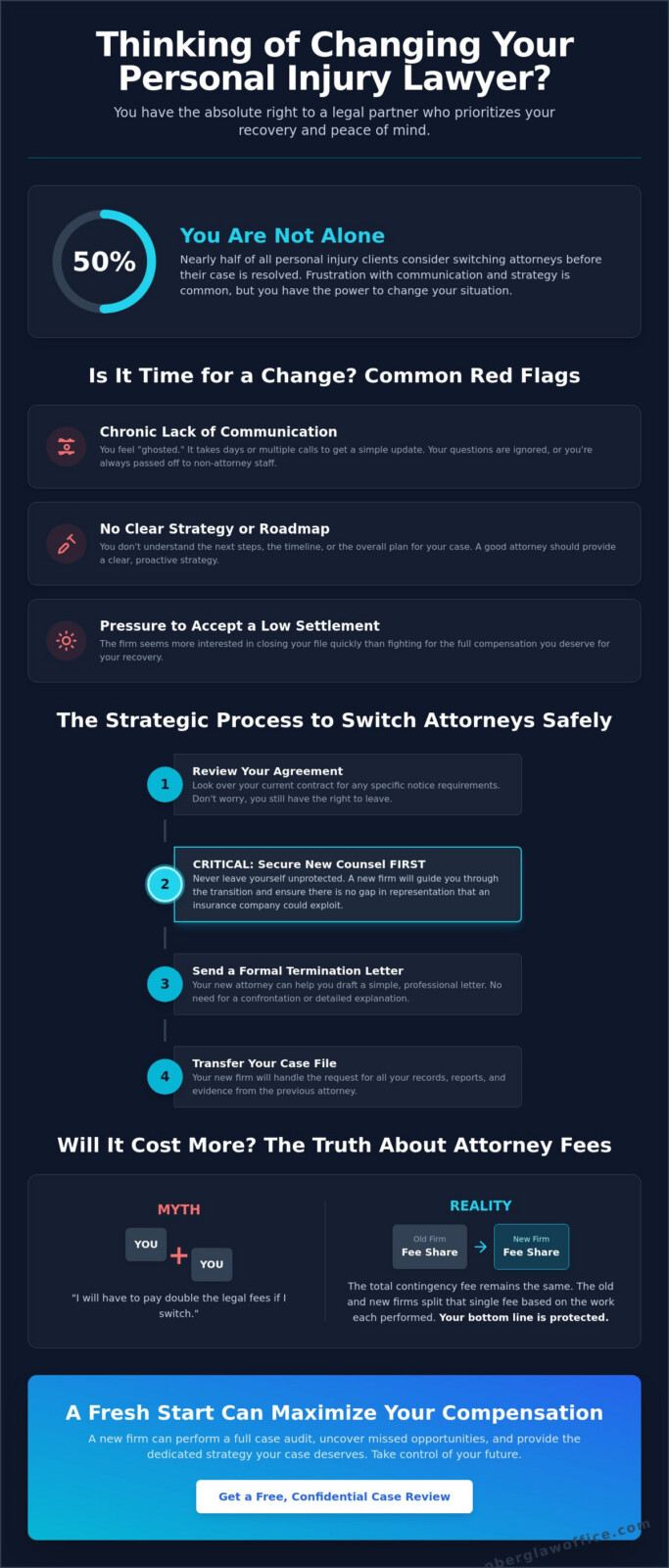
Did you know that nearly 50% of personal injury clients consider switching attorneys before their case ends? If you’re feeling like a “number” in a high-volume firm or waiting days for a simple update, you aren’t alone. It’s deeply frustrating when the person meant to protect your future seems more interested in their file cabinet than your physical recovery. You might worry that speaking up will cost you more money or derail your settlement, but you have a protected right to work with someone who actually listens. Learning how to fire your personal injury lawyer is often the first step toward reclaiming control of your case and your peace of mind.
You deserve a legal partner who prioritizes your health and provides the clear strategy you need to move forward. This guide will show you exactly how to terminate a failing relationship and transition to a firm that values your story without jeopardizing your compensation. We’ll walk through the formal notification process, explain how fee-splitting works so your bottom line stays protected, and help you find a faster path to resolution. Transitioning to new counsel doesn’t have to be a battle; it is a strategic move for your financial restoration and your family’s future.
Key Takeaways
- Understand that you’re the boss of your case and have the absolute legal right to change representation if your needs aren’t being met.
- Learn why switching firms doesn’t mean paying double fees, as legal costs are typically shared between firms through a process called fee-splitting.
- Follow a strategic, step-by-step process for how to fire your personal injury lawyer that ensures there’s never a gap in your legal protection.
- Identify the red flags of high-volume firms and learn how to choose a partner who offers direct communication with senior attorneys rather than support staff.
- Discover how a case audit can uncover missed opportunities for compensation, giving your claim the fresh start and the focus it deserves.
Understanding Your Legal Right to Change Representation
When you’re recovering from a car accident or a serious fall, the last thing you need is a lawyer who adds to your stress. You might feel trapped in your current contract, but the law provides you with a clear exit. The attorney-client relationship is fundamentally “at-will.” This means you have the absolute right to end the partnership at any time, for almost any reason. You are the employer in this relationship. The firm works for you, and if they aren’t meeting your needs, you shouldn’t feel guilty about seeking better support.
It’s vital to distinguish between being unhappy with the legal system and being unhappy with your specific counsel. Sometimes, the facts of a case are difficult or the law is restrictive. However, if your frustration stems from a lack of effort or poor communication, that’s a professional failure. If you are wondering how to fire your personal injury lawyer, the best time to act is before a significant settlement offer is on the table. Once an offer is made, the transition becomes more complex; addressing these issues early protects your interests and your final recovery.
Common Red Flags: When Is It Time to Move On?
Watch for these warning signs that your current firm isn’t the right fit for your needs:
- Chronic lack of communication: You shouldn’t have to call five times to get a simple update. If your lawyer has effectively “ghosted” you, they aren’t prioritizing your recovery.
- Lack of a clear roadmap: A professional should provide a clear strategy for your car or truck accident case. You deserve to know the next steps and the expected timeline.
- Pushing for low settlements: If your attorney is pushing you to accept an offer that feels inadequate just to close the file, they are looking out for their own bottom line, not yours.
The Role of Trust in Personal Injury Litigation
Winning a complex case requires a collaborative partnership built on mutual respect. When you don’t trust your attorney of record, the constant anxiety can actually hinder your physical and emotional healing. You need to feel secure knowing that your advocate is fighting for the restoration of your life and the security of your family. Attorney-client privilege is a legal shield that empowers you to speak freely so your lawyer can build the strongest possible defense for your future. Without that foundation of trust, your case cannot reach its full potential.
The Step-by-Step Process of Terminating Your Legal Contract
Switching legal counsel can feel like a daunting confrontation. You might worry about a face-to-face argument or a tense phone call. In reality, the process is far more administrative than personal. You don’t need to justify your decision or explain why you’re unhappy. By following a structured plan, you can protect your claim while moving toward a partnership that actually works for you. The focus should always remain on your restoration and the security of your settlement.
First, look at your signed representation agreement. While you have the right to leave, it’s smart to see if there are specific notice requirements. Second, and most importantly, you should never leave yourself unprotected. Secure a new attorney before you officially end the current relationship. This ensures there is no gap in your representation that an insurance adjuster could exploit. If you’re feeling overwhelmed by the process of how to fire your personal injury lawyer, remember that your new firm is there to guide you through these logistics.
Once you have a new advocate, you’ll draft a formal termination letter. There is no requirement for a phone call or a meeting. This document serves as your official record. You can find resources on how to fire or change my lawyer to help structure your notice. After sending the letter, you must request your complete case file. This includes all medical records, police reports, and evidence collected. If a lawsuit is already active, your new counsel will handle the formal notification to the court and the opposing parties.
Drafting the Termination Letter
Your letter should be professional and brief. You don’t need to provide a “cause” or list your grievances. Simply state that you are terminating the relationship and instructing the firm to cease all work on your behalf immediately. Include a specific request for the transfer of both physical and digital files to your new office. Keeping the tone neutral prevents unnecessary delays and keeps the focus on your recovery. A clear, written instruction is the most effective way to protect your rights.
The Role of Your New Firm in the Transition
Most of the “heavy lifting” is actually handled by your new legal team. They will reach out to the outgoing firm to coordinate the file transfer and discuss fee-sharing arrangements. Outgoing lawyers have an ethical obligation to cooperate and cannot hold your file hostage. This professional-to-professional handoff minimizes the awkwardness and ensures nothing falls through the cracks. If you’re ready for a team that treats you like a person rather than a case number, reaching out to a dedicated advocate can make this transition seamless.
Will It Cost More? Navigating Attorney Liens and Fee Splitting
One of the biggest fears keeping people in bad legal relationships is the “double fee” myth. You might worry that by moving your case, you’ll end up paying two separate legal fees and leaving yourself with nothing. This is simply not how the system works. In almost every case, your total legal fee remains exactly what you originally agreed to in your contract. The process of switching is about redistributing that single fee between firms, not adding a new one on top of your recovery.
If you’re researching how to fire your personal injury lawyer, you should understand the principle of “Quantum Meruit.” This Latin phrase translates to “as much as he has deserved.” It means that your first lawyer is only entitled to be paid for the actual work they completed before you terminated the relationship. They cannot claim a full fee for a case they didn’t finish. Instead, they place an “attorney lien” on the case, which is a formal notice that they should be reimbursed for their time and out-of-pocket expenses once the case settles.
These out-of-pocket expenses often include things like filing fees, the cost of requesting medical records, or police report charges. Your first firm is entitled to get this money back because they spent it to move your case forward. Usually, your new firm will pay these costs upfront to the old firm or agree to reimburse them from the final settlement. You don’t have to write a check out of your own pocket to make the switch happen.
How Fee Splitting Protects Your Recovery
The standard practice in the legal industry is a fee-sharing agreement. When your case eventually reaches a settlement or verdict, the two firms sit down and decide how to split the single contingency fee based on the amount of work each performed. This happens behind the scenes. Your take-home amount stays the same because the lawyers are fighting over their portion of the pie, not yours. You deserve total transparency during this process, and your new firm should be able to explain how these liens will be resolved in plain English.
Exceptions: When Costs Might Increase
While your fee percentage usually stays the same, there are rare moments when switching can become more expensive. If you change counsel very late in the process, such as a few weeks before a trial, there may be duplicate costs. For example, a new expert witness might need to be hired if the previous one was specifically tied to the old firm. Most personal injury lawyers will review your current contract for free to assess these risks and ensure your recovery remains protected. Acting sooner rather than later is the best way to keep your expenses low and your case on track.
Evaluating a New Firm: How to Avoid Making the Same Mistake
Finding yourself in a position where you need to know how to fire your personal injury lawyer is a difficult realization. It’s often born from a feeling of being ignored or treated like a case number in a digital filing cabinet. You don’t want to jump from one failing relationship into another. To avoid repeating history, you must look beyond the billboards and flashy advertisements. You need a partner who offers more than just a signature on a contract; you need a steadfast protector who is personally invested in your physical and financial restoration.
Ask about direct access. In many high-volume firms, you might go months without speaking to the actual attorney handling your case. You’ll spend your time talking to paralegals or support staff who can’t provide the strategic legal advice you need. A specialized, person-oriented practice ensures you have a direct line to the person actually litigating your claim. Inquire about their case volume too. If a lead attorney is personally handling hundreds of active files, your story will inevitably get lost in the shuffle. You deserve someone with the time to listen and the trial experience to go to court if the insurance company refuses to be fair.
Crucial Questions for Your Strategy Session
When you meet with a potential new advocate, be direct. Ask them, “What is your specific plan to get my case back on track?” They should be able to identify where the previous firm stalled and how they will fix it. Ask how they will handle the transition. A knowledgeable guide will explain that they handle the file transfer and lien negotiations. Finally, ask for proof of their expertise. Can they show you a track record of handling truck accident or catastrophic injury cases? These complex claims require a level of detail that high-volume settlement mills simply cannot provide.
The Importance of a “Neighborhood” Approach
Personalized advocacy is the cornerstone of a successful recovery. A neighborhood approach means your lawyer is a community advocate who understands the local courts and the specific challenges you face. This isn’t about abstract legal theories. It’s about tangible results and the security of knowing your family is protected. When leadership is personally involved, the focus shifts from processing files to restoring lives. If you’re ready to move away from a firm that doesn’t value your time, you can schedule a strategy session with a senior attorney to see the difference a personal touch makes.
Transitioning to Oberg Law Office: A Fresh Start for Your Case
Deciding to move your case is a significant step toward securing your future. If you’ve been searching for how to fire your personal injury lawyer, you’ve likely reached a point where the lack of progress is no longer acceptable. At Oberg Law Office, we treat your transition as a chance to breathe new life into your claim. We don’t believe in “settlement mills” where clients are passed between support staff. Instead, we offer direct involvement from senior-level attorneys who take a personal interest in your physical and financial restoration.
When we take over a case, we perform a comprehensive audit of your current file. This isn’t just a quick review; it’s a deep dive to identify missed opportunities for compensation that a high-volume firm might have overlooked. We examine every police report, medical record, and insurance communication with a fresh perspective. Our goal is to ensure no stone is left unturned in our pursuit of fairness. We provide a no-pressure environment where you can discuss your concerns openly, knowing that we’ll handle the aggressive insurance adjusters while you focus on your health.
Our Process for Taking Over Existing Cases
Our approach is designed to be seamless and stress-free. We begin with a free initial strategy session to evaluate where your case stands and where it needs to go. Once you decide to move forward, we coordinate the entire file transfer with your previous counsel. You don’t have to worry about awkward conversations or administrative hurdles. After we secure your records, we establish a new, aggressive timeline for your car accident claim to make up for lost time and push for the resolution you deserve.
Why 25 Years of Experience Matters
Navigating the tactics used by insurance defense teams requires more than just legal knowledge; it requires seasoned intuition. With 25 years of experience, we’ve seen the strategies these large institutions use to devalue legitimate claims. We counter those moves with integrity and a focus on tangible results rather than abstract legal theories. We are steadfast protectors of our community, and we believe every client deserves a knowledgeable guide who treats them like a neighbor. If you’re ready for a legal partnership built on trust and unwavering determination, Schedule your free strategy session with Gregg Oberg today and take the first step toward a fresh start.
Reclaim the Future of Your Recovery
You don’t have to settle for a legal relationship that leaves you feeling ignored or uncertain. Your recovery and the security of your family are too important to leave in the hands of a firm that treats you like a case number. We’ve discussed your absolute right to change counsel and the specific administrative steps for how to fire your personal injury lawyer without jeopardizing your final settlement. Remember that professional fee-sharing agreements protect your bottom line, ensuring you only pay the single contingency fee you originally agreed to.
At Oberg Law Office, we provide the personalized advocacy you need to move forward with confidence. With over 25 years of Texas legal experience, Attorney Gregg Oberg offers the direct access and senior-level expertise your case deserves. We work on a contingency-based fee structure, which means you pay nothing unless we win. Get a Free Case Review with Oberg Law Office today to start your fresh chapter. You’ve been through enough; you deserve a steadfast protector who is personally invested in your restoration and fairness.
Frequently Asked Questions
Is it ever too late to fire my personal injury lawyer?
You can change your legal representation at nearly any stage of your case, though it becomes more complex once a trial has started. If your case is already in court, a judge may need to approve the withdrawal of your current attorney to ensure the schedule isn’t disrupted. It’s best to act as soon as you feel your needs aren’t being met so your new advocate has ample time to build a winning strategy for your recovery.
Do I have to tell my lawyer to their face that I am firing them?
No, you aren’t required to have a face-to-face meeting or even a phone conversation to end the relationship. A formal termination letter sent via certified mail is the standard and most effective way to handle the process. This creates a clear written record for your case file and allows you to avoid an uncomfortable confrontation. Your new firm can often help you draft this letter to ensure it’s professional and covers all necessary points.
Can my lawyer sue me for firing them?
Your lawyer cannot sue you for exercising your right to switch counsel, but they are entitled to be paid for the work they’ve already performed. Instead of a lawsuit, they will typically place a lien on your eventual settlement or verdict. This lien ensures they receive a portion of the final legal fee for their time and out-of-pocket expenses. This process is handled between the two law firms and shouldn’t result in you paying more than your original fee percentage.
Will firing my lawyer delay my settlement?
There might be a short administrative pause while your files are transferred, but a more proactive lawyer can often resolve your case faster in the long run. If your current attorney has allowed your claim to stall or has failed to communicate with insurance adjusters, a fresh start can provide the momentum needed for a quicker resolution. The goal is to move from a state of uncertainty to a position of strength and clarity.
What happens to my medical records and evidence if I switch firms?
Your medical records, police reports, and all evidence collected are your property, and the outgoing firm has an ethical duty to provide them to you or your new counsel. When you’re figuring out how to fire your personal injury lawyer, remember that your new firm will handle the logistics of the file transfer. They’ll ensure that every digital and physical document is moved safely so your case continues without any missing pieces or lost evidence.
How do I know if my lawyer is doing a bad job or if the case is just slow?
Legal cases can move slowly due to court schedules or medical treatment timelines, but a “bad job” is usually marked by a lack of communication. If your lawyer doesn’t return calls, misses deadlines, or can’t explain the current strategy, those are significant red flags. A trustworthy guide will always keep you informed about why a case is taking time and what the next steps are, ensuring you never feel like a “number.”
Can I fire my lawyer if I have already signed a settlement offer?
It’s very difficult to change counsel once you’ve signed a final settlement release, as that document typically ends the legal process. If you’ve signed the offer but haven’t received the funds, there might be a small window to act, but it’s rare. This is why it’s so important to seek a second opinion the moment you feel pressured to accept an offer that doesn’t feel fair or sufficient for your long-term restoration.
What if I have a dispute with my first lawyer over their fee?
Disputes over the “reasonable value” of a former lawyer’s work are usually handled through negotiation between your new firm and the old one. If an agreement can’t be reached, the matter can be settled through a fee arbitration program provided by the state bar. Your new attorney will protect your interests during these discussions to ensure that the fee-splitting process doesn’t diminish the amount of money you take home for your medical bills and future security.