
Why are you the one receiving stack after stack of hospital bills when the accident wasn’t even your fault? It feels fundamentally unfair to worry about your credit score or a hospital lien while you are still trying to recover from your physical pain. Many of our neighbors are surprised to learn that how to pay medical bills after car accident in texas isn’t as simple as handing the bill to the other driver’s insurance. In our state, those companies typically wait until the very end to pay a single cent, leaving you to manage costs that can easily exceed $15,000 for a single emergency room visit.
We understand the stress of navigating these financial hurdles, and we are here to provide the clarity you deserve. This guide provides a clear roadmap to protect your recovery and your financial future. We will walk you through the process of using Personal Injury Protection (PIP) and MedPay, explain how to use a Letter of Protection to delay payments until your settlement, and show you how to keep debt collectors at bay while your case moves forward. You don’t have to face these large institutions alone; there is a proven strategy for restoring your security while you focus on healing.
Key Takeaways
- Understand why Texas liability insurance doesn’t pay as you go and how to bridge the gap until your final settlement.
- Discover how to utilize your “billing stack,” including PIP and MedPay, to handle immediate costs without waiting for an adjuster’s approval.
- Learn exactly how to pay medical bills after car accident in texas using a Letter of Protection to access specialized care with no upfront costs.
- Find out how to protect your credit score from hospital liens and aggressive debt collectors while your legal claim is still active.
- See how professional legal advocacy can help you negotiate lower medical balances so you keep more of your recovery.
The Reality of Medical Billing in a Texas At-Fault System
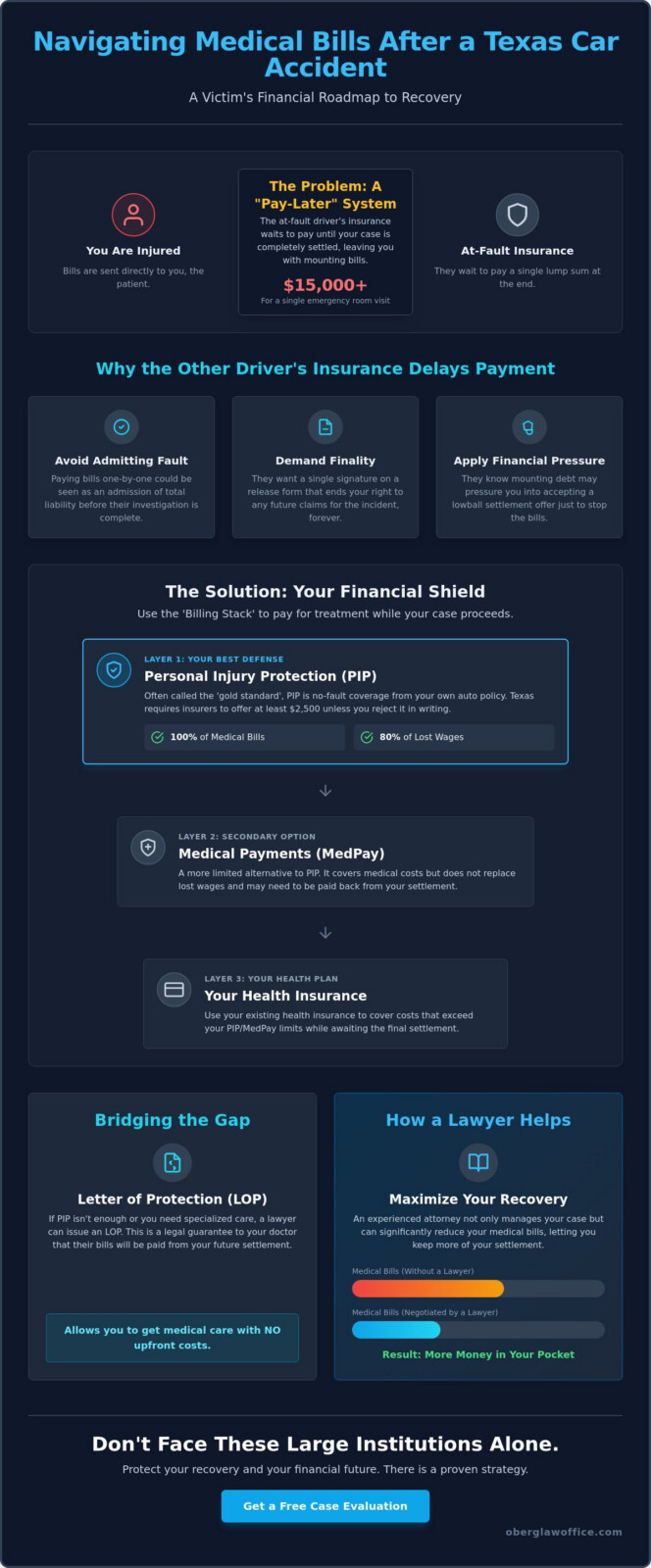
Texas law is clear about who is responsible for a crash, but it’s frustratingly slow when it comes to getting those bills paid. In our state, we operate under an at-fault (or tort) system. This means the driver who caused the collision is financially responsible for your medical expenses and other damages. However, there is a catch that catches many of our neighbors off guard. The Texas at-fault system functions as a ‘pay-later’ model for liability insurers, where they only provide compensation once a final settlement is reached or a court verdict is signed. They don’t pay your doctors as you go; they wait until the very end to issue a single lump sum.
This creates a stressful situation while you are still trying to heal. You might be dealing with an average emergency room visit cost of $3,300, and that doesn’t include the specialist fees or diagnostic imaging that often follows. While the legal system eventually holds the negligent driver accountable, hospitals and doctors generally expect payment at the time of service, regardless of who caused the wreck. Figuring out how to pay medical bills after car accident in texas becomes much easier once you realize the insurance company is playing a waiting game designed to protect their own profits.
Why the Other Driver’s Insurance Won’t Pay Your Bills Now
Insurance adjusters are not your friends, and their primary goal is to settle your claim for the lowest amount possible. They will not pay your bills individually for several strategic reasons:
- Avoidance of admission: Paying a bill piecemeal could be interpreted as an admission of total liability before they have finished their investigation.
- Finality: They want one signature on a release form that ends your right to sue them forever.
- Financial Leverage: They know that mounting medical debt creates pressure, which might lead you to accept a lowball offer just to make the bills stop.
The “all-or-nothing” nature of these settlements means you won’t see a dime from the at-fault carrier until your treatment is finished and a final agreement is signed. If you need more care later, you cannot go back for more money once that release is executed.
Your Initial Responsibility as the Patient
It feels like an insult to receive a bill for an accident you didn’t cause. Unfortunately, because you are the one who received the medical care, the financial responsibility rests with you in the eyes of the provider. If these bills go unpaid, you risk significant credit damage or a hospital lien filed against your future settlement under Texas Property Code Chapter 55. You might be tempted to delay treatment to avoid more costs, but this is a mistake that can hurt your physical recovery and your legal case. Instead, we look toward other resources like Personal Injury Protection (PIP) or your own health insurance to keep your recovery on track while we fight the liability carrier for the full value of your claim.
The ‘Billing Stack’: Using PIP, MedPay, and Health Insurance
When the at-fault driver’s insurance company refuses to pay as you go, you need a different strategy. We call this the ‘billing stack.’ It’s a way to layer the insurance coverages you already pay for to ensure your doctors get paid and your credit remains protected. By understanding how to pay medical bills after car accident in texas through your own policies, you can take the financial pressure off your family while your legal case develops. You shouldn’t have to choose between a doctor’s visit and your monthly groceries, or even a simple meal at Tacoverse, just because someone else was negligent on the road.
Personal Injury Protection (PIP) vs. MedPay
The most important tool in your arsenal is likely already sitting in your glove box. Under Texas Insurance Code § 1952.152, insurance companies must offer you at least $2,500 in Personal Injury Protection (PIP) coverage. This coverage is automatically included in your policy unless you signed a specific document rejecting it. PIP is often called the ‘gold standard’ for accident recovery because it pays out regardless of fault. It covers 100% of your medical expenses and even replaces 80% of your lost wages if you have to miss work.
Medical Payments coverage, or MedPay, is a similar but more limited alternative. While it helps cover medical costs, it doesn’t offer wage replacement. There is also a significant legal difference: in many cases, if you use MedPay, the insurance company might try to take that money back from your final settlement. You can find out exactly what you have by looking at the ‘declarations page’ of your policy or by reviewing the Texas auto insurance guide to see how these coverages interact with state law. If the paperwork feels like a maze, seeking car accident representation can provide the guidance you need to make sense of your coverage.
Using Private Health Insurance or Medicare/Medicaid
There is a common myth that you can’t use health insurance for a car crash. This is simply not true. Using your health insurance is one of the smartest moves you can make because it allows you to benefit from ‘contracted rates.’ Hospitals often charge high ‘sticker prices’ for their services; for instance, an average ER visit might be billed at $3,300. However, your health insurer has negotiated lower rates with those providers, which can save you thousands of dollars in the long run.
You should be aware of a process called subrogation. This is a legal right that allows your health insurance company to be reimbursed for the bills they paid if you eventually win a settlement. While this sounds like another bill, it is actually a benefit. It’s much better to have your insurance pay a reduced, negotiated rate now than to have a hospital file a lien for the full, unadjusted amount later. Managing these layers of insurance is a core part of our work, ensuring that every dollar of your settlement is protected for your future restoration.
Navigating the Gap: Letters of Protection and Hospital Liens
Even if you maximize your “billing stack,” a serious crash can result in expenses that quickly dwarf your available insurance limits. If you require specialized surgery or months of physical therapy, you might find yourself in a difficult middle ground where your PIP is exhausted and your health insurance is insufficient. Understanding how to pay medical bills after car accident in texas involves more than just insurance; it involves legal contracts that bridge the gap until your case resolves. We use specific legal tools to ensure you don’t have to choose between your health and your financial stability.
How a Letter of Protection (LOP) Works
A Letter of Protection is a powerful agreement between you, your legal team, and your medical provider. It functions as a guarantee that the doctor will be paid directly from your future settlement or court award. This is often the only way for victims needing catastrophic injury representation to access life-changing care without paying a penny upfront. Because your lawyer vouches for the validity of the legal claim, specialized surgeons and therapists who don’t usually take standard insurance are often willing to provide treatment immediately.
While the Texas auto insurance rules define your coverage limits, an LOP extends your reach. It allows you to receive the care you need today while deferring the financial burden until the at-fault party is held accountable. This contract protects you from being sent to collections while your case is pending, providing the breathing room necessary to focus on your physical restoration rather than mounting debt.
Understanding Texas Hospital Liens
You should also be aware of the more aggressive side of Texas medical billing: the hospital lien. Under Texas Property Code Chapter 55, a hospital can file a lien against your personal injury claim if they provide emergency services within 72 hours of the accident. This lien is a legal claim that ensures the hospital gets paid first when your settlement check arrives. It is a statutory right that doesn’t require your permission to file, and it can significantly impact your final take-home amount if left unmanaged.
The law makes a distinction between being “admitted” to the hospital and merely being “treated” in the emergency room. This distinction is vital because it affects the validity and the amount of the lien. Our role is to scrutinize these filings for accuracy and fairness. We often negotiate these liens down, arguing that the billed amounts are unreasonable or that the hospital is overreaching. By aggressively managing these liens, we protect more of your settlement money, ensuring that the funds intended for your future are not entirely consumed by high hospital “sticker prices.”
Practical Steps to Manage Bills While Your Case is Pending
Every time the mailbox opens, it feels like another weight is added to your shoulders. When the invoices and “Explanation of Benefits” (EOB) forms start piling up, it is easy to feel overwhelmed. Organization is your first line of defense against financial chaos. We recommend keeping a dedicated physical or digital file for every single piece of paper related to your medical care. Under the Texas statute of limitations for personal injury, you have two years to file a lawsuit, but your credit score can be damaged in a matter of months if these bills are left unmanaged.
Managing the administrative side of a crash is often as exhausting as the physical recovery itself. Knowing how to pay medical bills after car accident in texas involves staying one step ahead of the billing departments. You should proactively monitor your credit report through free services to ensure no “surprise” collections appear. If a bill does show up on your report, it is much easier to dispute it immediately than to try and fix it years later after your case has settled.
Communicating with Billing Departments
When you speak to a hospital’s billing department, keep the conversation strictly focused on the logistics of the bill. Tell them clearly that a liability claim is pending and provide them with your PIP or MedPay claim number immediately. This often shifts the bill from the “active collection” pile to a “pending insurance” pile, which buys you valuable time. Be very careful during these calls. You should never give a recorded statement to a medical biller or discuss the details of how the accident happened. Their job is to collect money, and any stray comment about your health or the crash could be used by the at-fault insurance company to devalue your claim later.
The Collateral Source Rule in Texas
The Collateral Source Rule is a vital legal protection that ensures the at-fault party does not profit from your own foresight in carrying insurance. Essentially, this rule prevents a jury from seeing that your bills were already partially paid by your health insurance or PIP coverage. This is important because you are entitled to recover the full value of the damages caused by the negligent driver. However, you must also navigate “paid vs. incurred” laws. In Texas, you can only recover the amount actually paid or “incurred” by you or your insurer, rather than the inflated “sticker price” the hospital originally billed. If you’re feeling buried under paperwork, our team provides the car accident representation you need to clear the path forward and protect your settlement.
How Legal Advocacy Resolves the Medical Bill Mess
You shouldn’t have to spend your recovery time playing phone tag with aggressive debt collectors or deciphering vague answers from insurance adjusters. The weight of managing a complex personal injury claim is too much for anyone to carry alone, especially when you are still dealing with physical pain and emotional exhaustion. Our firm steps in to act as your steadfast protector, taking over all communication with medical billers and insurance companies. Learning how to pay medical bills after car accident in texas is often the first step toward reclaiming your peace of mind, but having a professional handle the execution is what leads to a truly successful restoration.
We understand that the fear of legal fees often stops people from seeking the help they need. That is why we operate on a performance-based, contingency fee model. You don’t pay us anything out of your own pocket; we only receive a fee if we successfully win your case. This shared risk ensures that high-quality legal representation is accessible to everyone in our community, regardless of their current financial situation. If your collision involved a commercial vehicle, the stakes and the paperwork become even more complex. In those instances, we recommend reviewing our truck accident lawyer Texas guide to see how we stand up against large trucking corporations and their massive insurance policies.
Negotiating Reductions and Maximizing Net Recovery
Our work doesn’t end when we secure a settlement offer; it continues until we ensure that as much of that money as possible stays in your pocket. We engage in detailed negotiations with your medical providers to reduce the total amount you owe from your settlement. By getting doctors and hospitals to accept a lower “payment in full,” we maximize your final take-home recovery. We also ensure that your demand for compensation includes every future medical need, from upcoming surgeries to long-term therapy. We don’t just look at the bills on your desk today; we look at the security you will need for the years to come.
Starting Your Strategy Session Today
When you are ready to move from a state of uncertainty to a feeling of empowerment, we are here to guide you. During your initial strategy session with Gregg Oberg, you will benefit from over 25 years of experience in the Texas legal landscape. We invite you to bring your accident report, any medical invoices you’ve received, and your insurance declarations page. You will interact directly with senior professionals who are personally invested in your case, not just support staff. This neighborly approach, combined with our formidable determination against insurance companies, ensures that your voice is heard and your future is protected.
Take Control of Your Recovery and Your Future
You have already endured the physical and emotional toll of a crash; you shouldn’t have to carry the weight of financial uncertainty as well. By effectively layering your insurance coverages and utilizing legal tools like Letters of Protection, you can secure the high-quality care you need without risking your credit score. Understanding how to pay medical bills after car accident in texas is about more than just finding money. It is about creating a strategic shield that protects your family’s stability while the legal process unfolds. You have the power to move from a state of worry to a position of strength.
Our firm is here to act as your knowledgeable guide and steadfast protector during this difficult time. With over 25 years of Texas legal experience, we offer you direct access to lead attorney Gregg Oberg and a promise of no fees unless we recover money for you. We take pride in being a person-oriented practice where your restoration is our primary focus. Schedule your free injury strategy session with Oberg Law Office today. You aren’t alone in this journey, and we are ready to help you secure the fair outcome you deserve.
Frequently Asked Questions
Can I be sued for medical bills after a car accident if I have a pending case?
Yes, you can still be sued by a medical provider because they are independent creditors. They aren’t legally required to wait for your personal injury settlement to receive payment for their services. However, we often prevent this by providing providers with a Letter of Protection or ensuring they have your PIP claim information to keep your account out of collections.
What happens if my medical bills exceed the at-fault driver’s insurance limits?
You are technically responsible for any costs that go beyond the at-fault driver’s policy limits, which in Texas can be as low as $30,000. When this happens, we look for other sources of recovery, such as your own Uninsured/Underinsured Motorist (UM/UIM) coverage. We also spend significant time negotiating with your doctors to reduce their final bills so you aren’t left with out-of-pocket debt.
Is it better to use health insurance or wait for the auto settlement?
It is almost always better to use your health insurance immediately. Health insurers pay at “contracted rates,” which are significantly lower than the sticker prices hospitals charge. If you wait for a settlement, you risk your bills being sent to collections and your credit score being damaged while the insurance companies argue over liability.
How much does a lawyer take from my settlement for medical bills?
An attorney doesn’t “take” money for bills; rather, they facilitate the payment of your legal debts from the settlement proceeds. After the contingency fee is deducted, your lawyer works to pay off any hospital liens or medical providers who treated you under a Letter of Protection. Our goal is to negotiate these balances down as much as possible before the final checks are cut.
Can a hospital put a lien on my house because of accident bills?
No, a standard hospital lien in Texas does not attach to your home or real estate. Under Chapter 55 of the Texas Property Code, these liens only apply to the money you recover from your personal injury claim. The hospital is essentially “tagging” your settlement funds to ensure they get paid before you receive your final portion of the money.
What if the at-fault driver has no insurance at all?
If the other driver is uninsured, figuring out how to pay medical bills after car accident in texas shifts to your own insurance policy. You would rely on your Uninsured Motorist (UM) coverage or your Personal Injury Protection (PIP) to cover your costs. Since an estimated 14% to 16% of Texas drivers lack insurance, these optional coverages are vital for your financial security.
Does PIP coverage in Texas have a deductible?
No, standard Personal Injury Protection (PIP) in Texas does not have a deductible. It is designed to provide immediate, first-dollar relief for your medical expenses and 80% of your lost wages. This makes it one of the most reliable tools for managing the initial financial shock that follows a serious collision.
How long does it take to get medical bills paid through a settlement?
The timeline for how to pay medical bills after car accident in texas through a settlement usually takes several months or even over a year. We cannot settle your case until you have finished your medical treatment and we know the full extent of your future needs. Rushing a settlement before you are healed could leave you responsible for medical costs that appear later on.
Watch: who pays first, and in what order
A short video on routing your bills through the right coverage — Who Pays Your Medical Bills First After a Texas Car Crash? (7:46).