
You wouldn’t ignore a broken leg after a collision, yet many people try to “tough out” the invisible wounds that follow. It is common to feel like you’re losing your grip when your heart races at the sound of tires screeching or when you find yourself avoiding the driver’s seat altogether. You aren’t weak, and you certainly aren’t alone. Dealing with anxiety after a car crash is a physiological response to trauma, not a character flaw, and it deserves the same medical and legal attention as any physical injury.
We understand that the weight of intrusive thoughts and the fear that insurance adjusters won’t take your “invisible” pain seriously can be overwhelming. This guide is designed to validate your experience and provide a clear roadmap for your recovery. You’ll discover how to identify the clinical signs of post-accident anxiety, practical steps for emotional healing, and how to protect your legal rights so that your mental health is fully accounted for in a settlement. From understanding how to document your symptoms to navigating the complexities of modern personal injury law, we’re here to help you move from a state of uncertainty to a feeling of empowerment.
Key Takeaways
- Understand the biological reasons your brain remains on high alert and learn how to distinguish between normal stress and serious conditions like PTSD.
- Discover why professional therapy is a cornerstone of dealing with anxiety after a car crash and how it helps you reclaim your peace of mind.
- Learn how the legal definition of “pain and suffering” includes your mental health, allowing you to seek compensation for emotional distress.
- Explore the practical steps for documenting “invisible” injuries so that insurance companies cannot dismiss your very real psychological symptoms.
- See how a contingency-based partnership allows you to access senior legal expertise without any upfront costs while you focus on healing.
Understanding Anxiety After a Car Crash: Why Your Brain Stays on High Alert
A car accident is more than just a collision of metal and glass; it’s a profound shock to your entire biological system. If you find yourself struggling with the weight of dealing with anxiety after a car crash, it’s vital to recognize that your brain is performing exactly how it was designed to. It has entered a survival mode that doesn’t simply switch off because the insurance claim is filed. This isn’t a sign of weakness or a lack of resilience. It’s a natural, biological response to a life-threatening event.
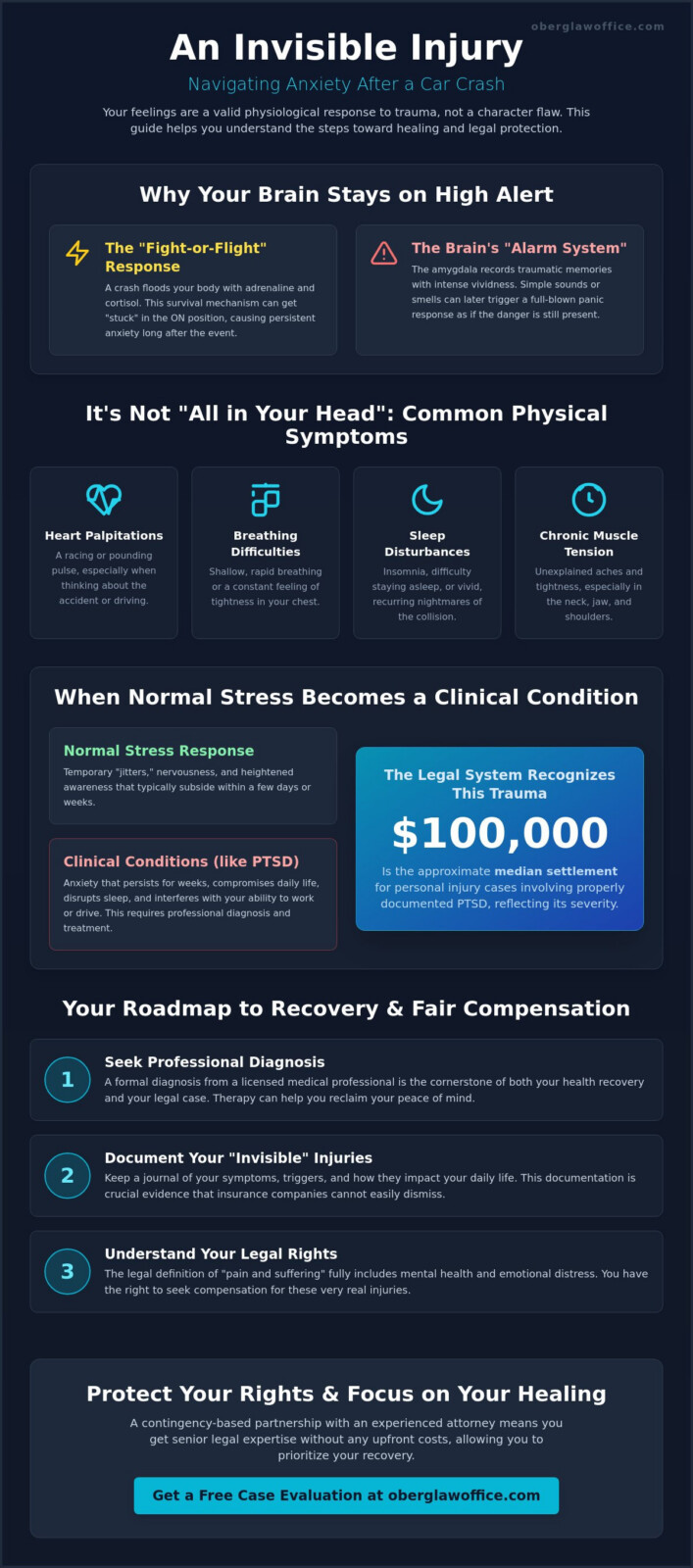
During a crash, your body is flooded with adrenaline and cortisol, triggering the “fight-or-flight” mechanism. This system is meant to help you survive immediate danger. However, the intensity of a vehicle collision can cause this mechanism to get “stuck” in the “on” position. While many people experience temporary “jitters” or a few days of nervousness, others find that their anxiety persists, evolving into a clinical condition that requires professional intervention. When your daily life, sleep, or ability to drive is compromised for weeks, you’re likely moving beyond a normal stress response into something more complex.
The Biological “Alarm System”: Why You Can’t Just “Snap Out of It”
Your brain’s emotional center, the amygdala, acts as a high-speed smoke detector. During a crash, it records traumatic memories with intense vividness to ensure you avoid similar dangers in the future. This is why a simple sound, like the screech of brakes or the smell of an airbag, can trigger a full-blown panic response months later. Even when you’re physically safe at home, your body may continue to produce stress hormones as if the threat is still present. In severe cases, this persistent state of alarm can lead to Post-Traumatic Stress Disorder (PTSD), a condition that fundamentally changes how your brain processes safety. Hypervigilance is a state of constant sensory scanning for danger that leaves you feeling exhausted and on edge.
Common Physical Symptoms of Post-Accident Anxiety
Anxiety isn’t just “in your head.” It manifests throughout your entire body, often mimicking or worsening physical injuries. You might notice several tell-tale signs:
- Heart palpitations or a racing pulse when thinking about getting back on the road.
- Shallow, rapid breathing or a persistent feeling of tightness in your chest.
- Chronic sleep disturbances, including insomnia or vivid nightmares of the collision.
- Unexplained muscle tension, particularly in the neck, jaw, and shoulders.
Physical pain can actually feel more intense when your body is in a state of chronic anxiety because your nervous system is sensitized. These “invisible” injuries are just as real as a broken bone and can significantly slow down your overall physical recovery speed. Acknowledging this connection is the first step toward a comprehensive healing process that addresses both your body and your mind.
Identifying Post-Accident Mental Health Conditions: From GAD to PTSD
When you’re dealing with anxiety after a car crash, it’s helpful to view your symptoms not as a personal failure, but as a “brain injury” caused by the physical and emotional impact of the collision. Just as a seatbelt can bruise your chest, a traumatic event can bruise your psychological well-being. Recognizing the specific labels for what you’re feeling isn’t about being “crazy.” It’s about finding the right tools for recovery and ensuring your medical records accurately reflect the full extent of your damages.
While the following checklist can help you identify patterns, only a licensed medical professional can provide a formal diagnosis. Securing an early diagnosis is vital for your health, but it’s also a cornerstone of your legal case. Insurance companies often try to dismiss emotional distress as a minor inconvenience. However, the legal system recognizes its weight. Research shows the median settlement for PTSD in personal injury cases is around $100,000, which reflects how seriously courts view this trauma when it’s properly documented. If you find yourself struggling to articulate these feelings to a doctor, speaking with an experienced car accident attorney can help you understand how to document your symptoms effectively.
Post-Traumatic Stress Disorder (PTSD) and Acute Stress Disorder
The primary difference between Acute Stress Disorder and PTSD is the timeline. If your symptoms resolve within a month of the crash, it’s typically classified as Acute Stress Disorder. When they persist longer, it may be PTSD. According to the NIMH on PTSD, this condition involves four distinct clusters of symptoms:
- Intrusion: Flashbacks where you feel like the crash is happening again, often triggered by the sound of screeching tires or the smell of exhaust.
- Avoidance: Refusing to drive on the road where the accident occurred or avoiding cars altogether.
- Negative Cognition: Feeling detached from loved ones or experiencing persistent guilt about the accident.
- Arousal: Being easily startled, feeling “on edge,” or having difficulty sleeping.
Amaxophobia: The Specific Fear of Being in a Vehicle
Amaxophobia is the clinical term for a persistent, paralyzing fear of being a passenger or driver in a vehicle. This isn’t just a mild case of nerves. It’s a debilitating condition that can lead to isolation, job loss, and strained family relationships if you can no longer commute or run errands. Often, this pairs with Generalized Anxiety Disorder (GAD), which manifests as a constant cycle of “what if” scenarios. You might find yourself worrying about every car that merges near you or obsessing over potential hazards that didn’t bother you before the crash. These feelings are valid, and they are a direct consequence of the trauma you’ve endured.
Practical Strategies for Managing Anxiety and Reclaiming Your Confidence
Reclaiming your independence behind the wheel requires a gradual, structured roadmap. Don’t force yourself onto a busy highway on day one. Start by simply sitting in your parked car for five minutes. Next, drive around the block during daylight hours. Progress to a short trip on a familiar, quiet road with a trusted friend in the passenger seat. This slow exposure prevents phobias from hardening and helps you rebuild confidence at your own pace. If the fear remains paralyzing, specialized driving instructors who work with trauma survivors can provide the professional support you need to feel secure again.
Professional Treatment Options: CBT and EMDR
Clinical therapies offer structured paths to recovery that go far beyond simple talk therapy. Cognitive Behavioral Therapy (CBT) is highly effective; it teaches you to identify and reframe the intrusive “what if” thoughts that keep you on edge. For deeper trauma, Eye Movement Desensitization and Reprocessing (EMDR) helps the brain “re-file” traumatic memories so they no longer trigger a physical panic response. Practical strategies for managing anxiety often start with these evidence-based approaches. Beyond the health benefits, these sessions create a vital paper trail. They provide objective evidence of your emotional distress, making it much harder for insurance companies to claim your injuries are “invisible” or non-existent.
Self-Care and Grounding Techniques for Daily Life
The Legal Reality: Seeking Compensation for Emotional Distress
There’s a persistent myth that if an injury doesn’t show up on an X-ray, it doesn’t count in a courtroom. This couldn’t be further from the truth. In the eyes of the law, “pain and suffering” is a broad category that specifically includes mental anguish, emotional distress, and the loss of enjoyment of life. When you’re dealing with anxiety after a car crash, you aren’t just facing a “bad mood.” You’re experiencing a real, compensable injury that has likely altered your ability to work, socialize, and care for your family. If your trauma has made it impossible to drive to work or has strained your relationship with your children, those are tangible losses that deserve restoration.
You don’t have to settle for just the cost of your car repairs and initial ER visit. A comprehensive settlement should reflect the full scope of your recovery, including the psychological toll the accident took on your daily life. To understand how these different types of damages are calculated in a modern claim, you can consult our personal injury lawyer guide. Our goal is to ensure that the insurance company treats your mental health with the same level of seriousness as a physical fracture.
How Insurance Companies Minimize Your Mental Health
Insurance adjusters are trained to protect the company’s bottom line, not your well-being. One common tactic is calling you within days of the collision to offer a “quick settlement” before the full weight of your trauma has even manifested. They may also pressure you to give a recorded statement while you’re still in a state of shock or hypervigilance. During these calls, adjusters often listen for any admission that you’re “feeling better” to use against you later. They might even dig through your past to claim your current anxiety is a “pre-existing condition” rather than a direct result of the crash. Never sign a medical release or agree to a recorded statement without having a legal advocate review the request first.
Proving “Invisible” Injuries in a Legal Claim
Because anxiety cannot be seen, we must make it visible through meticulous documentation. This process transforms your internal experience into objective evidence that a jury or adjuster can understand. We use several key pieces of information to build your case:
- Therapy and Pharmacy Records: Documentation from licensed professionals and receipts for anti-anxiety medications provide a clear timeline of your treatment.
- Expert Testimony: We work with medical experts who can explain to the court how the impact of the crash caused specific neurological and psychological changes.
- The “Pain Journal”: Keeping a daily log of how your anxiety limits your life provides the specific, human details that numbers can’t capture.
By documenting the days you were too afraid to drive or the nights you lost to flashbacks, you provide the evidence needed to calculate the true value of your settlement. If you’re ready to hold the at-fault party accountable for the full extent of your injuries, contact our team for a personal case evaluation today.
Navigating Your Recovery Journey with a Dedicated Advocate
You’ve spent weeks or months managing the invisible weight of your experience. Dealing with anxiety after a car crash isn’t a journey you should have to walk alone, especially when insurance companies are more interested in their bottom line than your peace of mind. We view ourselves as more than just your legal representatives; we’re your partners in restoration. While you focus on the hard work of emotional healing and attending therapy sessions, we take on the burden of confronting the institutions that would rather ignore your pain.
Our firm is built on the belief that every client deserves a steadfast protector who understands the local landscape here in Mesquite. You won’t be passed off to support staff or treated like a file number. Instead, you’ll work with a specialized team that is personally invested in your results. We know that the road to recovery is long, but having a knowledgeable guide can move you from a state of uncertainty to a feeling of true empowerment.
Why a Personalized Legal Strategy Matters for Trauma
Every collision has its own fingerprint, and the psychological impact is just as unique as the physical damage to your vehicle. A one-size-fits-all approach doesn’t work when we’re talking about your mental health. We build a tailored strategy that highlights the specific ways your life has changed, from the paralyzing fear of merging onto a highway to the chronic loss of sleep that affects your ability to provide for your family. Our firm fights for a maximum recovery that accounts for not just your past bills, but your long-term needs for specialized care. If you’re feeling overwhelmed by the process of finding the right help, our car accident lawyer guide offers essential tips on what to look for in an advocate who truly understands the complexities of trauma.
Your Next Steps: A Free Strategy Session
The path to justice starts with a simple, low-pressure conversation. During your free initial strategy session, you’ll speak directly with an experienced professional who will listen to your story without judgment. We’ll review the facts of your accident and help you understand the legal options available for your specific situation. You don’t need to worry about the cost of hiring a lawyer while you’re already stressed about medical bills. Our performance-based fee structure means we only get paid if we win your case. This shared risk ensures that high-quality legal representation is accessible to everyone in our community. Don’t let the fear that your case isn’t “big enough” stop you from seeking the help you deserve. You’ve been through enough; let us handle the insurance giants while you focus on reclaiming your life.
Reclaiming Your Peace of Mind and Your Future
You’ve taken a brave first step by acknowledging that your recovery involves more than just physical healing. Dealing with anxiety after a car crash is a heavy burden, but it’s one you don’t have to carry alone. We’ve explored how your brain’s alarm system works, the clinical paths to reclaiming your confidence, and the legal framework that ensures your emotional distress is treated with the respect it deserves. Your mental well-being isn’t an “invisible” issue; it’s a vital part of your restoration.
With over 25 years of experience in Texas law, Attorney Gregg Oberg provides the compassionate advocacy you need to stand up to insurance companies. You’ll have direct access to a senior professional who understands that your peace of mind is just as important as your settlement. Because we work on a contingency-based fee structure, you pay nothing unless we win your case. Get your free car accident strategy session today and start the next chapter of your recovery with a steadfast protector by your side. You have the strength to move forward, and we have the tools to help you get there.
Frequently Asked Questions
Is it normal to have anxiety after a car accident?
Yes, experiencing anxiety is a natural and very common response to a traumatic event like a vehicle collision. Your brain enters a state of high alert to protect you from future danger. While some people feel better within a few weeks, many others find themselves dealing with anxiety after a car crash for months. You aren’t weak for feeling this way; your nervous system is simply reacting to a significant shock.
Can I sue for emotional distress after a car crash?
You can absolutely seek compensation for emotional distress as part of a personal injury claim. In the legal world, these are known as non-economic damages. This category covers the psychological toll the accident has taken on your life, including mental anguish, fear, and sleep disturbances. Because these injuries aren’t visible on an X-ray, it’s vital to have a dedicated advocate who knows how to present this evidence to an insurance company or a jury.
How long does anxiety usually last after an accident?
The duration of post-accident anxiety varies for everyone. If symptoms resolve within 30 days, it’s often classified as Acute Stress Disorder. However, if your fear and intrusive thoughts persist longer than a month, it might be Post-Traumatic Stress Disorder (PTSD). Seeking professional help early on can significantly shorten your recovery time. Don’t wait for the feelings to just go away if they are interfering with your daily life.
What if my anxiety makes me unable to return to work?
If your psychological symptoms prevent you from performing your job, you may be entitled to compensation for lost wages. This includes the income you’ve already lost and any future loss of earning capacity if your condition is long-term. We document these losses by showing the direct link between your accident-related trauma and your inability to work. Your mental health is just as critical to your livelihood as your physical mobility.
Will insurance pay for my therapy or counseling sessions?
Therapy and counseling are considered legitimate medical expenses in a personal injury settlement. If another driver’s negligence caused your trauma, their insurance should be responsible for the costs of your mental health care. We ensure these bills are included in your claim so you don’t have to pay out-of-pocket for the professional support you need. Dealing with anxiety after a car crash requires clinical intervention, and those costs are part of your restoration.
How do I prove that my anxiety was caused by the accident?
Proving an invisible injury requires a clear paper trail. We use your therapy records, pharmacy receipts for anxiety medication, and testimony from mental health experts to build a strong case. Additionally, keeping a daily journal of your symptoms and how they limit your activities provides powerful evidence. This documentation shows the insurance company that your distress is a direct, documented consequence of the collision rather than a pre-existing condition.
What should I do if I am too afraid to drive again?
Amaxophobia, or the fear of driving, is a real condition that deserves professional treatment. You should speak with a therapist who specializes in trauma or Cognitive Behavioral Therapy to help reframe your fears. Start with very small steps, like sitting in your car or driving around a quiet block. Never force yourself to do more than you can handle; recovery is a gradual process that requires patience and the right clinical tools.
Can I include “loss of enjoyment of life” in my settlement?
Loss of enjoyment of life is a significant factor in many personal injury settlements. This applies if your anxiety prevents you from participating in hobbies, social events, or family activities you once loved. If you can no longer take your kids to the park or enjoy a road trip because of your trauma, the law recognizes that as a loss. We fight to ensure your settlement reflects the full impact the accident had on your quality of life.