
What if the insurance company’s “total loss” label isn’t actually the end of the road for your favorite vehicle? You know your car better than a claims adjuster does. It’s frustrating when a settlement offer feels like an insult, especially when the damage looks like something you could fix in your own garage with a little sweat equity. You’re likely wondering, can I keep my totaled car and repair it myself without losing your legal rights or your mind in the process?
This guide will walk you through the reality of salvage retention, from the complex paperwork to the hidden safety risks that could impact your future. We’ll explore the financial trade-offs of keeping your vehicle, how a salvage title affects your insurance, and why this decision is so critical if you’re also managing a personal injury claim. Our goal is to give you the clarity you need to make an informed choice for your recovery and your wallet. You deserve to understand every option available as you navigate the aftermath of an accident. We are here to act as your knowledgeable guide through this difficult transition.
Key Takeaways
- Understand that a “total loss” is a financial threshold set by insurers, not necessarily a sign that your car is impossible to fix.
- Master the salvage retention process to decide if you can keep your totaled car and repair it myself after weighing the deduction of the salvage value.
- Assess the serious safety risks of DIY repairs on modern vehicles, including hidden frame damage that could leave you vulnerable in a future accident.
- Consider the long-term challenges of securing full insurance coverage and the permanent impact a salvage title has on your car’s resale value.
- Avoid common pitfalls by ensuring your property damage settlement doesn’t inadvertently sign away your right to seek compensation for medical bills.
Understanding Total Loss: Why Insurers Decide a Car Is Not Worth Repairing
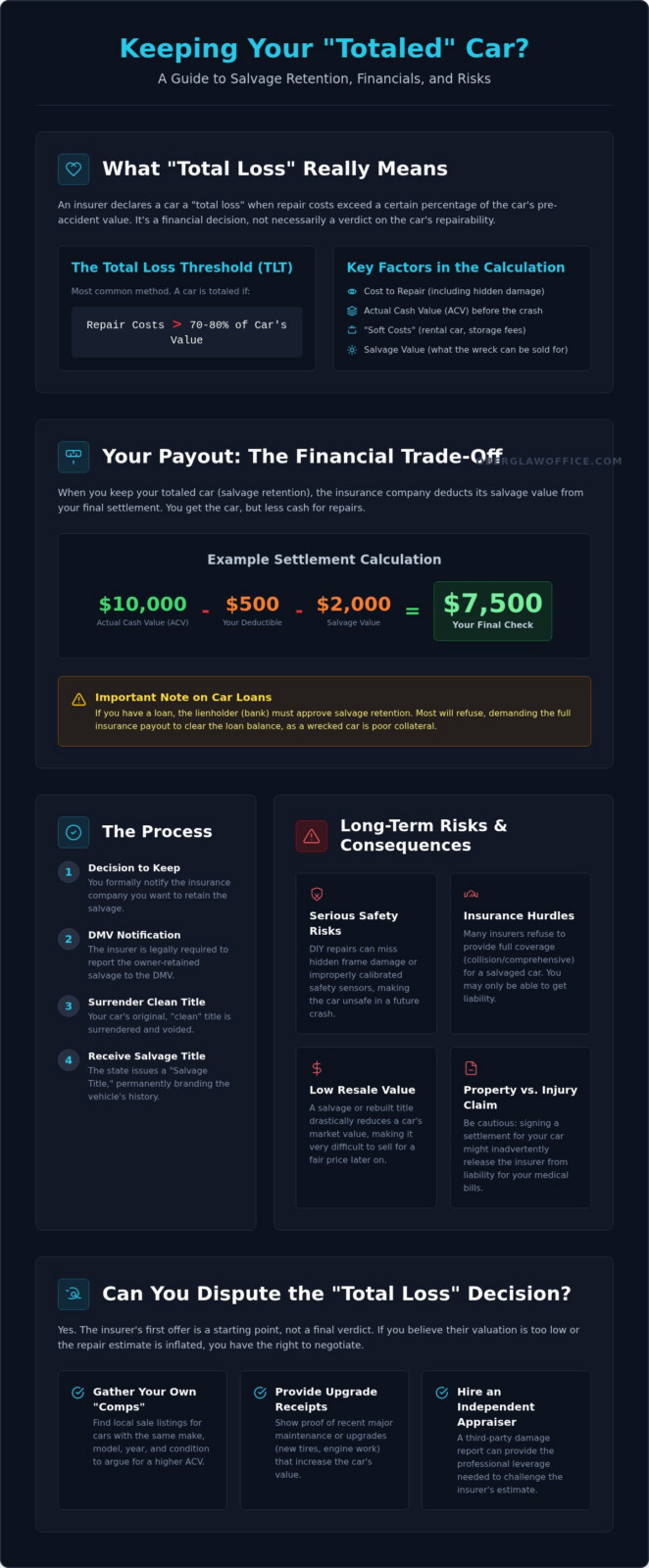
Finding out your car is “totaled” feels like a final verdict. It’s an emotional blow, especially if the vehicle still runs or looks fine to the naked eye. You should know that a total loss isn’t a mechanical death sentence; it’s a cold financial calculation. Insurers label a car a total loss when the cost to repair it reaches a specific percentage of its value. This limit is known as the Total Loss Threshold (TLT). While some policies set this at 70% or 80%, other states use a “Total Loss Formula” where the cost of repairs plus the salvage value must not exceed the car’s worth. If the math doesn’t work for their bottom line, they’ll write it off.
The insurance adjuster plays a pivotal role here. They inspect the damage and estimate repair costs while comparing them to the Actual Cash Value (ACV). This is the amount your car was worth the second before the crash. Often, cars that appear safe are totaled because of hidden frame damage or the extreme cost of replacing modern safety sensors. A single bumper tap can sometimes trigger a total loss if it compromises the complex calibration of your vehicle’s autonomous braking or lane assist systems.
The Math Behind the “Totaled” Label
Insurers calculate ACV by looking at comparable local sales of similar makes and models. They don’t just look at the metal and paint. They also factor in the “soft costs” they’d have to pay if they repaired the vehicle, such as weeks of rental car fees and daily storage costs at a body shop. Finally, they consider the “Salvage Value,” which is the money they can get by selling your wreck to a parts recycler. If the numbers don’t add up in their favor, they’ll push to scrap it, leaving you to ask, “can I keep my totaled car and repair it myself?” before the check is even cut.
Can You Dispute a Total Loss Decision?
You don’t have to accept the first number the insurance company throws at you. If you believe your car is worth more or that the repair estimate is inflated, you can push back. Start by gathering your own “comps” from local listings to prove a higher ACV. If the adjuster missed recent upgrades or major maintenance, show them the receipts. In some cases, hiring an independent appraiser for a secondary damage report provides the leverage needed to change the decision. We’ve seen how these companies operate, and we know that their “final” offer is often just a starting point for a fair negotiation. You have the right to fight for a settlement that actually reflects your loss.
The Legal Steps to Retain Salvage and Keep Your Vehicle
If you decide the insurance company’s math doesn’t mean your car’s life is over, you’ll enter a process called salvage retention. Essentially, you’re buying the vehicle back from the insurance company. They technically own the remains once they pay you for the total loss, so you’re negotiating to keep the wreckage instead of letting them sell it at auction. This isn’t a casual agreement. It’s a formal legal transition that changes how the state views your vehicle forever.
The insurance company will notify the DMV that you’ve chosen to keep the car. This owner-retained salvage notification is a mandatory step that prevents people from hiding a car’s history. You must be ready to surrender your clean title immediately. There’s no way around this; the law requires the vehicle’s history to be transparent for any future owners. If you’re asking, “can I keep my totaled car and repair it myself,” you need to be comfortable with the fact that your car will never have a “clean” reputation again.
How Salvage Retention Affects Your Payout
The financial trade-off is often the biggest hurdle. Your final check won’t be the full Actual Cash Value (ACV) of the car. Instead, the insurer takes the ACV and subtracts your deductible and the salvage value. For example, if your car is worth $10,000, your deductible is $500, and the salvage value is $2,000, your check will only be $7,500. You keep the car, but you now have $2,500 less for repairs. You also still owe your deductible, even though you aren’t using a preferred shop.
Dealing with lienholders adds another layer of complexity. If you still owe money on a car loan, the bank usually won’t let you keep a totaled vehicle. They want the full insurance payout to cover the loan balance because a wrecked car is poor collateral. Usually, you cannot keep a totaled car unless it’s paid off in full. If you’re struggling to handle these aggressive insurance adjusters while recovering from an accident, seeking car accident representation can take that weight off your shoulders.
Notifying the Department of Motor Vehicles
The law sets a strict timeline for reporting a totaled vehicle, often between 10 and 30 days. Failing to meet this deadline can result in fines or legal trouble. When you report the loss, the DMV will issue either a Salvage Title or a Non-Repairable Certificate. A non-repairable certificate is a permanent “death certificate” for the car, meaning it can only be used for parts and never driven again. A salvage title is a permanent brand on a vehicle’s history that alerts future buyers to its total loss status. You’ll need this title to begin the long road toward making the car legal to drive again.
DIY Repair vs. Professional Service: Safety and Compliance Hurdles
Many drivers look at a “cosmetic” total loss and see an easy weekend project. It’s tempting to think a few replaced body panels and a new headlight will put you back on the road. However, modern vehicles are incredibly complex machines where the exterior appearance rarely tells the whole story. If you’re asking, “can I keep my totaled car and repair it myself,” you must realize that you’re taking on the responsibility of a structural engineer and a software technician. Modern cars use high-strength steel and specific “crumple zones” designed to fold during an impact. Once these zones are compromised, the car’s ability to protect you in a second accident is significantly diminished.
Safety systems like airbags and Advanced Driver Assistance Systems (ADAS) add another layer of difficulty. Resetting an airbag module or recalibrating a radar sensor for your automatic braking isn’t something you can do with a standard toolbox. These tasks require proprietary software and specialized equipment that most hobbyists simply don’t own. Beyond the mechanical work, you face a strict legal requirement for a safety inspection. You cannot legally register or drive the vehicle until a state-certified inspector confirms it meets every safety standard, a bar that is much higher than many DIYers expect.
The “Rebuilt Title” Inspection Process
Moving from a salvage title to a “Rebuilt” or “Reconstructed” title is a grueling administrative hurdle. You must document every step of your repair process. State inspectors require you to keep every single receipt for every part used, down to the last bolt, to prove you haven’t used stolen components. Common reasons for failure include structural flaws that aren’t visible to the naked eye and anti-theft system errors. If your repair doesn’t meet the precise factory specifications, the state will refuse to issue a rebuilt title, leaving you with a car you can never legally drive.
Hidden Costs of Repairing It Yourself
The financial math of a DIY repair often falls apart once you look at the hidden costs. You’ll likely spend thousands on specialized tools, such as diagnostic scanners or frame-straightening equipment, that you may never use again. Paint and bodywork are also deceptively difficult. Achieving a finish that is durable and “road-legal” in terms of visibility and light reflection is a professional skill. Finally, consider the value of your time. Is saving a small amount of money worth 100 or 200 hours of grueling labor? We often find that our clients’ time is better spent focusing on their physical and emotional recovery rather than fighting with a stubborn engine block or a complex wiring harness.
The Long-Term Impact: Salvage Titles, Insurance, and Resale Value
Even after you’ve successfully navigated the DMV and the repairs, the shadow of a total loss follows your vehicle. The decision to keep and fix a car is a long-term commitment that affects your financial security for years. Once a title is branded as salvage or rebuilt, that mark is permanent. You cannot “clean” a title or remove the brand through more repairs or passage of time. It remains a permanent part of the vehicle’s history; it alerts every future insurer and buyer to the previous damage. If you’re asking, “can I keep my totaled car and repair it myself,” you must be prepared for the fact that the car’s reputation is changed forever.
This “branded” status creates a ripple effect that touches every part of your ownership experience. It isn’t just about the physical metal; it’s about how the world perceives the safety and value of your car. While you might know the car is safe because you did the work, large institutions often see things differently. This creates hurdles that can make the car more expensive to own in the long run than simply buying a new one.
Insuring a Rebuilt Vehicle
Finding insurance for a car you’ve fixed yourself is notoriously difficult. While some carriers might offer basic liability coverage, the reality is more complex. Most major insurers refuse to provide comprehensive or collision coverage for rebuilt vehicles. They view these cars as high-risk assets prone to mechanical failures or safety issues that could lead to another claim. To get even basic liability coverage, you’ll likely need a “statement of repair” from a certified mechanic. This document proves the car is safe, but it doesn’t guarantee your premiums will stay low. You should expect higher rates for a car that was once written off.
The Challenge of Future Resale
If you eventually decide to sell, the market will be much smaller than it was before the accident. A rebuilt title typically reduces a car’s market value by 30% to 50% permanently. Most dealerships flatly refuse to accept salvage or rebuilt titles as trade-ins because they cannot easily resell them to traditional buyers. You’re also legally obligated to disclose the title status to any private buyer. Without a clear log of receipts and photos documenting your repair process, it’s nearly impossible to convince a buyer the car is safe.
Navigating these insurance hurdles while trying to move on with your life is exhausting. If you’re struggling with a carrier that won’t give you a fair shake after an accident, getting car accident representation can help you secure the justice you deserve. We handle the difficult conversations and the technical details so you can focus on your family and your health.
Maximizing Your Recovery: How Legal Advocacy Changes the Equation
The insurance company’s “final offer” for your vehicle is rarely the end of the conversation. Most adjusters want to close your file quickly and for the lowest possible amount. When you’re asking, “can I keep my totaled car and repair it myself,” you’re making a decision that involves complex legal negotiations. One of the biggest dangers is signing a property damage release too early. We’ve seen many people accept a check for their car, only to realize the fine print inadvertently bars them from pursuing compensation for their medical bills. This is a common trap that billion-dollar corporations use to limit their liability.
An experienced car accident representation professional ensures you aren’t pressured into a bad deal. We look at your recovery as a whole, protecting both your property rights and your health. This comprehensive strategy is what separates a quick, inadequate check from a fair recovery that accounts for all your losses. You deserve a partner who understands the messy details of salvage retention and the high stakes of personal injury law.
Negotiating with the Insurance Company
Adjusters often use aggressive tactics to pressure you into accepting a low Actual Cash Value (ACV). They might ignore recent maintenance or use “comparable” vehicles that don’t match your car’s true condition. Having a personal injury lawyer handle these calls takes the stress off your plate. With over 25 years of experience, we know how to spot an undervalued calculation and demand a settlement that actually reflects your loss. We gather the data needed to push back so you don’t have to fight them alone.
The Advantage of Contingency-Based Representation
You don’t have to worry about hourly legal fees while you’re trying to fix your car and your life. Our firm operates on a contingency-fee basis, which means you pay nothing upfront for professional guidance. We only get paid if we recover money for you. This structure levels the playing field, giving you access to the same high-level expertise that the insurance companies have. We act as your steadfast protector, ensuring your voice is heard and your future is secured. Schedule your free accident strategy session today to learn how we can help you navigate this difficult time.
Taking Control of Your Vehicle’s Future
Deciding how to handle a total loss is about more than just mechanical repairs; it’s about protecting your long-term financial and physical security. You now understand that while the answer to can I keep my totaled car and repair it myself is technically yes, the path is paved with salvage title hurdles, safety inspections, and complex insurance challenges. Keeping your car requires a realistic look at the actual costs and the permanent brand on your vehicle’s history.
You don’t have to face these high-stakes negotiations or the pressure from insurance adjusters alone. At Oberg Law Office, we provide direct access to senior legal professionals who have over 25 years of experience fighting for the rights of accident victims. We operate on a contingency-fee basis, meaning there are no fees unless we win your case. Our team is here to handle the messy legal details so you can focus on your health and your family. We are ready to act as your steadfast protector during this difficult transition.
Get a Free Case Review with Oberg Law Office today and let us help you move forward with confidence. You deserve a partner who is as determined as you are to see justice served.
Common Questions About Keeping a Totaled Vehicle
Can I still drive my car if it has been declared a total loss?
No, you cannot legally drive a car once it is declared a total loss and the title is branded as salvage. The vehicle is officially considered unsafe for public roads. You must complete all necessary repairs and pass a rigorous state-certified safety inspection to earn a rebuilt title before you can legally operate it again. Driving a salvage-titled vehicle can lead to heavy fines and the immediate impoundment of your car by law enforcement.
What happens if I keep my totaled car but cannot finish the repairs?
If you realize you can’t finish the work, you’re left with a vehicle that cannot be legally driven or sold as a functioning car. You may have to sell it to a scrap yard or a parts recycler for its remaining metal value. This is a common risk when people ask, can I keep my totaled car and repair it myself, as the technical complexity often exceeds the available time or your remaining budget.
Will my insurance company pay for the repairs if I choose to keep the car?
No, the insurance company will not pay for the repairs directly. Instead, they’ll pay you the Actual Cash Value of the car minus your deductible and the salvage value. You’re responsible for using that reduced settlement check to fund all parts and labor yourself. If the repairs end up costing more than the check you received, every extra expense must come out of your own pocket without further help from the insurer.
Is it illegal to sell a car with a salvage title without telling the buyer?
Yes, it is illegal and considered fraud to sell a vehicle without disclosing its branded title status. Most states have strict consumer protection laws that require sellers to inform buyers of a salvage or rebuilt history in writing. Failing to do so can result in civil lawsuits and criminal penalties. Transparency is vital because a salvage title serves as a permanent warning about the vehicle’s past structural integrity and safety systems.
Can I keep my totaled car if I still have a loan on it?
It is very unlikely that you can keep a totaled car if you still owe money on a loan. The lender holds the title as collateral and usually requires the full insurance payout to satisfy the loan balance. Since a wrecked car has very little value, the bank won’t allow you to keep the vehicle while still owing a debt. You typically must pay off the loan in full before the insurer allows salvage retention.
How much does a salvage title affect the value of my car?
A salvage or rebuilt title typically reduces a vehicle’s market value by 30% to 50% compared to an identical car with a clean title. This loss in value is permanent and cannot be recovered through high-quality repairs. Even if the car looks and runs like new, most dealerships won’t accept it as a trade-in. Private buyers will also expect a significant discount due to the inherent risks associated with a previous total loss.
Do I need a lawyer if the insurance company totals my car but I am not hurt?
While you can handle property-only claims yourself, an attorney is highly recommended if there’s any chance of an injury. Insurance companies often try to bundle property damage settlements with liability releases. If you sign away your rights for a car check, you might lose the ability to seek compensation for medical bills that appear later. A firm with 25 years of experience can protect you from these aggressive institutional tactics and unfair offers.
What is the difference between a salvage title and a rebuilt title?
A salvage title is issued immediately after a car is totaled and indicates the vehicle is not legal to drive. It is essentially a designation for a car that should only be used for parts. A rebuilt title is what you receive after the car has been fully repaired and passes a rigorous state safety inspection. While a rebuilt title allows you to register and drive the car again, the brand remains on the history forever.


