
You’ve spent months fighting for justice, and now that you’ve finally put pen to paper, the silence from the insurance company feels heavier than ever. You might be watching your mailbox every morning, wondering exactly how long to get settlement check after signing release forms while medical bills continue to stack up on your kitchen table. It’s exhausting to feel like you’re at the finish line, yet the funds you need are still out of reach. We know this money represents more than just a balance; it’s the security you need to move forward with your life.
This guide will help you find peace of mind by breaking down the administrative hurdles that stand between you and your recovery. You’ll learn about the strict 2026 state laws that hold insurers accountable, including California’s new 30-day deadline and the interest penalties used in Texas and Florida. We will walk you through the essential steps of lien resolution and the attorney trust account process. By the time you finish reading, you’ll have a clear, realistic timeline for your final payout and the confidence that your case is moving exactly as it should.
Key Takeaways
- Signing the “Release of All Claims” is the official legal trigger that requires the insurance company to issue your payment.
- Understand the typical 5 to 20 business day window for corporate processing and exactly how long to get settlement check after signing release.
- Learn why your check must first clear an attorney trust account to protect your funds and satisfy state legal requirements.
- Identify potential delays, such as slow responses from health insurance companies regarding medical liens or minor paperwork errors.
- Get clarity on the final settlement statement, which provides a transparent line-item breakdown of your fees, costs, and final recovery amount.
What Happens Immediately After Signing the Settlement Release?
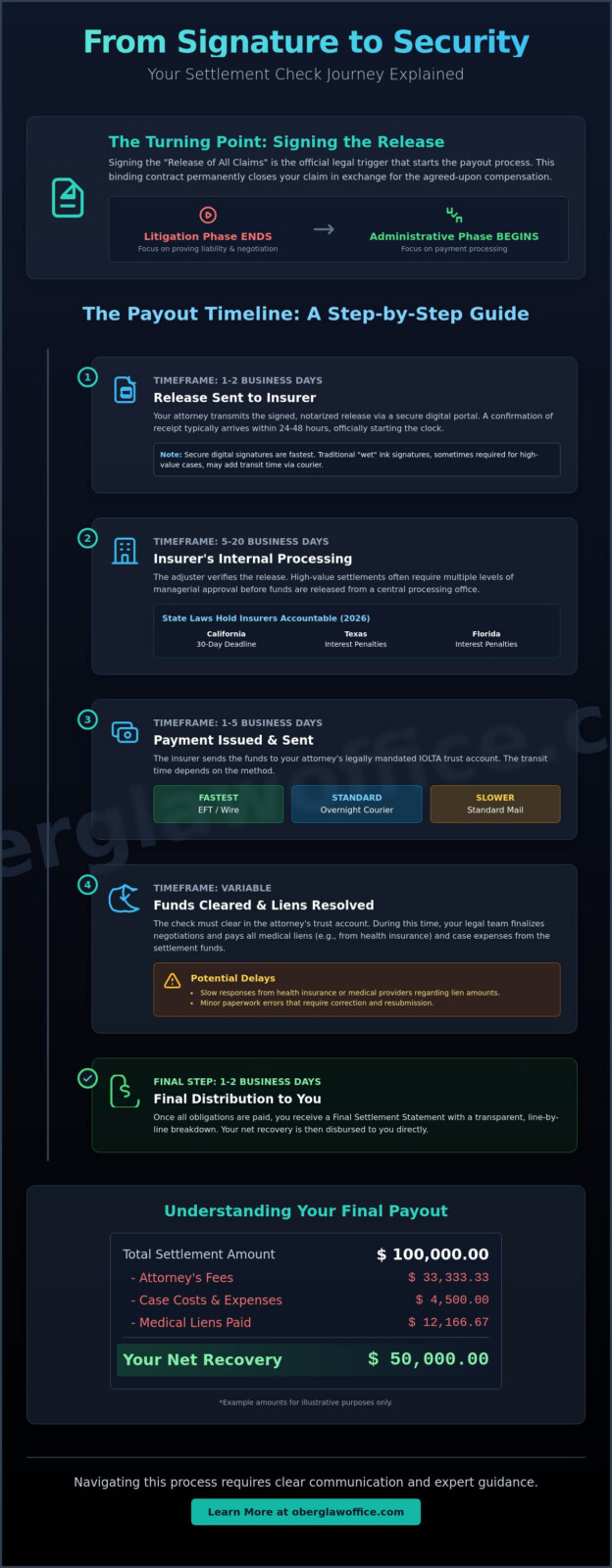
The moment you sign your settlement paperwork, the entire nature of your case shifts. For months, you’ve likely been in the “litigation phase,” where the focus was on gathering evidence, proving liability, and negotiating a fair value for your injuries. Once you sign, that conflict ends. You move directly into the “administrative phase.” This is a purely clerical period where the insurance company processes your payment and your legal team prepares for the final distribution of funds. A settlement release is a document where you waive your right to further legal action in exchange for compensation. By signing it, you’ve created a binding legal contract that officially closes the door on your claim.
Insurance companies are massive institutions with strict internal controls. They won’t issue a single dollar until they have a signed, and often notarized, release in their hands. This notarization serves as a vital security measure; it proves to the carrier that you are exactly who you say you are and that you’ve entered the agreement voluntarily. For the defendant, this document is their ultimate goal. It acts as a permanent legal shield, ensuring they can never be sued again for this specific incident, regardless of what happens in the future. Understanding how long to get settlement check after signing release depends heavily on how quickly this document is verified and accepted by the carrier’s legal department.
The Legal Weight of Your Signature
Your signature carries immense weight because it represents the finality of your recovery. It’s vital that we account for every medical bill, lost wage, and future care need before you sign. Once that ink is dry, you cannot ask for more money later, even if your injuries worsen or a new complication arises. In our modern 2026 legal environment, most carriers prefer secure digital signatures for speed. However, some insurance companies still require traditional “wet” ink signatures for high-value catastrophic injury cases to satisfy their internal audit requirements. This choice can affect the initial 48-hour window of your payment timeline, as physical documents may need to be couriered to the carrier’s headquarters.
Sending the Document to the Insurance Carrier
As your steadfast advocates, we don’t simply mail your release and hope for a response. Your attorney uses encrypted digital portals to transmit the executed document directly to the insurance adjuster. This starts a series of internal verification steps. The adjuster must confirm the document is complete, the notary seal is valid, and the settlement amount matches their records exactly. In a modern digital legal environment, we typically receive a confirmation of receipt within 24 to 48 hours. This confirmation is the signal that the “administrative lap” has truly begun. It’s often the most anxious time for our clients, but it’s also the point where your financial restoration becomes a mathematical certainty rather than a legal debate.
The Insurance Company’s Processing Timeline
After your signed release is delivered, the insurance carrier begins its internal payout sequence. While you might expect a check to be cut immediately, most corporate carriers operate within a 5 to 20 business day window for check issuance. This delay often stems from the carrier’s internal structure. For smaller claims, a local adjuster might have the authority to trigger a payment. However, high-value settlements, such as those involving catastrophic injury representation, frequently require multiple levels of managerial approval before the funds are released. This tiered authorization ensures that the large sum matches the settlement agreement exactly and satisfies the company’s auditing standards.
The physical location of the insurance company also plays a role. Many major carriers utilize a centralized “home office” or a third-party payment processing center located out-of-state. This means that even after the adjuster approves the payment, the request must travel through their corporate system to a different department. In 2026, we’ve seen a significant shift toward Electronic Fund Transfers (EFT), which can shave days off the timeline for receiving your settlement check. If the carrier still uses paper checks, the delivery method becomes the final hurdle. While some companies still rely on standard USPS mail, our firm often pushes for overnight courier services to ensure your recovery isn’t sitting in a sorting facility for a week.
Step 1: Final Review by the Adjuster
The adjuster’s first task is to verify that the release is legally sound and matches every term of our agreement. They check for missing initials, correct dates, and properly executed notary seals. If a clerical error is found, the process restarts, which is why we meticulously review every document before it leaves our office. Once the adjuster is satisfied, they “close” the file in their system, which triggers the accounting department to move forward. This step is the primary factor in how long to get settlement check after signing release paperwork.
Step 2: Issuing the Settlement Check
When the check is finally cut, it is standard practice for it to be made out to both you and our law firm. This isn’t a matter of preference; it’s a legal safeguard to ensure all parties, including medical providers with liens, are protected. In states like Texas, insurers must pay within 5 business days of accepting a claim to avoid an 18% interest penalty. In Florida, they have 20 days before a 12% penalty applies. These “prompt pay” laws are powerful tools we use to keep the insurance company moving. Whether it’s a digital transfer or a physical check from an out-of-state headquarters, we track every stage to ensure no corporate bureaucracy stalls your progress.
Why the Check Goes to Your Attorney’s Trust Account First
When the insurance check finally arrives at our office, it’s a major milestone in your recovery process. However, law firms are legally and ethically required to deposit these funds into a specialized Interest on Lawyers Trust Account, often called an IOLTA. This isn’t just a formality; it’s a vital safeguard. This account ensures your money is never commingled with the firm’s operating expenses, keeping your settlement secure and separate. As your personal injury lawyer, we act as a fiduciary. This means we have a professional duty to protect these funds until every legal and financial obligation related to your case is satisfied.
You might have read online that attorneys “sit on the money” to earn interest for themselves. This is simply not true. By law, any interest generated by these trust accounts is sent directly to the state bar to fund legal aid programs for the community. We don’t profit from the time your money spends in the trust account. Our only goal is to move your funds from the bank to your pocket as safely and quickly as possible. Understanding this part of the process is key to knowing how long to get settlement check after signing release paperwork, as the bank’s own internal rules now dictate the pace.
The Clearing Period
Once we deposit the insurance check, we must wait for the funds to fully clear. Because these checks are often for large amounts and frequently come from out-of-state banks, financial institutions place a mandatory hold on them. Standard banking practice typically requires a clearing period of 3 to 10 business days. We cannot distribute “uncollected funds” to you before the bank confirms the money is actually in the account. Doing so would violate professional ethics and could jeopardize the security of other clients’ funds. We monitor this daily so we can move to the next step the moment the hold is lifted.
Resolving Outstanding Liens and Medical Bills
The clearing period gives us the necessary time to finalize your “net recovery.” This is the most critical administrative task we perform. We work directly with your healthcare providers to negotiate final balances on any outstanding medical bills. We also address subrogation claims from health insurance companies like Medicare or private providers. These entities often have a legal right to be reimbursed from your settlement for the care they paid for. Our job is to negotiate these liens down as much as possible. By lowering what you owe to others, we maximize the amount of money you actually take home. This final accounting ensures that once you receive your check, you won’t have to worry about old medical bills resurfacing to haunt you later.
Common Factors That Can Delay Your Settlement Check
You have done everything right, yet the check still hasn’t arrived in your mailbox. It is a frustrating position to be in, especially when medical bills are mounting and you are ready to put this chapter behind you. While we strive for the fastest possible turnaround, several external factors can influence how long to get settlement check after signing release forms. Most delays are not caused by a lack of effort but by the slow moving gears of insurance bureaucracies and government agencies. If your case involves multiple defendants or several insurance carriers, each company must coordinate their payments. This often creates a “waiting game” where no one wants to be the first to send their check until every other party has confirmed their specific portion.
Large national insurance corporations also deal with massive administrative backlogs. Your file might be sitting on a desk in a different time zone, waiting for a supervisor who is currently out on leave or managing a heavy caseload. We stay in constant contact with these adjusters to keep your file at the top of their pile. Understanding how long to get settlement check after signing release paperwork helps you plan your financial future with confidence, even when the corporate world moves at a different pace than your daily life.
Lien Negotiation Hurdles
Healthcare providers and health insurance companies often have a “lien” against your settlement, meaning they are legally entitled to be paid back for the care they provided. A single uncooperative medical provider can stall your entire distribution. We must obtain “final payoff letters” from entities like Medicaid, Medicare, or private insurers to ensure the final accounting is perfect. These government agencies are notorious for taking weeks to provide a final number. To help you move forward, we can sometimes release the majority of your funds while holding a small “reserve” in our trust account to cover a disputed bill. This ensures you get your money quickly without risking legal trouble from unpaid providers later.
Clerical and Logistical Errors
Human error is another common culprit that can halt your progress. If a name is misspelled or a middle initial is missing on the legal release, the insurance company’s legal department will likely reject the entire document. Even a minor typo in a settlement release can force the entire check-issuance process to restart. We also see delays when physical checks are sent to the wrong regional office or are simply lost in the mail. This is why we prefer digital processing and overnight couriers whenever possible. If you are tired of waiting and need a team that proactively pushes against these corporate delays, our car accident representation experts are here to manage every detail of your financial recovery.
Navigating the Final Distribution: What to Expect Next
The final stage of your journey begins once the bank hold clears and the lien negotiations we discussed earlier are complete. This is the moment where legal theory becomes tangible financial support. Before we issue your payment, we provide you with a comprehensive document called a Settlement Statement. Think of this as a transparent roadmap for every dollar the insurance company paid. It lists the total settlement amount at the top and then provides a line-item breakdown of every deduction. This final phase highlights the benefit of our contingency fee structure, which ensures our interests stay perfectly aligned with yours. Because our fee is a percentage of the recovery, we’ve been motivated from day one to maximize the total value of your claim.
We understand that after weeks of wondering exactly how long to get settlement check after signing release forms, you want clarity and speed. We don’t just mail a check and disappear. We sit down with you, either in person or through a secure digital meeting, to review the accounting together. We want you to feel confident that every medical bill we’ve discussed has been addressed and that the “net recovery” in your hand is the maximum amount possible. This transparency is the cornerstone of our partnership. It transforms a complex legal transaction into a moment of genuine restoration and security for your family.
Reviewing the Settlement Statement
Your Settlement Statement is a formal accounting of the entire case. You’ll see specific deductions for litigation costs, such as filing fees with the court or payments made to expert witnesses who helped prove your claim. We also include the exact amounts paid to each of your medical providers. It’s your right to ask questions about any line item before you authorize the final distribution. We want you to see exactly how our negotiations reduced your medical debt, leaving more money in your pocket. Once you sign this statement, it serves as your final authorization for us to release the funds from our trust account.
Receiving Your Net Recovery
You have choices when it comes to how you receive your money. Many of our clients prefer a traditional physical check, while others opt for a direct wire transfer for immediate access to funds. In 2026, digital transfers have become the standard for speed, often making the money available in your personal account within 24 hours of authorization. There is a profound emotional relief that comes with this final step. It’s the moment the weight of the accident finally lifts. A dedicated car accident lawyer manages this home stretch with the same intensity as the initial lawsuit to ensure your stress is minimized. You’ve been through enough; the final distribution should be the easiest part of the process.
Secure Your Path to Financial Restoration
You’ve navigated the hardest parts of your recovery. Now, the final administrative steps ensure that your settlement is protected and maximized. By understanding the specific prompt pay laws in states like Texas and Florida, you can hold insurance companies accountable for their timelines. Remember that the attorney trust account process and lien negotiations are designed to shield you from future debt. While the question of how long to get settlement check after signing release depends on corporate processing and bank clearing times, you don’t have to wait in the dark.
At Oberg Law Office, we’ve spent over 25 years fighting insurance companies to ensure our neighbors receive every dollar they deserve. You’ll work directly with Attorney Gregg Oberg, receiving the personal attention your case requires. We operate on a performance-based fee structure, meaning there are no fees unless we win your case. If you’re facing delays or have questions about your recovery, Contact Oberg Law Office for a Free Strategy Session. We’re here to be your steadfast protector and guide you toward a secure future. You deserve a partner who is as invested in your results as you are.
Frequently Asked Questions
How long does it typically take to get a settlement check after signing the release?
You can typically expect your funds to arrive within 2 to 6 weeks. However, state laws play a major role in how long to get settlement check after signing release forms. For example, Texas insurers must pay within 5 business days of accepting a claim, while Florida allows 20 days. California’s 2026 laws require payment within 30 calendar days. We track these deadlines to ensure the carrier doesn’t stall your financial recovery.
Can I speed up the process of receiving my settlement funds?
The fastest way to receive your money is to utilize digital signatures and Electronic Fund Transfers (EFT). Opting for paper checks and standard mail can add a week or more to the timeline. Our firm pushes for digital processing whenever possible to bypass the delays of the physical mail system. Ensuring your paperwork is notarized correctly the first time also prevents the need for time-consuming revisions that can reset the clock.
Why is my lawyer holding my settlement check in a trust account?
Your attorney holds the funds in a trust account to fulfill a legal and ethical duty to protect your money. This period allows the insurance check to fully clear the bank, which usually takes 3 to 10 business days. During this time, we also finalize the payment of medical liens and litigation costs. This ensures that the check we eventually write to you is yours to keep, free from any future claims or unexpected bills.
What happens if the insurance company refuses to pay after I sign the release?
A signed release is a binding contract, so a total refusal to pay is extremely rare. If an insurer misses a state-mandated deadline, they may face significant interest penalties. In Texas, this penalty is 18% per year, while California applies a 15% rate. We monitor these timelines closely and will take formal legal action to enforce your right to payment if the insurance company becomes uncooperative after the agreement is executed.
Will I have to pay taxes on my personal injury settlement check?
Most personal injury settlements are not taxable at the federal or state level. The IRS typically considers compensation for physical sickness or injury as a restoration of what you lost rather than new income. However, certain portions like punitive damages or the interest earned on a delayed payment might be taxable. You should always consult with a tax professional to review the specifics of your final settlement statement and ensure you remain compliant.
What is a medical lien and how does it affect my final check amount?
A medical lien is a legal demand for repayment filed by a healthcare provider or insurance company that paid for your care. These liens must be satisfied before you receive your portion of the funds. Our team works to negotiate these balances down, often saving you a significant amount of money. Resolving these liens protects you from being sued by hospitals or insurers after your case is closed and your recovery is finalized.
Can I get a cash advance on my settlement while I wait for the check?
You can often apply for “pre-settlement funding” through third-party companies if you face immediate financial hardship. Our firm does not provide these loans directly, as we want to remain your independent legal advocates. Be cautious with these advances because they often come with high interest rates that can eat into your final recovery. We can help you evaluate if this is a safe or necessary option for your specific situation.
What should I do if it has been over 60 days and I still haven’t received my check?
If 60 days have passed, you should ask your attorney for a written status update immediately. Most state laws require payment much sooner than this, and a delay of this length often signals a clerical error or an unresponsive adjuster. We can send a formal demand letter to the carrier to trigger state interest penalties and force a resolution. Your peace of mind is our priority, and we’ll fight to resolve any administrative backlog.