
An insurance adjuster’s computer program will never truly understand the weight of the moments you’ve lost, from the ability to lift your child to the simple peace of mind you had before the accident. It’s common to feel like your physical and emotional trauma is being ignored by companies that treat your life like a spreadsheet. If you’re struggling to find a fair path forward, learning how to calculate pain and suffering in texas is the first step toward reclaiming your security. You deserve to know that your invisible burdens have real, legal value in our community.
We understand that the financial stress of missing out on work and family life is overwhelming, especially when complex laws make the process feel out of reach. This guide will show you exactly how to value your non-economic losses and master the methods insurance companies use to minimize your recovery. We’ll walk through the current 2026 legal framework, explain common calculation formulas like the multiplier method, and give you the tools to negotiate for a settlement that reflects your actual experience. By the end, you’ll have a realistic estimate of your claim and the confidence to stand your ground against large institutions.
Key Takeaways
- Discover the two primary frameworks used by adjusters and attorneys for how to calculate pain and suffering in texas, including the Multiplier and Per Diem methods.
- Learn to distinguish between physical sensations and mental suffering to ensure every aspect of your emotional distress is accounted for in your claim.
- Identify specific factors, such as the long-term impact on your hobbies and family life, that can significantly increase the value of your non-economic damages.
- Master effective documentation techniques, like maintaining a daily pain journal, to provide the concrete evidence needed to prove your intangible losses.
- Understand how a dedicated advocate can counter insurance software designed to minimize your payout and demand the maximum recovery you deserve.
Understanding Pain and Suffering Under Texas Personal Injury Law
When you are recovering from a serious accident, the weight of your experience goes far beyond the stack of medical bills on your kitchen table. You are likely dealing with sleepless nights, the frustration of being unable to pick up your kids, or a constant, dull ache that prevents you from enjoying your favorite hobbies. In our legal system, these internal struggles are collectively known as pain and suffering. Texas law recognizes that a physical injury doesn’t just damage your bank account; it damages your quality of life.
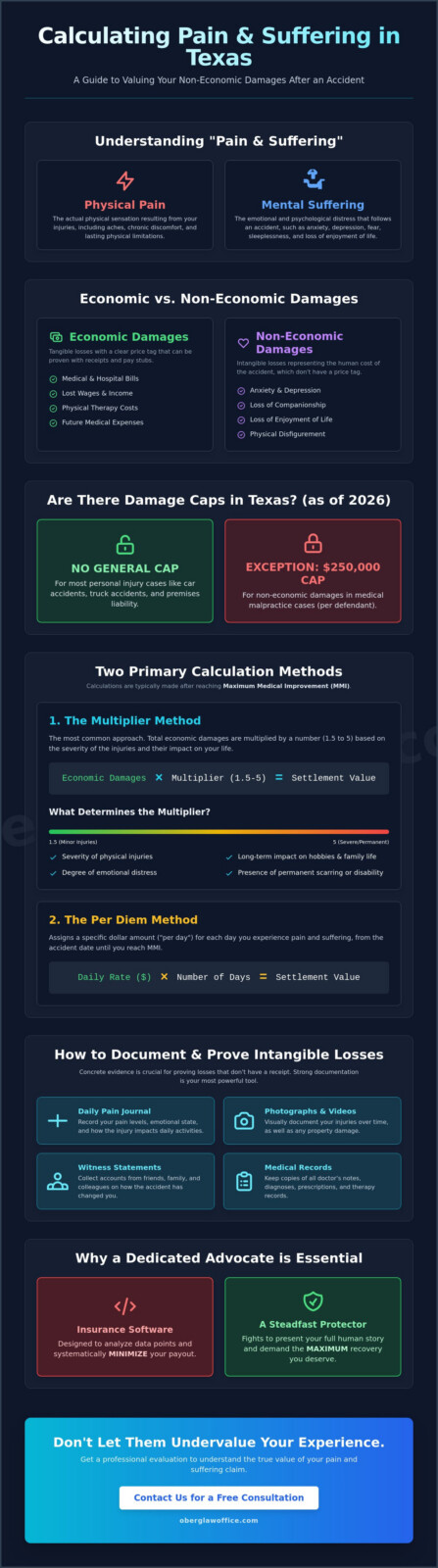
Under the Texas Civil Practice & Remedies Code Chapter 41, these losses are categorized as “non-economic damages.” While the law uses technical terms, the concept is simple: the goal is to make the victim whole again. Money can’t erase a traumatic memory or take away physical pain, but it provides a sense of justice and the resources needed to move forward. Understanding how to calculate pain and suffering in texas starts with recognizing that your “pain” is the actual physical sensation of the injury, while your “suffering” is the emotional and mental distress that follows. Both are equally valid in a courtroom or at the negotiating table.
Economic vs. Non-Economic Damages: What Is the Difference?
Economic damages are the tangible losses you can prove with a receipt or a pay stub. These include your hospital visits, physical therapy costs, and the wages you lost while you couldn’t work. Non-economic damages are different because they don’t come with a price tag. They represent the human cost of the accident, such as anxiety, depression, or the loss of companionship with your spouse. Non-economic damages act as the financial bridge between survival and restoration. When you’re trying to figure out how to calculate pain and suffering in texas, we look at how these two categories work together to tell the full story of your recovery.
Are There Damage Caps for Pain and Suffering in Texas?
One of the biggest concerns for many of our neighbors is whether the law limits what they can recover. As of 2026, there is no general cap on pain and suffering damages for most personal injury cases in Texas, including car and truck accidents. This remains true after several proposed legislative changes in 2025 failed to pass into law. However, there are specific exceptions you should know about. For example, under Chapter 74 of the Texas Civil Practice & Remedies Code, medical malpractice cases are still capped at $250,000 per defendant for non-economic damages. Because there is no limit for most other accidents, your choice of representation is critical. You need an advocate who knows how to present the full depth of your suffering to ensure you aren’t settling for a fraction of what your case is truly worth.
The Two Primary Methods for Calculating Pain and Suffering
You shouldn’t have to guess what your recovery is worth. While the law provides a framework through the Texas Civil Practice and Remedies Code, the actual math of how to calculate pain and suffering in texas often feels like a mystery. Insurance adjusters typically rely on two specific strategies to determine the value of your claim. They don’t always play fair, though. They’ll often switch between these methods to find the one that results in the lowest possible payout for you. Before you can finalize any demand, you usually need to reach Maximum Medical Improvement (MMI). This is the point where your doctors believe your condition has stabilized, giving us a clear timeline of your struggle to use in our calculations.
How the Multiplier Method Works
The Multiplier Method is the approach most often used by a personal injury lawyer mesquite tx to build a strong case. It’s a straightforward but powerful way to show the total impact of your injuries. First, we calculate your total economic damages, like medical bills and lost wages. Then, we multiply that sum by a number between 1.5 and 5. The number we choose depends on the severity of your situation. For instance, a broken bone that heals quickly might use a lower multiplier, while permanent scarring or a life-altering disability could justify a 5. This method is effective because it scales your non-economic recovery based on the objective evidence of your physical trauma. If you’re unsure which number applies to your life, speaking with an experienced advocate at oberglawoffice.com can help clarify your path.
The Per Diem Approach: A Daily Value for Pain
Another strategy for how to calculate pain and suffering in texas is the “per diem” or daily rate method. This approach assigns a specific dollar value to every single day you lived in pain, from the date of the accident until you reached MMI. Often, this daily rate is based on your actual daily wages. The logic is simple: if your time is worth a certain amount when you’re healthy and working, it’s worth at least that much when you’re hurting and unable to enjoy life. This method works well for shorter, high-intensity recoveries where the daily struggle is easy for a jury to visualize. However, defending a per diem rate in front of a Texas jury can be challenging. Adjusters will often argue that the daily amount is arbitrary, which is why having a steadfast protector to frame your story is so vital.
Factors That Increase or Decrease Your Settlement Value
Understanding the specific variables of your life is key to knowing how to calculate pain and suffering in texas. It isn’t just a cold equation; it’s a reflection of your lived reality. The nature of your injury plays a massive role in this process. For instance, insurance adjusters often view broken bones as more “valuable” than soft tissue damage because they appear clearly on an X-ray. However, chronic back pain from a soft tissue injury can be just as debilitating. We look at how your injury stops you from being the person you were before, whether that’s performing your job or simply playing tag with your children in the backyard.
Texas follows a modified comparative negligence rule, which can directly impact your final recovery. If you are found to be 51% or more at fault for the accident, you are barred from recovering any damages at all. If you are found to be 20% at fault, your total award for pain and suffering will be reduced by that same 20%. This is why protecting your side of the story is so important. We work to ensure the blame stays where it belongs so your compensation remains fair.
You might worry that a pre-existing condition, like an old sports injury, will ruin your claim. In Texas, the “Eggshell Skull” rule protects you. This rule states that a negligent party is responsible for the damages they cause, even if the victim was more susceptible to injury than an average person. We don’t let insurance companies use your medical history as an excuse to devalue your current suffering. Your health before the accident doesn’t give someone a “discount” on the harm they caused you today.
The Role of Permanent Disfigurement and Disability
Permanent scarring or the loss of a limb changes how the world sees you and how you see yourself. These life-altering events automatically trigger a higher multiplier because the trauma never truly ends. The psychological weight of disfigurement is profound, often leading to social anxiety or a loss of self-esteem. A catastrophic injury lawyer understands how to advocate for these losses by highlighting the long-term emotional toll and the need for ongoing support. We fight to ensure your settlement covers the lifelong impact of these changes.
Mental Anguish and Loss of Enjoyment of Life
Your mental health is just as important as your physical health. After a major wreck, many of our neighbors struggle with PTSD, anxiety, or depression. You may also qualify for “loss of consortium” if the accident has strained your relationship with your spouse or children. Loss of enjoyment of life is a valid legal claim. If you can no longer garden, paint, or run because of someone else’s mistake, that loss has a real dollar value when determining how to calculate pain and suffering in texas. We document these missed moments to show the true cost of your accident.
How to Document and Prove Your Intangible Losses
Proving what cannot be seen is often the hardest part of any injury claim. Because there are no receipts for emotional distress, you must create a paper trail that bridges the gap between your injuries and your recovery. Knowing how to calculate pain and suffering in texas is only half the battle; you must also provide the evidence that justifies those numbers to an insurance adjuster. This evidence often comes from your own daily routine, your medical records, and the observations of those who know you best. We help you gather these pieces to ensure your story is heard.
Consistent medical treatment is the backbone of your case. If you skip physical therapy appointments or ignore doctor’s orders, insurance companies will claim you aren’t actually suffering. They use gaps in treatment to argue that your pain is manageable or non-existent. Beyond your own records, we often use expert testimony from medical professionals and life-care planners to build your case. These experts can project the long-term costs of your care and explain the biological reality of your pain to a jury. If you are ready to protect your future, you can contact our team to start building your evidence today.
Writing a Legally Effective Pain Journal
Maintaining a daily pain journal is one of the most effective ways to document your struggle. It isn’t just about rating your pain on a scale of one to ten. You should record how your injuries affect specific daily tasks. For example, writing “could not lift my child today because of sharp lower back pain” is far more persuasive than a general statement of discomfort. Be brutally honest about your limitations but avoid exaggerating. This journal serves as a primary piece of evidence during settlement negotiations, providing a real-time account of your life that a medical chart might miss. This record is essential for anyone trying to understand how to calculate pain and suffering in texas in a way that adjusters will respect.
The Power of “Before and After” Witnesses
Witnesses who knew you before and after the accident can offer powerful testimony about the changes in your personality or physical capabilities. Friends, family members, and coworkers often see the subtle shifts that you might not even notice yourself. They can describe how a once-active neighbor now stays inside or how a cheerful colleague has become withdrawn. Third-party observations are often more persuasive to adjusters than your own claims because they provide an objective view of your loss. Your car accident lawyer uses these statements to humanize your file, turning a claim number into a person with a community that cares about them. By showing the contrast between your old life and your current reality, we make your pain and suffering tangible.
Why a Steadfast Protector Is Essential for Maximizing Your Claim
Facing a massive insurance company on your own can feel like shouting into a storm. While you are focused on healing, their adjusters are often using sophisticated software programs like “Colossus” to decide the value of your life. These algorithms are designed to strip away the human element of your story, turning your unique trauma into a standardized data point. When we step in, our job is to force these companies to look past the code and see the person behind the file. Understanding how to calculate pain and suffering in texas requires more than just a calculator; it requires a narrative that demands respect.
The art of the Demand Letter is where your recovery is often won or lost. We don’t just list your injuries. We frame your pain in a way that justifies the maximum multiplier, connecting your physical limitations to the emotional toll on your family. Insurance companies take you more seriously when they know your legal team is prepared for trial. They’re far more likely to offer a fair settlement when they realize we won’t back down from a courtroom battle. Because we operate on a contingency-based model, you never have to worry about upfront costs for expert testimony or medical illustrations. We share the risk with you, ensuring that professional advocacy is accessible to everyone in our community.
Fighting Insurance Algorithms
Adjusters rely on software to “standardize” pain, but your suffering isn’t standard. These programs often ignore the specific ways an accident has derailed your life, such as your inability to attend local events or volunteer in your neighborhood. An experienced attorney knows how to bypass the algorithm to reach a human decision-maker. We present evidence that the software isn’t programmed to value, making it impossible for them to ignore your unique restoration needs. Having a lawyer who is personally invested in your case means your story won’t get lost in a digital filing system. We focus on the tangible results that help you reclaim your security.
Securing Your Future Through Advocacy
At Oberg Law Office, we believe in a blend of professional authority and neighborly compassion. We are here to guide you through the uncertainty and stand as a formidable shield against those who would devalue your experience. If you are confused about how to calculate pain and suffering in texas for your specific situation, a free strategy session can provide the clarity you need. We will listen to your story, review your documentation, and help you understand the framework for a successful recovery. Contact Oberg Law Office today for a free evaluation of your case and let us help you move from a state of uncertainty to a feeling of empowerment.
Reclaim Your Peace of Mind and Your Future
You now have the essential tools to understand how insurance companies value your invisible burdens. By mastering the methods for how to calculate pain and suffering in texas, you’ve taken a significant step toward securing the restoration you deserve. Whether you are using a multiplier based on the severity of your injuries or a per diem rate for your daily struggle, your story has real legal value. Remember that consistent medical treatment and a detailed pain journal are your strongest assets in proving what an adjuster’s software might try to ignore.
You don’t have to carry this weight by yourself. Attorney Gregg Oberg has spent over 25 years fighting for our Texas neighbors; he ensures every client is treated like a person rather than a case number. We offer a personalized, neighborly approach rooted in integrity and results. Because we work on a contingency-based structure, we don’t get paid unless you win. This means you can focus on your recovery while we handle the formidable task of holding negligent parties accountable. Take the next step toward fairness today. Get a free personal injury strategy session with Oberg Law Office. You have the right to feel whole again, and we are ready to stand as your steadfast protector.
Common Questions About Pain and Suffering in Texas
How much is the average pain and suffering settlement in Texas?
There is no single average settlement because how to calculate pain and suffering in texas depends entirely on your unique circumstances. In many personal injury cases, non-economic damages can account for more than 60% of the total settlement value. Your specific payout is determined by the severity of your injuries, the impact on your daily routine, and the strength of the evidence we gather to support your claim.
Can I sue for pain and suffering if I was not physically injured?
In most instances, you must have sustained a physical injury to recover damages for pain and suffering in Texas. The legal system generally requires a physical impact to justify compensation for mental anguish. There are rare exceptions, such as bystander claims where you witness a traumatic injury to a close family member. If you’re unsure if your situation qualifies, we can help you understand your rights during a strategy session.
How do I prove emotional distress in a Texas court?
Proving emotional distress involves gathering evidence that shows a clear change in your quality of life. This includes medical records from therapists, prescriptions for mental health, and testimony from people who knew you before the accident. A detailed pain journal is also essential; it provides a day to day account of your anxiety, depression, or loss of sleep. These tangible records help humanize your experience for an insurance adjuster or a jury.
Does the 51% bar rule affect my pain and suffering payout?
The 51% bar rule is a vital part of how to calculate pain and suffering in texas correctly. Under this rule, you can only recover damages if you are 50% or less at fault for the accident. If your responsibility is found to be 51% or more, you are barred from receiving any compensation. If you are partially at fault, your payout is reduced by that specific percentage of responsibility, which directly impacts your final check.
Is pain and suffering compensation taxable in Texas?
Most settlements for pain and suffering are not taxable as long as they are linked to a physical injury. The IRS and state authorities view these payments as a way to make you whole after a loss, rather than as earned income. However, if you receive an award for emotional distress that did not originate from a physical injury, that portion might be taxable. It is always wise to speak with a tax expert regarding your settlement.
How long do I have to file a claim for pain and suffering?
In Texas, you generally have two years from the date of your injury to file a lawsuit for pain and suffering. This timeframe is the statute of limitations for personal injury claims. If you don’t file within this two year window, you will likely lose your right to recover any compensation. We recommend starting your claim as soon as possible to ensure all evidence and witness memories remain fresh for your case.
Will my pain and suffering be part of my initial insurance demand?
Your non-economic damages are a core part of the initial demand we send to the insurance company. We include these figures from the start to show that we are seeking a full and fair restoration for every part of your experience. By presenting a well documented calculation of your pain early on, we set a professional tone for negotiations and signal that we won’t overlook your intangible losses or emotional trauma.
What if the insurance company offers a lowball settlement for my pain?
You have the right to reject a low settlement and continue negotiating for a fairer amount. Adjusters often use software to minimize payouts, but we counter these offers with the human reality of your trauma. We use your pain journal, witness statements, and medical experts to demonstrate why a higher multiplier is necessary. Knowing you have a steadfast protector prepared for trial often forces the insurance company to be more reasonable.


