
Did you know that 95% of personal injury cases end in a settlement rather than a courtroom trial? Reaching a resolution is a major milestone, but for many, that relief is quickly followed by a nagging worry: is a personal injury settlement taxable? You’ve already navigated the physical and emotional aftermath of a difficult event. The last thing you deserve is a massive, unexpected tax bill at the end of the year.
We understand the confusion that comes with complex IRS terminology and the anxiety of accidentally “double-dipping” on medical deductions. It’s our goal to act as your knowledgeable guide through this process. You shouldn’t have to guess how much of your recovery will actually stay in your pocket after the government takes its share.
This guide provides a clear look at the 2026 IRS rules to help you protect your financial future and avoid surprises. We’ll break down which parts of your compensation are tax-free and which parts, like punitive damages or interest, require reporting. You’ll learn how to handle your settlement correctly so you can focus on your recovery with total peace of mind.
Key Takeaways
- Most compensation for physical injuries or sickness is exempt from federal taxes under IRS Section 104, ensuring your recovery goes toward your healing.
- Learn why the answer to is a personal injury settlement taxable usually depends on the nature of your physical injuries and how the IRS classifies compensatory versus punitive damages.
- Be aware that portions of your settlement like interest and punitive damages are generally considered taxable income and must be reported to the IRS.
- Discover how the 2017 Tax Cuts and Jobs Act changed the way attorney fees are handled, which could impact the total amount you take home.
- Find out which specific documents you need to keep to prove the physical nature of your claim and shield your recovery from unnecessary taxation.
The IRS “General Rule” and the Physical Injury Exception
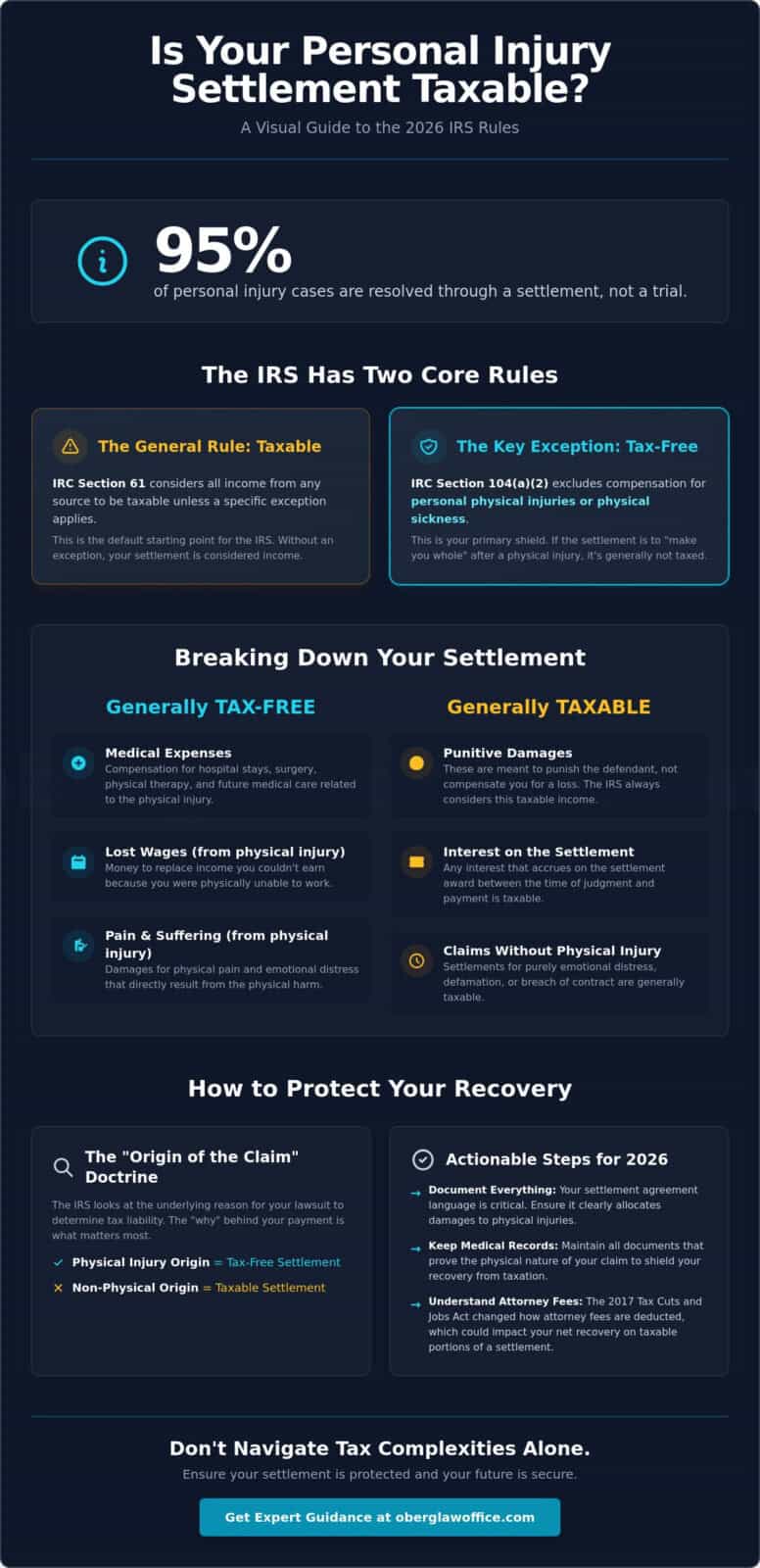
The IRS starts from a position that might feel intimidating. Under Internal Revenue Code (IRC) Section 61, the government considers all income from whatever source derived to be taxable. This is the broad net they cast over your finances. It’s the reason why the question “is a personal injury settlement taxable” is so common. Without a specific exception, the IRS assumes they’re entitled to a portion of your recovery. We know how frustrating it is to feel like the government is reaching into your pocket after you’ve already suffered so much.
However, the law also recognizes that a settlement isn’t always “new” wealth. Often, it’s simply an attempt to make you whole again after a loss. This is where IRC Section 104(a)(2) serves as your primary shield. This section specifically excludes damages received on account of personal physical injuries or physical sickness from your gross income. Defining these terms correctly is essential. Personal physical injuries usually involve an external force, like a car crash or a fall. Physical sickness refers to internal ailments, such as an illness caused by toxic exposure. Both are non-taxable under Section 104, provided the sickness isn’t purely mental or emotional.
The IRS applies the “Origin of the Claim” doctrine to decide your tax liability. They don’t just look at the final check amount. They look at the underlying reason for the lawsuit. If the core of your claim is a physical injury, the settlement usually remains tax-free. If the origin of the claim is a breach of contract or emotional distress without physical harm, the tax rules change. This doctrine means the words used in your settlement agreement matter deeply. We work to ensure your paperwork accurately reflects the physical nature of your loss to protect your recovery. It’s about ensuring the “why” of your payment is clearly documented before the IRS asks questions.
What the IRS Considers Gross Income
The IRS views almost any financial gain as potentially taxable gross income. When a large sum of money hits your bank account, it often triggers automated systems designed to flag unreported wealth. It’s vital to distinguish your settlement from other types of payments like gifts or loans. While a gift is given out of “detached and disinterested generosity,” a settlement is a legal obligation. Because the IRS defaults to taxing these gains, clear documentation of your injury is your best defense against a stressful audit. You’ve been through enough; you shouldn’t have to fight the government over money meant for your healing.
The Critical Distinction of Physical Harm
Visible injuries typically make for straightforward tax reporting. The IRS generally accepts that these settlements are non-taxable because the physical harm is evident. Things get more complex when a claim doesn’t involve a direct physical “touch” or impact. For instance, if you suffer from a physical sickness caused by environmental toxins, you must demonstrate the physical nature of the ailment to qualify for the tax exclusion. Whether you receive a lump sum or a structured settlement, the physical injury exception remains the most powerful tool for tax-free recovery.
Breaking Down Your Settlement: What Parts Are Tax-Free?
Most people feel a massive sense of relief when they finally see their settlement check. However, that relief often turns into a nagging question: is a personal injury settlement taxable in its entirety? The short answer is no. The IRS generally views compensatory damages as a way to restore what you lost rather than a way to increase your wealth. Because these funds are meant to make you whole again, they typically fall outside the definition of taxable income.
Compensatory damages serve as the core of your tax-free recovery. This category includes money intended to cover your actual losses, such as property damage and medical bills. If you received $10,000 to repair your vehicle after a truck accident, the IRS sees that as a return of capital. You aren’t gaining “income”; you’re simply getting back the value of the property you lost. As long as the payment doesn’t exceed the adjusted basis of your property, you won’t owe a dime in taxes on it.
Medical Expenses and the Tax Benefit Rule
Compensation for medical care is almost always exempt from federal taxes. This includes money for hospital stays, surgeries, and physical therapy. As outlined in IRS Publication 4345, these funds are meant to pay for the treatment of your physical injuries. You can breathe easier knowing the money meant for your healing is protected from the tax man.
There is one specific trap called the “Tax Benefit Rule.” If you itemized your deductions in a previous tax year and used your medical expenses to lower your tax bill, you cannot treat that portion of the settlement as tax-free. The IRS requires you to “recapture” that amount as income because you already received a tax benefit for it. If you used the standard deduction in previous years, this rule typically won’t affect you. Calculating the exact portion that must be reported as income requires a careful look at your past returns. Navigating these distinctions is easier when you have a dedicated personal injury lawyer helping you structure your recovery.
Pain, Suffering, and General Damages
Pain and suffering damages are intended to compensate you for the physical discomfort and emotional distress caused by your accident. When these damages stem directly from a physical injury or physical sickness, they remain non-taxable. This protection extends to “loss of enjoyment of life” or “loss of consortium” payments made to a spouse. The IRS treats these as a replacement for your human dignity and well-being. Because you cannot put a price on your health, the government doesn’t view these payments as a financial gain. To keep these funds tax-free, it is vital that your medical records clearly document the physical nature of your injuries from the start.
The Taxable Components: When the IRS Takes a Cut
While we fight to protect as much of your recovery as possible, it is vital to understand that the IRS doesn’t view every dollar of a settlement the same way. When clients ask us, “is a personal injury settlement taxable?” they are often surprised to learn that certain components are treated as regular income. The government distinguishes between money that replaces a loss and money that represents a gain. In the eyes of the IRS, if the money isn’t directly healing a physical wound or replacing a broken piece of property, they likely want a share of it.
Punitive Damages and Interest
Punitive damages are a specific tool used to punish a defendant for extreme negligence or intentional harm. Because these funds are designed as a penalty rather than a way to pay your bills, the IRS classifies them as pure profit. You must report punitive damages as “Other Income” on your tax return. Even if your physical injuries are severe, any portion of the award labeled “punitive” will be taxed at your standard income tax rate.
Interest on your settlement is another area where the IRS consistently takes a cut. Whether it is pre-judgment interest (accrued while the case is pending) or post-judgment interest (accrued after a verdict), the government views this as investment-like growth. As explained by Forbes on how settlements are taxed, even if the underlying personal injury award is 100% tax-exempt, the interest earned on that money is almost always taxable. In long legal battles, this interest can become a substantial part of your final check, making it important to plan for the resulting tax bill.
Emotional Distress: The Physical Nexus Rule
The taxability of emotional distress depends entirely on the “physical nexus” or connection to a physical injury. If your mental anguish, anxiety, or depression stems from a physical injury sustained in an accident, those damages are typically tax-free. However, if you receive a settlement for emotional distress alone, without a physical injury, the IRS treats it as taxable income. There is one small relief: you can subtract the amount you paid for actual medical treatment related to that distress, such as counselor fees or psychiatric care, from the taxable total.
The Lost Wages Complexity
Lost wages are generally taxable because they replace the salary you would have earned and paid taxes on if the accident hadn’t happened. However, there is a nuanced exception. If the lost wages are awarded as part of the compensatory damages for a physical injury, they can sometimes be excluded from your gross income. This is a sharp contrast to employment-related lawsuits, such as discrimination or wrongful termination claims, where back pay is strictly taxable. We focus on ensuring your settlement reflects the physical origin of your claim to help minimize these tax burdens whenever possible.
How Attorney Fees and Structuring Impact Your Taxes
One of the most frustrating surprises for injury victims is the “gross vs. net” tax problem. You might assume that because your lawyer kept a portion of your award for their contingency fee, you only need to account for the money that actually reached your bank account. However, the IRS often views things differently. When determining if and how much of a is a personal injury settlement taxable, the government typically starts with the total amount awarded before any fees or costs are subtracted.
This became even more complex after the 2017 Tax Cuts and Jobs Act. This legislation removed the ability for most taxpayers to deduct legal fees as an itemized deduction for many types of cases. If your settlement is considered taxable income, such as in a case involving only emotional distress or a breach of contract, you could potentially owe taxes on the full 100% of the settlement; even if 40% went directly to your legal team. This “tax on a tax” can significantly drain your actual recovery if your case isn’t handled with care from the start.
Contingency Fees and the IRS
The U.S. Supreme Court ruled in the case of Commissioner v. Banks that a litigant’s income includes the portion of the recovery paid to the attorney as a contingency fee. This means the IRS considers the lawyer’s cut as your income that you then “spent” on legal services. Fortunately, there is a major exception for personal physical injury cases. Because the underlying settlement for physical harm is non-taxable under Section 104, the attorney’s fee portion is also generally shielded from taxation. If you’re worried about how taxes will impact your final check, you need a personal injury lawyer who understands how to protect your recovery through every stage of the process.
The Power of Settlement Allocation
How your final agreement is worded can be your strongest defense against an IRS audit. Specificity is your friend. We work to ensure that the settlement release clearly “allocates” funds to specific categories. For example, explicitly labeling funds as “compensatory damages for physical injuries” provides a clear roadmap for the IRS. While the IRS isn’t legally bound by the labels in your agreement, they typically respect allocations that are reasonable and consistent with the facts of the case.
- Structured Settlements: Choosing to receive your money in installments rather than a lump sum can provide long-term tax benefits.
- Tax-Free Growth: In a structured settlement, the interest earned on the unpaid balance often remains tax-free, unlike interest earned on a lump sum you invest yourself.
- Audit Protection: Clear documentation of your physical injuries in the settlement agreement reduces the likelihood of the IRS flagging your recovery as taxable income.
By being purposeful with the language in your settlement, we help you build a wall around your recovery. It’s about more than just winning your case; it’s about making sure you keep what you’ve won to support your long-term healing and financial security.
Protecting Your Recovery: Actionable Steps for 2026
You’ve finally reached a settlement agreement. It’s a moment for profound relief, but it’s also the time to be most vigilant. To truly answer is a personal injury settlement taxable for your specific situation, you must take active steps before the final ink is dry. Waiting until tax season to think about the IRS is a mistake that can cost you thousands. We want to ensure you have the tools to protect every dollar meant for your restoration and healing.
Consult with a tax professional before you sign the final release. This ensures that the structure of your payout aligns with the 2026 tax brackets. For example, if you’re a single filer earning $60,000, you’re currently in the 22% bracket. Adding a large taxable portion from a settlement, like punitive damages, could push you into the 24% or 32% bracket. Knowing these numbers ahead of time allows your legal team to negotiate more effectively on how the settlement funds are allocated.
Documentation and Reporting
The IRS automated systems are highly efficient at flagging large deposits. You might receive a Form 1099-MISC or 1099-NEC from the insurance company. If they report the payment to the government, you must account for it on your return, even if it’s 100% non-taxable. Failing to report it can trigger a stressful audit. We suggest including a brief, professional statement with your tax return explaining that the proceeds are for physical injury and are excluded under Section 104. Your medical records are the bedrock of this explanation. They provide the undeniable proof of the “origin of the claim,” showing that the funds were meant to repair physical harm rather than serve as a financial windfall.
The Role of Professional Advocacy
Your attorney’s job isn’t just to get a high number on a piece of paper. It’s to ensure that the number you see is the amount you actually get to use for your future. An experienced personal injury lawyer negotiates the specific wording in the settlement agreement to favor tax-exempt categories. By focusing the language on physical injuries and long-term medical needs, we help build a shield around your recovery.
Choosing contingency-based legal representation means we’re personally invested in the net amount you keep. We don’t just walk away when the check is cut. We help you request a clear breakdown of damages in the final settlement check to provide a paper trail for your tax preparer. At the end of the day, a settlement is only as good as the amount you get to keep. We’re here to make sure that amount is as high as possible so you can move forward with the security you deserve.
Secure Your Financial Future After an Injury
Your settlement represents more than just a check; it’s the foundation for your recovery and long-term security. By understanding the nuances of how the IRS treats your compensation, you can avoid the fear of an unexpected tax bill. We have seen how physical injury exceptions protect your medical and pain and suffering awards, while punitive damages and interest require careful reporting. Knowing the answer to is a personal injury settlement taxable for your specific case is the first step toward true financial peace of mind.
You deserve a partner who is personally invested in your success. With over 25 years of experience in Texas law, Gregg Oberg provides the specialized, person-oriented representation you need during this difficult time. You will interact directly with Attorney Gregg Oberg to ensure your case receives the senior-level attention it deserves. Our firm operates on a performance-based fee structure, meaning there are no fees unless we win your case. Get a Free Case Review with Oberg Law Office today to start protecting your recovery. We are ready to stand as your steadfast protector and guide.
Frequently Asked Questions
Is a car accident settlement taxable?
No, most car accident settlements are not taxable as long as the money is meant to compensate you for physical injuries or sickness. Whether you were involved in a car, truck, or motorcycle accident, the IRS excludes these compensatory payments from your gross income under Section 104. However, you will still owe taxes on any portion of the settlement designated for interest or punitive damages.
Do I have to report my personal injury settlement to the IRS if it is non-taxable?
You typically don’t have to report the non-taxable portion of your recovery on your federal tax return. However, if you receive a Form 1099-MISC or 1099-NEC from the insurance company, you must include it to avoid an automated IRS flag. We recommend including a brief, professional explanation to show the IRS that the funds are for a physical injury and are exempt from taxation.
Are lost wages in a personal injury settlement taxable?
Lost wages are generally taxable because they replace income that would have been taxed if you hadn’t been hurt. There is a small exception when these wages are specifically part of a compensatory award for a physical injury rather than a standalone employment claim. Determining the exact answer to is a personal injury settlement taxable when it includes back pay requires a careful review of your settlement agreement’s language.
Can I deduct my attorney fees from my taxable settlement amount?
You usually cannot deduct attorney fees from your taxable settlement amount due to changes in the 2017 Tax Cuts and Jobs Act. This means you might owe taxes on the full settlement amount even if your lawyer kept a portion as a contingency fee. This rule makes it vital to allocate as much of your settlement as possible to non-taxable physical injury categories to protect your net recovery.
What happens if my settlement includes both physical and emotional damages?
If your emotional damages stem directly from a physical injury, the entire amount is usually tax-free. If the emotional distress is “standalone” and didn’t result from a physical impact or sickness, that portion is considered taxable income. You can still subtract any out-of-pocket medical costs you paid for mental health treatment from the taxable amount to reduce your overall tax liability.
Are punitive damages always taxable?
Yes, punitive damages are always taxable and must be reported as “Other Income” on your tax return. The IRS views these funds as a windfall or a punishment for the defendant rather than a way to pay for your actual losses. Even if your physical injuries are catastrophic, the government will still take a cut of any money labeled as punitive in your final judgment or settlement.
Do I owe state taxes on my personal injury settlement?
Your state tax liability depends entirely on where you live. For our neighbors in Texas, there is no state income tax, which means you won’t owe the state a penny on your settlement recovery. In states that do have an income tax, the laws often mirror federal IRS rules, but it’s important to consult with a local professional to confirm your specific requirements.
What is the “tax benefit rule” in personal injury cases?
The tax benefit rule applies if you deducted medical expenses related to your injury on your tax returns in previous years. If you later receive a settlement that pays you back for those same expenses, the IRS requires you to report that portion as income. This prevents you from getting a double tax break on the same medical bills, though it only applies if you itemized your deductions.