
Imagine waking up to a $15,000 stack of medical bills only to discover your insurance claim was denied because you missed a reporting deadline by just 48 hours. It’s a devastating reality for many Texans who assume they have years to act. You are likely wondering exactly how long do you have to make an insurance claim before your right to compensation vanishes forever. We know that when you’re recovering from an accident, the last thing you want to do is decode complex policy language or dodge calls from adjusters who don’t have your best interests at heart.
It’s completely normal to feel overwhelmed by the conflicting dates found in your policy and state law. This 2026 guide provides the clarity you need by explaining the critical differences between insurance company reporting windows and legal statutes of limitations. You’ll learn the specific deadlines that apply to your situation so you can move forward with total confidence. We’ll also highlight the exact moments when seeking professional legal help can protect your family’s financial future from aggressive insurance company tactics.
Key Takeaways
- Distinguish between your policy’s contractual reporting window and the legal statute of limitations to ensure you don’t lose your right to seek justice.
- Learn exactly how long do you have to make an insurance claim and which specific Texas factors might shorten or extend your window for recovery.
- Identify how different types of losses, such as property damage versus bodily injury, follow unique timelines that directly affect your potential settlement.
- Understand the “Discovery Rule” and how it protects your claim when injuries or damages aren’t immediately obvious following an accident.
- See how a dedicated legal advocate manages every critical deadline and filing requirement, protecting your family’s future while you focus on healing.
Understanding Insurance Claim Deadlines: Reporting vs. Filing
After an accident in Mesquite, your focus is naturally on your family and your physical recovery. You shouldn’t have to juggle complex legal jargon while trying to heal, yet two distinct clocks start ticking the moment a crash occurs. Knowing how long do you have to make an insurance claim requires you to understand the difference between your private insurance contract and Texas state law. One is a requirement from your provider, while the other is a hard limit set by the government.
Most drivers assume reporting an accident and filing a claim are the same action. They aren’t. Reporting is the initial notification you give to an insurance company. Filing is the formal process of seeking a specific settlement or initiating a lawsuit. A Statute of Limitations is the maximum time parties have to initiate legal proceedings from the date of an alleged offence. If you miss the reporting window, your insurer might make your life difficult. If you miss the legal filing deadline, you lose your right to seek justice entirely.
Insurance companies often use the phrase “ASAP” or “promptly” in their policy documents to keep the advantage in their favor. They want to investigate the scene before evidence disappears or witnesses forget what they saw. We see many clients who feel pressured by these vague terms, but we’re here to help you move forward with confidence and clarity.
The Contractual Duty to Report “Promptly”
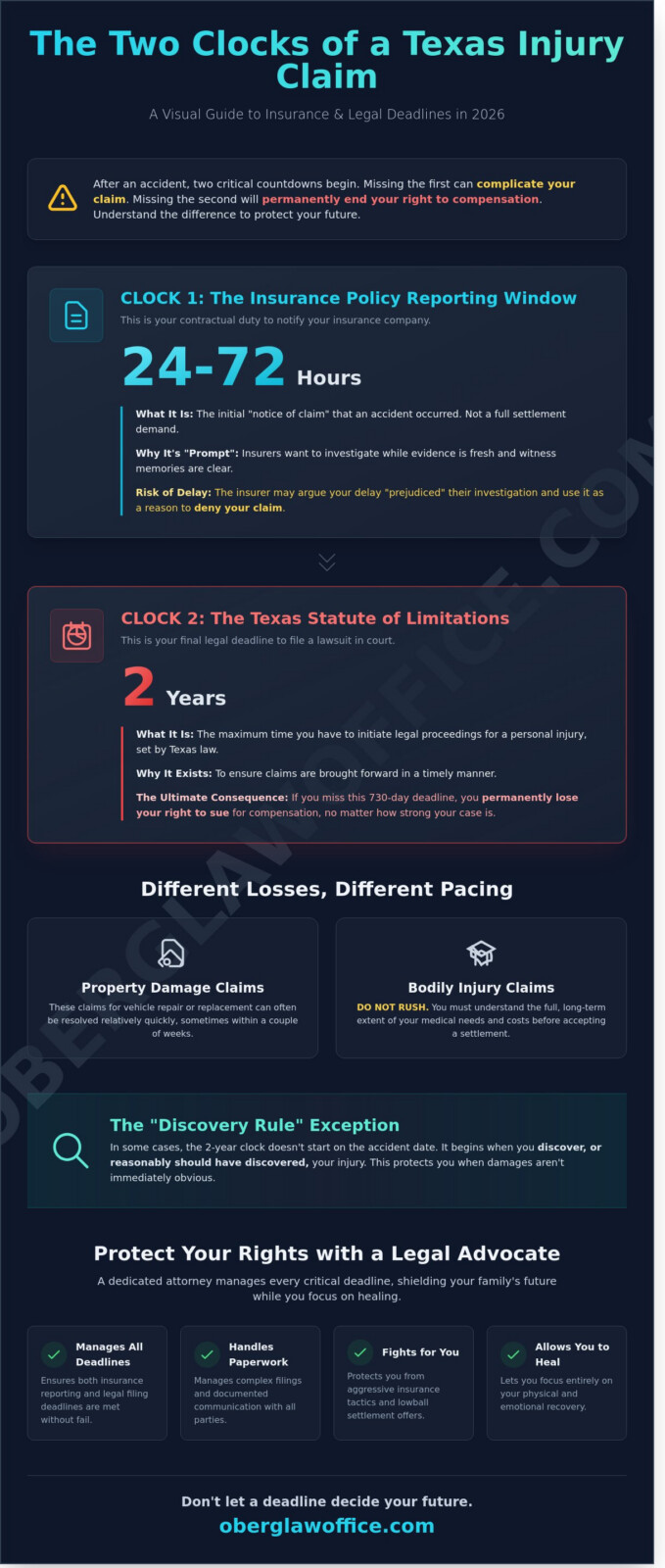
Your insurance policy is a binding contract that requires you to provide a “notice of claim” within a very short window, often just 24 to 72 hours after an incident. This isn’t the same as submitting all your medical bills or demanding a final settlement. It’s simply a heads-up to the company that an event occurred. If you wait too long, the insurer may argue “prejudice to the insurer.” This means they claim your delay harmed their ability to investigate the crash fairly, which they often use as an excuse to deny your coverage altogether.
The Legal Clock: What is a Statute of Limitations?
While your insurance policy has its own internal rules, Texas state law dictates the ultimate deadline for your case. In Texas, the statute of limitations for most personal injury claims is 2 years from the date of the accident. While some jurisdictions across the country allow up to 6 years, our local laws are much stricter. This 730-day window is the most vital timeline in your entire recovery process. Once this date passes, even the most clear-cut case of negligence cannot be brought before a judge. We make sure this deadline is protected so you can focus on getting back on your feet.
- Contractual Reporting: Usually required within days of the accident.
- Texas Statute of Limitations: Generally 2 years for personal injury lawsuits.
- Consequences: Missing a legal deadline results in a permanent loss of your right to compensation.
Understanding how long do you have to make an insurance claim is about more than just dates on a calendar. It’s about protecting your future. At the Oberg Law Office, we treat your case with the personal attention it deserves, ensuring no insurance company uses a technicality to walk away from their responsibilities to you.
The Two Clocks: Policy Requirements and Legal Statutes
You’re managing two distinct countdowns after an accident. The first clock is controlled by your insurance policy’s fine print. The second is the legal deadline set by Texas state law. Figuring out how long do you have to make an insurance claim involves balancing these two timelines. Most insurance companies require prompt notification, which often means you should call them within 24 to 72 hours. However, the legal deadline to actually file a lawsuit for a personal injury in Texas is 2 years under the Texas Civil Practice and Remedies Code Section 16.003.
Property damage and bodily injury timelines often diverge. You might resolve a vehicle repair claim in 14 days, but an injury claim shouldn’t be rushed. You need to know the full extent of your medical needs before you sign any settlement. A common mistake is believing that filing an insurance claim is the same as filing a lawsuit. A claim is an administrative process with a company. A lawsuit is a formal legal action filed in a local court. If you’re feeling overwhelmed by these deadlines, you can speak directly with an attorney to ensure your rights stay protected.
Documented communication is your best defense. Keep a dedicated folder for your case. Record the date of every conversation and the name of every adjuster you speak with. Insurance companies look for any reason to lower your payout. Consistent, early communication makes it much harder for them to argue that you weren’t taking your recovery seriously. We recommend sending a follow-up email after every phone call to create a written paper trail of what was discussed.
First-Party vs. Third-Party Claims
A first-party claim is one you file against your own policy, such as Personal Injury Protection or Uninsured Motorist coverage. These often have strict notification windows written into the contract. A third-party claim is filed against the at-fault driver’s insurance. Confusion arises when victims wait for the other driver’s insurance to respond. If that company denies liability after 18 months, you may have very little time left to trigger your own policy’s benefits. Both clocks run at the same time; missing one can be devastating for your financial recovery.
Why “Prompt” is Subjective but Critical
Texas courts generally interpret “prompt” based on the specific circumstances of your accident. If you were incapacitated in a hospital for 10 days, a 2-week delay is reasonable. If you’re uninjured and wait 60 days, the insurer might claim your delay prejudiced their investigation. Fading memories are a real threat to your case. Witness statements taken 48 hours after a crash are much more reliable than those taken 6 months later. Reporting early protects your credibility and ensures that physical evidence, like debris or tire marks on local Mesquite roads, is documented before it’s gone.
Factors That Can Shorten or Extend Your Timeline
Life is messy, and accidents are rarely straightforward. While you might assume you have a full two years under Texas law, specific variables can shift your deadline significantly. You don’t want to find out your deadline passed while you were still focused on physical therapy. Knowing these nuances helps you protect your right to compensation and ensures you aren’t left paying for someone else’s mistake. Variables such as the age of the victim or the specific entity you are suing can fundamentally change how long do you have to make an insurance claim.
Legal “tolling” provides a necessary safety net in specific circumstances. This process effectively pauses the countdown clock. It most commonly applies when the victim is a minor or is legally incapacitated at the time of the accident. For a child injured in a Mesquite car accident, the clock typically won’t start ticking until they turn 18. This gives them until their 20th birthday to seek justice for their injuries. We treat these cases with extra care because we know your family’s future depends on a fair outcome.
Claims Involving Government Entities
If your accident involved a city bus, a mail truck, or a dangerously maintained public road, the rules change instantly. You face much shorter notice requirements; government entities require an “Administrative Claim” to be filed before any legal action can proceed. Claims against government entities often have much shorter notice requirements, sometimes as little as 30 to 180 days. Missing this tiny window can permanently bar you from recovery. These cases require much faster action than private citizen accidents because the government has built-in protections that limit their liability.
The Discovery Rule and Latent Injuries
Not every injury screams for attention the moment an impact occurs. You might walk away from a wreck feeling fine, only to have a traumatic brain injury or internal organ damage manifest months down the line. The Discovery Rule can help. It potentially moves your filing deadline to the date you discovered, or reasonably should have discovered, the injury. This ensures that victims aren’t punished for injuries that were physically impossible to detect immediately after a crash.
Proving a latent injury is a steep uphill battle. Insurance companies fight these cases aggressively. They will often argue your symptoms resulted from a different event. You’ll need concrete medical evidence to show why the damage wasn’t apparent on day one. When you’re wondering how long do you have to make an insurance claim after a delayed diagnosis, remember that the legal burden of proof is high. We work directly with you to gather the necessary medical records to prove your case’s timeline and secure the justice you deserve.
What Happens if You Wait Too Long to File?
Missing a deadline isn’t just a minor paperwork error. It’s a door slamming shut on your recovery. If you file a lawsuit after the Texas two-year statute of limitations expires, the defense attorney will immediately file a “Motion to Dismiss.” Judges almost always grant these requests. This means your case ends before it even begins. You lose the legal right to hold the negligent party accountable, regardless of how much evidence you have. This leaves you carrying the financial weight of medical bills and lost wages alone, which creates an immense emotional burden for your family. In 2024, hundreds of Texas claims were dismissed simply because of these missed dates.
Adjusters also use late reports to devalue your claim. They’ll argue that if you were truly hurt, you would have sought help sooner. Every day you wait gives them more room to claim your injuries happened somewhere else. They might suggest your back pain came from yard work you did last weekend rather than the car accident three months ago. Even if you worry that you’ve waited too long, don’t give up. You should speak with a professional to see if any exceptions apply to your specific situation before walking away from the compensation you deserve.
The Insurance Company’s “Wait and See” Strategy
Insurance adjusters often use a friendly tone to build a false sense of security. They might tell you they’re “still reviewing the file” while the clock ticks toward the 24-month mark. This is a common tactic to let the statute of limitations expire. We’ve seen insurers issue a “final offer” that expires just 72 hours before the legal deadline. This pressure is designed to make you settle for pennies because you’ve run out of time to file a lawsuit. If an insurer stops responding for more than 14 days, you need to take action to keep your claim moving forward. Knowing how long do you have to make an insurance claim is your best defense against these stalling tactics.
Can You Still File if You Missed the Reporting Window?
It’s vital to distinguish between a policy reporting window and a legal bar to recovery. Your insurance policy might require notice within 30 days, but missing that doesn’t always end your case. An experienced personal injury lawyer can often challenge a denial based on late reporting. We look for ways to prove the insurance company wasn’t “prejudiced” or harmed by the delay. Texas courts often require the insurer to show that the late notice actually hindered their investigation by a measurable degree. If the evidence is still available, we can fight to keep your path to justice open. Don’t let the insurance company have the last word on how long do you have to make an insurance claim without a fight.
How Legal Representation Protects Your Right to Compensation
Dealing with a serious injury is exhausting. You shouldn’t have to spend your recovery tracking calendar dates and complex legal filings. When you partner with our team, we manage every deadline so you can focus on getting back on your feet. We understand the stress of wondering how long do you have to make an insurance claim, and we ensure those windows don’t close on your right to justice. We treat you like a neighbor because you are one. In Mesquite, we’ve seen how big insurance companies try to wait out the clock, hoping you’ll simply give up or miss a filing window.
Insurance adjusters often use stalling tactics to push you closer to the statute of limitations. Having an attorney signals that you’re prepared for litigation. In complex cases, we might utilize “tolling agreements.” These are legal contracts between parties that pause the clock on the filing deadline. This gives both sides more time to negotiate a fair settlement without the immediate threat of a lawsuit expiration. Our firm works on a contingency-fee basis. This means you don’t pay us a penny unless we win your case. This model ensures our interests are perfectly aligned with yours; we’re motivated to get you the maximum recovery possible.
Preserving Evidence Before the Clock Runs Out
Evidence disappears quickly. A truck accident involves critical data from the vehicle’s black box, which is often overwritten after 30 days of operation. Similarly, local business surveillance footage is frequently deleted or looped within 7 to 14 days. We act immediately to send spoliation letters, legally requiring parties to preserve this data. This early intervention builds a foundation that protects your future claim before the physical evidence is lost forever.
Calculating the Full Value of Your Claim Early
Rushing to settle because you’re worried about how long do you have to make an insurance claim can be a costly mistake. You need a complete picture of your medical needs before signing any releases. A catastrophic injury lawyer looks beyond today’s bills. We account for future surgeries, lost earning capacity, and long-term care needs. We balance the pressure of legal deadlines with the necessity of a thorough medical evaluation. This ensures you don’t accept a lowball offer that fails to cover your lifetime expenses. Our goal is to provide a clear path from uncertainty to empowerment.
Don’t Let the Clock Run Out on Your Recovery
Time is often the biggest enemy in a legal case. While you might feel overwhelmed right now, missing a reporting deadline or the Texas statute of limitations can permanently bar you from receiving the money you need for medical bills and lost wages. Understanding exactly how long do you have to make an insurance claim ensures you stay in control of your situation. You shouldn’t have to navigate these complex legal clocks alone while you’re trying to heal.
At Oberg Law Office, we bring over 25 years of experience to the fight against insurance companies that want to delay or deny your justice. You won’t be handed off to a paralegal; you’ll receive personalized attention directly from your attorney. We believe everyone deserves a fair shot, which is why we offer a no fee unless we win guarantee. This means we share the risk with you, focusing entirely on getting the results your family deserves.
Get a Free Strategy Session with Oberg Law Office today so we can start building your case together. You’ve been through a difficult season, but you don’t have to walk the path to recovery by yourself. We’re ready to stand by your side.
Frequently Asked Questions
How long after an accident can I claim injury?
In Texas, you generally have 2 years from the date of the accident to file a lawsuit for a personal injury. Most insurance policies require you to report the incident within 24 to 72 hours to remain eligible for coverage. Waiting too long gives the insurance company a reason to deny your claim. We recommend calling us immediately so you can speak directly with an attorney to protect your rights.
What is the “prompt” notification requirement in an insurance policy?
A prompt notification requirement means you must inform your insurer about the accident as soon as it’s reasonably possible, which typically translates to 1 to 3 days. Texas policies don’t always define prompt with a specific hour count, but state courts often rule that a 30 day delay is unreasonable. Failing to meet this window can jeopardize your coverage. Our team helps you navigate these strict timelines so your family’s recovery stays on track.
Can I still file a claim if I did not feel hurt at the scene?
Yes, you can still file a claim because injuries like whiplash or internal bruising often don’t show symptoms for 24 to 48 hours. Adrenaline masks pain immediately after a crash. If you discover an injury later, seek medical care and then ask us how long do you have to make an insurance claim under your specific policy. In Mesquite, clients realize they’re hurt days later in 40 percent of our cases.
What is a statute of limitations and how does it affect my case?
The statute of limitations is a strict legal deadline, which is 2 years for personal injury cases in Texas under Civil Practice and Remedies Code Section 16.003. If you miss this 730 day window, the court will likely dismiss your case forever. This law acts as a hard cutoff for seeking justice. We track these deadlines for you, and remember, there is no fee unless we win your case.
Does the clock start on the day of the accident or the day I found the injury?
The clock typically starts on the day of the accident, though the discovery rule can sometimes extend this if an injury was impossible to detect. In 95 percent of Texas motor vehicle accidents, the 2 year countdown begins the moment the collision occurs. Knowing how long do you have to make an insurance claim depends on these specific dates. We’ll review your medical records to identify the exact legal timeline for your situation.
What happens if the insurance company stalls until the deadline passes?
If an insurance company intentionally stalls to let the 2 year statute of limitations expire, they’re often acting in bad faith. They use delay tactics in roughly 15 percent of claims to avoid paying settlements. Once that deadline passes, you lose your legal leverage to sue. We step in to stop these games. Our firm is formidable against insurers who try to outrun the clock on your family’s justice.